










 Limited to 100 registrants
AI agents and agentic AI appear constantly in technology discussions, yet most definitions blur them together. They are related but not interchangeable, and the distinction shapes how you apply AI in practice.
For Australian businesses evaluating AI investments, the distinction determines which problems AI can solve, how much automation is realistic, and what infrastructure your systems need.
This article explains both terms, how they differ across five key dimensions, and where each fits in a real business context. It also covers how HashMicro integrates Hashy OS to bring agentic AI into everyday operations.
Key Takeaways
What makes something an AI agent is not the model inside it but the ability to act. An agent perceives, decides, and takes action on a specific task without human direction at each step.
The five differences that separate AI agents from agentic AI come down to scope, autonomy, memory, coordination, and business fit. Understanding these makes it easier to choose the right architecture.
What Australian businesses need to know first: adoption typically starts with single-purpose agents in finance or HR, then expands into agentic AI as workflows become multi-step and cross-system.
Why MCP matters: without a common protocol connecting agents to tools and data, every agentic system becomes an expensive custom build. MCP is what makes multi-agent architectures scalable in practice.
What Are AI Agents?
An AI agent perceives its environment, makes decisions, and takes actions to complete a specific task. It operates without a human directing each step, using a defined goal to determine what comes next.
Most AI agents are task-specific. A customer service agent handles support queries. A data extraction agent pulls records from documents. Each is built to execute one type of action reliably.
The intelligence inside an AI agent typically comes from a large language model or machine learning model. What makes it an agent is the ability to act, connecting to tools, systems, and data sources to get things done.
What Is Agentic AI?
"The distinction between AI agents and agentic AI is not academic. It determines whether you are automating one task or transforming an entire workflow. That difference defines what AI can actually deliver."
Where a single AI agent executes one task, an agentic AI system takes a broader objective, breaks it into sub-tasks, and delegates them to individual agents. It then synthesises the results into a final output.
Agentic AI systems typically include memory to carry context across multiple steps, tools for external connections, and reasoning loops that allow the system to self-correct when something goes wrong.
The result is a system capable of handling end-to-end workflows from intake to delivery without human orchestration at each step. This is what separates agentic AI from a single-purpose agent.
AI Agents vs Agentic AI: Five Key Differences
The five differences below cut through the terminology and make it clear which approach fits which business problem.
1. Scope of task
An AI agent is built for one well-defined task. It receives an instruction, executes it, and stops. The scope is intentionally narrow because that is what makes the agent reliable and predictable.
Agentic AI operates at a higher level. It takes an open-ended objective, such as onboarding a new employee or processing a supplier invoice, and determines which sub-tasks need to run and in what sequence.
2. Level of autonomy
An AI agent is autonomous within a fixed boundary. It makes decisions inside its assigned task, but it does not plan beyond that. If the task changes mid-way, a human typically needs to intervene.
Agentic AI operates with higher-level autonomy. It can reassess its own plan, switch agents, retry failed steps, and adjust its approach when outputs do not match expectations, all without human redirection.
3. Memory and context retention
Most AI agents are stateless. They complete their task and do not retain context between runs. Each interaction starts fresh, which keeps things simple but limits performance across complex workflows.
Agentic AI systems maintain memory across the full workflow. A later step can reference what happened earlier, which is critical when tasks depend on each other or span multiple systems over time.
4. Multi-agent coordination
A single AI agent has no awareness of other agents. It performs its role in isolation, with no shared context or cross-agent communication, even if other agents run alongside it in the same system.
Agentic AI adds a coordination layer. A planning component determines which agents to activate, in what sequence, and how to handle conflicts between their outputs. This coordination is what makes complex automation possible.
5. Where each fits in your business
AI agents work well when the task is clear, bounded, and repeatable. Email classification, invoice data extraction, and customer query routing are all strong single-agent use cases.
Agentic AI suits multi-step workflows that cross system boundaries. Processing a leave request end-to-end, from submission through HR approval, calendar update, and payroll adjustment, benefits from an agentic approach.
The Worker and Manager Analogy
The clearest way to understand the relationship between AI agents and agentic AI is through a workplace analogy. The two concepts mirror how individual contributors and managers operate in a team.
Think of an AI agent as a skilled worker. The worker knows exactly how to do one job. They receive a task, execute it to completion, and wait for the next instruction. They do not need to understand the broader project.
Agentic AI is the manager. It knows the end goal, breaks the work into tasks, assigns those tasks to the right workers, and monitors progress. If something goes wrong, the manager adapts the plan rather than waiting for direction.
This distinction matters when you are planning your AI architecture. A single agent handles what one worker can do. Agentic AI coordinates what an entire team of specialised workers can do, with no human in the loop.
In HashMicro's ERP, Hashy OS provides the agentic layer. It connects to underlying systems, deploys AI capabilities for each workflow, and coordinates results across departments without manual management at each step.






AI Agents, Agentic AI, and Generative AI Compared
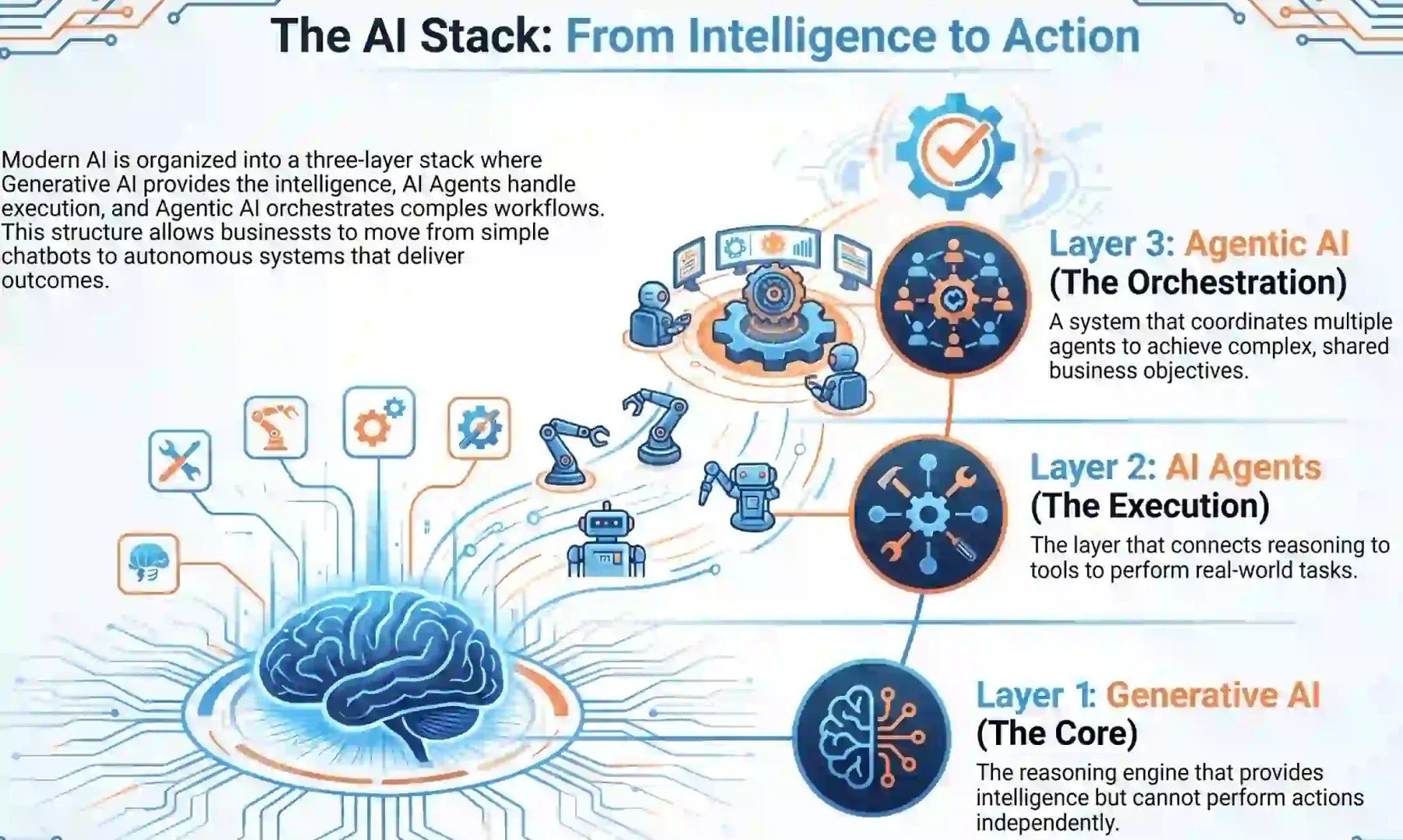
Generative AI, AI agents, and agentic AI are often grouped together, but they occupy different layers of the technology stack. Understanding how they relate makes it easier to evaluate tools and platforms accurately.
1. How generative AI underpins both
Generative AI refers to models that produce outputs such as text, images, code, or audio from a prompt. Large language models like GPT-4 or Claude are examples.
On their own, they respond to prompts but do not act. Both AI agents and agentic AI systems use a generative AI model as their reasoning core. The model decides what to do next, but the agent or agentic system is what takes action in the real world.
Generative AI is the intelligence. Agents are the execution layer. Without a generative model, agents cannot reason. Without the agent wrapper, generative AI can only generate text and cannot take action on your behalf.
2. Is ChatGPT an AI agent or agentic AI?
ChatGPT in its standard form is neither an AI agent nor agentic AI. It is a generative AI model that responds to prompts. It does not take actions, connect to external systems, or retain memory between sessions by default.
When ChatGPT is given tools, browsing capabilities, or external plugins, it begins to exhibit agent behaviour. When multiple GPT-based agents run in a coordinated pipeline, the system starts to resemble agentic AI.
The key question is not which AI product you use, but how it is configured. The same underlying model can behave as a simple chatbot, an AI agent, or part of an agentic system depending entirely on what surrounds it.
3. The full AI stack explained simply
The three layers work together. At the base is the generative AI model, which provides the reasoning capability. Above that is the AI agent layer, which connects that reasoning to tools and real-world actions.
At the top sits the agentic layer, which orchestrates multiple agents toward a shared objective. A business system that combines all three can handle complex, multi-step workflows with minimal human input.
Most enterprise AI platforms, including HashMicro with Hashy OS, are moving toward this full-stack approach, bringing all three layers into one environment so your team interacts with outcomes, not infrastructure.
What This Means for Australian Businesses
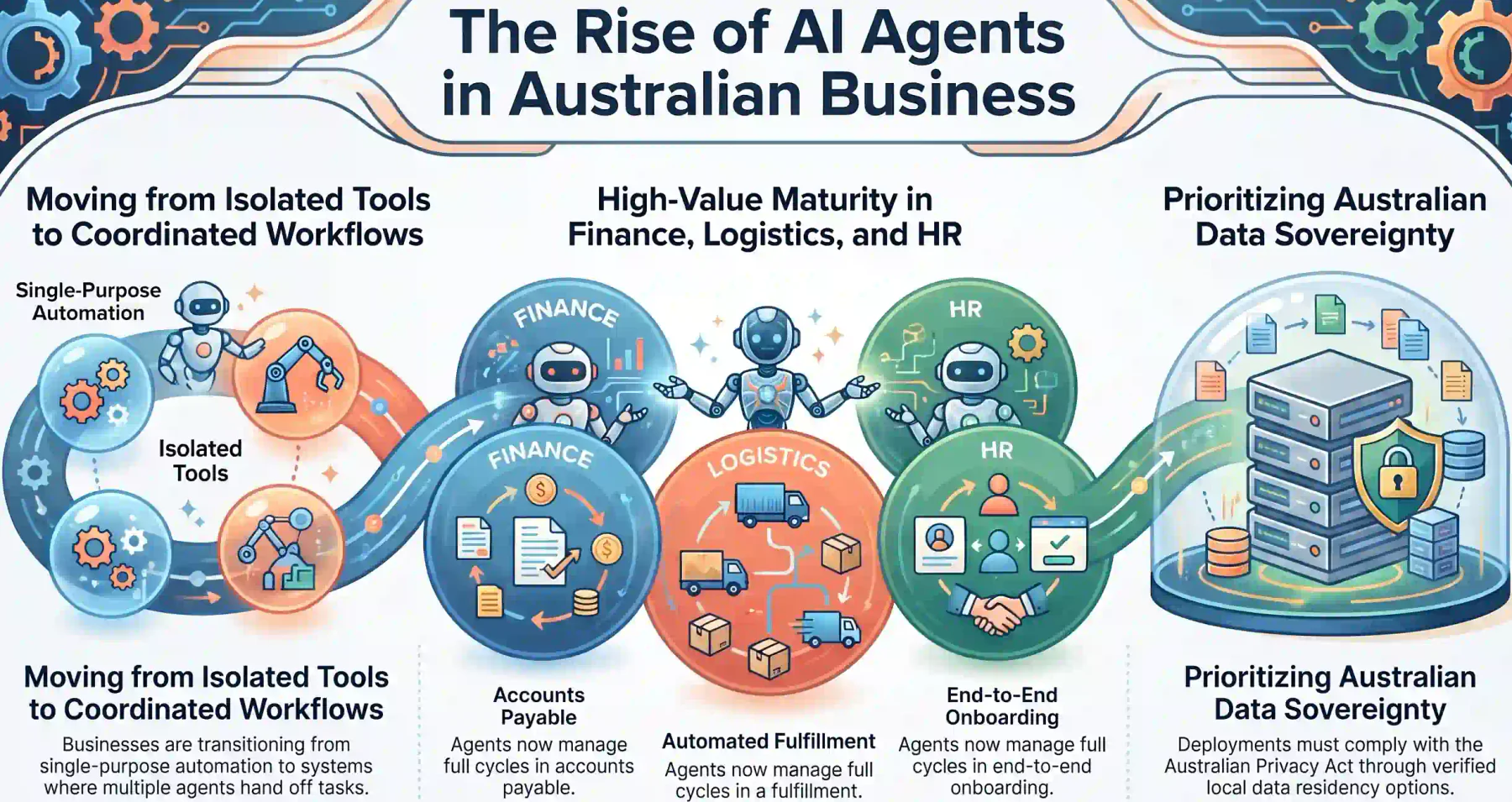
Australian businesses are moving from early AI experiments toward structured deployment. The shift from isolated tools to coordinated AI systems is the most significant transition in enterprise technology right now.
1. How Australian enterprises are adopting AI agents
Adoption typically starts with single-purpose AI agents. A business automates one function, such as invoice matching or customer query triaging, and measures the result before expanding further.
The next step is connecting those agents. Australian enterprises, particularly in manufacturing, professional services, and financial services, are beginning to build workflows where multiple agents hand off to each other seamlessly.
According to the Australian Bureau of Statistics, digital technology investment among Australian businesses continues to grow year on year, with automation and AI leading the spend across most industries.
2. Use cases by industry: finance, logistics, and HR
The most mature AI agent use cases in Australia are concentrated in three functions: finance, logistics, and HR. Each one has distinct starting points and realistic near-term outcomes for businesses of most sizes.
In finance, AI agents handle invoice extraction, payment matching, and anomaly detection in transaction records. Agentic AI takes that further by managing the full accounts payable cycle without manual review at each step.
Logistics teams use AI agents to match purchase orders, track shipments, and flag delivery delays. Agentic AI coordinates these agents across supplier and warehouse systems to execute fulfilment decisions automatically.
HR is a high-value area. AI agents handle candidate screening, leave requests, and onboarding document checks. Agentic AI connects these steps so onboarding runs end-to-end with minimal admin involvement from HR teams.
3. Data sovereignty and compliance considerations in Australia
Data sovereignty is a real concern for Australian businesses deploying AI. When agents process data, that data passes through the model's hosting environment. Knowing where your data sits is a regulatory requirement, not a preference.
The Australian Privacy Act and sector-specific frameworks in finance and health set clear expectations around data handling and storage location. AI systems that process personal or sensitive data must comply with these rules fully.
When evaluating AI agent platforms, ask specifically where inference runs, where data is stored, and whether the vendor has Australian data residency options. These are not optional questions for any serious deployment.
AI Agents, Agentic AI, and MCP Explained
MCP, or Model Context Protocol, is an open standard that defines how AI agents connect to external tools, data sources, and systems. It is the infrastructure layer that makes agentic AI practical at scale.
1. What is MCP and what does it do?
MCP standardises how AI agents access information and tools. Instead of building a custom connector for every data source, developers use MCP to give agents a consistent interface regardless of what they are connecting to.
In practice, MCP means an AI agent can connect to a database, an API, a file system, or a web service using the same method regardless of the source. This reduces the engineering work required to build and maintain agentic systems significantly.
For business teams, MCP is largely invisible. What you see is that your AI assistant or agentic workflow can pull data from your ERP, CRM, and email platform without a separate integration project for each connection.
2. How MCP fits into an agentic AI architecture
In an agentic AI architecture, MCP sits between the planning layer and the tools it needs to reach. The planning layer issues instructions, and MCP translates them into specific calls against specific systems.
Without MCP, every agent needs its own custom connector for every tool. With MCP, a new tool becomes available to all agents as soon as it is registered. This makes MCP a foundational layer, not just a convenience feature.
HashMicro's ERP, integrated with Hashy OS, uses this type of architecture. Agents in the system can reach finance data, inventory records, HR profiles, and procurement workflows through a unified connection layer.
Therefore, your team works with AI-powered outcomes in the tools they already use daily, without needing to manage the underlying agent infrastructure or maintain custom integrations for each data source.
Conclusion
AI agents and agentic AI are different concepts often used interchangeably. An AI agent handles a single task, while agentic AI coordinates multiple agents across a workflow, with memory, planning, and self-correction.
HashMicro's ERP integrates Hashy OS to provide both capabilities in one platform, so your team benefits from task-level AI agents and agentic coordination without building or managing separate tools for each function.
If you want to see how AI agents and agentic AI fit into your business operations, book a free consultation with the team today.
Frequently Asked Questions
Yes. The same system can act as a single AI agent for simple tasks and as part of an agentic AI architecture for complex workflows. The difference depends on configuration. A single agent becomes part of an agentic system when given a planning layer, memory, and the ability to coordinate with other agents.
The terms are closely related but not identical. Multi-agent AI describes a system where multiple agents operate together. Agentic AI adds the coordination layer: a planning component that decides which agents to use, manages the workflow, and synthesises the outputs. All agentic AI systems involve multiple agents, but not all multi-agent systems have the planning intelligence that defines agentic AI.
Finance, logistics, and HR are the most active areas. In finance, agentic AI automates accounts payable and anomaly detection. In logistics, it coordinates order fulfilment and supplier communication. HR teams use it for end-to-end onboarding. Manufacturing and professional services are also seeing early returns in quality control and contract processing.
Start with AI agents if your automation needs are task-specific and bounded. If your workflows span multiple departments, require memory across steps, or depend on earlier decisions, agentic AI is the right architecture. Many businesses begin with individual agents and expand into agentic AI as their confidence and data infrastructure grow.