







 Limited to 100 registrants
A single supplier going quiet is rarely the problem. The problem is finding out three weeks later, when the order that depended on them was already promised to a customer. Supply chain risk management exists to close that gap between something going wrong and someone knowing about it.
Australian businesses carry a particular version of this. Long freight distances, thin domestic supplier pools in some categories, and a growing set of legal obligations mean risk work here looks different from the textbook version. This article covers the process, how to score and prioritise risks, what an Australian plan must include, and the controls that actually reduce exposure.
Key Takeaways
Map supply chain risk beyond tier 1 and connect every material exposure to a record, accountable owner and review trigger.
Australian supply chains can be disrupted by supplier failure, freight delays, natural hazards, cyber incidents, compliance changes and demand swings.
Check whether SOCI, CPS 230 or Modern Slavery Act obligations apply to your organisation, and verify every threshold against current Australian sources.
Technology can improve supplier, procurement, inventory and audit visibility, but governance still determines who acts on the information.

What Is Supply Chain Risk Management?
"Supply chain risk management is not a folder of policies. It is the work of knowing where supply can fail, what the business loses if it does, and which controls you need in place before the pressure hits."
Supply chain risk management is the practice of identifying what could interrupt your supply of goods and services, judging how serious each threat is, and putting controls in place before it happens. It covers suppliers, logistics, systems, people, and the regulations attached to all of them.
The work is continuous rather than annual. Suppliers change ownership, freight lanes shift, and a category that was easy to source last year can tighten quickly.
Australian businesses often start it for a specific reason, such as a customer contract, a lender question, or a near miss. However, the value shows up in ordinary weeks, because a mapped supply base makes routine decisions faster.
The discipline is not about eliminating risk, since no business can. It is about knowing where you are exposed and choosing deliberately which exposures you accept.
What Risks Can Disrupt an Australian Supply Chain?
Risk categories overlap in practice, though separating them helps you see which part of the business owns each one. The table below sets out the main categories with an Australian example and the signal that usually appears first.
| Risk Category | Australian Example | Early Signal |
|---|---|---|
| Supplier failure | A sole-source component maker enters administration | Slipping delivery dates and slower responses to email |
| Logistics and freight | Port congestion, rail closure, or a flooded highway cutting an interstate lane | Transit times drifting above the contracted window |
| Natural hazard | Flood, bushfire, or cyclone affecting a supplier site or a distribution route | Seasonal warnings and insurance repricing in a region |
| Cyber and systems | A logistics provider loses order systems to a ransomware incident | Security questionnaires going unanswered or expired certifications |
| Regulatory and compliance | Modern slavery, biosecurity, or import requirements changing mid-contract | Regulator consultation papers and industry association notices |
| Demand and financial | Exchange rate movement or a demand swing leaving stock stranded | Forecast accuracy falling and stock cover moving outside target |
| Concentration | Several products depending on one region, one port, or one carrier | Spend analysis showing a large share sitting with one party |
Concentration deserves particular attention in Australia, since distance and market size often push businesses toward a single freight partner or a single overseas source. Therefore, run a spend concentration check before assuming your supplier list is genuinely diverse. Supplier exposure is the largest single category, which makes vendor risk management the first control most businesses formalise.
How Does the Supply Chain Risk Management Process Work?
The process runs as a loop rather than a project with an end date. The sections that follow describe each part in the order most businesses work through them.
Identification comes first, and it means listing what could interrupt supply across products, suppliers, routes, and systems. Draw on procurement records, past incidents, and the people who deal with suppliers daily, since they usually know where the fragile points sit.
Assessment then scores each risk on how likely it is and how much damage it would do. Scoring matters because a list of forty risks with no ranking produces no action.
Treatment follows, and every risk gets one of four responses: avoid it, reduce it, transfer it through contract or insurance, or accept it with a documented reason. Accepting a risk knowingly is a legitimate choice, while accepting it by default is not.
Monitoring closes the loop by tracking indicators that tell you a risk is becoming real. As a result, the plan stays current instead of describing the supply chain you had eighteen months ago. Demand risk is easier to model, and disciplined demand forecasting is what stops a seasonal swing being read as a structural shift.
How Do You Assess and Prioritise Supply Chain Risks?
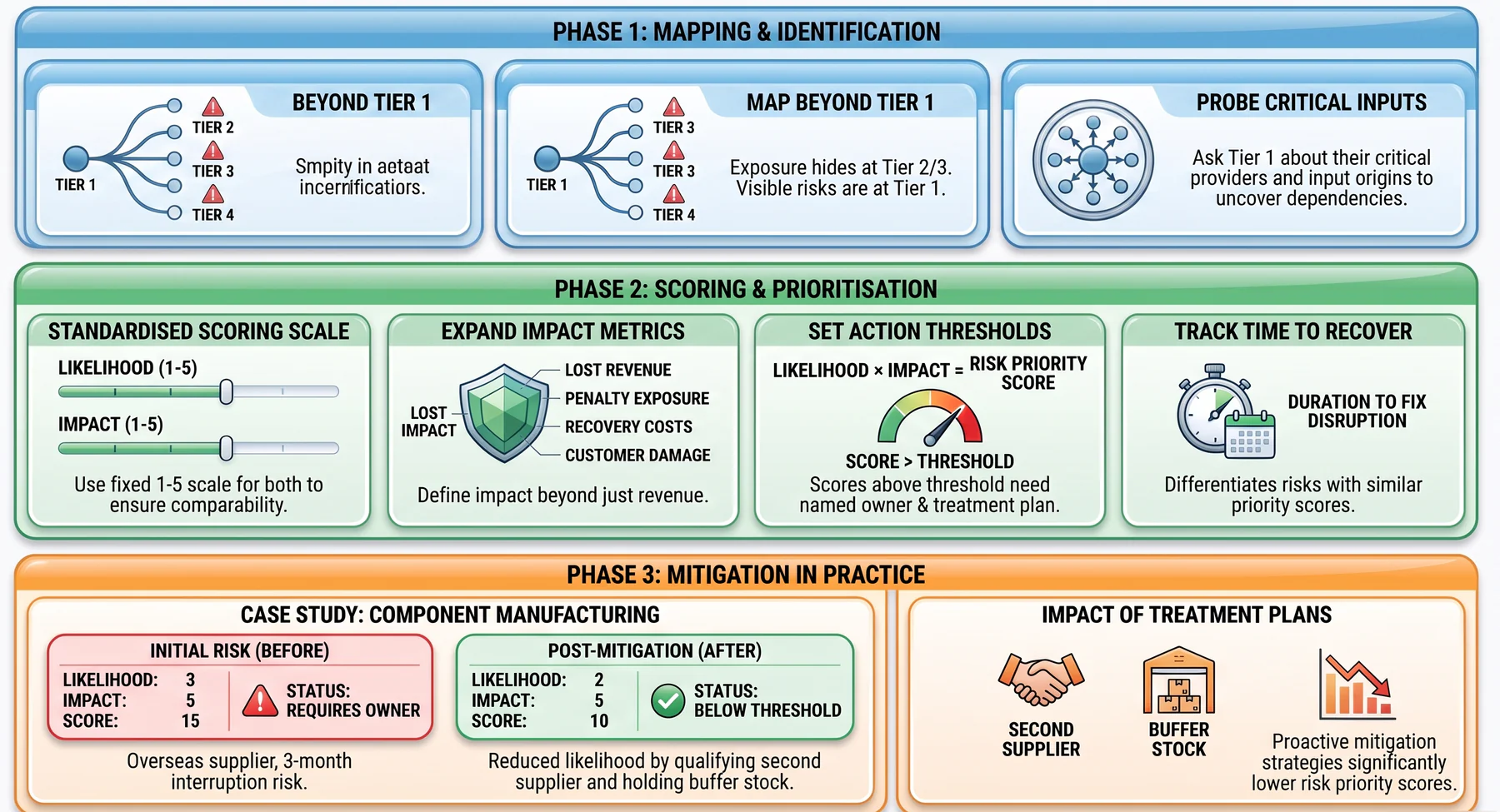
Prioritisation is where most risk registers either become useful or become shelf decoration. The approach below turns a long list into a short queue of things someone actually owns.
1. Map beyond tier 1
Tier 1 is who invoices you, and it is usually the part you already know. The exposure that surprises businesses sits at tier 2 and tier 3, where a shared sub-supplier can sit behind three vendors you thought were independent.
Ask your critical suppliers who their critical suppliers are, and where those inputs come from. Consequently, you find the single points of failure that a tier 1 review will never show.
2. Score likelihood and impact
Use a simple scale, such as one to five for likelihood and one to five for impact, and define what each number means before anyone scores. Impact should cover lost revenue, penalty exposure, recovery cost, and customer damage rather than revenue alone.
Score with the people who own the relationship rather than in a finance meeting. However, keep the definitions fixed, because scores are only comparable when everyone applies the same scale.
3. Set a risk priority score and action threshold
Multiply likelihood by impact to get a risk priority score, then agree the threshold above which a risk must have a named owner and a treatment plan. Setting the threshold before scoring stops the number being negotiated afterwards.
Also record time to recover, since two risks with the same score behave very differently if one takes a week to fix and the other takes six months. Therefore, the register should carry both figures side by side.
4. Work through an example
Take a Brisbane manufacturer buying a moulded component from one overseas supplier. Likelihood of a three-month interruption is scored 3, and impact is scored 5 because production stops entirely, giving a risk priority score of 15.
With a threshold set at 12, that risk needs an owner and a plan. The treatment chosen is qualifying a second supplier and holding six weeks of buffer stock, which drops likelihood of an actual production stoppage to 2 and the score to 10. Holding the right safety stock is the cheapest buffer available, provided the level is set from lead time variability rather than habit.
What Must an Australian Risk Management Plan Include?
Australian obligations depend on your sector, your size, and who regulates you. The sections below cover the three that catch out most mid-market businesses, plus how to pick a framework.
SOCI Act 2018 and the CIRMP obligation
The Security of Critical Infrastructure Act 2018 applies to entities responsible for critical infrastructure assets across sectors including energy, transport, food and grocery, data storage, and healthcare. Responsible entities in specified asset classes must adopt and maintain a Critical Infrastructure Risk Management Program.
A CIRMP requires the entity to identify and minimise material risks across four hazard vectors, including supply chain hazards, and to report annually. Guidance and current asset class coverage sit with the Cyber and Infrastructure Security Centre, so confirm whether your assets are captured before assuming they are not.
APRA CPS 230 and material service providers
Prudential Standard CPS 230 on operational risk management applies to APRA-regulated entities, including banks, insurers, and superannuation trustees. It requires those entities to identify material service providers, assess the risks of relying on them, and maintain arrangements they can actually manage.
The practical effect reaches further than the regulated entity itself, because service providers to those entities face tighter due diligence and contractual expectations. Therefore, check the current requirements published by APRA if you supply the financial sector, even when the standard does not bind you directly.
Modern Slavery Act 2018 (Cth) reporting
The Modern Slavery Act 2018 requires entities based or operating in Australia with consolidated revenue above the legislated threshold to publish an annual modern slavery statement. That statement must describe the risks of modern slavery in the entity's operations and supply chains, and the actions taken to address them.
Statements are published on the Modern Slavery Statements Register, which makes them visible to customers, investors, and journalists. In addition, many businesses below the threshold now report voluntarily because their larger customers ask for the same information.
Choosing a framework: ISO 31000, ISO 28000, and PPRR
A framework gives your plan a recognised structure, which matters when a customer or auditor asks how you arrived at your conclusions. The comparison below sets out the three most commonly used by Australian businesses.
| Framework | What It Covers | Best Suited To |
|---|---|---|
| ISO 31000 | General risk management principles and process, applied across the whole business | Businesses wanting one risk language across finance, operations, and supply |
| ISO 28000 | Security and resilience management specific to the supply chain | Logistics, freight, and import-heavy businesses needing a certifiable standard |
| PPRR model | Prevention, preparedness, response, and recovery across a disruption lifecycle | Smaller businesses wanting a practical continuity plan without certification |
Pick one and apply it properly rather than borrowing pieces from all three. As a result, your plan reads as a coherent system when someone external reviews it.
Which Controls Reduce Supplier and Operational Risk?
Controls are where the register stops being paperwork and starts changing exposure. The measures below deliver the most for mid-market businesses.
Qualify a second source before you need one
Qualification takes time, since a new supplier needs samples approved, terms agreed, and often a trial order run. Doing that under pressure produces a worse outcome and a worse price.
Qualify second sources for your highest-scoring items while nothing is wrong. Therefore, switching becomes a decision you make in a day rather than a project you start in a crisis.
Inventory buffers and supplier diversification
Buffer stock is the bluntest control and the most expensive, so apply it where lead times are long and substitution is hard. Australian importers often need deeper buffers than overseas guidance suggests, because replenishment shipping simply takes longer.
Diversification spreads exposure across suppliers, regions, or freight lanes. However, it only helps when the alternatives are genuinely independent, which brings you back to mapping beyond tier 1.
Contracts, service levels, and exit clauses
Contracts should state delivery expectations, notification obligations when the supplier hits trouble, and what happens if performance slips. A requirement to notify you of a material change is one of the cheapest early-warning tools available.
Exit clauses matter just as much, since a contract you cannot leave becomes a risk in itself. In addition, agree upfront who owns tooling, data, and specifications when the relationship ends.
Early-warning indicators and review triggers
Pick a handful of indicators that move before a failure, such as on-time delivery, quality rejection rates, response times, and any credit or trading signals you can access. Track them monthly rather than annually.
Then set triggers that force a review outside the normal cycle, for example a supplier being acquired, a lane closing, or an indicator breaching its limit. Consequently, the register updates when reality changes rather than when the calendar says so None of it is manageable without supply chain visibility, since a risk you cannot see is one you can only respond to after it has landed. .
How Can HashMicro Improve Supply Chain Risk Visibility?
Most risk registers fail for a practical reason, since the data needed to keep them current sits in purchasing, inventory, and finance systems that do not talk to each other. Someone has to rebuild the picture manually, and that only happens when there is time.
HashMicro's supply chain management software connects procurement, inventory, supplier records, and accounting in one system, so spend concentration, supplier performance, and stock cover come from live transactions rather than a quarterly export. Vendor records also hold certifications and expiry dates, which keeps compliance evidence attached to the supplier rather than in a folder.
In addition, Hashy, the HashMicro AI Coworker, reads that connected purchasing and inventory data through the Company Nexus. A procurement manager can ask which suppliers carry the largest share of spend, or which items sit below buffer, without waiting for a report to be built.






Conclusion
Supply chain risk management earns its cost when it produces a short, owned list of exposures backed by real controls, rather than a register nobody has opened since it was written. The Australian layer matters too, since SOCI, CPS 230, and modern slavery reporting each set expectations that a generic global template will not cover.
Start by mapping beyond tier 1, score honestly against an agreed threshold, and connect your supplier and inventory data so the picture stays current. To see how connected procurement, inventory, and supplier data could work across your operations, book a free consultation with HashMicro.

Frequently Asked Questions
Common groupings include operational, financial, strategic, and external or disruption risks, although businesses classify them differently. This article uses an internal-versus-external view and does not present four categories as a universal legal or standards-based rule.
Review frequency should reflect risk criticality, change events and trigger conditions rather than one universal interval. Review after supplier changes, incidents, material control failures, major demand shifts or regulatory changes, and set a formal cadence as an editorial starting point.
There is no single obligation applying identically to every business. Duties may arise based on critical infrastructure status, APRA regulation, material service-provider arrangements, Modern Slavery Act reporting status and sector requirements; verify scope with legislation.gov.au and the relevant regulator.
Risk management identifies, assesses, treats and monitors exposure. Resilience is the capability to absorb disruption, adapt and recover, while business continuity planning supports resilience but does not replace risk assessment or ownership.
Accountability is shared: executives set risk appetite, procurement manages supplier exposure, operations and inventory teams manage continuity, finance assesses financial impact, IT addresses systems and data, and business units own local actions. Assign a named accountable owner and escalation path.
Heading section
Paragraph content...
Heading section
Paragraph content...