






Valuable knowledge often sits across emails, documents, employee experience, and disconnected software. When employees cannot find reliable information, routine decisions take longer and work becomes inconsistent.
Knowledge management provides a structured way to capture, organise, share, and improve what a company knows. It helps Australian businesses retain expertise, support employees, and use operational information more effectively.
A strong approach combines people, processes, and technology. Software supports access and control, while employees provide context and practical judgement.
Key Takeaways
Knowledge management gives employees reliable access to company expertise, data, and practical guidance.
Australian businesses can use knowledge management to protect expertise, improve consistency, and support informed decisions.
An effective process identifies, captures, organises, shares, and regularly reviews business knowledge.
ERP and AI connect operational data with searchable insights, helping growing companies use knowledge more effectively.
What Is Knowledge Management?
Knowledge management is the practice of identifying, capturing, organising, sharing, and improving the knowledge a company needs to operate. It covers documented information and the practical expertise employees gain through experience.
A knowledge management system gives employees a reliable place to find policies, procedures, customer information, operational guidance, and previous decisions. However, technology alone does not create an effective knowledge-sharing culture.
Companies also need clear ownership, review schedules, and contribution rules. These controls help employees trust the information they find and understand how to apply it.
Knowledge management differs from related information practices in several important ways. The following table outlines their primary purposes.
Why Knowledge Management Matters for Australian Businesses
Small and mid-sized companies often depend on a limited number of experienced employees. If those employees leave or change roles, undocumented knowledge can disappear with them.
Growth also increases the number of systems, departments, and locations involved in daily work. Therefore, employees need a shared source of reliable guidance to maintain consistent service and operating standards.
Effective knowledge management and document management software reduce time spent searching through emails, shared drives, and separate applications. Employees can instead access approved instructions and supporting context when they need them.
The practice also supports business continuity. A company can respond more confidently to staff changes, customer enquiries, operational disruptions, and compliance reviews when essential knowledge remains accessible.
Types of Knowledge in an Organisation

Business knowledge takes several forms, so one capture method will not suit every situation. Companies should recognise the following three categories when building their knowledge management approach.
Explicit Knowledge
Explicit knowledge is information that employees can document and share in a clear format. Examples include manuals, policies, checklists, training materials, reports, and product specifications.
This knowledge is usually easier to store and search because it already has a defined structure. However, teams must still assign owners and review dates to prevent outdated guidance from remaining in use.
Tacit Knowledge
Tacit knowledge comes from personal experience, judgement, and practical skill. An experienced employee may know how to calm a difficult customer or detect an unusual stock issue without following written instructions.
Companies can capture parts of this expertise through interviews, mentoring, recorded demonstrations, and after-action reviews. Even so, direct interaction remains important because some judgement depends on context.
Embedded Knowledge
Embedded knowledge exists within workflows, system rules, templates, products, and established routines. For example, an approval sequence may reflect years of experience even when employees cannot explain every decision behind it.
Documenting the purpose of these controls helps teams understand their value. It also reduces the risk of removing an important rule during process or software changes.
Real World Examples of Knowledge Management
Knowledge management becomes easier to understand when connected with daily activities. The following examples show how different departments can apply it.
1. Customer service teams
Customer service teams can maintain approved answers, troubleshooting guides, escalation rules, and previous case resolutions. As a result, employees can resolve common enquiries without repeatedly asking senior colleagues.
A searchable knowledge base also supports consistent communication across phone, email, and digital channels. Managers can review recurring enquiries and update guidance when products or policies change.
2. Sales and Account management
Sales teams can store proposal templates, product information, qualification criteria, objection responses, and successful sales practices. Account managers can also record customer preferences and previous commitments.
Shared knowledge reduces reliance on personal notes and individual memory. Therefore, sales representatives can prepare for meetings and manage customer handovers with better context.
3. HR and Employee Onboarding
HR teams can provide role guides, workplace policies, training materials, benefits information, and onboarding checklists. New employees can then find essential information without waiting for an HR representative.
Managers can also document role-specific practices and performance expectations. This approach creates a more consistent onboarding experience across departments and locations. This approach creates a more consistent employee onboarding experience across departments and locations.
4. Inventory and Operations
Operations teams can record stock-handling procedures, supplier lead times, reorder rules, quality checks, and common exception responses. These resources help employees act consistently when disruptions occur.
Historical operational knowledge can also explain why certain controls exist. For example, a receiving checklist may reflect previous supplier, quality, or traceability issues.
5. Finance and Compliance
Finance teams can maintain account coding guides, approval rules, reporting calendars, reconciliation procedures, and audit evidence requirements. Clear documentation helps employees complete recurring work accurately.
Compliance knowledge should include ownership, review dates, and current record-keeping requirements because obligations and internal controls can change. Professional advice remains necessary when decisions involve legal, tax, or regulatory interpretation.
The Knowledge Management Process
A practical knowledge management process turns scattered information into a maintained business resource. The following five activities provide a workable structure.
1. Identify Critical Knowledge
Start by identifying the knowledge employees need to complete important work, serve customers, and manage risk. Interviews, workflow reviews, support records, and operational incidents can reveal where gaps exist.
Companies should prioritise knowledge that affects revenue, safety, compliance, customer experience, or business continuity. This focus prevents teams from documenting large amounts of low-value information.
2. Capture Knowledge from Teams and Systems
Collect useful insight from employees, policies, project records, customer interactions, and operational systems. Interviews, workshops, screen recordings, templates, and case reviews can support this activity.
The capture method should suit the type of knowledge involved. A checklist may work for a routine task, while a recorded demonstration may better explain practical judgement.
3. Organise Knowledge in a Searchable Structure
Group content by department, workflow, role, customer need, or subject. Clear titles, tags, categories, and naming rules help employees locate information without knowing where a specific document sits.
Each resource should also display its owner, review date, and approval status. These details help users distinguish current guidance from drafts or archived material.
4. Share Knowledge Across Departments
Make approved knowledge available through tools employees already use. Portals, internal search, collaboration platforms, role-based dashboards, and the best ERP software for Australian businesses can centralise access and reduce unnecessary switching between applications.
Access controls should protect confidential information without creating avoidable barriers. Employees need enough visibility to complete their responsibilities while sensitive records remain restricted.
5. Review and Improve Knowledge Over Time
Knowledge becomes less useful when products, systems, regulations, or responsibilities change. Content owners should review high-impact material regularly and update it after significant operational changes.
Usage data, employee feedback, search failures, and repeated support questions can highlight weak content. Therefore, continuous review keeps the knowledge base relevant and practical.
Benefits of Knowledge Management
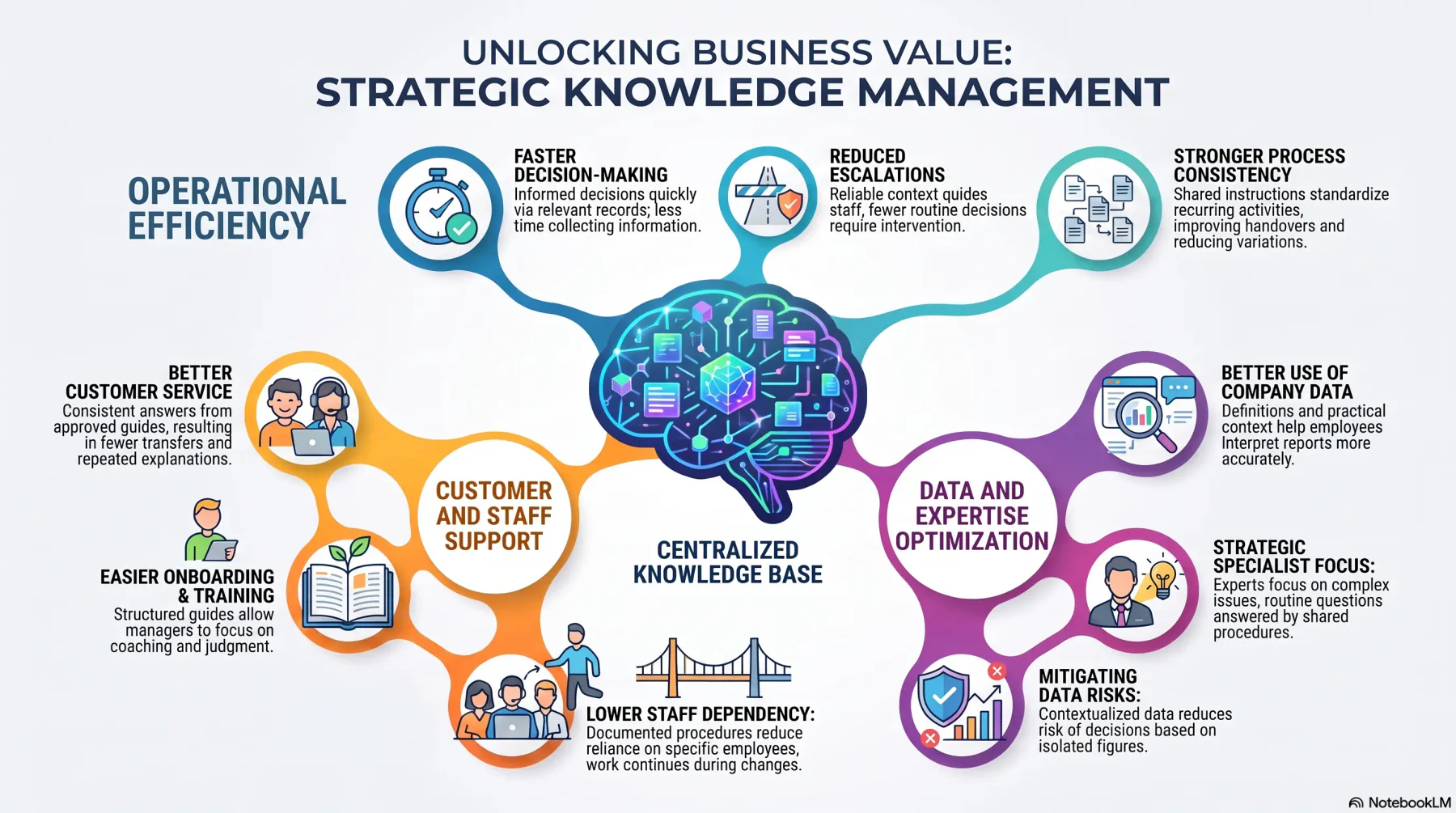
A well-managed knowledge base supports daily work and long-term resilience. The following benefits apply across many business functions.
Faster Decision-Making
Employees can make informed decisions more quickly when they can access relevant records, procedures, and previous outcomes. Managers also spend less time collecting information from separate teams.
Reliable context helps employees understand both the available options and the reasoning behind established practices. Consequently, routine decisions require fewer escalations.
Better Customer Service
Service employees can provide more consistent answers when they use approved product information and resolution guides. Customers also benefit from fewer transfers and repeated explanations.
A shared record of previous interactions supports smoother handovers. In addition, teams can use recurring questions to improve customer resources and internal training.
Lower Dependency on Individual Staff
Documented procedures and shared expertise reduce reliance on a few experienced employees. Important work can continue when staff members take leave, change roles, or leave the company.
This approach does not remove the value of specialists. Instead, it allows experts to focus on complex issues rather than answering the same routine questions.
Easier Onboarding and Training
New employees can learn their responsibilities through structured guides, examples, and approved procedures. Managers can then spend more training time on judgement, coaching, and role-specific support.
Consistent resources also reduce variation between trainers. As a result, employees receive a clearer introduction to company expectations.
Stronger Process Consistency
Shared instructions help departments complete recurring activities in the same way. Consistency improves handovers because employees understand the information and approvals required at each point.
Process knowledge can also reveal unnecessary variation. Teams can review different practices and select the approach that best supports quality and control.
Better Use of Company Data
Operational systems contain valuable facts about customers, transactions, stock, employees, and workflows. Knowledge management adds definitions, explanations, and practical context to those facts.
This combination helps employees interpret reports more accurately. It also reduces the risk of making decisions based on isolated figures without understanding their source or meaning.
How ERP and AI Improve Knowledge Management
ERP software connects records and workflows across departments. Employees can access customer, finance, inventory, procurement, HR, and operational information within a shared environment instead of searching through disconnected applications.
Integrated workflows also preserve knowledge through approval histories, transaction records, system rules, and audit trails. This context shows employees what happened, who acted, and which controls applied.
AI can improve search by interpreting the meaning behind a question instead of relying only on exact keywords. It can also summarise records, suggest related information, and highlight patterns across large data sets.
However, businesses should not treat every AI response as approved guidance. Access controls, source references, review processes, and human judgement remain necessary for reliable knowledge use.
HashMicro’s AI-powered ERP system connects company data and processes within one operating environment. Its Hashy AI Coworkers use live business context to complete practical tasks across connected workflows.
Growing businesses can use this approach as a natural progression from separate files and applications. A connected platform supports knowledge sharing while preserving the operational context behind each record.
Paragraf baru...
Conclusion
Knowledge management helps companies protect expertise, improve access to information, and support consistent work. Its value comes from combining employee experience, documented resources, maintained processes, and suitable technology.
Australian businesses should begin with critical operational knowledge rather than trying to document everything at once. Clear ownership and regular reviews will then keep each resource accurate and useful.
ERP and AI can strengthen this approach by connecting knowledge with live records and everyday workflows. Discuss your requirements and implementation priorities through a free consultation with HashMicro.

Frequently Asked Questions
Knowledge management examples include customer service guides, sales playbooks, onboarding resources, standard operating procedures, compliance records, and searchable internal knowledge bases. These resources help employees find and apply reliable information during daily work.
A knowledge management system is a digital platform that captures, organises, stores, and shares company knowledge. It may include search tools, document libraries, employee directories, workflow records, and access controls.
Document management focuses on storing, controlling, and retrieving files. Knowledge management has a broader purpose because it also connects documents with employee expertise, operational context, company data, and practical guidance.
Knowledge management projects often fail when employees cannot find relevant content, responsibilities remain unclear, or information becomes outdated. Poor adoption, limited leadership support, and disconnected systems can also reduce long-term value.
AI can improve knowledge management by searching large information sets, summarising records, identifying related content, and suggesting answers based on approved company data. However, businesses should maintain access controls and human review for sensitive or high-impact decisions.