






Conversational AI is changing how Australian businesses communicate with customers, employees, and internal teams. Instead of relying on traditional support channels or basic chatbots, businesses can now use AI systems that understand questions, retrieve information, and assist with everyday tasks.
For businesses managing sales, finance, HR, procurement, and operations, conversational AI is becoming a practical tool for improving efficiency and speeding up decision-making.
This guide explains what conversational AI is, how it works, and how Australian businesses can use it across their operations and ERP systems.
What Is Conversational AI?

Conversational AI is a type of artificial intelligence that allows people to interact with software using everyday language instead of navigating menus or searching through data manually.
Users can ask questions such as, "Where is my order?" or "Which invoices are overdue?" and receive relevant answers based on business data. The technology uses natural language processing, machine learning, and automation to understand requests and provide useful responses.
When integrated with systems such as ERP, CRM, accounting, and HR software, conversational AI can retrieve real-time information, automate tasks, and help businesses make faster decisions.
How Does Conversational AI Work?
Conversational AI works by converting human language into structured requests that software can understand. When a user sends a message, the system identifies the intent, context, and key information behind the question.
The AI then retrieves data from connected systems such as ERP, CRM, accounting, or inventory software to find the relevant information. The accuracy of its responses depends on how well it is integrated with business data.
Finally, the system provides an answer, suggests an action, or triggers a workflow such as creating a ticket, updating a record, or routing a request. Advanced conversational AI can also follow business rules and approval processes, making it far more capable than a basic chatbot.
Conversational AI vs Chatbots: What Is the Difference?
An AI chatbot for business is typically a rule-based tool that follows predefined scripts and can only answer a limited set of questions. If a user asks something unexpected, the chatbot often cannot provide a helpful response.
Conversational AI is more advanced because it understands natural language, recognises intent, and connects with business systems. It can answer more complex questions and provide responses based on real-time data.
| Area | Traditional Chatbot | Conversational AI |
|---|---|---|
| Conversation style | Follows scripted paths and menu options | Understands natural language and intent |
| Context handling | Often treats each message separately | Can remember context within a conversation |
| Flexibility | Works best for predefined questions | Handles more varied questions and follow-ups |
| Data connection | Often linked to static FAQs | Can connect to CRM, ERP, HR, inventory, and other systems |
| Task handling | Usually answers simple questions | Can trigger workflows, route requests, and retrieve live data |
| Human escalation | May offer limited handoff | Can escalate based on intent, risk, or complexity |
| Best use case | Basic website support and FAQ automation | Customer service, internal support, sales, operations, and workflow automation |
In short, chatbots handle simple conversations, while conversational AI supports real business processes and helps users complete tasks more efficiently.
Benefits of Conversational AI for Australian Businesses
Conversational AI can help Australian businesses improve service quality, reduce manual admin, and make information easier to access across departments.
1. Faster Customer Response
Conversational AI can instantly answer common questions such as order status, appointments, and payment updates, reducing wait times and supporting better customer experience management. This allows support teams to focus on more complex issues.
2. Lower Administrative Workload
By handling routine enquiries and retrieving information from business systems, conversational AI reduces repetitive tasks and gives employees more time for higher-value work.
3. 24/7 Support Coverage
Conversational AI provides around-the-clock support by answering common questions, capturing requests, and preparing cases for follow-up, even outside business hours.
4. More Consistent Answers
By pulling information from approved data sources and systems, conversational AI delivers more accurate and consistent responses across different teams and channels.
5. Better Lead Qualification
Conversational AI can collect customer information, identify requirements, and prioritise qualified prospects before passing them to the sales team.
6. Easier Access to Business Data
Employees can quickly retrieve information such as sales figures, stock levels, or payment status using simple questions instead of manually searching through multiple systems.
Conversational AI Use Cases Across Business Functions
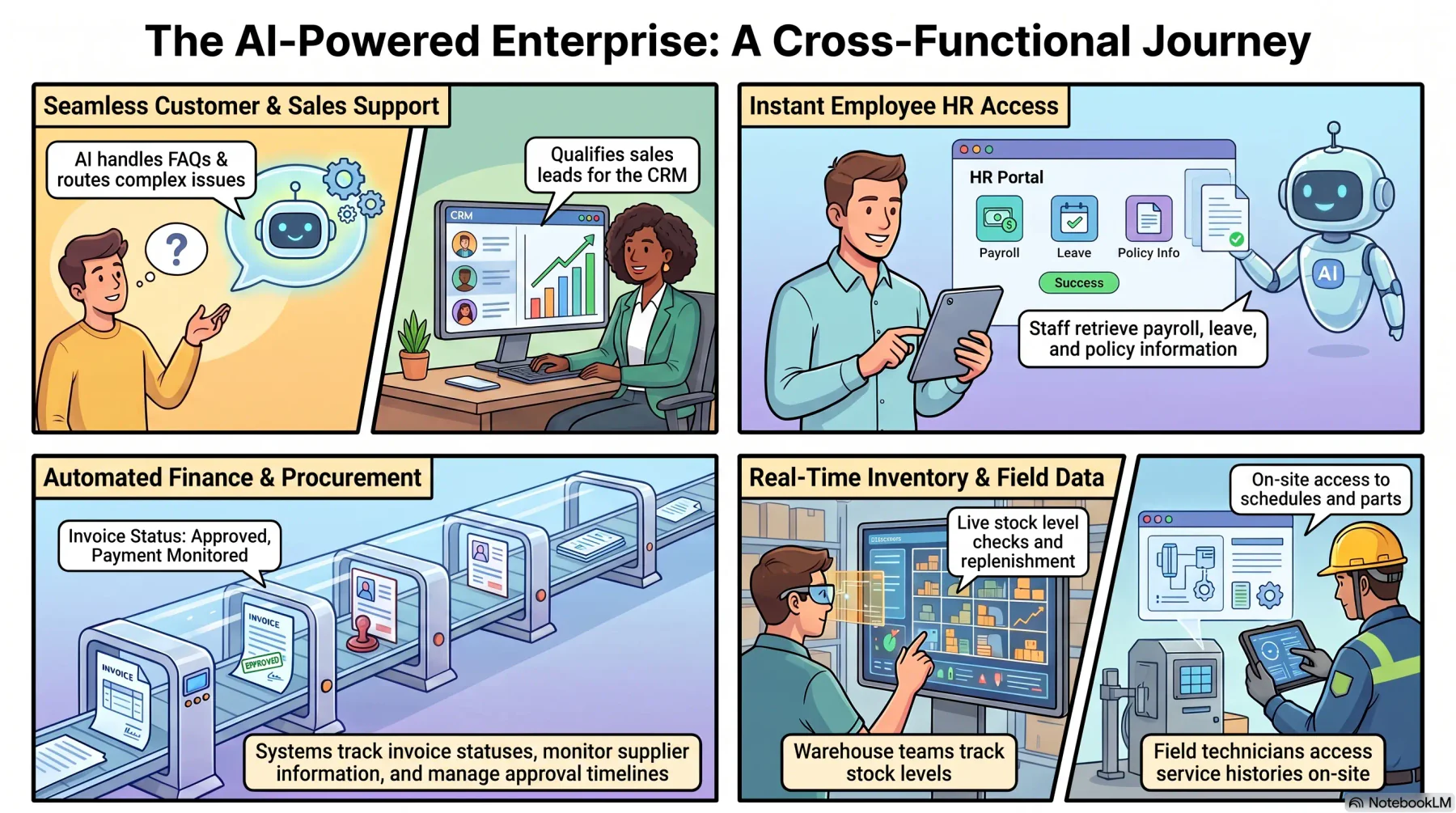
The most common use case for conversational AI is customer service, but its value can extend across the business.
1. Customer service
Conversational AI can answer FAQs, provide order updates, track deliveries, and route complex issues to the right support agent, improving response times and customer satisfaction.
2. Sales and CRM
Sales teams can use conversational AI to qualify leads, answer product questions, book demos, and retrieve customer information from CRM systems. Integrated CRM analytics can further help teams evaluate lead quality, customer behaviour, and sales performance.
3. Human resources
Conversational AI helps employees access information about leave, payroll, benefits, and company policies without relying on manual HR support.
4. Finance and accounting
Finance teams can use conversational AI to check invoice status, monitor payments, retrieve policy information, and answer common financial queries.
5. Procurement
Conversational AI can provide updates on purchase requests, supplier information, approval status, and delivery timelines, making procurement processes more efficient.
6. Inventory and warehouse operations
Warehouse teams can quickly check stock levels, track deliveries, and monitor replenishment needs using conversational requests connected to live inventory data.
7. Field service
Conversational AI supports field teams by providing access to schedules, customer details, service history, and parts availability while they are on-site.
Conversational AI in ERP and Business Workflows
Conversational AI becomes more useful when it is connected to systems such as ERP, CRM, accounting, HR, and inventory software. It can answer questions using real business data instead of providing only general information.
This makes it easier for employees to check invoices, stock levels, order status, and other important information without searching through multiple systems. As a result, teams can work faster and make better decisions.
Businesses should also make sure the system is secure. Users should only be able to access the information they need, and sensitive data should remain protected.
Privacy, Security, and AI Governance in Australia
Australian businesses should consider privacy, security, and governance before adopting conversational AI, especially when the system handles customer, employee, or financial information. Businesses need to be clear about how data is collected, used, and protected.
Good governance includes limiting the information the AI can access, following user permissions, and providing a clear path for human support when dealing with sensitive issues. Businesses should also keep records of important interactions and regularly review the information used by the AI.
While conversational AI can improve efficiency, it should not compromise privacy or security. The best approach is to define clear use cases, protect sensitive data, and monitor the system regularly to ensure it delivers accurate and reliable results.
How to Choose a Conversational AI Platform
Choosing the right conversational AI platform starts with integration. The solution should connect with systems such as ERP, CRM, accounting, and HR software so it can access real business data and support daily workflows.
| Evaluation area | What to check |
|---|---|
| Business system integration | Can it connect with ERP, CRM, HR, accounting, inventory, and support systems? |
| Data governance | Does it support access control, audit logs, and privacy settings? |
| Human handoff | Can it escalate conversations to the right team with full context? |
| Knowledge management | Can approved content be updated, reviewed, and controlled easily? |
| Workflow automation | Can it trigger actions such as ticket creation, approval requests, or order updates? |
| Analytics | Does it show conversation volume, unresolved queries, customer intent, and performance trends? |
| Multi-channel support | Can it work across website, mobile, messaging apps, and internal tools? |
| Scalability | Can it support more departments, users, and locations as the business grows? |
| Local relevance | Can it support Australian privacy requirements, terminology, and business processes? |
| Vendor support | Is implementation, training, and ongoing support available? |
Businesses should also look for strong security features, including role-based access, audit trails, and human handoff options. Analytics and reporting tools can help measure performance and identify improvements.
Finally, choose a platform that supports automation, scales with your business, and fits your operational needs, including integration with existing lead management processes. The best solutions do more than answer questions—they help teams work more efficiently.
Conclusion
Conversational AI is helping Australian businesses improve service, reduce manual work, and make information easier to access. It enables employees and customers to get answers quickly without navigating multiple systems.
The biggest value comes when conversational AI is connected to systems such as ERP, CRM, finance, and HR software, turning it into a practical tool for supporting everyday business processes.
Want to explore how conversational AI can work for your business? Contact our experts for a free consultation to find the right solution for your operational needs.
FAQ
A traditional chatbot often follows scripted responses or menu paths. Conversational AI is more advanced because it can understand intent, manage context, answer varied questions, and connect with systems such as CRM, ERP, HR, and inventory software.
Conversational AI helps businesses respond faster, reduce repetitive admin, improve customer service, support employees, qualify leads, and make business information easier to access.
Conversational AI can be used safely if businesses apply privacy controls, role-based access, audit trails, human escalation, and regular knowledge base review. Australian businesses should also consider OAIC privacy guidance and local AI governance expectations.
Examples include customer support chatbots, HR assistants, sales qualification bots, invoice status assistants, stock availability queries, procurement request updates, and ERP-connected AI assistants that answer operational questions.
Businesses should look for integration with existing systems, strong data governance, human handoff, workflow automation, analytics, scalability, and support for Australian privacy and operational requirements.