





Finding the right AI chatbot for business has become one of the more consequential technology decisions for Australian companies this year. With customer expectations rising and support costs under pressure, businesses across retail, professional services, and manufacturing are deploying conversational AI conversational AI to handle enquiries, qualify leads, and automate routine tasks without adding to headcount. This guide compares the top platforms available in 2026 and helps you choose the tool that matches your operations.
The tools reviewed here cover a broad spectrum: from standalone customer-facing bots to embedded AI assistants that work directly within ERP and CRM platforms. Whether you run a growing SMB or a more complex mid-market business, there is a solution here built for your use case, budget, and compliance environment.
Key Takeaways
AI chatbots interpret intent from natural language and connect to live business data, unlike rule-based bots that match fixed keywords.
Eight tools compared across use case, pricing, ERP fit, and Privacy Act compliance, from standalone bots to ERP-embedded AI.
Privacy Act 1988 and Spam Act 2003 apply directly to chatbot deployments, covering data collection, cross-border storage, and automated follow-up messages.
Five questions narrow the field before requesting a demo: use case priority, tech stack fit, query complexity, compliance needs, and pricing model.
What Is an AI Chatbot for Business?
"AI chatbots work best when they are connected to live business data, not just a static knowledge base. A bot that can tell a customer their actual order status, or tell a manager their real stock level, delivers something genuinely useful. One that can only answer FAQs is a different product."
An AI chatbot for business is a software application that uses artificial intelligence to conduct natural language conversations with customers or staff, completing tasks and answering questions automatically. Unlike a scripted bot, it interprets the meaning behind a question rather than scanning for exact keyword matches.
Modern business chatbots connect with knowledge bases, CRM systems, support platforms, and ERP software to retrieve accurate, context-aware answers. They manage multi-turn conversations, retain context across the session, and escalate to a human agent when a query moves beyond their configured scope.
Australian businesses deploy these tools across a range of touchpoints: website chat, WhatsApp, email portals, internal HR systems, and ERP dashboards. The commercial benefit is consistent across contexts: faster response times, lower cost per resolution, and support teams freed from high-volume, low-complexity enquiries.
How AI Business Chatbots Work (vs. Rule-Based Bots)
Rule-based bots and AI chatbots both appear in chat windows, but the way they process a query is fundamentally different. A rule-based bot follows a fixed decision tree: it checks incoming text against a list of keywords, selects a matching response, and routes the user through predetermined options. Any query that falls outside the predefined paths returns an error or loops back to the beginning.
An AI chatbot uses a large language model to interpret natural language and generate contextual responses. It understands intent rather than just keywords, handles follow-up questions coherently, and produces useful answers across variations in how users phrase the same request. A customer asking "when does my order arrive?" and "what is the delivery ETA on my latest purchase?" both receive a relevant, accurate response.
The practical outcome for Australian businesses is a higher first-contact resolution rate and fewer escalations to human agents. Within an omnichannel customer service strategy, these gains can be reflected in support team metrics and customer satisfaction scores within the first few months of deployment.
The table below illustrates the core differences between the two approaches.
Key Use Cases for AI Chatbots in Australian Business
AI chatbots address a broad range of business needs, but four categories consistently deliver the strongest results for Australian SMBs and mid-market companies. Each use case has distinct requirements in terms of tooling, system integration, and content preparation.
Customer Support and Ticket Deflection
Customer support remains the most established use case for AI chatbots and offers the clearest return on investment for most businesses. As part of effective customer experience management, a chatbot deployed on a support portal can resolve common enquiries such as order status, returns, account access, and product questions without human involvement.
The primary performance metric to track is deflection rate: the percentage of incoming contacts the chatbot resolves before they reach a human agent. Well-configured deployments consistently achieve deflection rates above 60%, which reduces your support team's repeat query volume and allows them to focus on genuinely complex cases.
For Australian businesses that receive high volumes of after-hours enquiries, a chatbot extends service availability to around the clock without additional staffing cost. This is particularly relevant for e-commerce, hospitality, and financial services businesses, where customer questions do not stop at the end of the working day.
Lead Capture and Qualification
Rather than relying on a static contact form, an AI chatbot can engage website visitors in a guided conversation to capture details and qualify prospects against your ideal customer profile. The bot asks targeted questions about budget, timeline, and requirements, then routes qualified leads directly to your CRM or sales team.
This approach closes the gap between a visitor showing interest and a sales representative making contact. Response speed in the first few minutes of a lead expressing interest significantly increases conversion rates compared to a delayed email follow-up.
For B2B businesses in Australia, lead qualification chatbots are especially valuable on high-traffic landing pages where a significant portion of visitors leave without submitting a form. A conversational entry point generates more data and produces better-qualified hand-offs than a static form at the same page position.
Appointment and Booking Automation
Service businesses such as medical practices, law firms, trades businesses, and consultancies rely on appointment scheduling as a core operational function. An AI chatbot can manage the complete booking flow: checking live availability, capturing required client details, confirming the appointment, and sending automated reminders, all without manual involvement.
This removes the administrative load from reception and customer service staff and ensures bookings proceed without delays or phone tag. Business can also connect this workflow with a quotation to payment process to streamline the customer journey from initial service requests to payment. Customers can book at any hour, and the bot handles reschedules and cancellations automatically.
Calendar integration is the critical technical requirement for this use case. Most leading AI chatbot platforms connect with Google Calendar, Outlook, and major practice management systems. Businesses should confirm these integrations work cleanly with their existing setup before committing to a platform.
Internal Operations and ERP Queries
One of the most underutilised applications for AI chatbots in Australian businesses is internal operations. Rather than serving customers, an internal chatbot gives staff a natural language interface to query live business data and complete routine tasks directly from a chat window.
An employee can ask "what is the current stock level for Product X?" or "show me this month's outstanding invoices" and receive an accurate answer drawn from the ERP or inventory system. This is where ERP-integrated AI such as Hashy OS by HashMicro delivers a clear advantage over standalone tools, because the data connection is built in from the start rather than requiring custom integration work.
Internal chatbots also handle HR queries, leave requests, policy lookups, and IT support tasks. The result is a measurable reduction in internal ticket volume and faster self-service for staff across departments.
Best AI Chatbots for Business in Australia (2026)
PThe tools below represent a broad cross-section of the market available to Australian businesses. Each has distinct strengths, and the right choice depends on your primary use case, your existing technology stack, and your budget. A full comparison table follows the individual tool summaries.
1. Hashy AI by HashMicro
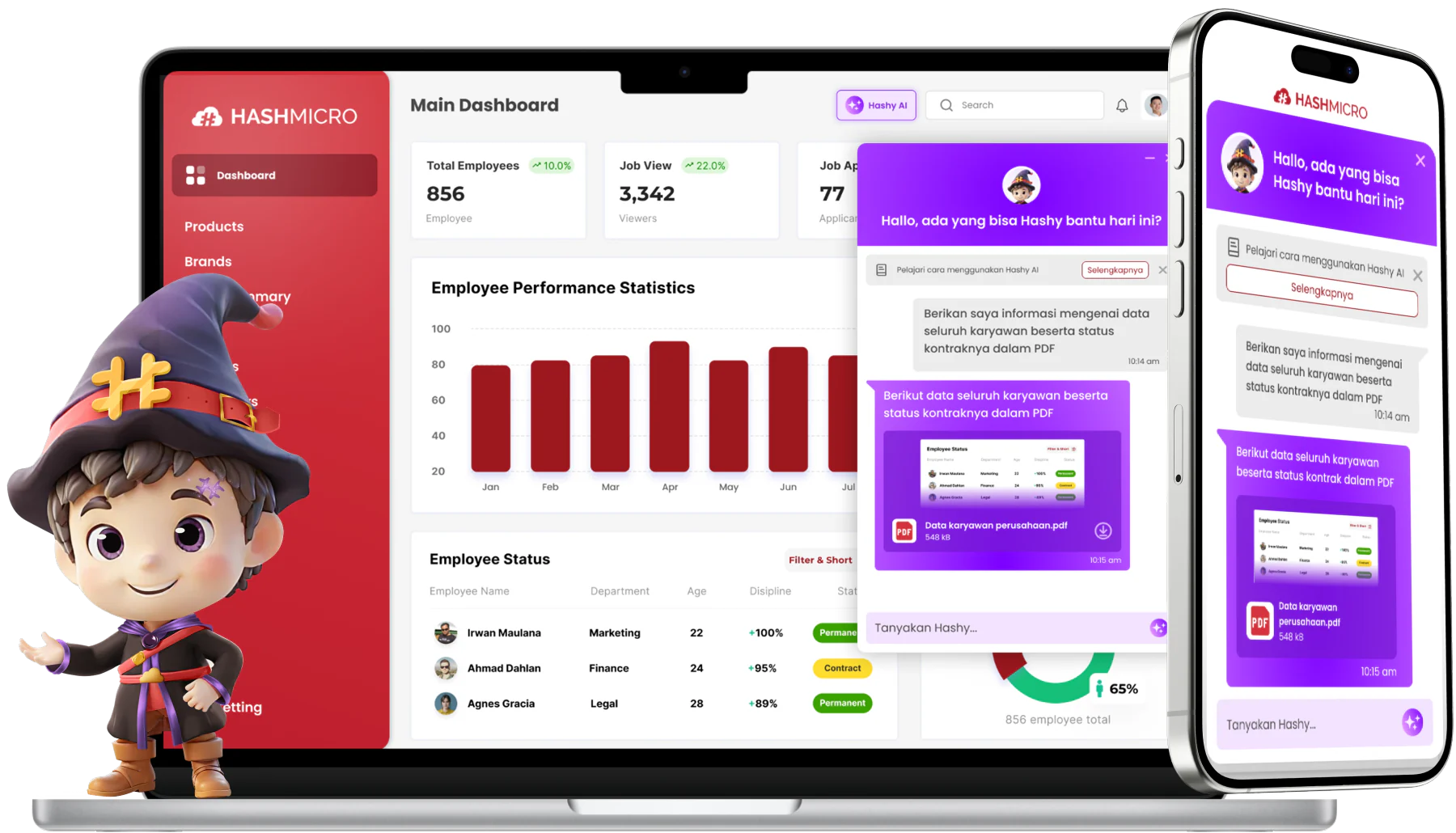
Hashy AI Coworkers are autonomous AI employees that complete business tasks, not just answer questions. Delivered through Hashy OS, they work across HashMicro’s HMX and HM Nova platforms using live, permission-controlled company data, including inventory, sales, customer, procurement and financial records.
Teams can assign recurring work to an AI Coworker much like they would to a colleague. Depending on its role, a Coworker can support payment reconciliation, collection follow-ups, candidate screening, interview scheduling or sales-order entry. It can operate continuously, follow established workflows and approval policies, and report progress through familiar channels such as WhatsApp.
Every Coworker draws on the Company Nexus, Hashy OS’s shared company knowledge layer. This gives it access to relevant procedures, documents, decisions and historical context instead of relying on generic responses. As the organisation uses Hashy OS, that institutional knowledge continues to accumulate and improves the context available for future work.
For Australian businesses using or evaluating HashMicro ERP, this creates a grounded AI workforce without adding a disconnected automation platform. Hashy OS works across existing ERP data, permissions and workflows, helping teams reduce repetitive administration while retaining governance over what each Coworker can access and execute.
Best for: Growing Australian businesses and mid-market enterprises seeking autonomous AI Coworkers for finance, HR, sales and other rules-based operational work.
Pricing: Availability and pricing depend on the selected HashMicro platform, AI Coworkers, usage requirements and implementation scope. Confirm the inclusions in the tailored HashMicro quotation.
2. Intercom Fin
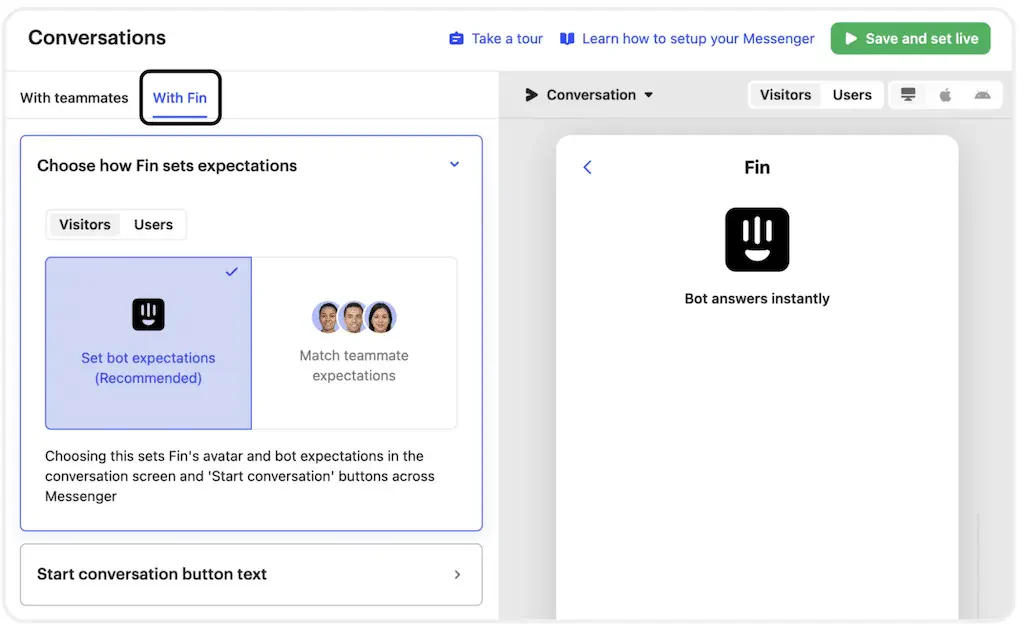
Intercom Fin is a GPT-4-powered support agent built into Intercom's customer communication platform. It draws answers from your knowledge base, help articles, and uploaded documentation to resolve support tickets automatically and hands off to a human agent with appropriate context when it cannot answer reliably.
Fin is mature, well-tested, and integrates naturally with Intercom's CRM and ticketing features. It performs best for SaaS and technology businesses with large, well-maintained knowledge bases and high incoming support volumes.
Best for: SaaS companies and technology businesses with established Intercom environments and high support ticket volumes.
Price range: Intercom base plans start from approximately $74 per seat per month. Fin is charged at approximately $0.99 per resolved conversation on top of the base plan.
3. Zendesk AI
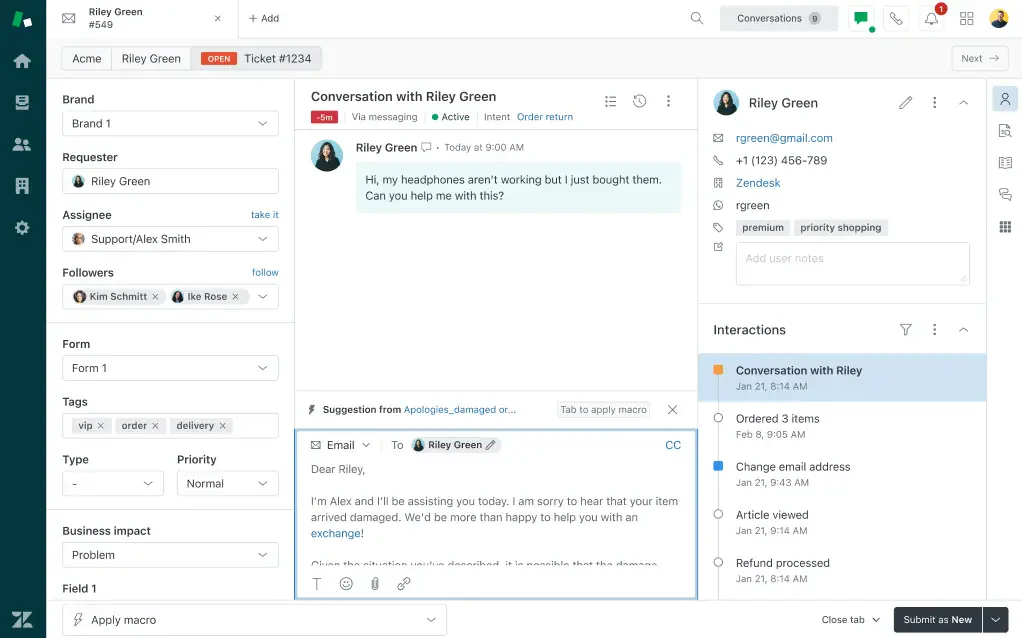
Zendesk's AI suite includes intelligent triage, automated reply suggestions for human agents, and a customer-facing Answer Bot for first-contact resolution. All components sit within the Zendesk ticketing platform, making them the natural choice for businesses that already operate Zendesk for customer support.
The AI handles intent detection, sentiment analysis, and first-contact resolution for common queries. Businesses exploring Zendesk competitors can compare other platforms based on their AI capabilities and support needs. Human agents benefit from suggested responses and contextual article recommendations, which reduces handling time even on escalated tickets.
Human agents benefit from suggested responses and contextual article recommendations, which reduces handling time even on escalated tickets.
Businesses exploring Zendesk competitors can compare other platforms based on their AI capabilities and support needs
Best for: Mid-to-large businesses with existing Zendesk environments and high-volume support operations.
Price range: AI features require Suite Growth or above, starting from approximately $89 per agent per month. Enterprise tiers are priced on request.
4. Tidio
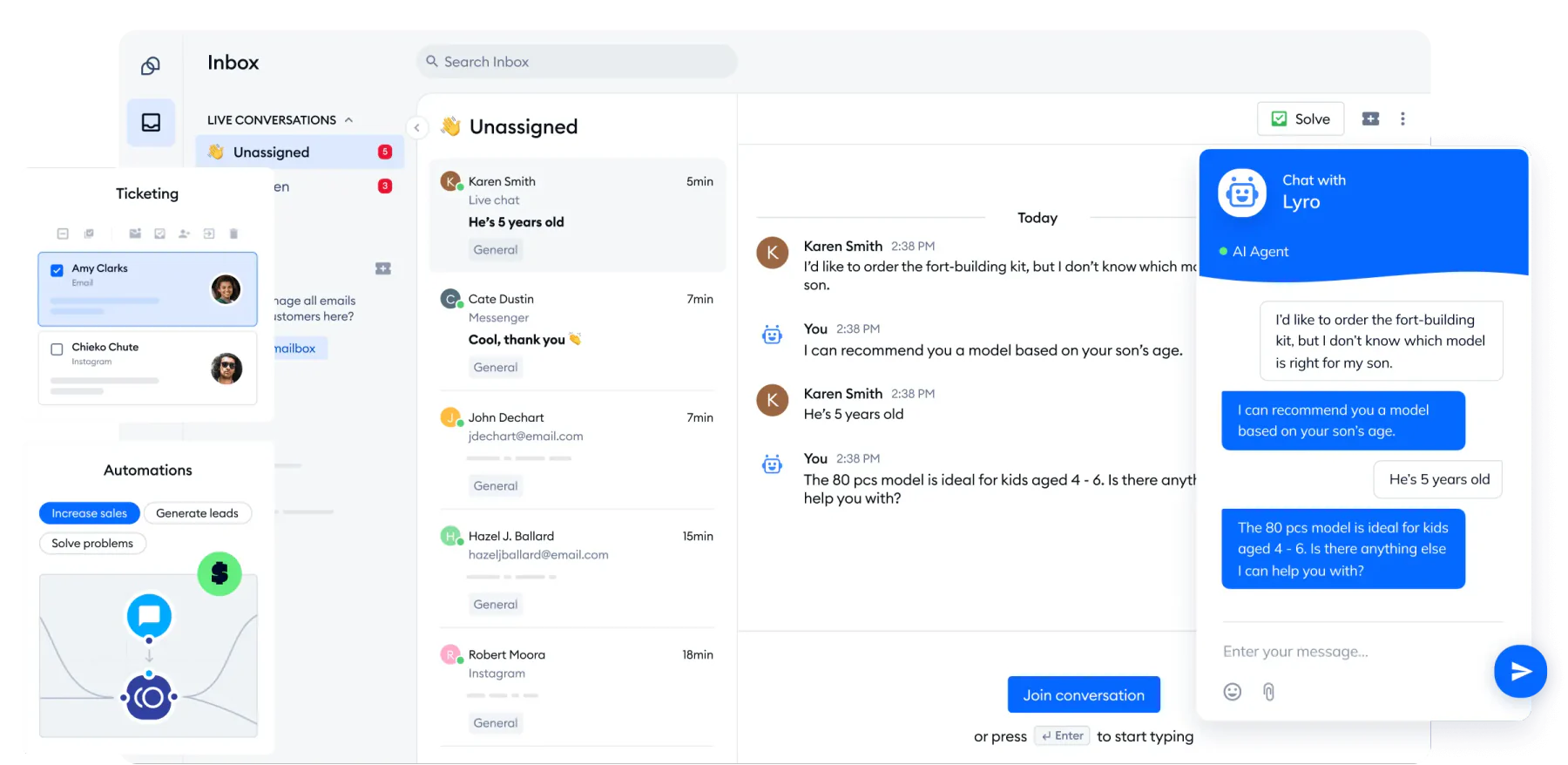
Tidio is a small-to-mid-business-focused live chat and chatbot platform with an AI component called Lyro. It is straightforward to deploy and works well for e-commerce businesses that want to add conversational support and sales assistance to their website without a large technical investment.
Lyro handles basic support queries, recommends products, and captures lead information. It connects with Shopify, WooCommerce, and major email marketing tools, making it a practical starting point for online retailers.
Best for: Small to mid-size e-commerce and retail businesses looking for a quick and accessible chatbot solution.
Price range: A free plan is available with limited conversations. Lyro AI starts from approximately $29 per month; higher tiers unlock more conversations and channels.
5. Manychat
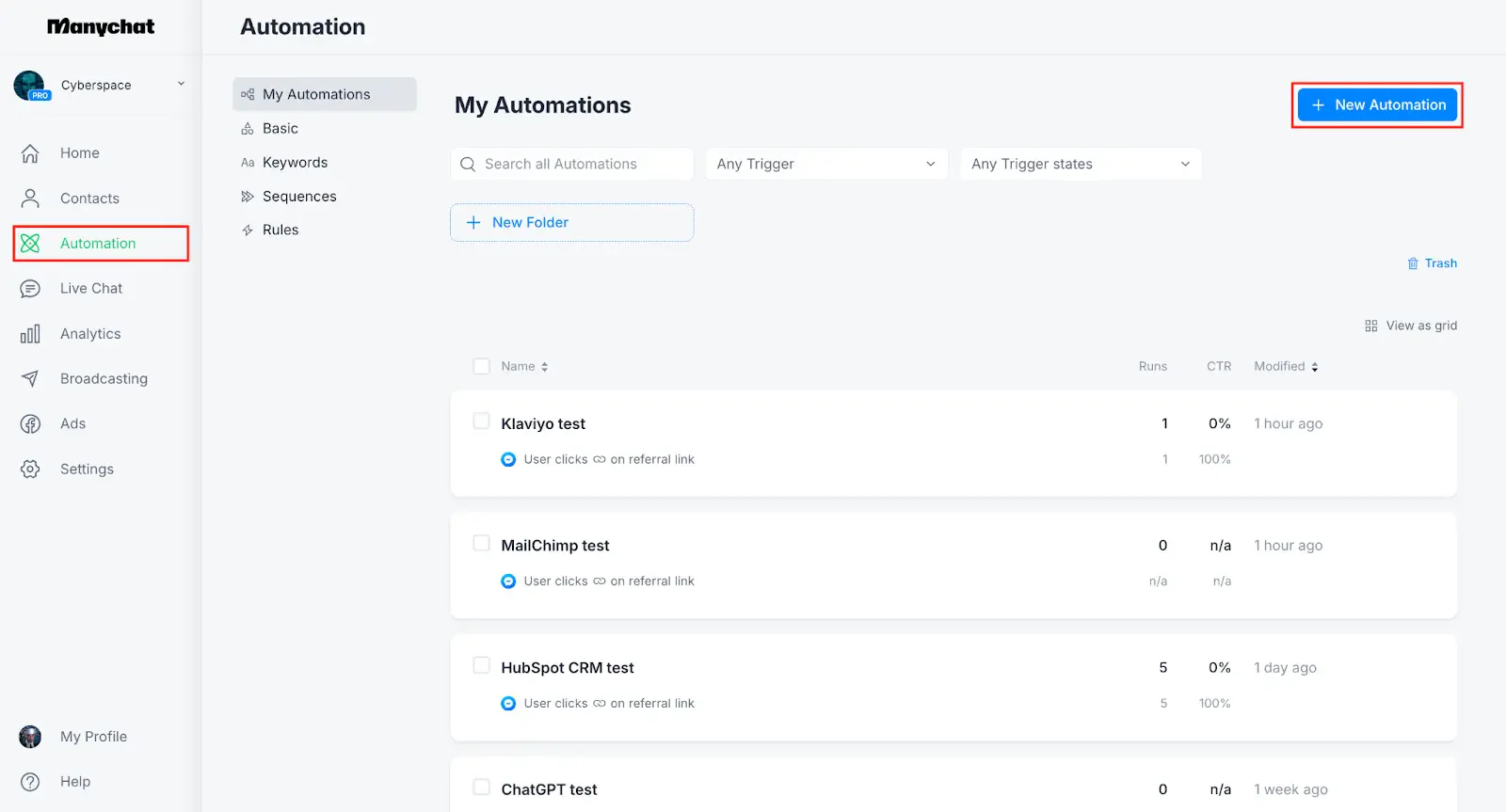
Manychat is a marketing automation platform that operates primarily through Meta channels: Instagram DMs, Facebook Messenger, and WhatsApp. Its AI features focus on automated conversation flows that respond to comments, capture leads, and guide users towards purchases or bookings through social media touchpoints.
For businesses that rely on social media for customer acquisition, Manychat automates high volumes of first-touch interactions and connects with Shopify, Stripe, and leading CRM tools for a social-to-sale workflow.
Best for: Businesses running high-volume social media marketing, particularly in retail, hospitality, and personal services.
Price range: A free plan covers basic flows. The Pro plan starts from approximately $15 per month and scales by contact tier.
6. Landbot
Landbot is a no-code chatbot builder focused on creating highly customised conversational experiences through a visual flow editor. It supports website embeds, WhatsApp, and API connections. Its AI features help handle intent-based deviations from the predefined flow without breaking the conversation.
Landbot suits businesses that need precise control over the conversation design for specific workflows such as survey collection, client onboarding, or multi-step lead qualification with conditional logic.
Best for: Businesses requiring highly controlled, custom-designed conversation flows for specific operational processes.
Price range: The Starter plan begins at approximately $40 per month. The Business plan is approximately $240 per month and unlocks WhatsApp and advanced integrations.
7. Heyy
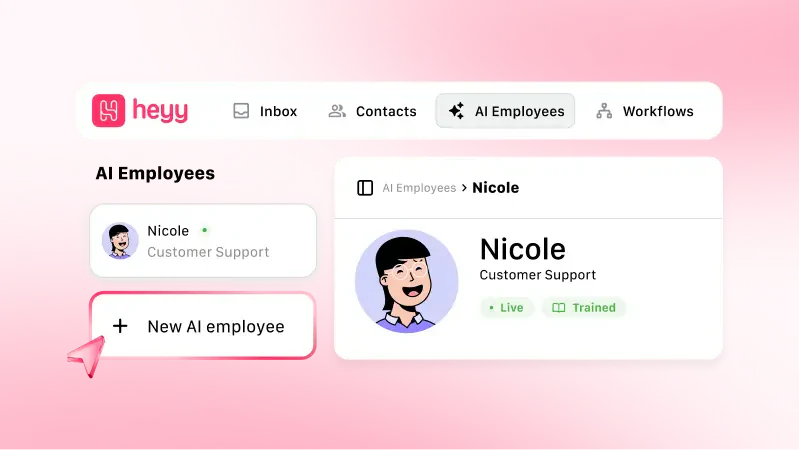
Heyy is an Australian-built conversational AI platform designed specifically for appointment-driven businesses such as medical practices, allied health providers, and professional services firms. It focuses on booking automation, client communication, and follow-up sequences aligned with Australian healthcare and professional services workflows.
As a locally built product, Heyy integrates with practice management and booking software commonly used in the Australian market, which reduces implementation friction considerably for its target users.
Best for: Australian healthcare providers, allied health practices, and appointment-driven professional services businesses.
Price range: Practice-based pricing; not publicly listed. Pricing is available on request and varies by practice size and booking volume.
8. Chatbot.com
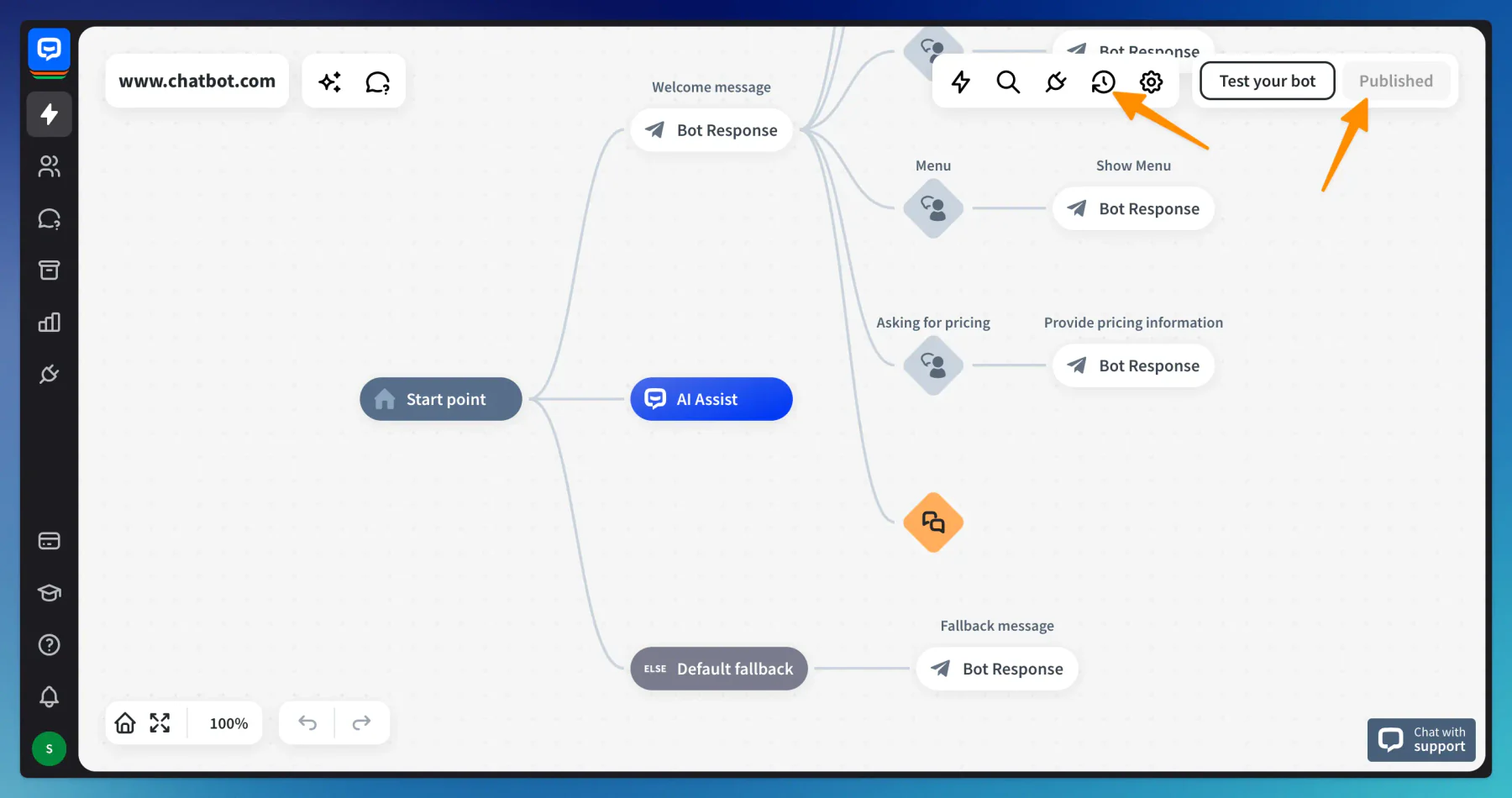
Chatbot.com is a standalone chatbot builder that allows businesses to create AI-powered bots for websites, Facebook Messenger, and Slack without writing code. Its AI engine learns from uploaded content and handles a range of support and lead generation tasks across multiple channels.
The platform is relatively quick to deploy and connects with CRM and helpdesk tools. It suits businesses looking for a versatile, general-purpose bot without committing to a larger enterprise platform or a specific vendor ecosystem.
Best for: Small to mid-size businesses wanting a flexible standalone bot for website support and lead capture.
Price range: The Starter plan begins at approximately $65 per month. The Team plan is approximately $169 per month and covers additional chat volumes and integrations.
Full Platform Comparison
How to Choose the Right AI Chatbot for Your Australian Business
Selecting the right chatbot depends on where you need the most impact, what systems you currently run, and how much internal capacity you have for setup and ongoing management. The five questions below provide a practical framework for narrowing the field before you request a demo or trial.
What is your primary use case? Define whether your priority is support deflection, lead capture, appointment booking, or internal operational queries before comparing platforms. Tools like Intercom Fin and Zendesk AI are built for support; Manychat targets social lead generation; Hashy OS addresses both internal ERP queries and customer-facing automation within a single platform.
What does your existing tech stack look like? A chatbot that does not connect to your CRM, ERP, or support platform will produce incomplete answers for both customers and staff. Prioritise tools with native integrations for your current systems rather than those that require custom API development.
How complex are your typical queries? Businesses with large knowledge bases and nuanced, multi-part queries need a more capable AI engine. A bot designed for simple FAQ deflection will not handle complex product, compliance, or operational questions reliably at scale.
Do you need Australian-specific compliance support? Any chatbot collecting personal data from Australian customers creates obligations under the Privacy Act 1988. Confirm whether your vendor offers data residency aligned with Australian requirements, consent management tools, and a documented breach response process.
What pricing model suits your volume? Per-resolution pricing models become unpredictable at high enquiry volumes. Flat-rate or per-seat models offer more predictable costs for businesses with variable or seasonal demand patterns. Build your cost model against realistic monthly conversation volumes before committing.
AI Chatbot Compliance in Australia, What You Must Know

Deploying a chatbot that collects, processes, or stores customer data in Australia creates legal obligations that differ from many other markets. Two pieces of legislation are directly relevant for most Australian businesses.
Privacy Act 1988 and Customer Data
The Privacy Act 1988 governs how Australian businesses handle personal information. When a chatbot collects names, email addresses, phone numbers, or any other identifying data from users, your business becomes responsible for how that information is stored, used, and protected throughout its lifecycle.
You must inform users that their data is being collected, explain its purpose, and obtain consent where required. Data must not be retained beyond what is necessary for the stated purpose, and users hold the right to request access or correction at any time. From a deployment perspective, your conversation script must include clear disclosure language at the point of data collection.
Vendors hosting conversation logs on overseas servers create additional considerations. The Privacy Act covers cross-border data flows, and your business remains responsible for how third-party vendors handle Australian user data. Request your vendor's data processing agreement before signing, and confirm whether Australian data residency is available if that matters to your risk profile.
Spam Act 2003 and Automated Follow-Ups
The Spam Act 2003 applies when a chatbot triggers automated follow-up messages via email, SMS, or messaging apps. Sending a commercial message to a contact who has not explicitly opted in constitutes a breach, and penalties for commercial operators are significant.
For chatbots that capture lead contact details and trigger nurture sequences automatically, the user must have clearly opted in to receive future messages before the sequence begins. This requirement applies whether the follow-up message is generated by AI or written by a human.
Businesses using Manychat or similar tools for Meta channel automations should also review Meta's own messaging policies. These include restrictions on the frequency and timing of automated messages sent to users who have not actively initiated a conversation within the relevant window.
What Results Can Australian Businesses Expect from AI Chatbots?
Results from AI chatbot deployments vary based on use case, implementation quality, and the completeness of the knowledge base provided. However, consistent patterns emerge across both Australian and global deployments at the SMB and mid-market level.
Customer support teams typically achieve ticket deflection rates of 40% to 70% within the first six months of deploying a well-configured chatbot. This directly reduces the cost per resolved enquiry and shortens average handling time on escalated cases, freeing agents for higher-value interactions.
Lead generation chatbots on high-traffic pages tend to produce higher completion rates than static forms, because the conversational format guides users through qualification questions more naturally. Businesses in finance, insurance, and B2B services have reported conversion rate improvements of 20% to 40% when replacing static forms with a guided chatbot flow at the same page position.
For internal operations, the gains come from time saved on routine data retrieval and process execution. Businesses running Hashy OS within HashMicro's ERP report faster procurement cycles and fewer manual escalations on standard operational queries, as staff access live data through natural conversation rather than navigating multiple system screens.
Response time is the metric with the most direct effect on customer satisfaction. AI chatbots respond within seconds regardless of queue depth or time of day, and that consistency shows up measurably in post-interaction satisfaction scores across support, booking, and lead capture deployments.
How to Implement an AI Chatbot in Your Business
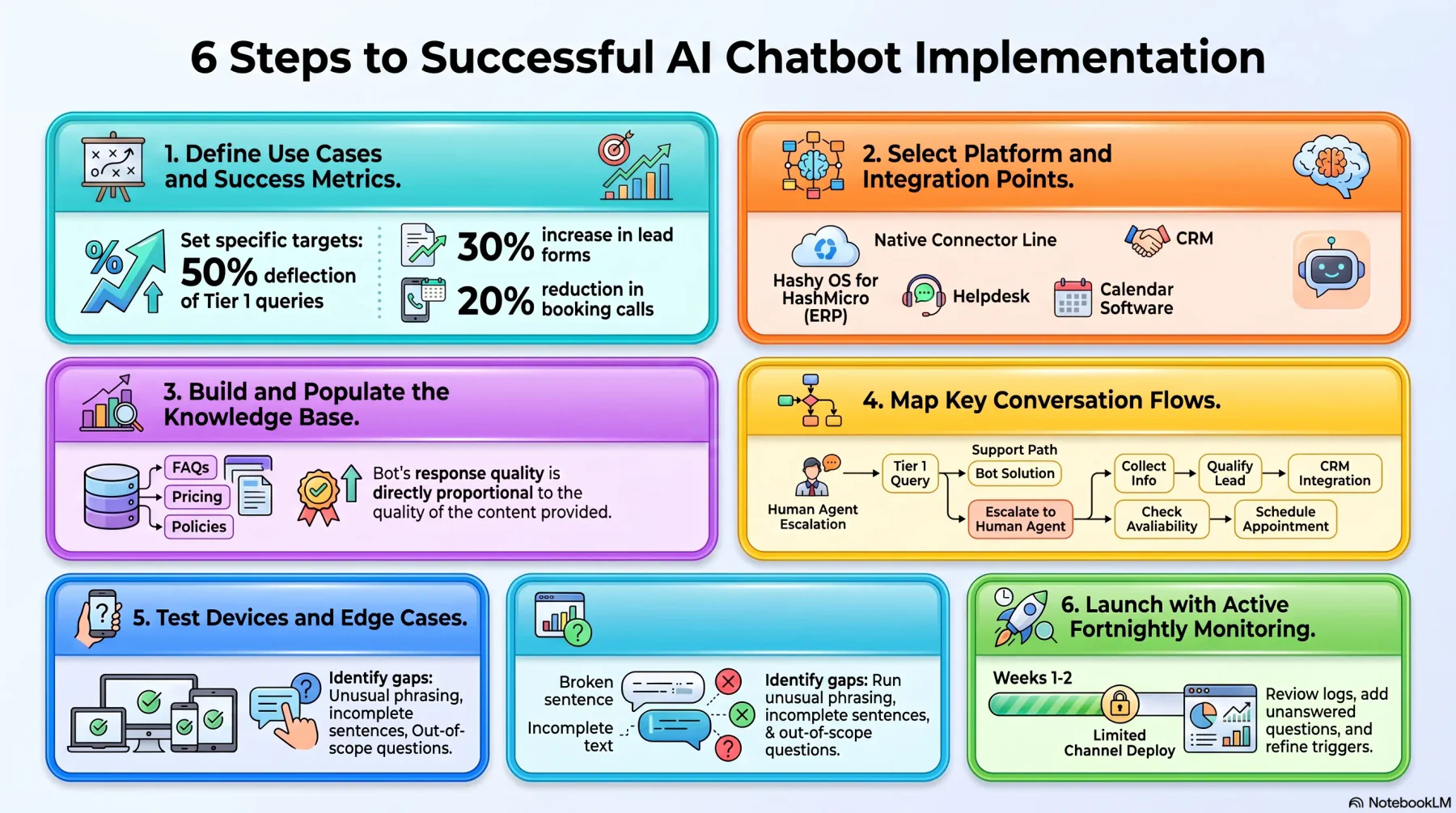
A structured implementation approach consistently produces better outcomes than a rapid deployment without defined targets or a tested knowledge base. The following steps apply to most business chatbot tools, regardless of the platform you choose.
1. Define your use case and success metrics
Before selecting a tool, decide what the chatbot should achieve and set specific, measurable targets. Examples include a 50% deflection rate on Tier 1 support queries, a 30% increase in lead form completions, or a 20% reduction in booking-related phone calls. Without defined targets, evaluating performance after launch becomes difficult.
2. Select your platform and confirm integration points
Choose a chatbot tool that connects directly with the systems your team already uses. For businesses using HashMicro’s ERP, Hashy OS offers the most seamless path because the integration is native. For other platforms, confirm that native connectors are available for your CRM system, helpdesk, and calendar software before committing to a contract.
3. Build and populate the knowledge base
Upload the content the bot needs to answer questions accurately: help documentation, product information, FAQs, pricing guides, and relevant policy documents. The quality of the bot's responses is directly proportional to the quality and completeness of the content provided at this stage.
4. Design and map key conversation flows
Map out the primary journeys users will follow: a support query path, a lead capture flow, a booking flow. Define the conditions that trigger escalation to a human agent, and test each path manually before going live.
5. Test across devices and edge cases
Run the chatbot through a range of real queries, including unusual phrasing, incomplete sentences, and questions outside its trained scope. Identify gaps in the knowledge base and refine escalation logic based on what the testing reveals.
6. Launch with active monitoring in the first fortnight
Deploy the chatbot on a limited channel or page first and review conversation logs closely during the first two weeks. Identify high-frequency unanswered questions, add them to the knowledge base, and refine escalation triggers before expanding to additional channels.
Conclusion
AI chatbots are now practical tools for customer support, lead qualification, bookings and internal assistance. The right choice depends on data access, workflow fit and compliance controls.
For HashMicro ERP users, Hashy AI Coworkers go beyond conversation. They use live business data to complete governed tasks across finance, HR and sales. Book a free consultation to see how Hashy AI Coworkers can support your operations.
Frequently Asked Questions
The best AI chatbot for small business in Australia depends on your use case. For e-commerce businesses, Tidio is a quick and accessible starting point. For businesses already running HashMicro's ERP, Hashy OS delivers both customer-facing and internal AI capability within a single platform and subscription, without a separate tool or additional fee.
AI chatbot pricing varies significantly by platform. Standalone tools like Tidio and Chatbot.com start from around $30 to $100 per month. Intercom Fin uses per-resolution pricing at approximately $0.99 per resolved conversation. Hashy OS by HashMicro is included within the HashMicro ERP subscription. Budget for knowledge base development and integration time in addition to the platform fee when calculating total cost.
Yes. Any AI chatbot that collects personal information from Australian users must comply with the Privacy Act 1988. This includes obligations around disclosure, consent, data minimisation, and breach notification. Your business remains responsible for how your chatbot vendor stores and processes Australian user data, including any cross-border data transfers.
Yes. Most leading AI chatbot platforms support integration with CRM and ERP systems, though the depth of those integrations varies. Hashy OS by HashMicro is natively integrated with the HashMicro ERP, providing live data access without custom development. Tools such as Intercom, Zendesk, and Chatbot.com connect with major CRM platforms through native connectors or automation middleware.
A live chat tool connects a customer directly with a human agent in real time. An AI chatbot handles conversations automatically using artificial intelligence, without a human agent present unless escalation is triggered. Many modern platforms combine both: the AI handles first contact and routes to a human agent when the query requires it.
Most cloud-based AI chatbots can be deployed in one to four weeks for a basic configuration. The timeline depends on integration complexity, knowledge base size, and how thoroughly you test conversation flows before going live. ERP-integrated tools like Hashy OS have shorter setup times for businesses already on the HashMicro platform, as data connections are pre-built.