






Businesses need a pricing method that covers costs, generates profit, and is simple enough to apply consistently across products, services, and contract-based work.
Cost plus pricing sets the selling price by adding a fixed markup to the total cost of a product or service. The result is a price floor that ensures every sale contributes to covering costs and generating profit.
It applies across manufacturing, construction, retail, wholesale, and professional services. This method works wherever costs are trackable and maintaining a consistent margin per unit or project is the priority.
Key Takeaways
Cost plus pricing calculates total costs before adding a percentage markup to establish the selling price.
The cost plus pricing formula sets a reliable price floor when direct and indirect costs are recorded accurately.
Markup and margin measure different values, so businesses must convert between them to protect expected profitability.
Combining cost plus with market insights helps businesses protect costs while considering competition and customer value.
What Is Cost Plus Pricing?
Cost plus pricing calculates total costs, then adds a percentage markup for profit. The markup also covers the desired margin and overhead allocated to each unit.
It is widely used because it is simple to calculate, easy to explain, and transparent for contract work. When costs are accurate, every sale helps cover costs and generate profit.
In Australia, cost plus is common across manufacturing, construction, wholesale, retail, and professional services. Australian Government and Business Queensland pricing guidance support it for setting a reliable margin floor.
The Cost Plus Pricing Formula
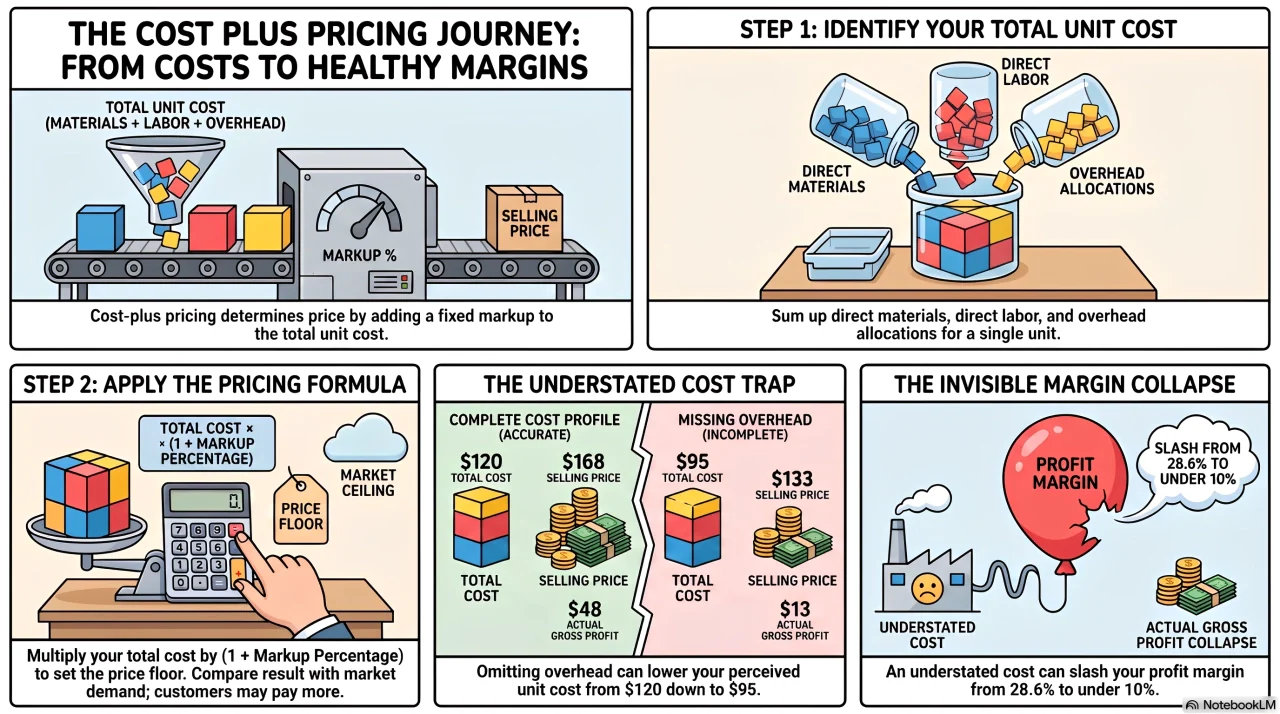
Cost plus pricing has two components: total cost and markup percentage. Both must be accurate, or the final price may undersell the product and reduce the expected margin.
Formula:
Selling Price = Total Cost + (Total Cost × Markup Percentage)
Simplified formula:
Selling Price = Total Cost × (1 + Markup Percentage)
Total cost includes direct and indirect expenses. Accurate cost accounting helps allocate them correctly, while missing any category can reduce the actual margin.
The formula sets a price floor, not a ceiling. Businesses should still compare the result with market demand, as customers may be willing to pay more.
Worked example: Melbourne manufacturer produces a component with these costs:
- Raw materials: $60
- Direct labour: $35
- Overhead allocation: $25
- Total cost: $120
Applying a 40% markup: $120 × (1 + 0.40) = $168
Selling price: $168
This price generates $48 in gross profit per unit. What if the overhead allocation is missed?
- Understated cost: $95
- Price at 40% markup: $133
- Actual gross profit: $13 instead of $48
Missing one cost category reduces the effective margin from 28.6% to under 10%, without the business realising it.
Markup vs Margin: Why the Difference Matters
Markup and margin are both percentages, but they measure different values. Confusing them is a common pricing mistake among small and mid-sized Australian businesses.
Markup formula:
Markup % = (Selling Price − Cost) ÷ Cost × 100
Margin formula:
Margin % = (Selling Price − Cost) ÷ Selling Price × 100
Worked example:
- Cost: $100
- Selling Price: $150
- Markup: ($150 − $100) ÷ $100 × 100 = 50%
- Margin: ($150 − $100) ÷ $150 × 100 = 33.3%
Conversion formulas:
- Markup to Margin: Margin = Markup ÷ (1 + Markup)
- Margin to Markup: Markup = Margin ÷ (1 − Margin)
A business targeting a 40% margin but applying a 40% markup earns only a 28.6% margin. Across a full year, this gap can create a major profit shortfall that may only appear in annual reporting.
The ATO small business benchmarks use gross margin, not markup. Without conversion, businesses may struggle to compare results with industry peers or meet lender reporting requirements.
"Cost plus pricing protects profit only when every cost is captured and the markup produces the intended margin."
Cost Plus Pricing Examples by Industry
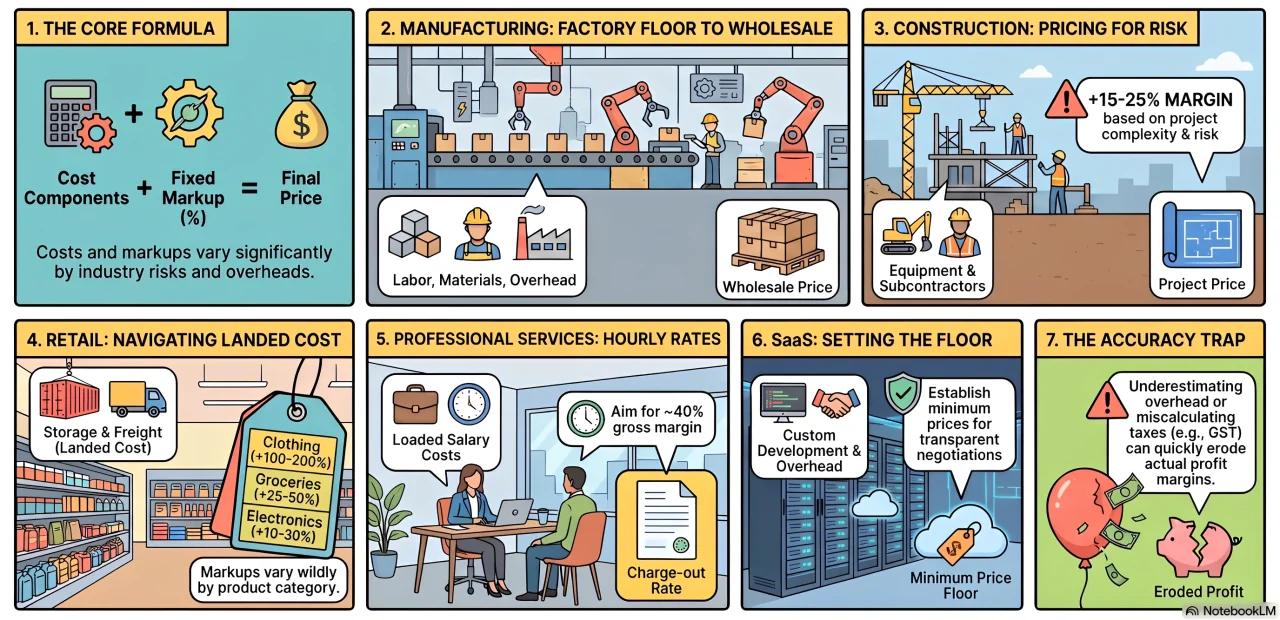
The formula stays the same across industries, but what goes into total cost and what markup percentage is appropriate varies significantly by sector.
1. Manufacturing
In manufacturing, total cost usually includes raw materials, direct labour, factory overhead, and allocated admin expenses. Markup often ranges from 20 to 50%, depending on the product, volume, and competition.
For a food manufacturer producing an item that costs $4.50 per unit, a 40% markup gives a wholesale price of $6.30. However, underestimated factory overhead will reduce the actual margin.
2. Construction and trade
Construction cost plus pricing covers labour, materials, equipment, and subcontractors. Reliable job costing helps businesses assign these expenses to each project before adding a margin based on its risk and complexity.
The chosen cost base affects the final price. A 20% markup on $80,000 in direct costs gives a project price of $96,000, while applying it to a $100,000 total that includes overhead produces a different result.
3. Retail and wholesale
Retailers and wholesalers use purchase price, freight, storage, and handling to calculate landed cost before applying a markup to the full cost base.
Businesses must decide whether GST is part of the cost base. Applying markup to a GST-inclusive cost, then adding GST again at sale, can cause margin and compliance errors.
4. Professional services
Service businesses calculate their hourly cost using salary, on-costs, superannuation, and allocated overhead. They then add a markup to determine the charge-out rate, following guidance from the Australian Government.
An accountant with a fully loaded hourly cost of $60 and a 67% markup would charge $100 per hour. This produces a 40% gross margin, showing why businesses should convert markup to margin before setting rates.
5. SaaS and software
Cost plus pricing is less common for pure SaaS products because serving another customer often adds little direct cost. Value-based pricing may therefore capture the product’s commercial value more accurately.
However, cost plus remains useful for custom software and project-based development. When hours and costs are trackable, it provides a clear minimum price and a transparent basis for client negotiations.
Advantages of Cost Plus Pricing
Cost plus pricing remains popular because it helps each sale cover costs and generate profit without complex market analysis.
- Simple and consistent. Once total cost is known, a standard markup takes minutes to apply across product lines.
- Supports cost recovery. Accurate costs and markup help prevent losses on each sale, improving cash flow predictability.
- Easy to justify. A clear audit trail helps clients and procurement teams verify contract prices, reducing disputes.
- Scales with volume. As variable costs rise with output, the markup adjusts the price floor without constant repricing.
- Sets a useful baseline. It establishes the minimum viable price before testing whether the market supports a higher price.
Disadvantages and Limitations of Cost Plus Pricing
Cost plus pricing is useful, but its limits can affect demand, competitiveness, and profit. Knowing them helps businesses decide when to adjust or change methods.
- Ignores market demand. A $50 markup may work at $150 but fail at $200, while some customers may pay $250. Cost plus does not show willingness to pay.
- Depends on accurate costs. Incomplete or outdated records can distort prices. An integrated accounting system keeps costs and margins current.
- Ignores competitor pricing. Businesses with higher costs may set prices above the market without realising it.
- May weaken premium value. A standard markup can price premium products too low, signalling lower quality to customers.
- Does not follow demand changes. It misses chances to charge more when demand rises or lower prices to support sales when demand falls.
Cost Plus Pricing vs Pricing Strategies
Cost plus is rarely the only pricing method a business needs. Comparing it with other approaches shows when to use it alone or combine it with another method.
1. Cost Plus vs Value-Based Pricing
Cost plus starts with internal costs, while value-based pricing starts with what customers will pay. Cost plus suits commodity products with predictable costs and little differentiation.
Value-based pricing can earn more margin on differentiated products, outcome-based services, or markets where price signals quality. Cost plus alone may limit revenue.
2. Cost Plus vs Competitive Pricing
Competitive pricing follows market rates rather than internal costs. It suits comparable products or markets where businesses must meet price expectations.
However, matching a lower-cost competitor may push prices below the cost plus floor. Without a clear cost base, competitive pricing can reduce margins over time.
3. When to Combine Approaches
Use cost plus to set the price floor, then compare it with market rates and customer value. A lower price leaves room to charge more, while a higher price may signal costs need review.
This hybrid approach follows Australian Government guidance for SMEs: start with cost data, then consider what the market will pay before setting the final price.
Conclusion
Cost plus pricing provides a reliable margin floor when costs are known and stable. However, businesses must understand the difference between markup and margin to achieve their intended profit.
Integrated procurement and accounting systems can connect accurate cost data with pricing decisions. Explore a free consultation to strengthen cost control and pricing accuracy.
Frequently Asked Questions About Cost Plus Pricing
Businesses should review cost plus prices whenever material, labour, freight, or overhead costs change. Regular monthly or quarterly reviews can also prevent outdated costs from reducing margins.
Yes, but the cost base must be updated regularly. Businesses with volatile supplier prices may need current purchase data or rolling average costs before applying markup.
Businesses should check that a discounted price remains above the cost plus floor. Otherwise, the discount may reduce the intended margin or create a loss.
Yes, although limited cost history can make estimates less reliable. New businesses should use supplier quotes, labour forecasts, overhead budgets, and regular reviews until actual cost data becomes available.
Useful records include supplier invoices, freight charges, payroll costs, overhead allocations, project timesheets, and historical cost reports. These records support pricing reviews and provide an audit trail.