










 Limited to 100 registrants

Bad debt occurs when a customer owes money that a business no longer expects to collect. Unpaid invoices can reduce profit, restrict cash flow, and create additional recovery and accounting work.
Australian businesses can limit these losses through stronger credit checks, clear payment terms, regular accounts receivable reviews, and timely collection activity. This guide explains how bad debts arise, how businesses record them, and when an income tax or GST adjustment may apply.
Key Takeaways
A bad debt is an amount a business no longer expects to collect after making reasonable recovery attempts.
Writing off an unpaid balance reduces accounts receivable and records the loss as a bad debt expense.
A bad debt deduction may apply when the debt meets the relevant income, write-off, timing, and record-keeping requirements.
Credit checks, clear payment terms, invoice reminders, credit limits, and regular receivables reviews can reduce unpaid accounts.
What Are Bad Debts?

Bad debts are amounts that customers owe but a business no longer expects to recover. They usually arise from credit sales where a company supplies goods or services before receiving payment.
An overdue invoice does not automatically become bad debt. The business should assess the customer's circumstances, previous collection attempts, available security, and realistic chance of recovery.
A debt may become bad when the customer enters insolvency, cannot be located, disputes the liability without a practical resolution, or has no assets available for collection. The business should document why continued recovery would probably fail or cost more than the amount owed.
Bad Debt vs Doubtful Debt vs Bad Debtor
These terms describe different parts of the credit and collection process. Understanding the distinction helps businesses apply the correct accounting treatment and collection response.
Common Causes of Bad Debts in Business
Bad debts rarely result from one issue alone. The following causes often combine until an overdue balance becomes difficult to recover.
Late or unpaid invoices
Customers may overlook invoices, delay approval, or prioritise other payments. An invoice becomes harder to collect when the business waits too long before following up.
A consistent collection schedule helps prevent routine lateness from becoming a serious default. Therefore, businesses should contact customers shortly after an invoice passes its due date.
Poor credit control
Offering credit without checking the customer's payment capacity exposes the business to avoidable risk. Weak approval rules can also allow customers to place new orders while earlier invoices remain overdue.
A documented credit policy should define limits, approval authority, payment terms, and escalation triggers. This structure helps sales and finance teams make consistent decisions.
Customer cash flow problems
A customer may experience declining sales, delayed funding, unexpected costs, or seasonal pressure. These problems can affect an otherwise reliable customer's ability to pay on time.
Early communication may support a workable payment plan. However, the business should avoid extending more credit without reviewing the customer's current financial position.
Invoice disputes or errors
Incorrect prices, purchase order details, quantities, tax calculations, or delivery information can delay payment. Customers may also withhold the full balance while disputing only one item.
Businesses should resolve invoice errors quickly and separate undisputed amounts where possible. Accurate documentation reduces delays and provides stronger evidence if recovery action becomes necessary.
Weak accounts receivable monitoring
A business may miss collection risks when it does not regularly review ageing reports. Overdue invoices can remain unnoticed until the customer has accumulated a significant balance.
Weekly accounts receivable monitoring helps finance teams identify worsening payment behaviour. As a result, managers can intervene before the exposure becomes difficult to control.
Examples of Bad Debts
Bad debt scenarios vary by customer, contract, and recovery cost. The examples below show when an unpaid amount may move from overdue to irrecoverable.
Customer Does Not Pay an Invoice
A consulting firm completes a project and issues a $12,000 invoice on 30-day terms. The customer ignores reminders, does not respond to a formal demand, and cannot be located at its registered address.
The firm may classify the balance as bad after documenting its recovery attempts and concluding that further action is unlikely to succeed.
Customer Becomes Insolvent
A wholesaler supplies stock on credit before the customer enters liquidation. The appointed liquidator advises unsecured creditors that available assets will not cover their claims.
The wholesaler may write off the unrecoverable balance once it has sufficient evidence of the likely loss. Any later distribution should be recorded as a recovery.
Small Debt Is Not Commercially Worth Recovering
A customer owes $180, but formal collection would cost more than the outstanding balance. The business may decide that continued recovery is not commercially reasonable.
The decision should still follow the company's approval policy. A small amount does not remove the need for clear records and consistent treatment.
How Bad Debts Affect Accounting and Cash Flow
Bad debts reduce the value of accounts receivable and may create an expense in the income statement, affecting financial reporting. This lowers reported profit because revenue previously recognised will not produce the expected economic benefit.
The cash flow effect can be more immediate. A business may have already paid wages, suppliers, freight, or tax connected with a sale without receiving the customer payment.
Repeated defaults can also distort sales performance. Revenue may appear healthy while cash collections weaken, which makes accounts receivable ageing and operating cash flow essential management measures.
Bad Debt Expense and Accounting Treatment
Bad debt expense records the estimated or confirmed loss from uncollectible receivables. Businesses generally use either the direct write-off method or an allowance method, depending on their reporting obligations and accounting policy.
Under the direct write-off method, the business recognises the expense when it identifies a specific balance as irrecoverable. The usual entry debits bad debt expense and credits accounts receivable.
An allowance method estimates expected credit losses before individual invoices become irrecoverable. A business applying relevant financial reporting standards should obtain accounting advice on whether expected credit loss requirements apply.
The table below compares the two accounting approaches.
How to Write Off Bad Debts
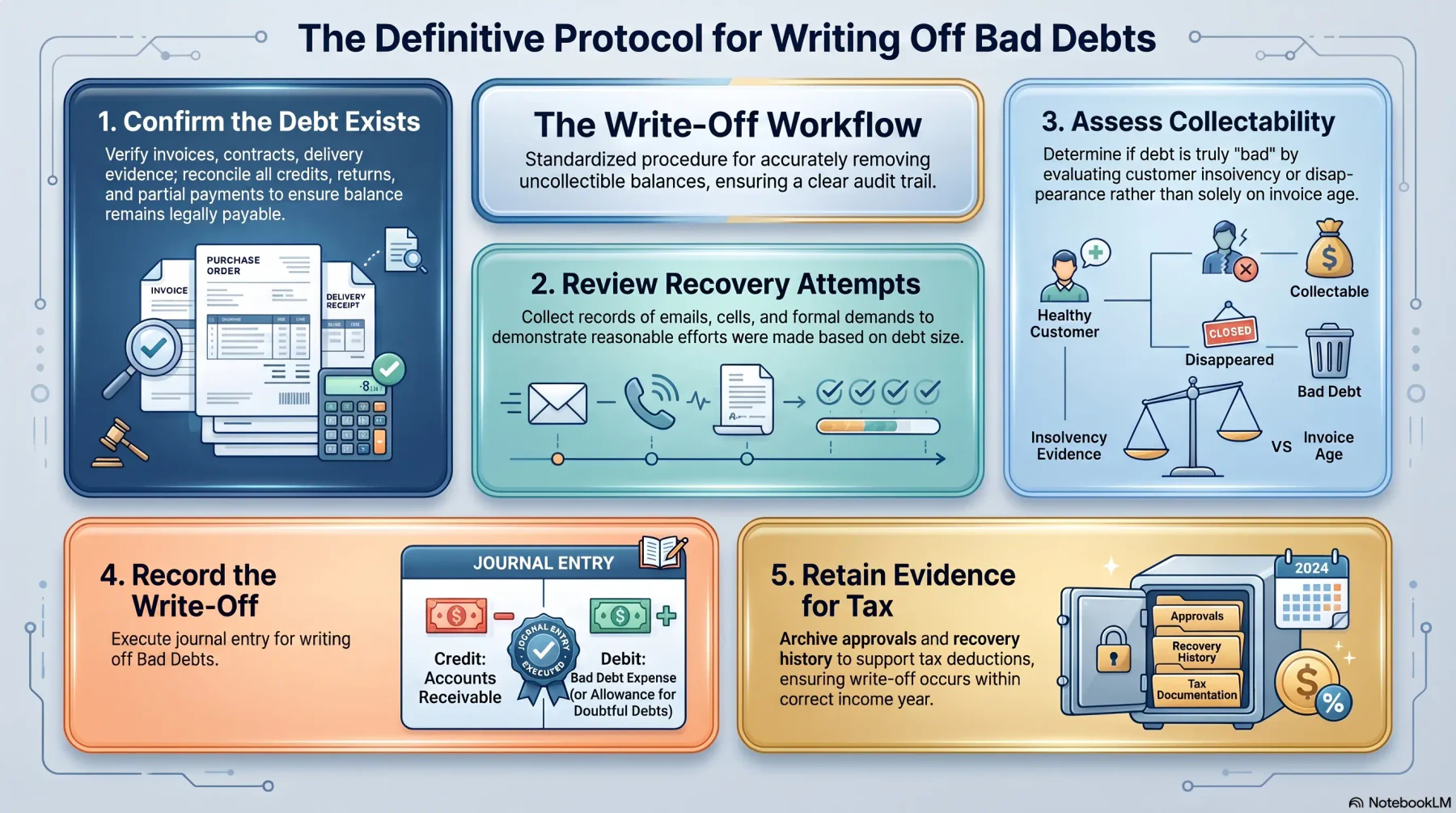
A write-off should follow a consistent process because it affects financial reporting, tax records, and customer balances. The following actions create a clearer audit trail.
1. Confirm the Debt Exists
Check the invoice, contract, delivery evidence, payment terms, customer statement, and any adjustments. The review should confirm that the amount remains legally and commercially payable.
Reconcile credits, deposits, returns, and partial payments before approving a write-off. This prevents the business from removing an incorrect balance.
2. Review Recovery Attempts
Collect copies of reminders, emails, call notes, formal demands, repayment proposals, and collection agency correspondence. These records demonstrate that the business made reasonable attempts to recover the money.
The required effort should reflect the size and circumstances of the debt. A large balance will usually justify more extensive recovery activity than a minor invoice.
3. Decide Whether the Debt Is Truly Bad
Assess whether the customer has entered insolvency, disappeared, denied liability, or demonstrated an inability to pay. The decision should rely on available evidence rather than the age of the invoice alone.
Management should also compare the likely recovery with the cost of further action. A debt can remain doubtful if a realistic collection path still exists.
4. Record the Write-Off
Record the approved journal entry against the correct customer and invoice. Under a direct write-off, debit bad debt expense and credit accounts receivable.
Where the business already maintains an allowance, debit that allowance and credit accounts receivable. The accounting treatment should follow the company’s reporting framework and advice from its accountant.
5. Keep Evidence for Reporting and Tax Purposes
Retain the approval, journal entry, customer correspondence, recovery history, and insolvency documents. These records support the financial treatment and any tax deduction claimed.
The write-off must occur during the income year in which the business seeks the deduction. A general provision for doubtful debts does not, by itself, establish that a particular debt has been written off as bad.
Bad Debt Deductions in Australia
Australian tax treatment depends on how the business recognises income, whether the debt has been written off, and how it accounts for GST. The following summary provides general guidance rather than tax advice.
Accrual basis: A business may generally deduct a debt written off as bad if the amount was included in assessable income for the current or an earlier income year. Section 25-35 of the Income Tax Assessment Act 1997 sets out this core requirement. Australian Taxation Office guidance
Cash basis: An unpaid invoice generally has not entered assessable income under cash accounting. Therefore, the business usually cannot deduct the unpaid sale as bad debt because it did not previously recognise that income.
GST and bad debts: A business accounting for GST on a non-cash basis may receive a decreasing adjustment after writing off a taxable debt or when the debt has remained overdue for at least 12 months. The ATO states that Division 21 bad debt adjustments generally do not apply to entities accounting for GST on a cash basis. ATO GST ruling GSTR 2000/2
Professional advice: Company continuity rules, related-party arrangements, debt assignments, recoveries, and partial write-offs can complicate a claim. Businesses should obtain advice from a registered tax agent or qualified accountant before claiming a material deduction.
How to Prevent Bad Debts
Prevention starts before a business offers credit and continues until payment arrives. These controls can reduce exposure without making legitimate customers unnecessarily difficult to serve.
Set clear payment terms:
State the due date, accepted payment methods, dispute process, and consequences of late payment on quotations, contracts, and invoices.
Check customer credit risk:
Review trade references, payment history, financial information, and publicly available insolvency indicators before extending significant credit.
Monitor accounts receivable ageing:
Review current, 30-day, 60-day, and 90-day balances regularly so finance teams can prioritise collection work.
Automate invoice reminders:
Schedule notices before and after each due date while giving staff a clear escalation path for unresolved accounts.
Set credit limits and approval rules:
Stop new orders or require senior approval when a customer exceeds its limit or has overdue invoices.
Review cash flow regularly:
Compare expected receipts with actual collections so management can identify emerging gaps and adjust spending or funding plans.
How Accounting Software Helps Manage Bad Debts
Accounting software gives finance teams a consistent view of invoices, collections, customer risk, and cash flow. The following capabilities help businesses manage receivables before balances become irrecoverable.
Real-Time Accounts Receivable Dashboard
A receivables dashboard groups invoices by customer, due date, status, and ageing category. Finance teams can identify overdue balances without compiling separate spreadsheets.
Managers can also compare total exposure across branches, entities, or customer groups. This improves collection priorities and credit decisions.
Automated Payment Reminders
Automated reminders send consistent notices before and after invoice due dates. Therefore, finance staff can focus on disputed or high-risk accounts instead of routine follow-up.
The system should record each reminder against the customer account. This history supports later escalation and provides evidence of recovery efforts.
Customer Credit Limit Monitoring
Credit controls compare new orders and unpaid balances against the customer's approved limit. The software can warn users or hold a transaction when exposure exceeds the allowed amount.
Approval workflows let authorised managers review exceptions. As a result, sales teams can respond quickly without bypassing financial controls.
Write-Off Approval and Audit Trail
A controlled write-off workflow records who requested, reviewed, and approved each adjustment. It can also require supporting documents before the journal entry posts.
This audit trail helps prevent unauthorised removals from accounts receivable. In addition, it gives accountants clearer evidence during tax reviews and financial audits.
Cash Flow Forecasting
Cash flow forecasts use expected receipt dates, customer payment behaviour, and open invoices to estimate future cash availability. Managers can then identify whether delayed collections may affect payroll, supplier payments, or planned spending.
Forecasts should separate expected receipts from high-risk balances. This prevents doubtful collections from creating an overly optimistic cash position.
Integrated Financial Reporting
Integrated software connects accounts receivable with the general ledger, cash flow, sales, and customer records. A write-off can then update the relevant reports without repeated manual entry.
Connected reporting also helps management compare revenue growth with collection quality. Strong sales provide limited value when receivables remain unpaid.
HashMicro Accounting Software for Bad Debt Management
Growing businesses need more than an invoice list once customer volumes, approval layers, and reporting requirements increase. HashMicro Accounting Software connects invoicing, accounts receivable, debt collection, journal entries, cash flow, and financial reports in one platform.
The system provides invoice and payment status tracking, customer statements, collection records, and automated reminders. HashMicro also integrates accounting with CRM and sales data, helping teams identify customers with unpaid or overdue invoices. Explore HashMicro Accounting Software
Hashy OS adds an AI layer to connected financial data. Finance teams can use natural-language queries to review overdue invoices, identify collection priorities, and examine cash flow information without searching through several reports.
Conclusion
Bad debt represents more than an accounting adjustment because it removes expected cash from the business. Strong credit checks, accurate invoices, timely reminders, and regular ageing reviews help reduce the likelihood of customer defaults.
Businesses should document recovery activity and apply consistent approval rules before writing off an amount. Australian income tax and GST treatment can differ according to the accounting basis, timing, and circumstances of the debt.
HashMicro connects accounts receivable, invoicing, debt collection, reporting, and Hashy OS within one financial system for growing businesses. Review the right setup for your company through a free consultation with HashMicro.
Frequently Asked Questions
A bad debt is an amount owed to a business that it no longer expects to collect. This may happen when a customer becomes insolvent, cannot pay, or remains unresponsive after reasonable recovery attempts.
Businesses generally record bad debts as an expense when they determine that an outstanding amount is uncollectible. The accounting entry reduces accounts receivable and recognises the resulting loss.
A bad debt is considered uncollectible and ready to be written off. A doubtful debt may become uncollectible, but the business still has a reasonable chance of receiving payment.
A bad debtor is a customer or borrower who has not paid an amount by the agreed due date. The term refers to the party that owes the money, while bad debt refers to the unpaid amount.
Australian businesses may write off debts that have become genuinely uncollectible. A tax deduction may apply when the debt meets the relevant income, timing, and record-keeping requirements, so professional tax advice may be necessary.
Businesses can reduce bad debt risk by checking customer credit, setting clear payment terms, monitoring accounts receivable ageing, sending invoice reminders, and applying suitable credit limits.
Accounting software can track overdue invoices, automate reminders, monitor customer credit limits, support write-off approvals, and maintain an audit trail. These controls help finance teams identify payment risks earlier.