






 Limited to 100 registrants

Preventive maintenance is planned work performed before a known or suspected failure point, using a calendar date, usage reading or condition signal to trigger inspection, servicing or replacement.
Overdue work orders, repeat failures and parts missing at service time are operational data, not paperwork gaps. They show where a maintenance strategy has drifted from how assets are actually used and resourced.
This article covers the compliance rules Australian businesses carry, the main trigger types, and a six-step framework for building a plan that holds up under review.
Key Takeaways
Preventive maintenance uses planned tasks and defined triggers to control asset risk before an avoidable failure disrupts operations.
Australian businesses carry specific WHS Act and ISO 9001 obligations around plant maintenance records, not just internal best practice.
The six-step framework moves a programme from asset criticality and task design through to scheduling, execution and performance review.
Maintenance software becomes worth assessing once disconnected records make work orders, parts, approvals and reporting difficult to control.

What Does Preventive Maintenance Control in an Enterprise Operation?
Preventive maintenance is planned work performed before a known or suspected failure point, using a calendar date, usage reading or condition signal as the trigger.
The distinction that matters is task versus strategy. Replacing a filter is a task, while deciding why and who owns that decision is the strategy.
Common triggers include calendar dates, usage hours, inspection findings and manufacturer guidance, such as a coil check timed before summer at a distribution site.
| Control element | What it answers | Example evidence |
|---|---|---|
| Asset record | Which equipment is covered? | Asset ID, location, parent asset and criticality |
| Task | What must be done? | Inspect belt tension and record measurement |
| Trigger | When or why is it due? | 500 operating hours or inspection result |
| Owner | Who plans, performs and approves it? | Planner, technician, supervisor or contractor |
| Evidence | How is completion demonstrated? | Reading, photo, test result or sign-off |
| Escalation | What happens when a defect is found? | Follow-up work order or management review |
The objective isn't to maintain every asset more often. It's to move selected work out of an uncontrolled failure event and into a visible, scheduled activity.
Why Does Preventive Maintenance Matter for Asset-Intensive Businesses?
Preventive maintenance matters because it shifts selected work from an uncontrolled failure into a planned activity across manufacturing systems. The result still depends on accurate intervals and disciplined completion records.
A useful way to weigh the value is the operating-control chain. Asset risk sets task priority, priority drives resource planning, and the completed record feeds cost reporting.
| Potential benefit | Condition required to realise it |
|---|---|
| Reduced exposure to unplanned disruption | Critical assets and credible triggers identified before failure |
| Better work planning | Labour, access and shutdown windows visible early enough to coordinate |
| Improved safety visibility | Isolation notes and escalation rules recorded consistently |
| Predictable parts demand | Bills of material and stock minimums kept accurate |
| Clearer maintenance costs | Labour, parts and contractor charges assigned to the same record |
| Stronger contractor coordination | Scope, access and approval defined in advance |
There are trade-offs worth naming. A short interval creates overmaintenance, a long one can leave a real failure mode untreated, and a full schedule can look like control without enough technicians to run it.
What Compliance Obligations Apply to Preventive Maintenance in Australia?
Preventive maintenance in Australia sits inside two obligations rarely covered together: workplace safety duties, and the evidence a quality system expects.
1. WHS Act duties and maintenance records for plant
A business carries a duty to keep plant safe and properly maintained under the Work Health and Safety Act. Safe Work Australia's guidance on plant duties sets out what that covers.
Maintenance records for registered plant should show what was inspected, when, and what action followed. A regulator investigating an incident asks for the plant register, not a depreciation schedule.
2. ISO 9001:2015 Clause 7.1.3 and audit-ready documentation
Clause 7.1.3 requires a business to maintain the infrastructure its processes depend on, equipment included. ISO 9001:2015 sets no fixed frequency, but auditors expect proof it happens.
A missed task with no completion record is treated the same as a task never done. This is where evidence, approval and defect fields earn their place in the process.
Which Main Types of Preventive Maintenance Fit Your Assets?
The right type depends on an asset's failure behaviour and available data. A stable asset may suit a calendar rule, while a critical machine may need condition data or a risk assessment.
| Type | Trigger | Typical task | Limitation |
|---|---|---|---|
| Time-based | Date or elapsed period | Inspect or replace a component every set interval | May overmaintain lightly used assets |
| Usage-based | Hours, cycles or kilometres | Service after operating hours or distance | Weak readings create missed or premature work |
| Condition-based | Inspection, test or sensor result | Investigate temperature, vibration or pressure findings | Needs dependable measurement and interpretation |
| Risk-based | Criticality and consequence assessment | Apply stronger controls to higher-exposure assets | Risk ratings can become subjective or stale |
Predictive maintenance forecasts intervention from condition data, but it doesn't replace every preventive task. Basic cleaning and statutory inspection may still be required without any predictive signal.
Start with the simplest trigger that gives adequate control, then add condition data only once it actually changes a decision.
- Start from manufacturer guidance and failure history. Use the manufacturer's baseline interval, then adjust it against your own repeat-failure data.
- Adjust using run hours, duty cycle and environment. An asset running harder than the manufacturer assumed usually needs a shorter interval than the manual states.
Where Is Preventive Maintenance Used Across Australian Operations?
Two areas show the range clearly: process-heavy sites with cold chain exposure, and mobile assets spread across a wider footprint.
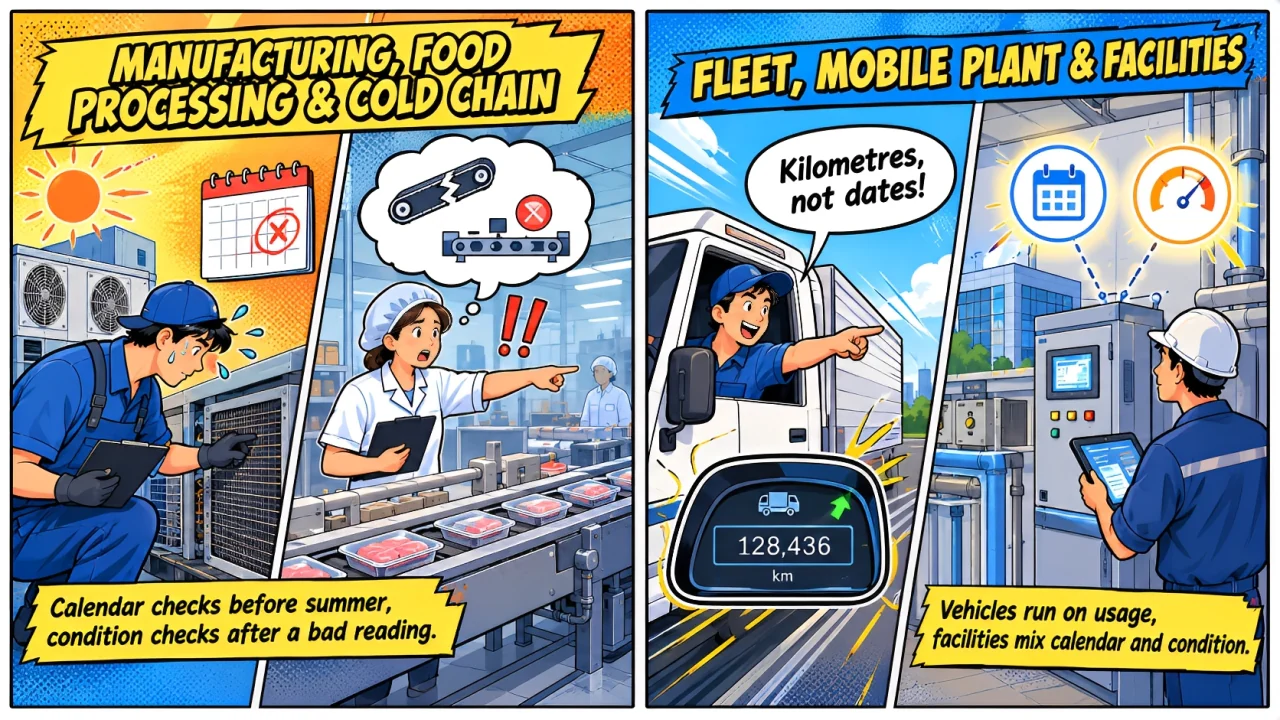
1. Manufacturing, food processing and cold chain
A refrigeration unit shows the mix well: a calendar coil check before summer, and a condition check after an abnormal reading. Food lines follow the same logic, since a belt failure halts a run.
2. Fleet, mobile plant and facilities
Vehicles and mobile plant usually run on usage-based triggers such as kilometres, since calendar dates alone say little about wear. Facilities equipment mixes calendar and condition triggers instead.
How Does Preventive Maintenance Differ from Planned, Predictive and Reactive Work?
Preventive maintenance describes the purpose of work, reducing the likelihood of failure and supporting effective asset lifecycle management. Planned is a scheduling category, predictive forecasts from condition data, and reactive happens after a fault is found.
| Category | Trigger and timing | Example |
|---|---|---|
| Preventive | Work starts before an anticipated failure point | Replace a known-wear component at a set interval |
| Planned | Work is arranged ahead, regardless of purpose | Schedule a shutdown repair after a defect is confirmed |
| Predictive | Data indicates a developing condition | Analyse vibration data before deciding on bearing work |
| Reactive | A fault has already occurred | Replace a failed motor after production stops |
The distinction matters for reporting. A work-order system should separate strategy, trigger and evidence, or a completed emergency repair can get counted as planned work.
What Belongs in a Preventive Maintenance Checklist?
A useful checklist identifies the asset, trigger, task, owner, required resources and escalation path. Without that context, a ticked box is hard to audit and tells a reviewer little.
| Checklist field | Why it matters | Example |
|---|---|---|
| Asset ID and hierarchy | Prevents work recorded against the wrong equipment | FAC-REF-014, cold-room system |
| Location | Supports access and site coordination | Wagga Wagga distribution centre |
| Criticality | Helps prioritise overdue work | High: service continuity impact |
| Task description | Gives the performer a repeatable instruction | Inspect coil, clean fins, record condition |
| Trigger and frequency | Explains when the task is due | Every 500 hours or after alarm |
| Responsible role | Clarifies ownership and approval | Refrigeration technician; site supervisor |
| Estimated labour | Supports capacity planning | Two hours, two technicians |
| Parts and tools | Reserves stock and flags lead times | Filter, gauges, isolation kit |
| Safety or isolation notes | Makes required controls visible upfront | Isolate power and refrigerant circuit |
| Completion evidence | Makes the result auditable | Reading, photo, test result, sign-off |
| Defect findings | Captures conditions needing follow-up | Corrosion found on mounting bracket |
| Escalation rule | Defines what happens past a threshold | Raise corrective work order within 24 hours |
| Approval status | Shows if work is accepted or under review | Supervisor approved; finance pending |
| Next due date | Keeps the programme moving | 15 January 2027 |
A technician needs clear instructions, a planner needs duration and parts, and finance needs the approval trail. Inventory management also helps keep required parts available. One well-designed record supports all three.
How Do You Build a Preventive Maintenance Plan in Six Steps?
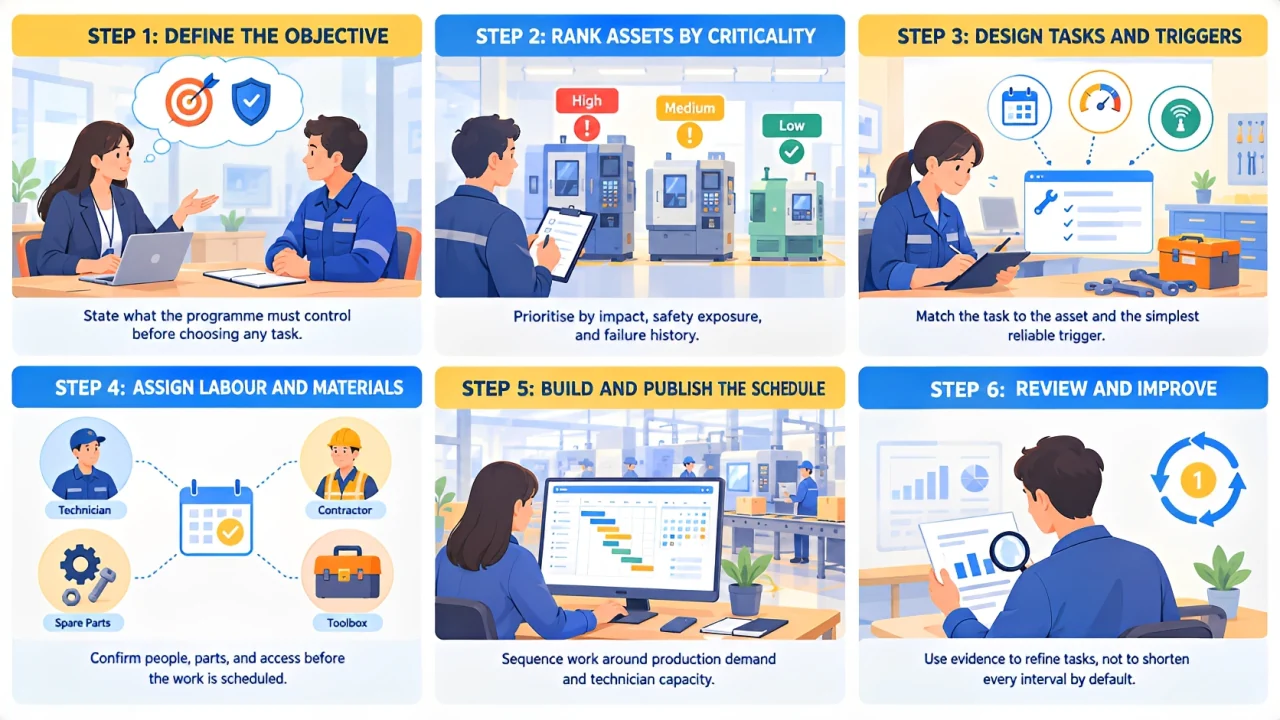
Build the programme in six stages, each producing a usable output and a decision check before the next one begins.
1. Define the operational objective
State what the programme must control, such as service continuity, safety visibility or cost allocation.
- Inputs: operating priorities, failure history and shutdown constraints.
- Owner: operations sponsor with maintenance leadership.
- Output: a short objective statement and scope boundary.
- Decision check: can the objective be measured with records you can collect?
2. Rank assets by criticality
Prioritise by operational impact, safety exposure, failure history and replacement lead time.
- Inputs: asset register, failure records and process dependencies.
- Owner: maintenance planner with operations input.
- Output: approved criticality classes and ownership.
- Decision check: would a failure change the urgency or evidence required?
3. Design repeatable tasks and triggers
Match task instructions to the asset and pick the simplest reliable trigger available.
- Inputs: manuals, inspection findings and engineering advice.
- Owner: maintenance engineer or subject-matter owner.
- Output: task library with trigger, duration, parts and escalation rules.
- Decision check: can a competent person record evidence consistently?
4. Assign labour, contractors and materials
Match each task to capability, tools and lead time before it reaches the calendar.
- Inputs: workforce capacity, contractor agreements and stock levels.
- Owner: maintenance planner with procurement support.
- Output: resource-ready work package and identified shortages.
- Decision check: are people, parts and access available for that date?
5. Build and publish the schedule
Sequence work around production demand, shutdown windows and realistic technician capacity through effective production planning.
- Inputs: due dates, priorities and site calendars.
- Owner: maintenance planner or scheduling lead.
- Output: approved schedule and issued work orders.
- Decision check: does the schedule show exceptions and reasons for change?
6. Review findings and improve the programme
Use completion evidence, defects and costs to refine tasks, without reflexively shortening every interval.
- Inputs: closed work orders, corrective work and financial postings.
- Owner: maintenance manager with finance participation.
- Output: approved changes to tasks, resources and reporting.
- Decision check: did the change improve control, or just add work?
"A maintenance schedule that only exists on paper is not a control. It is a checklist waiting for an incident to prove it wrong."
How Does Maintenance Software Support Preventive Maintenance?
A CMMS platform becomes relevant once a business can't reliably connect asset records, work orders, parts and reporting on its own.
1. Automating work orders, parts and reporting
A useful system generates recurring work orders from calendar or condition triggers, captured on a mobile device rather than paper. Parts data and cost dashboards build on that same record.
2. What to look for when evaluating a system
Start with a controlled asset register, since everything else depends on it being accurate. Confirm role-based access and migration support for messy historical data before signing anything.
For a multi-site business, also test remote connectivity and contractor access. A demonstration should run on your own sample asset, not just a polished generic scenario.
Which Preventive Maintenance Metrics Should You Track?
Measure performance with definitions your own asset data can support, then read trends alongside operating conditions using business intelligence reporting.
1. Reliability metrics: MTBF, MTTR and availability
Mean time between failures, mean time to repair and availability describe how often equipment fails and how fast it returns to service. A downtime rise during expansion doesn't always mean the task failed.
2. Programme health: PM compliance and planned vs reactive ratio
Schedule compliance, overdue work and the planned versus reactive ratio show whether the programme is actually being followed day to day. Decide upfront whether cancelled work counts toward that figure.
Implementation Risks to Resolve Before Going Live
A plan can fail for reasons unrelated to the maintenance concept itself. Common risks include incomplete asset history, unclear ownership and unrealistic workload assumptions.
Reduce those risks by piloting on a limited asset group, agreeing naming conventions, and defining who can defer or close high-priority work before rollout expands.
Change management should focus on the decisions the process improves, what's due, what's ready, what was found. Technicians adopt a workflow faster when supervisors visibly act on what's captured.
Conclusion
Preventive maintenance is a control system for deciding what work happens before failure and what evidence proves it was done. Its value depends on credible triggers and a review process that learns from findings.
For Australian businesses, compliance evidence under the WHS Act and ISO 9001 sits alongside the operational case, not apart from it. The same record satisfies an auditor and makes the framework work.
If disconnected records are making schedules or approvals hard to control, book a consultation to map that gap against a proper asset and work-order system.

Frequently Asked Questions
Review frequency should depend on asset criticality, failure history, operating conditions and the quality of available data. Review overdue work, repeat failures and reporting quality rather than changing intervals automatically, since there is no universal rule that suits every asset.
Planned maintenance describes work arranged in advance, while preventive maintenance describes the purpose of reducing the likelihood or impact of failure. A task can be classified as both, but reporting should still distinguish strategy, trigger, status and completion evidence.
Routine maintenance covers any regularly performed task, whether or not preventing failure is the purpose, such as daily cleaning or basic checks. Preventive maintenance specifically targets a known or suspected failure point using a defined trigger, which is a narrower category than routine work.
Practical signals include multiple sites, recurring work orders, contractor coordination and reporting that needs manual consolidation. Evaluate software against workflow and integration requirements rather than adopting it because the business has many assets.
Track schedule compliance, overdue preventive work, planned maintenance percentage, mean time between failures, mean time to repair and maintenance cost by asset. Define each metric using your own work-order data, then interpret trends alongside reporting quality.
An interval set too short creates overmaintenance and unnecessary labour cost, while a full schedule can create false confidence if the business lacks technicians to complete it. Preventive maintenance also cannot fully replace inspection for failure modes that develop faster than any fixed interval allows.