


 Limited to 100 registrants

Australian businesses are adopting artificial intelligence (AI) at a rapid pace. By late 2025, more than 70% of organisations were using or piloting AI tools, yet fewer than a quarter had formal AI governance policies.
This gap exposes businesses to risks such as regulatory non-compliance, biased AI outcomes, and operational liability. As AI becomes increasingly integrated into business operations, organisations must focus on implementing effective governance frameworks.
This guide outlines the six pillars of AI governance, Australia's regulatory requirements, and practical steps to develop an AI governance framework suited to different industries and business sizes.
Key Takeaways
Learn the fundamentals of AI governance and why it matters for businesses.
Discover the key steps to creating an effective AI governance framework.
Explore how ERP software supports responsible and compliant AI use.

What Is AI Governance?

AI governance is a set of policies and processes that helps organisations use AI responsibly. It ensures AI is used safely, fairly, and in line with legal requirements while keeping people accountable for AI-supported decisions. It also provides clear guidance on how AI should be developed, used, monitored, and reviewed across the organisation.
As AI becomes more common in the workplace, strong governance helps organisations manage risks, maintain compliance, and build trust with employees, customers, and stakeholders.
Unlike AI ethics, which focuses on values such as fairness and transparency, and AI compliance, which focuses on meeting legal obligations, AI governance brings both together by providing a practical framework for the responsible use and AI integration across the organisation.
What Are the Pillars of AI Governance?
AI governance is built on several key pillars that help organisations manage AI responsibly. Together, these pillars provide a practical framework for ensuring AI is used safely, ethically, and in compliance with legal requirements.
- Visibility: Know what AI systems are being used, where they operate, and what data they rely on.
- Enforcement: Put policies into action through approval processes, access controls, and clear accountability.
- Compliance: Ensure AI use meets legal and regulatory requirements, including Australia's Privacy Act 1988.
- Integration: Embed AI governance into existing business processes instead of treating it as a separate function.
- Cost Management: Monitor AI spending, licensing, and the value AI delivers to the organisation.
- Scalability: Build governance practices that can adapt as AI use grows and new tools are introduced.
The 4 Core Accountability Pillars
The four accountability pillars focus on ensuring AI is used responsibly and that organisations remain accountable for its outcomes.
Transparency: AI decisions should be clear, explainable, and open to review.
Responsibility: Assign clear ownership for every AI system and its outcomes.
Oversight: Ensure people review and monitor AI, especially for important decisions.
Ethics: Identify and address risks such as bias, unfairness, and potential harm.
While the six pillars focus on the practical side of AI governance, these four pillars emphasise the principles that guide responsible and accountable AI use. Together, they create a strong foundation for effective AI governance.
"AI delivers the greatest value when it's guided by strong governance, clear accountability, and responsible decision-making."
What Is an AI Governance Framework?
An AI governance framework is a structured set of policies, processes, and controls that helps organisations manage AI responsibly throughout its lifecycle. Rather than being a single policy document, it provides a practical system for guiding the use, monitoring, and improvement of AI over time.
A strong AI governance framework includes three key layers:
Policy: Defines the organisation's AI principles, acceptable use, and risk management approach.
Technical Controls: Uses tools such as access controls, monitoring, and audit logs to enforce policies.
Operational Oversight: Establishes governance roles, regular reviews, staff training, and incident management to keep the framework effective.
An effective framework should also cover key areas such as AI risk management, data governance, human oversight, third-party AI vendors, and documentation to support transparency, accountability, and compliance.
AI Governance in Australia: The Regulatory Context
Australia does not yet have dedicated AI legislation, but AI is already regulated through existing laws and government guidance. Organisations using AI must comply with current legal obligations, particularly around privacy, while preparing for future AI-specific regulations.
1. Australia's AI Ethics Principles
Australia's AI Ethics Principles outline eight voluntary principles for responsible AI use, including fairness, transparency, privacy, safety, accountability, and human-centred values. Although these principles are not legally binding, they provide a strong foundation for organisations and are expected to shape future AI regulations.
2. Privacy Act 1988 and AI Governance
The Privacy Act 1988 already applies to AI systems that collect or process personal information. Organisations must ensure AI uses personal data lawfully, protects privacy, limits unnecessary data collection, and follows OAIC guidance on privacy and AI products alongside obligations under the Australian Privacy Principles (APPs).
3. The AICD's Guidance for Boards
The Australian Institute of Company Directors (AICD) recommends treating AI governance as a board-level responsibility rather than solely an IT issue. Boards should understand how AI is used, assign clear accountability, monitor AI-related risks, and integrate AI governance into the organisation's overall risk management framework.
Who Is Responsible for AI Governance?
Clear ownership is essential for effective AI governance. Without defined responsibilities, AI risks can be overlooked or managed inconsistently across the organisation.
1. Business Units
Teams that use AI are responsible for using it appropriately and following organisational policies. They are accountable for how AI supports day-to-day decisions and operations.
2. Risk, Compliance, and Internal Audit
Risk and compliance teams develop governance policies, assess AI risks, and ensure legal requirements are met, while internal audit independently reviews whether these controls are working effectively.
3. Leadership and Human Oversight
Senior leaders should oversee AI governance by assigning clear accountability and ensuring AI risks are managed across the organisation. AI should support and not replace human decision-making, with important or high-risk decisions always reviewed by people.
Key Risks AI Governance Helps Manage
AI governance helps organisations reduce the risks that come with using AI by putting clear controls, oversight, and accountability in place.
1. Bias and Unfair Decisions
AI systems can produce biased or unfair outcomes if they are trained on inaccurate or unbalanced data. Regular testing, human oversight, and diverse data help organisations identify and reduce these risks.
2. Privacy and Data Protection
AI often relies on personal information, making compliance with Australia's Privacy Act 1988 essential. Organisations must ensure personal data is collected, stored, and used responsibly to avoid privacy breaches and regulatory penalties.
3. AI Performance and Unauthorised Use
AI models can become less accurate over time as business conditions change, so they need ongoing monitoring and regular updates. Organisations must also manage "shadow AI", AI tools used by employees without approval which can expose sensitive business information and create compliance risks.
How to Build an AI Governance Framework
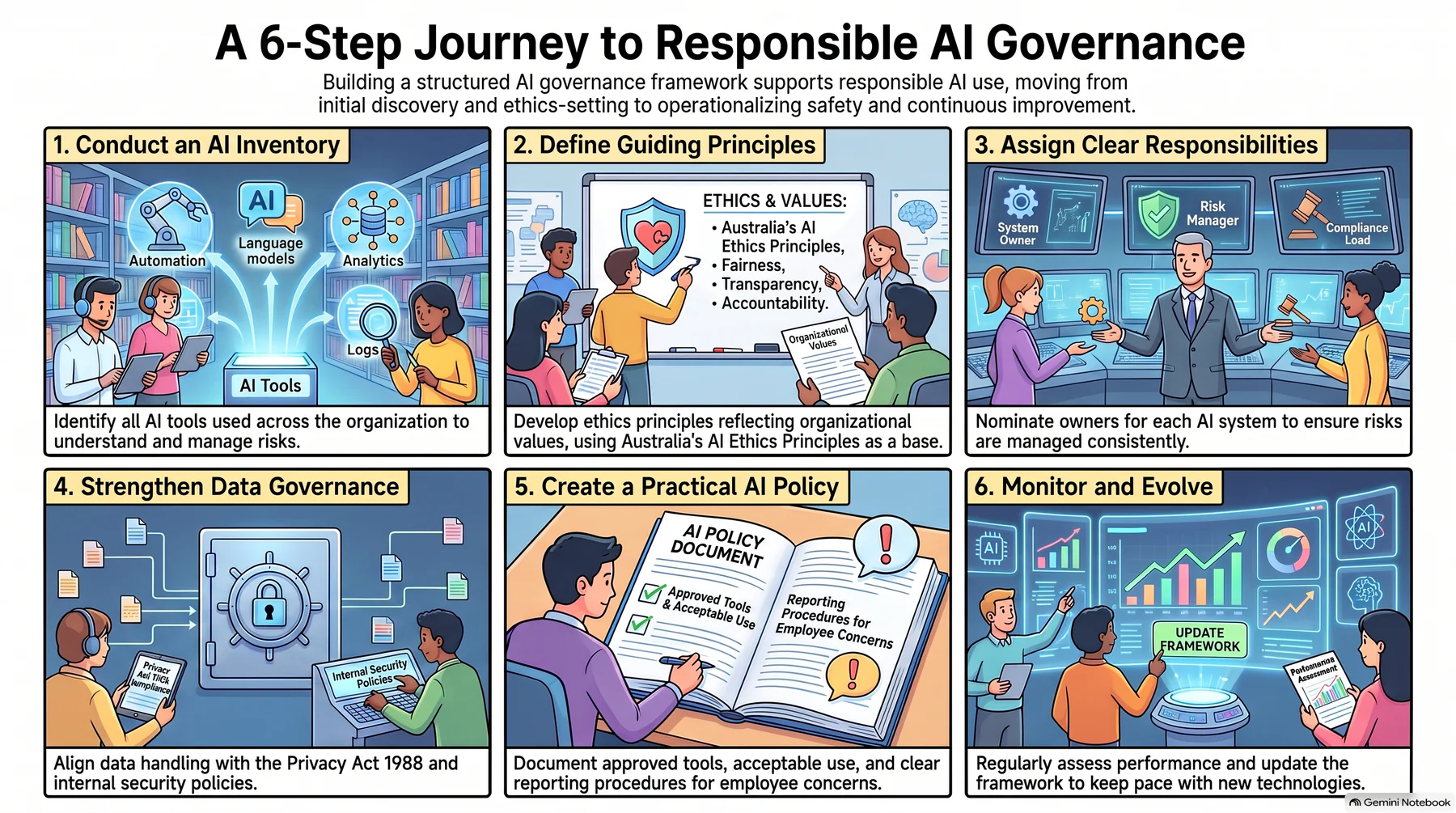
Building an AI governance framework does not have to be complicated. By following a structured approach, organisations can establish a practical framework that supports responsible AI use and grows with their business.
1. Conduct an AI Inventory
Identify all AI tools used across the organisation, including approved business systems and employee-used AI applications. Understanding what AI is in use is the first step to managing its risks.
2. Define AI Principles
Develop a set of guiding principles that reflect your organisation's values and approach to responsible AI. Australia's AI Ethics Principles provide a useful starting point.
3. Assign Clear Responsibilities
Assign an owner for each AI system and nominate a person or team to oversee AI governance. Clear accountability helps ensure AI risks are managed consistently.
4. Strengthen Data Governance
Review how AI systems collect, use, and protect data while avoiding data silos that can limit visibility and control. Ensure personal information is handled in accordance with the Privacy Act 1988 and internal policies.
5. Monitor and Review AI Systems
Regularly assess AI performance, document incidents, and review potential risks. Ongoing monitoring helps maintain accuracy, fairness, and compliance.
6. Create an AI Policy
Develop a clear and practical AI policy that explains approved AI tools, acceptable use, data handling requirements, and how employees should report concerns.
7. Review and Improve
AI governance should be reviewed regularly to keep pace with new technologies, business needs, and regulatory changes. Updating the framework over time helps organisations remain effective and compliant.
AI Governance Tools: How ERP Software Supports Responsible AI
The right tools make AI governance easier by improving visibility, accountability, and control. For businesses using an ERP system, many of these governance features are already built into daily operations.
1. Key Features of AI Governance Tools
Effective AI governance tools should include audit trails, role-based access, data tracking, approval workflows, and system monitoring. These features help organisations manage AI responsibly while supporting compliance and reducing operational risks.
2. ERP as the Foundation for AI Governance
An ERP system provides the data, security, and approval processes needed to support responsible AI use across connected ERP modules. Features such as user permissions, workflow approvals, and audit logs help ensure AI is used under appropriate human oversight and within organisational policies.
3. HashMicro's AI Governance Approach
HashMicro's Hashy AI is built into the ERP system, allowing organisations to use AI within existing security, approval, and access controls. By integrating AI governance into everyday business processes, organisations can strengthen compliance, improve transparency, and maintain greater control over AI-assisted decisions.






Generative AI Governance: What's Different in 2026
If you're looking to adopt AI without compromising security or compliance, Hashy AI provides a practical solution for responsible AI use across your business.
Unlike traditional AI, generative AI creates open-ended content such as text, code, and images, making its outputs less predictable and more difficult to monitor. As a result, organisations need additional governance measures to reduce risks such as inaccurate content, data leakage, and misuse.
Key Governance Controls for Generative AI
Australian businesses using generative AI should implement controls such as:
Acceptable use policies: Clearly define what employees can and cannot enter into AI tools, especially confidential or personal information.
Human review of AI outputs: Ensure customer-facing, regulated, or business-critical content is reviewed before it is published or acted upon.
Data protection and privacy: Understand how AI providers store and use data, and ensure personal information is handled in line with the Privacy Act 1988.
Prompt and activity logging: Keep records of how AI tools are used to improve accountability and support audits where needed.
Conclusion
If your business is adopting AI, having the right governance framework is essential. Clear policies, defined responsibilities, and ongoing oversight help reduce risks, maintain compliance, and ensure AI is used responsibly across your organisation.
An integrated ERP system can also strengthen AI governance by providing secure data management, approval workflows, audit trails, and role-based access controls. This allows businesses to manage AI confidently while supporting transparency and accountability.
Looking to implement AI governance in your organisation? Contact HashMicro's experts for a free consultation and discover how our AI-powered ERP solutions can help you build a secure, compliant, and future-ready business.

FAQ
AI governance is the set of policies, processes, and controls that help organisations use AI safely, ethically, and in compliance with legal requirements.
Australia does not have a dedicated AI law yet, but organisations must comply with existing regulations, including the Privacy Act 1988, when using AI.
AI ethics defines the values behind responsible AI use, while AI governance provides the policies and processes to put those values into practice.
Businesses can implement AI governance by creating clear policies, assigning responsibilities, protecting data, monitoring AI systems, and regularly reviewing their governance framework.