









 Limited to 100 registrants

A good RFI template should capture more than just questions. It should include key information, assign clear ownership, and support procurement research or construction project communication.
This guide includes a copy-ready RFI template, essential fields, an RFI register, an RFx comparison, and industry-specific examples. It also explains when to move from a simple document to a structured digital workflow.
Use these templates to evaluate your current RFI process and customise them to suit your contracts, approval process, and Australian business requirements before use.
Key Takeaways
Choose the template path first: procurement RFIs research supplier capability, while construction RFIs resolve design or document questions.
Keep nine core fields consistent across the request form, response record and RFI register so each item remains traceable.
Select RFI, RFQ, RFT or EOI according to requirement maturity, commercial intent and the decision you need suppliers to support.
Consider a managed workflow only when volume, approvals, permissions, version control or multi-project reporting exceed practical spreadsheet controls.

What Is a Request for Information (RFI)?

An RFI (Request for Information) is used to gather information before making a decision. In procurement, it helps assess supplier capabilities and solution options. In construction, it is used to clarify questions about project documents.
Use an RFI when important information is missing and the response will guide the next decision. If requirements and pricing are already defined, an RFQ or RFT is usually more appropriate.
Procurement RFIs focus on supplier research, while construction RFIs help resolve project questions before work continues.
Construction RFI vs Procurement RFI: Which Type Do You Need?
A Request for Information (RFI) can be used for different purposes depending on the industry. Understanding which type you need helps ensure the request reaches the right person and supports the correct decision.
1. Procurement RFI
A procurement RFI is sent to suppliers to gather information about their capabilities, experience, compliance, and solution options. The responses help businesses refine requirements or shortlist vendors before issuing an RFQ or RFT.
2. Construction RFI
A construction RFI is used to clarify questions about drawings, specifications, or project documents. Approved responses should be shared with all relevant stakeholders and recorded before work continues.
3. Choosing the Right RFI
Use a procurement RFI to research suppliers and solution options, and a construction RFI to resolve project document issues. If you are requesting pricing for a defined requirement, use an RFQ or RFT instead.
4. Australian Construction RFI Example
For example, a contractor may submit an RFI to clarify conflicting information between a drawing and a specification. Once the designer provides an approved response, the project documents are updated and work can continue.
"A well-structured RFI helps businesses make informed decisions before committing to suppliers."
RFI vs RFQ vs RFT vs EOI in Australia
Different RFx documents are designed for different procurement stages. Understanding when to use each one helps businesses gather the right information and choose the most suitable sourcing process.
1. Why Australia Uses RFT Instead of RFP
In Australia, Request for Tender (RFT) is commonly used for formal procurement, while Request for Proposal (RFP) is more common in private-sector or solution-based purchasing. The preferred term depends on the organisation's procurement policy.
2. When to Use an EOI Before an RFI
An Expression of Interest (EOI) is used to identify suitable suppliers before requesting more detailed information. Some businesses use an EOI before an RFI, while others begin directly with an RFI or RFT.
3. RFI vs RFQ vs RFT vs EOI
Each document serves a different purpose. An RFI gathers information, an RFQ requests pricing, an RFT invites formal tenders, and an EOI identifies potential suppliers for future procurement.
| Document | Purpose | When to Use |
|---|---|---|
| RFI | Gather supplier or solution information | Early research |
| RFQ | Request pricing | Requirements are defined |
| RFT | Invite formal tenders | Formal procurement |
| EOI | Identify interested suppliers | Initial market screening |
| RFP | Request solution proposals | Compare different approaches |
4. Common Procurement Sequences
The procurement process varies by project. Businesses may follow an EOI → RFI → RFT, RFI → RFQ, or direct RFT approach depending on how well requirements are defined and the complexity of the purchase.
When an RFI document stops being the right tool
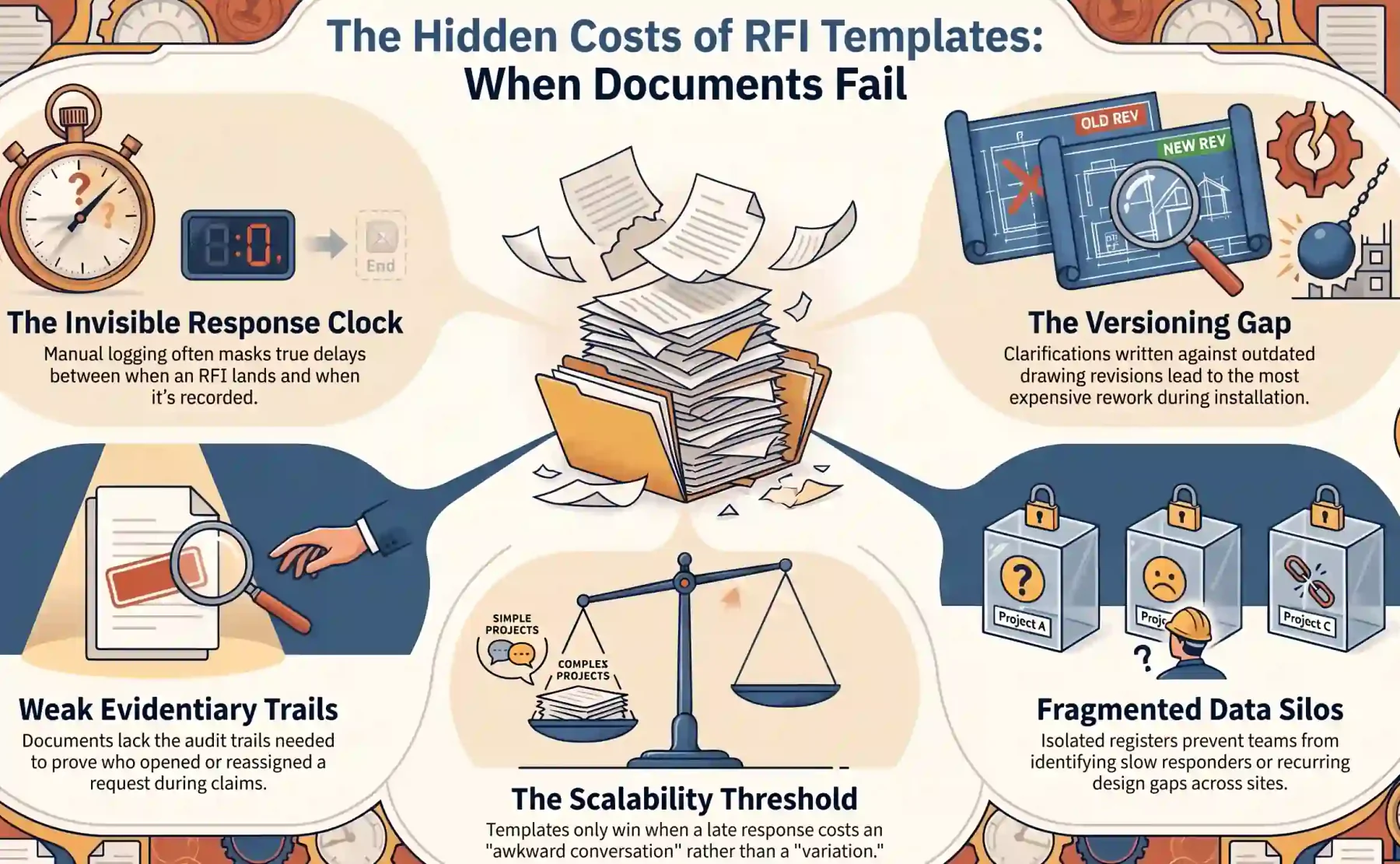
An RFI template does one job well. It makes the question clear. What it cannot do is make the answer arrive, prove when it arrived, or connect that answer to the work it was holding up.
That gap gets expensive in a specific order. Each stage below costs more than the one before it.
1. The response clock nobody is actually running
A due date typed into a document is a suggestion. Nothing checks it, nothing escalates it, and nobody notices the day it passes unless someone happens to open the register that morning.
Construction RFIs carry a contractual weight here. Where a superintendent must respond within a set period, the date the request was received and the date it was answered can decide an extension of time claim.
A Word document records both dates only if a person types them in. If the RFI sat in an inbox for three days before anyone logged it, the register shows the day it was logged, not the day it landed.
2. The answer that referenced the wrong revision
An RFI response is only correct against the document version the responder was looking at. Drawings get reissued, and a clarification written against Revision C becomes wrong the moment Revision D lands.
The template has no way to know this. It captures the answer as text, not as a link to a specific revision, so nothing flags when the underlying document moves on.
Subcontractors working off the earlier answer will not find out until installation, which is the most expensive possible moment to discover it.
3. The register that only one person can read
An RFI register works while it is one project and one coordinator. Across four sites, each with its own workbook, nobody can answer which discipline is slowest to respond or where the recurring design gaps sit.
Procurement hits the same wall differently. Supplier responses to a capability RFI live as attachments in an email thread, so comparing what six vendors said about data migration means reopening six documents.
The information exists. It just cannot be queried, which means it never informs the next RFI you write.
4. The claim that arrives eighteen months later
Delay claims are argued on the RFI record. A contractor will point to a question raised on a date, a response that took longer than the contract allowed, and the work that could not proceed in between.
Documents alone struggle here. A folder of files shows what was written, but not who opened the request, who reassigned it, or how many times the due date was quietly pushed out.
Businesses subject to the Security of Payment regime in their state face tight statutory response windows on payment claims too, and the same evidentiary weakness applies. Proving what happened when is harder than being right.
5. Where the template still wins
None of this argues against the template. A single procurement RFI to five suppliers, or a handful of clarifications on a small fitout, is faster to run as a document than to configure anywhere else.
The honest test is whether an unanswered RFI can hurt you. If a late response only costs an awkward conversation, keep the template. If it costs a program day or a variation, the record needs to be stronger than the request.
Download: Free RFI Template for Australia
The template includes the key sections needed to capture supplier details, project information, responsibilities, and response requirements, making it easier to collect consistent and comparable information.
Download this free RFI template
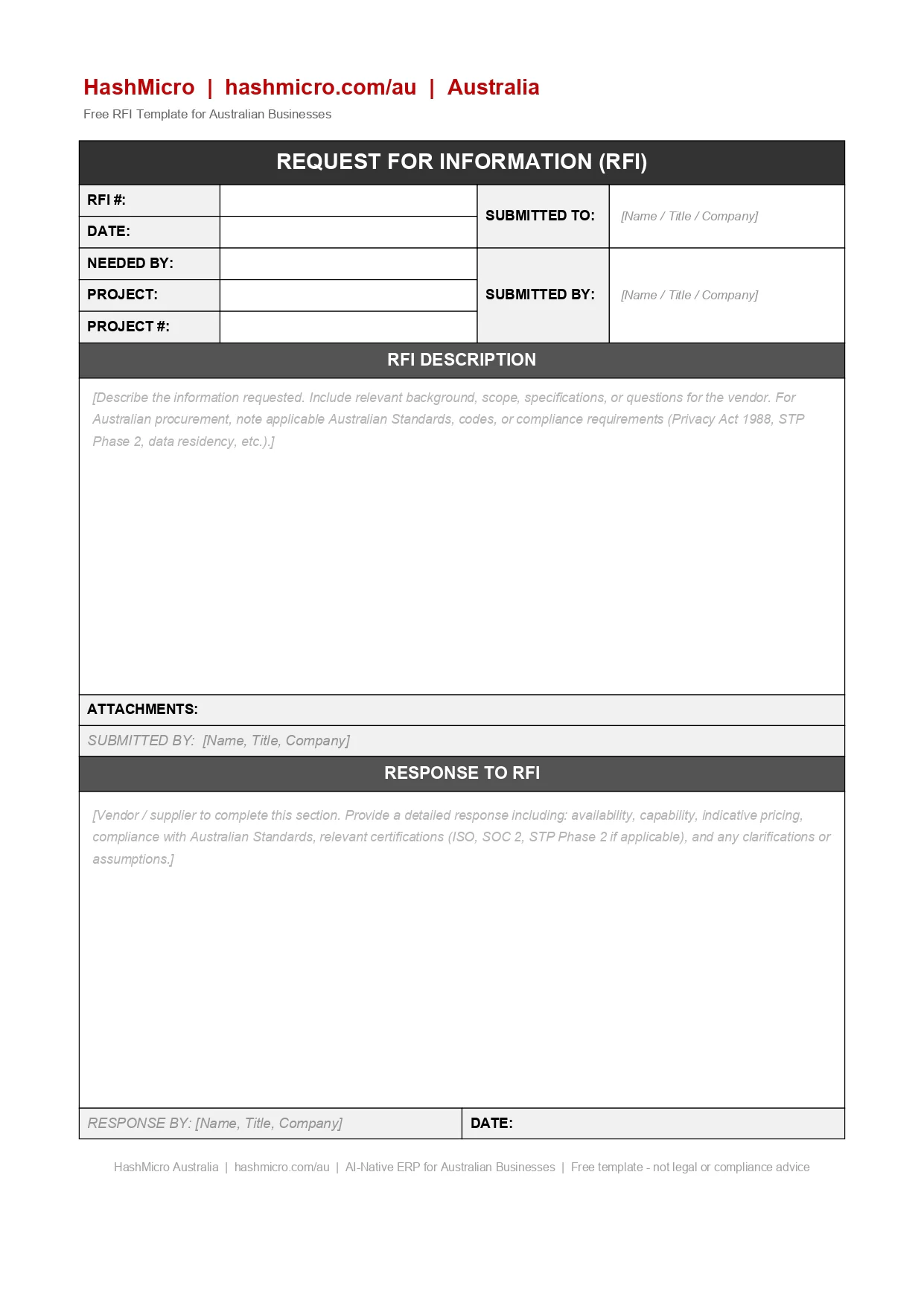
Whether you are evaluating potential vendors or requesting clarification on construction documents, you can customise the template to suit your organisation's approval process, governance requirements, and Australian business practices before issuing it.
What to Include in an Australian RFI Template
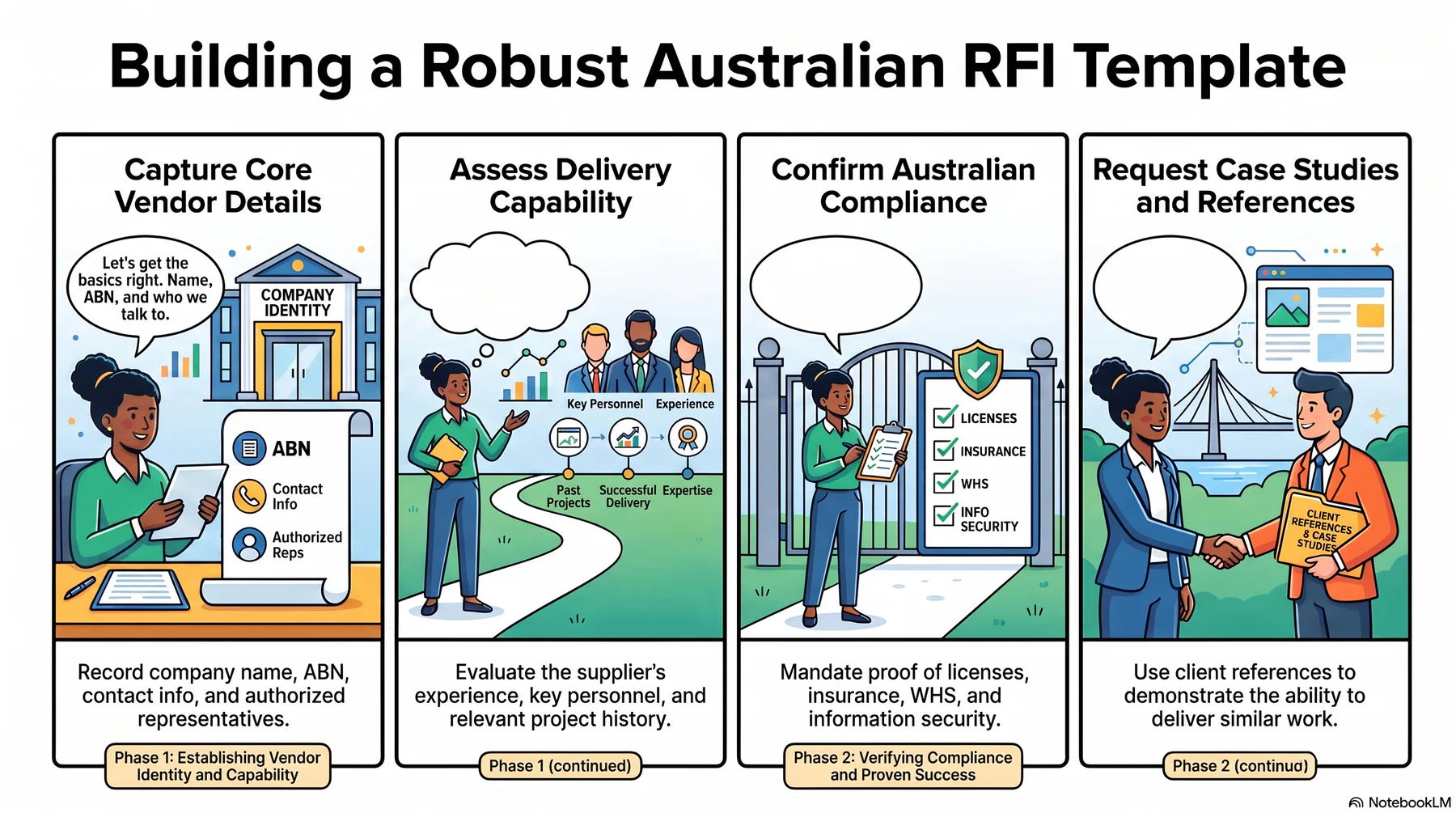
A well-designed RFI template should collect the information needed to evaluate suppliers fairly and consistently. The following sections are commonly included in Australian RFI documents.
1. Vendor Information
Record the supplier's company name, ABN (if applicable), contact details, business locations, and authorised representative. This information helps verify the supplier's identity and ensures the response comes from the appropriate contact.
2. Capability and Experience
Ask suppliers to describe their business capabilities, relevant experience, key personnel, and similar projects they have completed. This helps assess whether they have the skills and resources to meet your requirements.
3. Australian Compliance Requirements
Include any compliance requirements relevant to the procurement, such as licences, insurance, work health and safety (WHS), privacy, or information security. Request supporting evidence where appropriate to confirm the supplier meets your standards.
4. References and Case Studies
Request examples of similar projects or client references that demonstrate the supplier's experience and performance. Relevant case studies provide greater confidence in the supplier's ability to deliver the required outcomes.
Industry-Specific RFI Templates for Australia
Different industries require different RFI questions based on their operations and risks. While the overall RFI structure remains the same, the information requested should match the business or project.
1. Mining and Resources
Mining RFIs often focus on workforce capacity, equipment availability, safety systems, environmental management, and remote site operations. These questions help assess whether suppliers can meet operational and compliance requirements.
2. Construction and Civil Engineering
Construction RFIs typically request information about licences, project experience, safety management, subcontractor controls, and document clarification. This helps ensure suppliers are qualified and project issues are resolved before work proceeds.
3. Manufacturing
Manufacturing RFIs usually assess production capacity, quality control processes, lead times, material traceability, and system integration. The responses help businesses determine whether suppliers can support their production requirements.
4. Software and ERP Procurement
Software and ERP RFIs evaluate system functionality, implementation approach, integrations, data migration, security, reporting, and ongoing support. This helps businesses compare vendors and identify the solution that best fits their operational needs.
How to Control RFI Registers, Delays and Governance
Clear governance helps keep RFIs organised, on time, and properly reviewed. Defining responsibilities and tracking progress reduces delays and improves accountability.
1. Maintain an RFI Register
Use an RFI register to track key details such as the RFI number, requester, responder, issue date, due date, status, and approval. This makes overdue and outstanding RFIs easy to identify.
2. Assign Clear Ownership
Define who is responsible for creating, reviewing, responding to, approving, and closing each RFI. Clear ownership helps prevent delays and confusion.
3. Set Response Deadlines
Assign realistic due dates based on the complexity of the request and its impact on the project or procurement timeline. Escalate overdue RFIs when necessary.
4. Move Beyond Spreadsheets
As RFI volumes grow, consider using a digital workflow instead of spreadsheets. This improves version control, approvals, document tracking, and reporting across teams.
Conclusion
A well-structured RFI template helps businesses gather consistent information, evaluate suppliers more effectively, and support better procurement decisions.
With clear ownership and a standardised process, organisations can reduce delays, improve collaboration, and maintain better control over procurement activities. As your procurement needs grow, digital workflows can further simplify approvals, document tracking, and supplier management.
Consult with our experts for free to discover how HashMicro Procurement Software can help streamline your procurement process from end to end.

Frequently Asked Questions
An RFI (Request for Information) is used to gather information before making a decision. In procurement, it helps assess suppliers and solution options. In construction, it is used to clarify questions about drawings, specifications, or project documents.
An RFI is generally used to gather information, not request a binding offer. However, its legal effect depends on the wording and the applicable procurement or contract requirements.
An RFI gathers information, an RFQ requests pricing for defined requirements, and an RFT invites formal tender submissions. The process may vary depending on the organisation's procurement policy.
An RFI template should include the purpose, issuer and vendor details, scope questions, compliance requirements, attachments, submission instructions, and approval information.
There is no standard RFI response time. The deadline depends on the complexity of the request, required approvals, and project or procurement needs.