






Your new supplier doesn't become tradeable the moment the deal is approved. Onboarding is the work in between, verifying identity, checking tax and bank details, and setting the record up in your ERP.
Still, many procurement teams run this over email and spreadsheets, and that gap is where mistakes happen. The ACCC recorded $166.8 million lost to payment redirection scams in Australia in 2025 alone. It goes to show just how important supplier onboarding is.
This article walks through the process step by step, from first request to ERP activation. It covers required documents, risk checks, Australian rules like ABN and Peppol, and the metrics that prove it works.
Key Takeaways
Supplier onboarding turns an approved vendor into a governed record, ending only when checks, approvals, ERP setup and trading readiness are documented.
Collecting supplier details means capturing verified identity, tax records, bank data and compliance evidence, each checked against an independent source.
The onboarding process runs through five steps, from identifying the need and selecting a vendor to due diligence, approval and ERP activation.
The right onboarding software replaces email and spreadsheets with self-service capture, automated verification and a clean link into your ERP.

What Is Supplier Onboarding in Procurement?
Supplier onboarding in procurement is how a business turns an approved new supplier into a usable, governed record. It confirms the supplier can trade through your purchasing, invoice and payment workflow.
A completed registration form is only an input, not the finished job. Onboarding ends when risk checks, approvals, ERP records, and trading readiness are complete and documented for audit.
Treat onboarding as a control gate rather than paperwork. Each supplier passes the same checkpoints, and the depth of review scales with the money, access, and risk that the relationship carries.
"A completed registration form is only an input, not the finished job. Onboarding ends when checks, approvals and activation are documented and ready for audit."
How Is Supplier Onboarding Different From Supplier Registration and Qualification?
Registration captures a supplier's first details, and qualification tests whether they are suitable. Onboarding is the wider process that governs both stages through to a governed, activated record.
The distinction matters because each stage has a different owner, output, and exit test. The table below maps registration, qualification, onboarding, and ongoing management, so hand-offs stay clear.
| Stage | Main Purpose | Typical Owner | Exit Test |
|---|---|---|---|
| Registration | Capture the supplier's identity, contacts and service details | Supplier or requesting team | A complete, submitted form with documents |
| Qualification | Test suitability, capability and risk before commitment | Procurement with risk and finance input | A documented suitability decision |
| Onboarding | Validate, approve, create and activate the governed record | Procurement, supported by AP and IT | An approved record cleared to trade |
| Ongoing management | Monitor performance, documents and continuing suitability | Contract or supplier owner | A current, reviewed, compliant supplier |
Onboarding does not replace ongoing supplier management. It creates the controlled record and permission that later performance reviews, document renewals, and change controls build on.
Many teams use vendor onboarding and supplier onboarding to mean the same workflow. The label matters less than the control, because the record is not live until all preparations are complete.
Why Does a Strong Supplier Onboarding Process Matter?
A strong supplier onboarding process protects your cash, data, and compliance, while keeping purchasing moving. It helps manage supplier risk by preventing duplicate records, unapproved bank changes, and invoices arriving before a supplier is ready.
Speed alone is not the goal. Cutting cycle time helps only when review depth holds, because rushing incomplete records into purchasing and payment simply moves the errors downstream faster.
The payoff is measurable: complete data at first submission, one clean supplier record, traceable approvals and controlled activation. Each outcome maps to a metric you can track and defend.
What Information and Documents Do You Collect During Onboarding?
Collect only what the supplier's role and risk justify, then verify each item against an independent source. The core set covers business identity, tax records, bank details, and relevant compliance evidence.
1. Business Identity and Tax Records (ABN, ACN, and GST)
Start with the legal entity. Capture the registered business name, any trading name, the ABN and, where relevant, the ACN and GST registration status. Then, match them to the approved contracting party.
Verify the numbers; do not just store them. Check the ABN against the government's ABN Lookup, confirm the GST status, and record who reviewed each field and when, so the identity trail stays auditable.
2. Financial and Bank Account Details
Bank details are the highest-risk fields you collect, so treat them as controlled data. Capture the account name, number, and payment references through an approved channel, never from a plain email request.
Apply independent verification before the first payment. Confirm any account through a known contact, separate the person who requests a change from the one who approves it, and keep a full change history.
3. Compliance, Insurance and Risk Documents
Request compliance evidence that fits the work, not a generic document dump. Ask for licences, insurance certificates, safety records or privacy terms where the supplier's role and jurisdiction require them.
Record validity dates and set review triggers as you file each document. An expired certificate of insurance should flag for renewal, and a lapsed licence should pause new orders until it is resolved.
How Does the Supplier Onboarding Process Work?
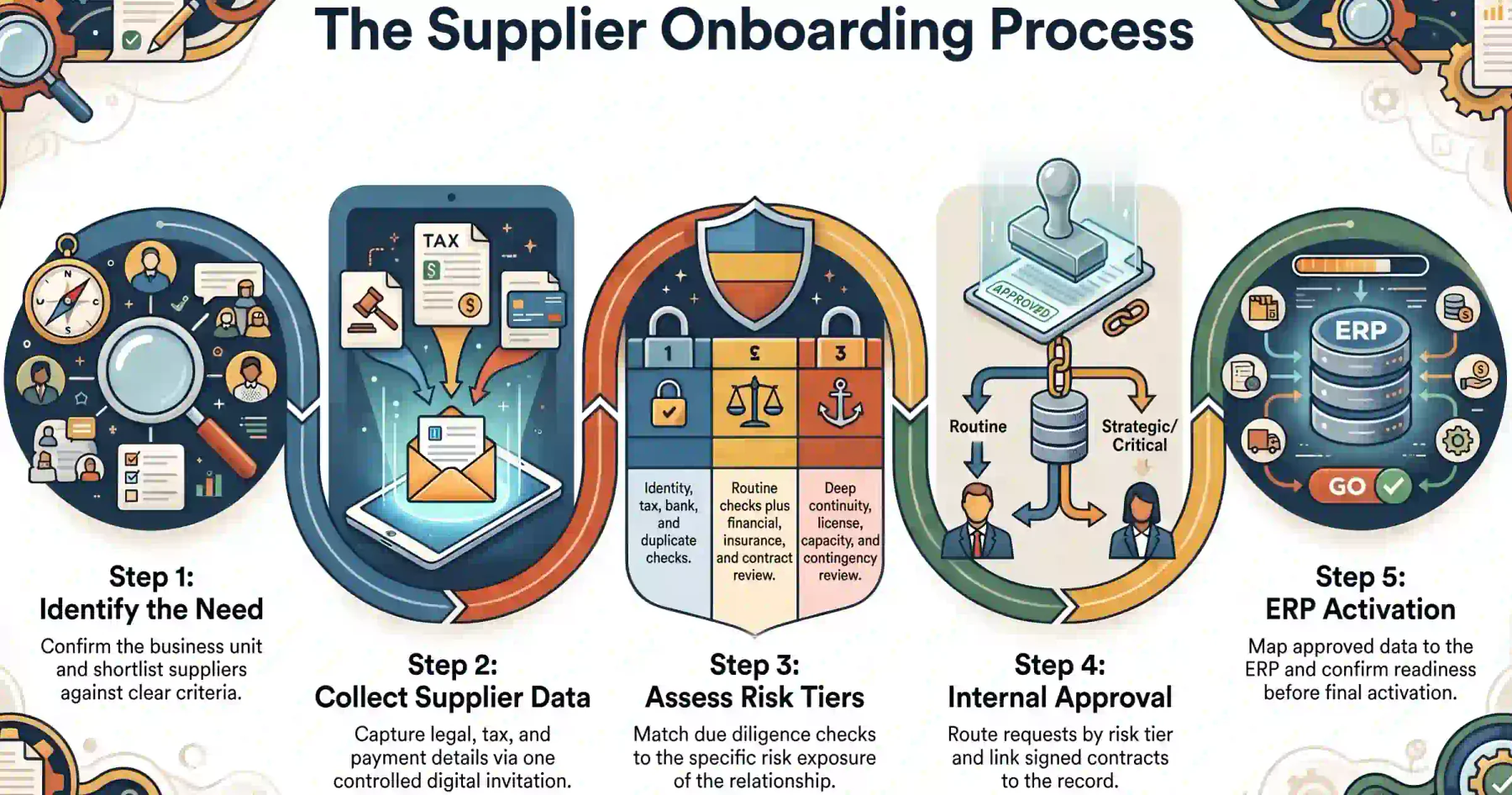
The supplier onboarding process works best as five sequenced steps, each with an owner, an output, and a clear route for exceptions. The flow below moves from first need to an active, governed supplier.
1. Identify the Need and Select a Supplier
Every onboarding starts from a real need and an accountable requester. Confirm the business unit, the intended purchase, and the legal entity, then select or shortlist a supplier against clear criteria.
Record why this supplier and why now. A short justification, the expected spend and the assigned owner give every later approval the context it needs and stop unofficial suppliers entering by the back door.
2. Collect Supplier Information and Registration Forms
Send one controlled invitation that names the requesting entity, the evidence required, the due date and a support contact. Use conditional fields so each supplier only sees the forms their role needs.
This is where supplier registration really happens. Capture legal, tax, contact, payment and service details in one submission, with a timestamp and attachments you can audit rather than scattered emails.
3. Run Due Diligence and Risk Assessment
Match the risk checks to what the relationship actually exposes. A low-risk stationery vendor and a supplier with system access should not face the same review, so weigh each supplier's supply chain risk before you go deeper.
| Risk Tier | Typical Trigger | Minimum Review | Approvers and Evidence |
|---|---|---|---|
| Routine | Low spend, no system or sensitive-data access | Identity, tax, bank and duplicate checks | Requesting manager plus AP, with evidence kept |
| Strategic | Material spend or important supply dependency | Routine checks plus financial, insurance and contract review | Procurement and business owner, with finance or legal input |
| Critical | Failure would disrupt production, service or safety | Deeper continuity, licence, capacity and contingency review | Senior operational owner and control functions |
| Digitally integrated | Supplier connects systems or handles sensitive data | Security, privacy, access and integration testing | IT or security approval plus the data owner |
Use the tier to route work, not to replace judgement. The questionnaire can assign reviewers and evidence automatically, but the accountable owner still signs off the decision and records any conditions.
4. Approve Internally and Sign the Contract
Approve the commercial relationship before you build the record. Route the request by risk tier so the business, finance, legal or security owners sign, each with an identity, a decision and a time stamp.
Tie approval to the contract, not just an email. Link the signed agreement, the agreed terms and any conditions to the record, so the reason a supplier was approved stays visible long after the decision.
5. Set Up in Your ERP and Activate the Supplier
Create the supplier once, in a controlled record only authorised roles can edit. Map the approved fields into your ERP and confirm the purchasing, tax and payment details match the approval before activation.
Activation is the final gate, not an afterthought. Confirm purchasing, invoice, integration and support readiness, check for duplicates under one identifier, then switch the supplier on and tell the owner.
Why Do Supplier Onboarding Programs Break Down?
Most supplier onboarding programs break down at the hand-offs, not inside any single team. Work stalls when ownership is unclear, requests sit in inboxes, and data is re-entered across disconnected systems.
The usual failure modes repeat across businesses. Duplicate suppliers fragment spend history, unapproved bank changes slip through, and suppliers reach payable status before purchasing has approved them.
Under these symptoms sits one root cause: no single owner and no shared status. When the workflow lives in email and spreadsheets, nobody sees the full picture, so exceptions hide until they become expensive.
What Are the Best Practices for Onboarding New Suppliers?
The best practices for onboarding new suppliers come down to clear ownership, risk-based checks, and verified master data. Each one turns a manual, email-driven task into a controlled, traceable workflow.
Start by fixing accountability and duplicates, because most breakdowns trace back to those two gaps. The controls below show what to verify, who owns each field, and when a change must be re-approved.
- Give every stage a named owner and a visible status, so nothing waits in a private inbox.
- Tier suppliers first, then apply only the checks each tier justifies.
- Verify identity, tax and bank details against independent sources before activation.
- Separate the person who requests a supplier or bank change from the person who approves it.
- Run a duplicate search on names, identifiers and bank details before creating a record.
- Set review triggers for expiring documents, inactivity and any material change.
| Master-Data Field | Verification | System Owner | Change Control |
|---|---|---|---|
| Legal name and identifier | Match approved request and source records | Supplier-master owner | Block uncontrolled identifier changes |
| Tax fields (ABN, GST) | Review through the approved finance process | Finance or tax-data owner | Route material changes for review |
| Bank details | Independent verification through a known contact | Accounts payable or treasury | Separate request and approval roles, keep history |
| Purchasing terms | Match contract, order policy and approved entity | Procurement | Require procurement authorisation |
| Documents and licences | Confirm relevance, validity and review outcome | Procurement or risk owner | Suspend or escalate on expiry |
| System or data access | Apply least-necessary access and security review | IT or security owner | Restrict fields, preserve access history |
Treat bank-detail changes as the highest-risk event of all. Confirm every request through a known contact, never the details in the email, and keep sensitive-field access limited to named, accountable roles.
Automation should expose exceptions, not hide them behind a rigid form. Used well, AI procurement tools can route reviews and flag anomalies, while a named owner keeps approval of sensitive changes.
Which Metrics Show Your Supplier Onboarding Is Working?
The metrics that show supplier onboarding is working track speed, completeness, exceptions, and control together. A faster cycle time means little if duplicates, rework, or activation reversals are climbing.
Set a baseline from your own workflow, then compare like-for-like supplier tiers rather than chasing an external benchmark. The dashboard below pairs each metric with the management question it answers.
| Metric | What It Measures | Management Question |
|---|---|---|
| End-to-end cycle time | Accepted request to authorised activation | Where does the process lose the most time? |
| Stage waiting time | Time awaiting supplier, reviewer or approver | Which hand-off needs clearer ownership? |
| First-pass completion | Submissions needing no avoidable correction | Are instructions and fields clear enough? |
| Exception rate | Requests handled outside the standard path | Which rules or data create repeated work? |
| Duplicate-match outcome | Potential and confirmed duplicates found | Are naming and identifier controls working? |
| Activation reversal rate | Records restricted soon after activation | Are readiness checks happening too late? |
| Evidence currency | Required documents still valid and reviewed | Are obligations visible after onboarding? |
Report these numbers by supplier tier, because a routine vendor and a system-integrated supplier will never move at the same pace. Targets should follow your real volume, risk mix, and approval depth.
How Does Supplier Onboarding Apply to the Australian Market?
In the Australian market, supplier onboarding should verify the ABN and GST status, respect Peppol eInvoicing and follow local privacy rules. Public registers inform checks, but they do not prove suitability.
Australia's business population keeps shifting, which changes supplier risk. The Australian Bureau of Statistics reports on business numbers and their entries and exits, so review onboarding as conditions move.
eInvoicing is a practical onboarding checkpoint in Australia. Record whether the supplier can exchange documents through the Peppol network, assign an internal owner, and test the connection before you rely on it.
Government requirements and registration details change over time. Confirm obligations with the responsible tax or finance owner before you approve the workflow, and brief suppliers on what they must provide.
What Should You Look for in Supplier Onboarding Software?
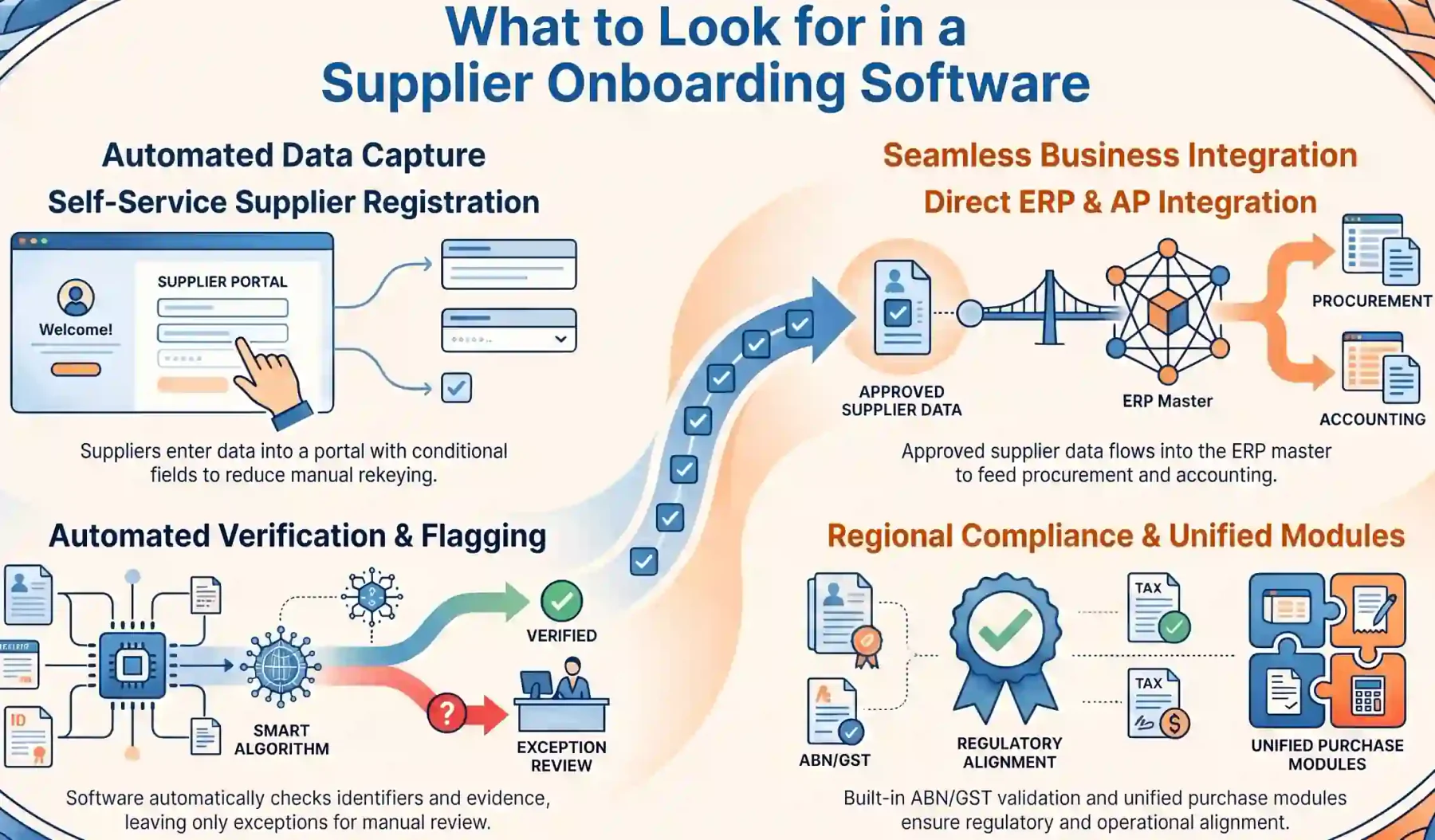
Good supplier onboarding software should replace email and spreadsheets with self-service capture, automated verification, and a clean link into your ERP. The features below matter more than a long module list.
1. Self-Service Registration and Automated Verification
Let suppliers enter and update their details in a controlled portal, with conditional fields driven by type and risk. Self-service cuts rekeying and gives you a time-stamped submission to verify.
Automated verification then does the first pass. The software can check identifiers, search for duplicates and flag missing evidence, leaving reviewers to handle exceptions instead of routine data entry.
2. ERP and Accounts Payable Integration
Onboarding only pays off when the approved supplier flows straight into your ERP. Look for one governed supplier master that feeds procurement, accounts payable and accounting, so nobody rekeys details.
Check how the tool fits your ERP architecture, including approvals, tax fields and payment controls. Strong integration also routes exceptions, so an invoice arriving before activation lands in a clear queue.
3. Australian-Specific Requirements (ABN Lookup, GST, Peppol eInvoicing)
For Australian suppliers, the software should support ABN and GST checks and Peppol eInvoicing out of the box. Built-in ABN validation and duplicate matching save your team from manual lookups on every record.
Align the tool with official guidance rather than assumptions. The ATO explains eInvoicing for businesses, so confirm the software supports the same standards before you promise suppliers a compliant exchange.
4. How HashMicro Supports Supplier Onboarding in the Purchase Module
HashMicro runs supplier onboarding through its purchasing management system, so vendor onboarding and buying live in one place. Suppliers can register, submit documents, and route through the approval flow you define.
Similar-vendor detection, approval routing, and vendor limits cut duplicates and unapproved spend. Because the supplier master feeds procurement and payables, an approved supplier can transact without rekeying.
Whether you run HashMicro or map the process first, the goal is the same: one controlled path from request to trading readiness. A short workflow assessment shows where your current setup needs attention.
How Can You Build an Ongoing Supplier Onboarding Practice?
An ongoing supplier onboarding practice treats the workflow as a living process. Review it on a set cadence, watch the metrics, and update checks as risks and regulations change.
Assign clear owners for supplier data, approvals, and post-activation changes, then hold periodic reviews. Feed what you learn from exceptions and audits back into the forms and rules that run onboarding.
That assessment is easier when supplier data sits in one governed record. When registration, approvals, and payables share it, Hashy AI reads it live and flags the suppliers stuck before activation.






Conclusion
A reliable supplier onboarding process does more than gather contact and bank details. It records who requested the supplier, which checks applied, who approved it, and whether the supplier can trade.
Map these steps and controls against your current workflow, then find the incomplete hand-offs and unmanaged exceptions. A supplier onboarding workflow assessment can turn those gaps into an auditable path.
To learn more about supplier onboarding, you can book a free consultation with our team today.
Frequently Asked Questions
In simple terms, supplier onboarding is the checklist a business runs before it buys from a new supplier. It confirms who they are, that their bank and tax details are valid, and that someone has approved them to trade.
In most businesses the two terms describe the same workflow. Some teams use vendor onboarding for resellers and supplier onboarding more broadly, but the checks, approvals and activation steps are the same.
The core steps are selecting a supplier, collecting information, running risk checks, approving and contracting, then activating the record in your ERP. Smaller teams may merge steps, but none should be skipped.
It depends on the risk tier. A routine, low-risk supplier can be active in a day or two once verified, while strategic, critical or system-integrated suppliers can take weeks due to added review and testing.
Usually the legal and trading name, ABN and GST status, bank account details, and any licences or insurance relevant to the work. Request compliance documents only where the role and jurisdiction require them.
Yes. If your ERP has a procurement module with supplier registration, duplicate checks, approval routing and a supplier master, you can run onboarding inside it without syncing a separate tool.