









 Limited to 100 registrants

Walk into the head office of a retail brand doing eight figures in revenue and ask to see its tech stack, and you may find a patchwork of tools that nobody fully understands anymore. Behind the polished storefront, analytics platforms disagree, inventory systems are bolted together, and marketing teams make decisions from conflicting dashboards.
Growth exposes these weaknesses quickly. A brand doing £500,000 a year may survive on spreadsheets and manual processes, but at £15 million, the volume of data, SKUs, and multi-market operations can turn small inefficiencies into serious revenue leaks.
This is the gap that a specialist AI SEO agency for ecommerce is built to address. Search performance at scale depends on more than content and backlinks. It also relies on how product data moves between systems, how quickly new SKUs are indexed, and how effectively products can be surfaced by search engines and AI-driven tools.
Key Takeaways
The infrastructure beneath a fast-scaling retail brand, data flows, product feeds, and site architecture, decides whether marketing spend converts, yet it rarely gets budgeted for.
Attribution tends to break down exactly as a brand adds channels, leaving leadership to make seven-figure decisions on numbers that do not reconcile.
Product data quality now determines visibility in both traditional search and AI-generated shopping recommendations, and multi-market brands feel every inconsistency multiplied.
Why Does No One Budget for Infrastructure?

Most growth plans focus on the visible layers: marketing spend, hiring, and new product lines. Almost none allocate serious budget to the plumbing. Yet the plumbing determines whether everything else actually works.
When that foundation is weak, the symptoms show up in predictable places:
Phantom stock and cancelled orders: product feeds that do not sync properly between a warehouse system and the online store.
Suppressed rankings: site architecture never designed for tens of thousands of SKUs starts throwing up duplicate content and crawl-budget problems across the whole catalogue.
Unexplained plateaus: organic traffic stalls months later, and nobody can say why.
Brands rarely notice this in real time. It surfaces as a plateau that seems inexplicable, because the marketing team is doing everything right on the surface while the technical foundation underneath is quietly bleeding visibility.
Why Does Attribution Break Down as You Scale?
The faster a brand grows, the more channels it runs at once: organic search, paid social, affiliate, email, and increasingly AI-driven referral traffic from tools like ChatGPT and Perplexity.
Each tends to sit in its own reporting silo, built by a different agency or hired at a different stage of the company's life. The result is a leadership team making seven-figure decisions on numbers that do not reconcile.
This is where many high-growth brands lose control without realising it. Nobody can say with confidence which channel actually drove a given sale, so budget gets allocated on gut feeling, or on whichever channel shouts loudest in its own dashboard, rather than on what the data, properly unified, would actually show.
Why Is Product Data the New Battleground?
Product data quality is becoming just as important for AI shopping recommendations as it is for traditional search. Incomplete specifications, missing schema, or inconsistent product names can make products harder for search engines and AI tools to understand and surface.
For brands selling across multiple markets, these issues can multiply. Differences in product names, currencies, or availability across feeds can reduce how consistently products appear in search and AI recommendations.
The table below shows how a patchwork setup compares with unified infrastructure:
Aspect | Patchwork Setup | Unified Infrastructure |
|---|---|---|
Data architecture | Systems bolted on over time; feeds out of sync | Designed to scale; feeds sync cleanly |
Attribution | Each channel siloed; numbers conflict | One unified view of what drove each sale |
Product data | Incomplete specs, missing schema, inconsistent naming | Complete, structured, consistent across markets |
Visibility | Rankings quietly suppressed; missed by AI tools | Surfaced by both search engines and AI answer tools |
Outcome | Unexplained plateaus and repeated rebuilds | Compounding growth on a stable foundation |
How Do You Fix the Foundation Before Scaling Further?
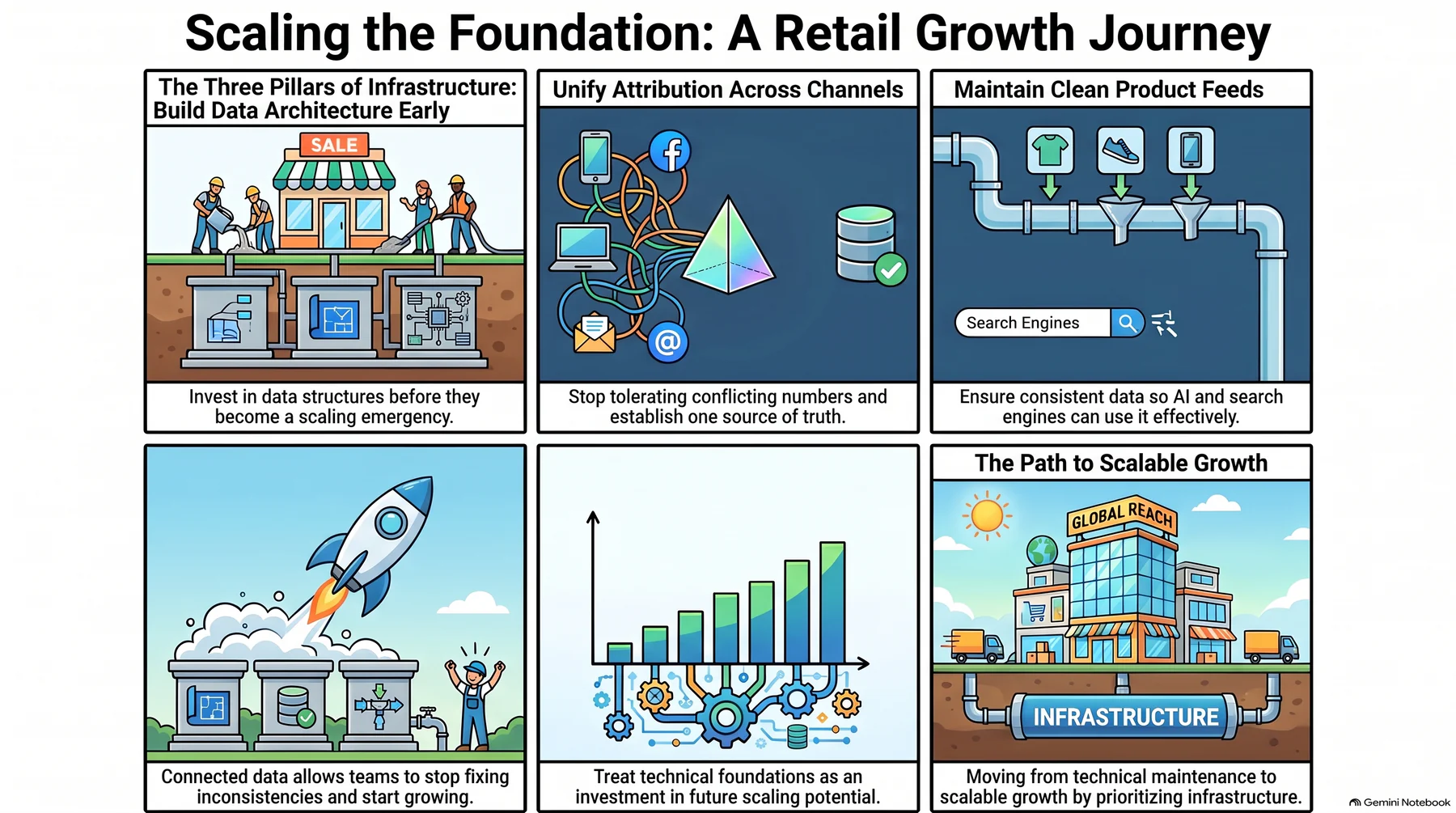
The brands that manage this well treat technical infrastructure as a growth lever rather than a maintenance cost. In practice, that comes down to three priorities:
Build proper data architecture early: invest before it becomes an emergency, not after.
Unify attribution across channels: stop tolerating conflicting numbers and work from one source of truth.
Keep every product feed clean: consistent and structured so that both search engines and AI tools can actually use it.
These priorities give growing retail brands a more reliable foundation for scaling. With connected data and cleaner processes in place, teams can spend less time fixing inconsistencies and more time focusing on growth.
Where Does HashMicro Fit Into This Foundation?
Fixing the foundation sounds straightforward on paper. In practice, the challenge is often that key data sits across systems that were never designed to work together. The warehouse shows one stock figure, the storefront another, while finance reconciles a third at month end.
A unified ERP platform helps close that gap. Instead of adding another tool, HashMicro brings inventory, orders, purchasing, product data, and finance into one operational system. For a scaling retail brand, this supports three priorities:
- Consistent product data across markets: One master record per SKU keeps product details, naming, and availability aligned across storefronts and feeds.
- More accurate stock visibility: Real-time inventory across warehouses and sales channels helps reduce phantom stock, cancelled orders, and suppressed listings.
- One source for business numbers: Sales, margins, and fulfilment data sit in one system, reducing discrepancies between reports and dashboards.
Hashy, HashMicro’s AI coworker, works on top of this shared data. It can surface issues such as an approaching stockout, a margin change, or an order delayed in fulfilment, helping teams act without manually checking multiple systems.






The infrastructure work may not be the most visible part of retail growth, but getting it right creates a more reliable foundation for everything that follows.
Conclusion
A strong technical foundation makes it easier for retail brands to scale without constantly fixing the same data and operational issues.
With connected data, accurate inventory, and reliable product feeds, teams can work more efficiently and make better-informed decisions.
If you are looking to strengthen your retail operations, consult with our experts for free to explore how HashMicro can support your business.

FAQ
It is the technical foundation beneath the storefront: how data flows between systems, how product feeds sync, how the site is architected, and how attribution is tracked across channels. It determines whether marketing spend and new products actually perform.
Each new channel is often set up separately, at a different stage and by a different team, so reporting ends up siloed. The numbers stop reconciling, and leadership can no longer tell which channel truly drove a sale.
AI answer tools pull from structured data aggressively. Product pages with incomplete specifications, missing schema, or inconsistent naming across markets become hard for these systems to surface, regardless of how strong the paid marketing is.
Before it becomes an emergency. Treating infrastructure as a growth lever, and investing early in data architecture, unified attribution, and clean feeds, avoids the costly cycle of rebuilding the same broken foundation every couple of years.