


 Limited to 100 registrants

CRM pricing in Australia ranges from free to over AUD $230 per user per month, depending on the platform, plan tier, and user count.
CRM cost is structured across the software subscription, implementation, training, customisation, and ongoing maintenance. The subscription price is usually the smallest part of the total spend.
Key Takeaways
CRM pricing in Australia varies by team size, plan tier, and platform, so buyers should compare total annual cost rather than the headline rate.
Different CRM pricing models affect how costs grow as users, contacts, and platform usage increase.
CRM implementation and ongoing costs can exceed the subscription when migration, integrations, training, and support are required.
Comparing CRM quotes on the same basis reveals exclusions, usage limits, and future expenses hidden behind a lower starting price.

What Is a CRM?
A CRM system centralises contact records, deal pipelines, sales activity, and customer communications in one platform. It connects the people your business sells to with the processes behind those relationships.
CRM software ranges from simple contact databases to full revenue platforms with marketing automation, service tools, and ERP integrations. That breadth is why pricing comparison needs a clear framework.
How Much Does CRM Cost in Australia?
Pricing depends on team size, plan tier, features required, and how many systems the CRM needs to connect with. Here are the realistic ranges for Australian businesses in 2026.1. By business size
Small businesses with 1 to 50 employees typically pay AUD $10–30 per user per month. Most SMBs with 2 to 5 users end up paying AUD $100–400 per month in total for a capable platform.Medium businesses (51 to 250 employees) generally fall in the AUD $40–100 per user range. Enterprise contracts above 250 employees run AUD $150–650+ per user, often with custom terms.
2. By platform (2026 AU pricing reference)
Free tiers come from HubSpot (up to 100 contacts), Zoho CRM (up to 3 users), and Freshsales (up to 3 users). These work for early-stage teams but have contact and feature caps.Paid entry tiers start at AUD $14/user (Zoho Standard), AUD $24 (Pipedrive), and AUD $35 (Salesforce Essentials). HubSpot Professional costs AUD $1,780 for 5 users and 2,000 contacts.
Most providers bill in USD. Confirm the AUD equivalent and GST treatment before signing. MerchantCompare has a current Australian CRM pricing comparison.
How Do CRM Pricing Models Work?
1. Per-user pricing
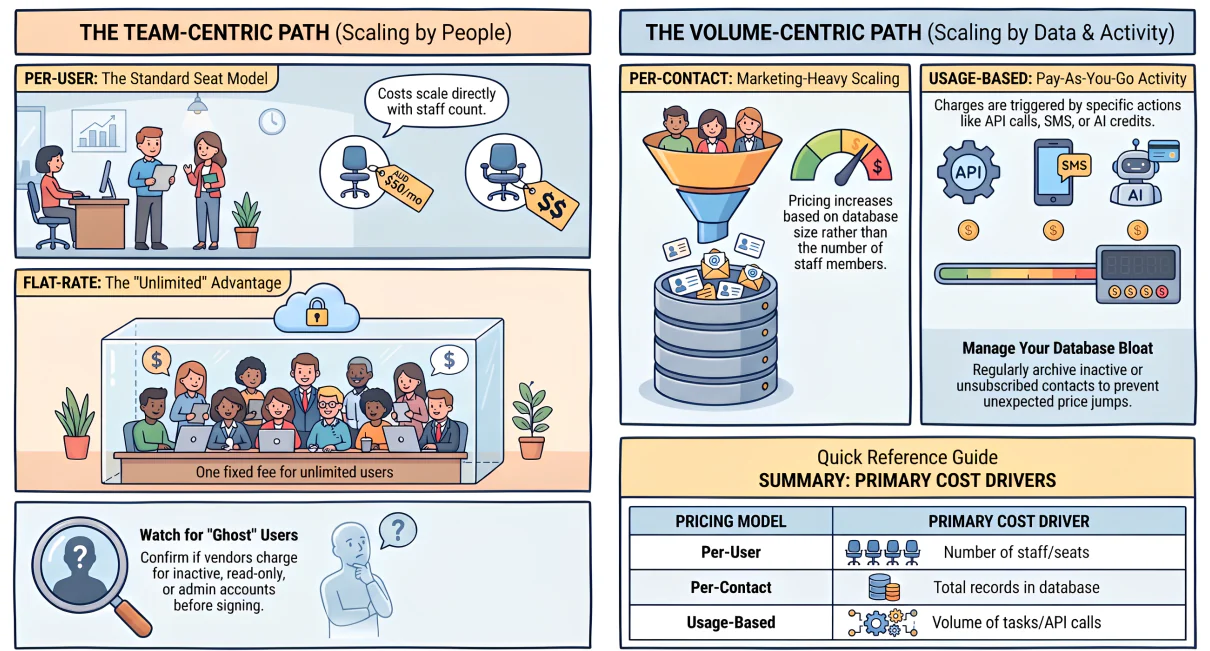
Per-user pricing is the most common model. At AUD $50/user/month, five users costs $250/month and 20 users costs $1,000. Compare the total team cost, not just the per-seat price.Some vendors charge for inactive, read-only, or admin accounts. Confirm exactly which account types count as paid users before requesting a quote.
2. Per-contact pricing
Per-contact pricing is common in marketing-heavy platforms like HubSpot and ActiveCampaign. Cost scales with database size, not team size. A 10,000-contact list costs more than a 1,000-contact list on the same plan.Growing lists can push costs up quickly, especially when inactive or unsubscribed contacts stay in the count. Ask vendors how contacts are measured and whether old records can be archived.
3. Flat-rate pricing
Flat-rate pricing charges one fee for unlimited users. Thryv charges AUD $199/month per location regardless of user count. This can work well for larger teams on standard processes.The trade-off is that flat-rate plans often include fewer advanced features. Check whether the included tools match your sales process before treating the fixed fee as a saving.
4. Usage-based pricing
Usage-based pricing charges by activity volume, such as emails sent, API calls, SMS messages, or automation runs. Costs are predictable for low-usage teams but can fluctuate at scale.Microsoft offers prepaid and pay-as-you-go Copilot credit arrangements alongside its CRM plans. AI features are increasingly priced this way, so review usage terms separately from the base licence.
5. Custom enterprise pricing
Salesforce, Microsoft Dynamics, and enterprise CRM deployments use custom quotes. The final price depends on user count, modules, data volume, integration complexity, and contract length.Always request a line-itemed quote so discounts don't obscure costly exclusions. This matters especially when CRM is bundled with broader sales order management capabilities in an enterprise platform.
What Factors Determine CRM Price?
Two businesses can pay very different amounts for the same CRM. Five factors drive most of the variation.1. Users and roles
More users means higher costs on per-user models. Some vendors charge the same rate for a sales rep and a read-only reviewer, while others offer tiered licence types.
Classify users by actual need before requesting a quote. Ask vendors to explain each licence type and what restrictions apply.
2. Features and plan tiers
Entry plans cover contacts, deals, and basic pipeline. Mid-tier plans add automation, reporting, and integrations. Moving up one tier can double monthly costs.Top plans include AI tools, advanced analytics, and multi-team management. Map each feature to an actual process before committing to a higher tier based on a demo.
3. Customisation requirements
Custom fields, workflows, and objects outside the standard plan require a higher tier or developer work. Sales process complexity drives most of this cost.Standard configuration is cheaper and easier to maintain than bespoke development. Check whether a requirement can be met through configuration before approving custom code.
4. Storage, APIs, and usage limits
File storage, API call limits, and automation run limits are the most underestimated cost drivers. Hitting a cap mid-month can incur overage charges or break workflows.A quote should state the included allowance and cost of exceeding it. Check whether projected usage fits the plan before signing.
5. AUD, GST, and contract terms
Most vendors price in USD or EUR. Currency movement affects AUD cost monthly unless the rate is locked in. GST applies to software subscriptions, so confirm whether the quoted price includes it.Annual contracts typically offer 15–20% savings over monthly billing. Review licence-reduction and cancellation terms before signing.
The ATO guidance on imported services and digital products explains how GST applies to international digital sales.
What CRM Implementation and Ongoing Costs Include
The subscription is the starting point. What most buyers underestimate is everything that comes before, during, and after go-live.| Cost Category | Typical Range (AUD) | Notes |
|---|---|---|
| Implementation and setup | $2,000–$50,000+ | Depends on complexity, integrations, and data migration volume |
| Onboarding fee (vendor-mandated) | $500–$4,500 | HubSpot Professional requires AUD $4,500 onboarding. Not all vendors charge this. |
| Data migration | $1,000–$10,000 | Cleaning and migrating contact and deal history from legacy systems |
| Training | $500–$5,000 | Per session or per team. Often skipped, leading to low adoption. |
| Customisation and development | $1,500–$20,000+ | Custom workflows, integrations, and fields beyond standard configuration |
| Integration work | $1,000–$15,000 | Connecting CRM to ERP, accounting, email, or other business systems |
| Ongoing admin and support | $200–$2,000/month | Internal admin time or external partner retainer |
| Annual subscription (5 users, mid-tier) | $3,600–$18,000 | Varies by platform and plan |
Before go-live costs include setup, data migration, and training. Scope creep is the main cost driver when ERP integration is not scoped upfront.
A realistic first-year budget includes 12 months of subscription plus implementation. SMBs typically spend AUD $5,000–$20,000. Mid-market ranges from AUD $20,000–$100,000+.
"Comparing CRM proposals by subscription price alone can hide the real cost. Implementation, integration, migration, training, and support must be budgeted before a decision is made."
CRM Pricing Scenarios by Deployment Complexity
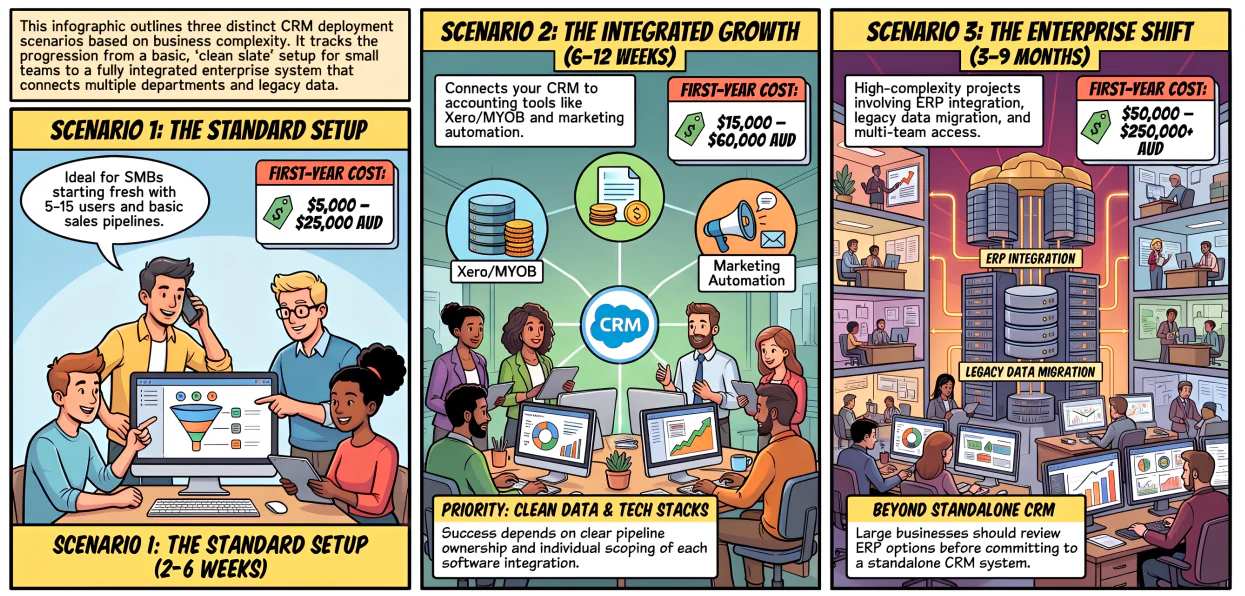
Three scenarios cover most of what Australian businesses encounter. Each has a different cost and risk profile.
1. Standard deployment
5 to 15 users, standard pipeline configuration, no custom integrations. Implementation typically takes 2 to 6 weeks. Total first-year cost: AUD $5,000–$25,000 including subscription and setup.Best for SMBs with a straightforward sales process starting from scratch. Clean data, clear pipeline ownership, and user training are the main priorities.
2. Integrated deployment
CRM connected to accounting software such as Xero or MYOB, email, and marketing automation. Custom fields and workflows required. Implementation: 6 to 12 weeks. Total first-year cost: AUD $15,000–$60,000.Best for growing businesses with an existing tech stack that need CRM to share data across systems. Each integration should be scoped individually in the quote.
3. Enterprise deployment
Multiple teams, custom objects, ERP integration, data migration from legacy systems, and role-based access across departments. Implementation takes 3 to 9 months. Total first-year cost: AUD $50,000–$250,000+.Best for larger businesses with complex sales processes or multi-entity operations. ERP software Australia options are worth reviewing before committing to a standalone CRM at this scale.
How to Compare CRM Pricing Plans and Quotes
Raw subscription prices are not comparable without normalisation. Four steps make CRM quotes comparable on a like-for-like basis.- Normalise commercial terms: Convert quotes to AUD, confirm GST, and calculate the annual cost for your expected user count. Avoid comparing rates across currencies.
- Normalise implementation scope: Confirm what each fee covers. “Setup” may include data migration for one vendor but exclude it for another, so request a written scope.
- Check exclusions and usage limits: Review contact, API, automation, and storage limits. Confirm each allowance, overage trigger, and additional rate.
- Use a quote-comparison scorecard: Compare annual subscriptions, implementation, integrations, support, and estimated year-two costs across the same rows.
How to Reduce CRM Costs Without Compromising Adoption
Cutting the wrong things raises the risk of failed adoption, which costs more than the savings. These approaches reduce real cost without affecting the outcome.- Negotiate annual contracts upfront: Most vendors offer 15–20% off annual billing. Negotiate before signing, when you have more leverage.
Audit user licences quarterly: Review login activity every quarter and remove inactive accounts to reduce wasted CRM spending.
- Use lower-tier user roles where available: Assign read-only or limited licences to employees who only need to view records.
- Phase the implementation: Begin with core features, then add modules as adoption grows. Advanced tools add little value before users understand the basics.
- Evaluate ERP-integrated CRM: A native CRM may lower costs for businesses also managing finance, inventory, procurement, or HR by reducing separate tools and integration maintenance.
Reducing CRM costs is not only about choosing a cheaper licence. The banner below shows how Hashy OS uses AI Coworkers grounded in live CRM data to handle routine sales work and help teams gain more value from the system.






Conclusion
CRM pricing in Australia starts at free and scales to enterprise contracts worth hundreds of thousands per year. Implementation, integration, customisation, and ongoing admin are the cost drivers most buyers underestimate.Businesses that want CRM connected with procurement, inventory, finance, and HR in one system can arrange a free consultation to explore a more integrated approach.
Frequently Asked Questions About CRM Pricing in Australia
CRM subscriptions range from free plans to more than AUD $230 per user per month. The final amount depends on the plan tier, user count, features, billing currency, and contract terms.
Usually not. Published prices generally cover software access, while implementation, migration, customisation, integrations, training, and deployment may be quoted separately.
Enterprise deployments vary in users, modules, data volumes, security needs, integrations, and support. Custom pricing allows vendors to quote for the required scope.
Check for onboarding, data migration, storage, API usage, automation, AI credits, premium support, additional environments, training, and integration maintenance.
Convert every quote to AUD, confirm GST, align the user count and contract period, then compare implementation, integrations, support, usage limits, and year-two costs.
No. A cheaper plan may exclude essential features, implementation, or support. The best value comes from the system that meets requirements without costly add-ons or low adoption.