






A production line can hit its output target and still lose ground through rework that the final count never reveals. Understanding what is first pass yield closes that blind spot for manufacturing teams.
First pass yield is the percentage of units that complete a defined process correctly on the first attempt, without rework, repair or a repeat inspection. The formula ties output to that attempt alone.
This guide works through the first pass yield calculation with a worked example. It compares FPY against rolled throughput yield and sets out eight owner-led actions alongside ERP and DMAIC controls.
Key Takeaways
First pass yield reveals the proportion of units that clear a defined production stage on the first attempt, without rework, repair, or repeat inspection.
Calculating FPY without overstating it means reworked units cannot re-enter the numerator, even if they pass on a second attempt.
Why FPY matters: every first-attempt failure consumes capacity planned for saleable production, adding unplanned labour, machine time, and material cost.
Improving first pass yield requires named process owners, standardised defect codes, traceable rework records, and a recurring management review cycle.

What Does First Pass Yield Reveal About Your Process?
First-pass yield indicates the share of units that entered a defined process and met its agreed-upon specification on the first attempt. The numerator counts good units; the denominator counts every entry.
A unit only qualifies as first-pass good when it clears specification without an unplanned correction or an extra processing loop. A verbal call of acceptable after a quick fix does not preserve a controlled result.
The measured boundary can cover one machine, a work centre, a stage or an entire line, and each choice answers a different question. Final inspection alone cannot show where components were repaired earlier.
Production orders and routings, checkpoints and rework records should all use the same boundary. Otherwise one site counts an operation while another measures a finished order, and figures stop being comparable.
"A first pass yield figure is only as credible as the boundary it measures. If each team draws the line in a different place, you are not comparing performance, you are comparing definitions."
How Do You Calculate First Pass Yield Without Overstating It?
The first pass yield formula divides units passing correctly on the first attempt by units entering the defined process, then multiplies by 100. The result shows the share of entries cleared without correction.
1. The FPY Formula and What Counts as a "Good" Unit
Consider an illustrative workstation receiving 1,000 units in a reporting period, where 920 pass specification on the first attempt. Fifty units need rework and thirty are scrapped before the count closes.
The first pass yield calculation divides 920 by 1,000 and multiplies by 100, giving 92 percent. Reworked units cannot rejoin that numerator once corrected, since the measure tracks first-attempt performance only.
Scrap stays in the denominator because those units entered the process and never became first-pass good output. Before approving any FPY figure, confirm the period, checkpoint and treatment of concessions.
2. Multi-Step Processes: Calculating FPY Per Workstation, Not Just at End-of-Line
A three-stage line needs a separate calculation wherever units enter a new measured stage, rather than one figure covering the whole route. The numbers below are illustrative rather than sector benchmarks.
| Process Stage | Units Entering | First-Pass Good Units | Rework | Scrap | FPY |
|---|---|---|---|---|---|
| Machining | 1,000 | 950 | 35 | 15 | 95.0% |
| Assembly | 950 | 912 | 28 | 10 | 96.0% |
| Final Test | 912 | 876 | 24 | 12 | 96.1% |
The assembly stage divides 912 by 950 and multiplies by 100 for a result of 96.0 percent. A final report showing 876 acceptable units alone would not reveal the 87 corrections made across all three stages.
This distinction matters once a line is being improved. Stage-level FPY points to the specific work centre generating first-attempt failures, while an end-of-line percentage mostly describes final disposition.
Why Does First Pass Yield Matter for Production Performance?
Every first-attempt failure can consume capacity that was planned for saleable output, even when the corrected unit eventually ships. Extra labour, machine time, material and inspection all get spent along the way.
1. The Direct Cost of Rework on Throughput, Labour, and Schedule
Rework creates a chain that crosses departments: production reopens an operation, quality repeats a test, and scheduling moves another order to make room. Finance is then left tracing where the extra cost belongs.
A weak result can constrain throughput, repeat labour outside standard routing, consume replacement materials and delay committed delivery dates. None of it shows up unless rework gets deliberately recorded.
Comparing first pass yield with OEE in manufacturing separates quality losses from availability and performance losses on the same line. That split gives managers a clearer starting point.
2. FPY Benchmarks by Industry: What Australian Manufacturers Target
There is no defensible universal percentage every Australian manufacturer should adopt. A mature packaging line should not be judged against a low-volume, tightly toleranced engineered product.
| Benchmark Factor | Management Interpretation | Suitable Comparison |
|---|---|---|
| Process maturity | A stable process may support a tighter internal target | Same line across controlled periods |
| Product complexity | More operations change the opportunity for failure | Similar product families and routings |
| Compliance risk | Critical characteristics may need stricter controls | Like-for-like regulated processes |
| Production volume | Low-volume results can move sharply after few failures | Comparable volumes and periods |
A good first pass yield reflects genuine process risk and improves against a controlled internal baseline. Manufacturers can review Australian Government manufacturing standards before adopting any external number.
Which Yield Metric Answers the Right Management Question?
FPY, RTY, final yield, scrap rate and rework rate are related but not interchangeable. The right metric depends on whether management wants to locate a defect, assess a line or reconcile output.
1. FPY vs RTY: What Each Measures and When to Use Which
Use first pass yield when a manager needs to identify which workstation is generating first-attempt failures. Use rolled throughput yield when executives need the cumulative probability across the line.
Finance should review FPY alongside rework and scrap data when estimating correction cost. An executive dashboard works best combining RTY, final yield and schedule attainment, not one percentage alone.
2. RTY Calculation Across a Multi-Step Production Line
Using the illustrative stage yields above, RTY multiplies 0.950 by 0.960 by 0.961 for roughly 87.6 percent. That figure is not workstation FPY; it is the probability a unit clears all three stages first time.
A line can report every stage above 95 percent while its cumulative right-first-time performance sits lower. Multiplying stage yields together shows how modest losses compound across several operations.
3. The Hidden Factory: What RTY Reveals That FPY-Only Reporting Conceals
The hidden factory is the unplanned work spent correcting, moving, reinspecting and administering failed output. An informal fix or a part sent back to an earlier station rarely appears on a final report.
Final output figures can conceal that activity once a corrected item eventually passes. Stage-level FPY, RTY and traceable rework records make those hidden capacity demands visible to operations and finance alike.
4. FPY vs FTY: The Same Metric Under a Different Six Sigma Label
First-time yield is commonly used as another name for first pass yield, though the data dictionary still needs checking first. One dashboard may exclude repeat inspections while another counts any eventual pass.
The label matters less than the controlled definition behind it. Every report should state its process boundary, numerator, denominator and treatment of rework before two percentages are compared side by side.
Why Is Your First Pass Yield Data Unreliable?
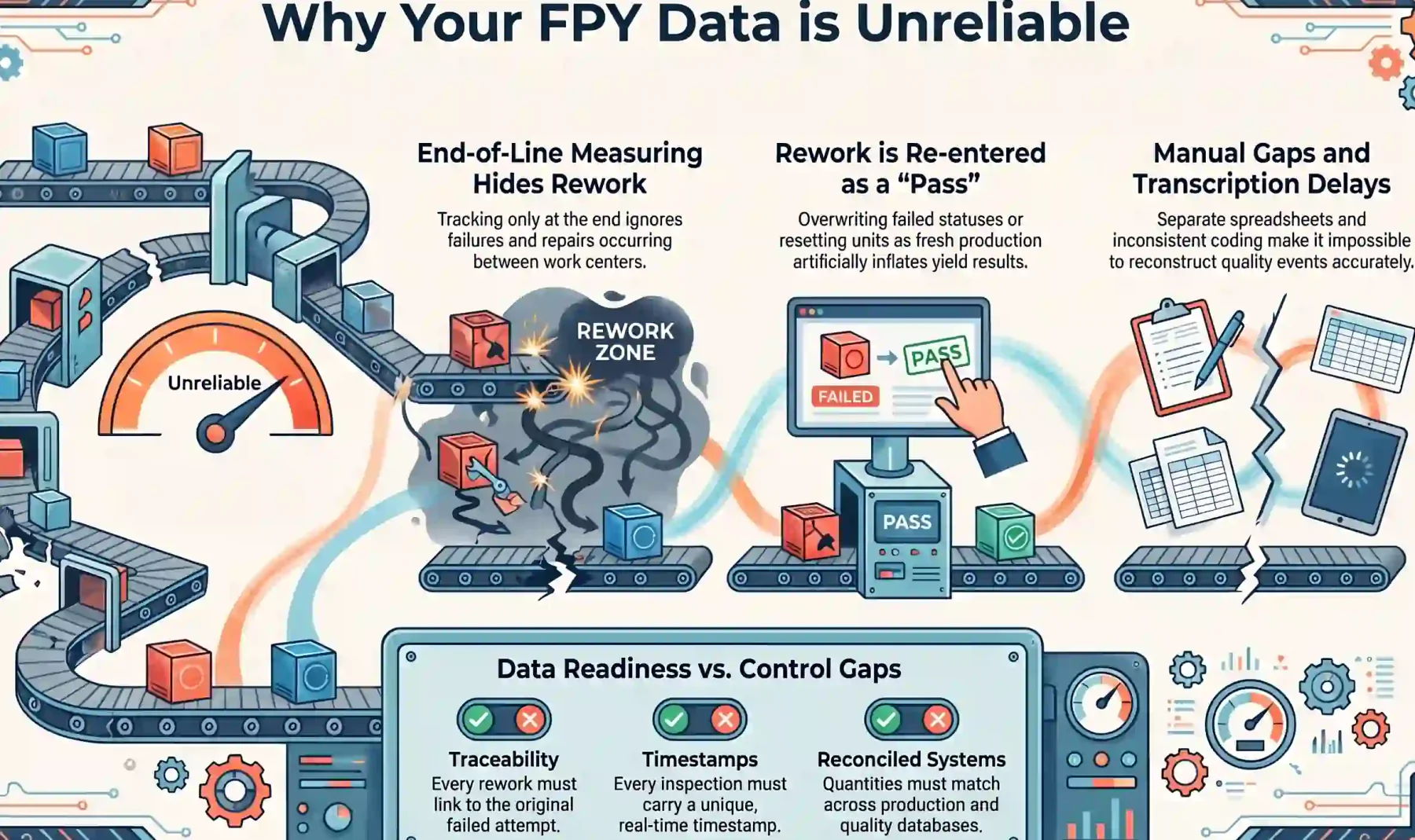
FPY data becomes unreliable once entries, inspection attempts and rework movements can no longer be traced with confidence. The reporting dashboard ends up reconciling output rather than measuring first-attempt quality.
1. Measuring Only at End-of-Line Hides Rework Between Stations
Imagine an assembly failing an electrical check, returning to wiring for repair, then passing inspection. An end-of-line report shows one pass; a stage-level record should show the failure, repair and second test.
Without those stage events, managers cannot tell which work centre absorbed the unplanned capacity or which defect caused it. End-of-line inspection stays useful, but cannot replace checkpoints where defects start.
2. Rework Re-Entered as "Pass": How Common Reporting Practices Inflate FPY
FPY gets overstated when a failed status is reset, a replacement order opens without linking to the original failure, or a corrected unit re-enters as fresh production. Overwritten results cause the same distortion.
The system should preserve the first inspection outcome and connect every later repair to the same unit, batch or order. A corrected unit can become acceptable output, but it cannot regain first-pass status.
3. Manual Data Collection Delays and Transcription Gaps in AU Manufacturing
Spreadsheet-based reporting can still support controlled analysis, but it turns risky once production and quality teams keep separate versions. Delayed updates and inconsistent codes make events hard to reconstruct.
A useful readiness check asks whether quantities reconcile across systems, whether every inspection carries a timestamp, and whether reworked units trace to their original failed attempt. A no flags a control gap.
How Can You Improve First Pass Yield? 8 Owner-Led Actions
Improving first pass yield rests on three pillars: process control, data discipline and accountable ownership. Each action needs a named owner, a data source and a recurring control confirming whether it worked.
| Action | Typical Owner | Required Data | Management Control |
|---|---|---|---|
| Define each process boundary | Operations Manager | Routings, work centres, checkpoints | Approved metric definition |
| Standardise failure classifications | Quality Manager | Defect, rework and scrap codes | Monthly code review |
| Validate production master data | Production Engineering | BOMs, routings, instructions | Change approval and revision audit |
| Position risk-based checkpoints | Quality Engineering | Defect origin and process-risk data | Checkpoint effectiveness review |
| Segment recurring defects | Continuous Improvement Lead | Product, shift, batch and work-centre records | Pareto and trend review |
| Connect competency records | Production Supervisor | Training and authorised operator records | Competency refresh control |
| Coordinate supplier quality | Procurement and Quality | Supplier batch and incoming inspection data | Supplier corrective-action review |
| Review results and actions | Operations Director | FPY, RTY, rework, scrap and cost data | Recurring management meeting |
Assigning an owner to every boundary resolves disagreement between routing quantities, QC results and shop-floor reporting. Standardised defect codes keep root-cause analysis usable, not just recorded.
Positioning checkpoints where defects originate matters more than inspecting everything indiscriminately. A recurring review pairing FPY with RTY, rework hours and overdue actions keeps the cycle accountable.
How Does ERP Software Support First Pass Yield Improvement?
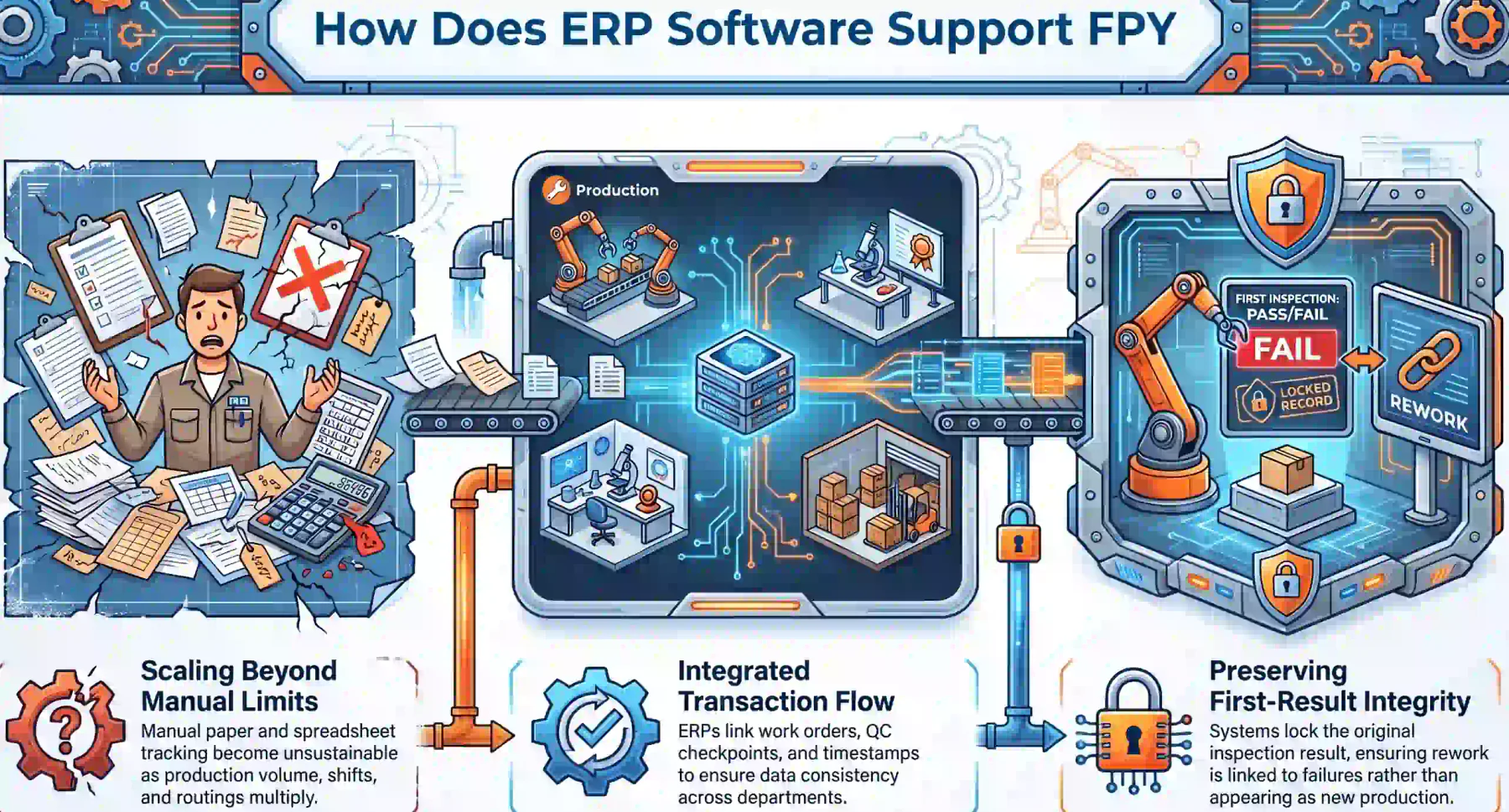
ERP software can support FPY once production, quality, inventory and cost records share one controlled transaction flow. A dashboard alone does not create that discipline; configuration has to enforce it first.
1. Why Manual FPY Tracking Breaks Down as Production Volume Scales
A single work centre can track pass and fail counts on paper without much difficulty. Multiply that across dozens of routings, shifts and batches, and manual reconciliation stops being sustainable.
Spreadsheet versions drift apart once production, quality and inventory teams update figures separately. By the time a manager compares them, the events may already be a week old and hard to trace precisely.
2. How ERP Connects Work Orders, QC Checkpoints, and Rework Classification Into Automatic FPY Calculation
A production order releases the approved item, quantity and routing, while operation confirmations record what enters and leaves each work centre. Timestamped QC results preserve the first inspection outcome.
Failed units receive a controlled defect code, and any rework order stays linked to that original failure rather than appearing as new production. Reporting can then calculate FPY by work centre, product or shift.
3. What to Look for in a Manufacturing ERP for FPY Visibility
Look for a system that locks the first inspection result once recorded, rather than allowing a status to be silently overwritten during rework. Traceability to the original failed attempt should not need digging.
Configurable defect libraries, work-centre reporting and integration with inventory movements matter more than a polished dashboard alone. A specialised Manufacturing ERP can connect these production and quality events.
How Should You Control FPY Through DMAIC and Management Reviews?
A single FPY improvement rarely holds without a repeatable framework behind it. DMAIC and a documented quality management system give Australian manufacturers a structure for controlling first pass yield over time.
1. DMAIC as the Systematic FPY Control Framework
DMAIC defines, measures, analyses, improves and controls a process in sequence, and FPY fits naturally into each phase. Define sets the boundary; measure and analyse use stage-level FPY to locate causes.
Improve tests a specific corrective action against a control group, while control locks the gain in with a monitoring plan and a recurring review. Skipping control is the most common reason an early gain reverses.
2. ISO 9001 and AU Quality Management System: Where FPY Fits
ISO 9001 does not mandate a specific FPY target, but its requirement for measurable quality objectives gives first pass yield a natural home inside a documented QMS. Auditors expect traceable evidence behind it.
Standards Australia maintains the national standards that AS/NZS ISO 9001 builds on. Government tenders increasingly expect certified suppliers to demonstrate this level of documented control.
3. Management Review Cadence: What to Include in Monthly QA Reporting
A monthly review should pair stage FPY with RTY, rework hours, scrap value and overdue corrective actions, not one headline percentage. Trends across shifts and product families reveal more than a snapshot.
Each action from the review needs a named owner and a due date, then a follow-up check confirming whether first-attempt performance moved. Reviewing the percentage alone risks rewarding delayed reporting.
By the time a monthly review meets, stage FPY, RTY, rework and scrap figures often sit in separate files. When they share one system, Hashy AI reads them together and flags them automaticaly.






Conclusion
First pass yield earns its place on a dashboard only when it prompts a decision, not when it sits there as a static score. A controlled calculation shows how much work clears a defined stage on the first attempt.
Agree the process boundary, preserve the original inspection outcome, and build a recurring DMAIC-style review around the result. That foundation supports sharper capacity planning and clearer cost analysis.
If you want to learn more, you can book a free consultation with our experts today. Discover how you can implement first pass yield and optimize your operation.

Frequently Asked Questions
A good result depends on product complexity, process risk, the measurement boundary and production volume, not one universal number. Compare like-for-like work centres and improve against a controlled baseline.
First pass yield measures first-attempt performance at one specified process or workstation. Rolled throughput yield measures the probability a unit passes every stage of a multi-step line without correction.
Calculate FPY separately at each workstation by dividing first-pass good units by units entering that workstation, then multiplying by 100. Multiplying the decimal yields together produces rolled throughput yield.
The hidden factory is the unplanned labour, machine time, inspection and material movement consumed correcting failed output. Final output figures can conceal this work once a repaired unit becomes acceptable.
ERP software connects work orders and operation entries with timestamped QC results, defect codes and rework classifications. Reliable automation still depends on correct configuration and consistent boundaries.