



A freight management system is the operational backbone for any business that ships goods regularly, whether via road freight, sea, or air. Australian companies face particular challenges with freight, including long transit distances, multiple carrier networks, and the ongoing need to control costs across every shipment. This article covers how freight management systems work, what features matter most, the key business benefits, and what to consider when selecting software for an Australian context.
Key Takeaways
How a freight management system works: each shipment moves through five stages, from order capture to invoice reconciliation, with carrier selection, documentation, and tracking handled automatically.
Key features that reduce costs: rate comparison at booking, automated invoice matching, and ERP integration are the capabilities that deliver the fastest return for Australian freight teams.
Benefits go beyond logistics: a freight system cuts finance workload through automated invoice reconciliation and gives customer service teams live delivery data without manual carrier follow-up.
What separates good freight software from poor: carrier coverage for your trade lanes and ERP integration depth matter more than feature count when evaluating platforms for an Australian business.
What Is a Freight Management System?

A freight management system (FMS) is software that helps businesses plan, manage, and track the movement of goods from origin to final delivery. It centralises freight operations into one platform for better visibility and control.
The system manages tasks such as carrier management, shipment tracking, freight documentation, and invoice reconciliation. This reduces reliance on spreadsheets and multiple carrier portals while improving accuracy and efficiency.
An FMS is suitable for any business that ships goods regularly, whether through local deliveries, interstate transport, or international air and sea freight.
How Does a Freight Management System Work?
A freight management system connects every stage of the shipping process, from order capture through to payment reconciliation. The five stages below outline how each part of that cycle is handled.
1. Shipment planning and order capture
The process begins when a sales or warehouse order triggers a shipment requirement in the system. The FMS captures the order details, including weight, dimensions, origin, destination, and required delivery date, and consolidates orders where possible to reduce freight costs. Planning tools factor in carrier availability and transit times so businesses can set realistic delivery expectations before a booking is confirmed.
2. Carrier selection and freight rate comparison
Choosing the right carrier for each shipment is one of the most cost-sensitive decisions in the freight process. The FMS pulls live or contracted rates from connected carriers and presents them side by side, filtered by transit time, cost, and service level requirements. Businesses can configure rules to automatically select the lowest-cost compliant option, or route the decision to a coordinator for review before the booking is placed.
3. Booking, dispatch, and freight documentation
Once a carrier is selected, the FMS confirms the booking and generates the required freight documents automatically from the underlying order data. These include consignment notes, bills of lading, packing slips, and customs documentation for cross-border shipments. Automated document generation reduces the risk of errors on compliance paperwork, which is particularly critical for businesses handling regular international freight.
4. Tracking, proof of delivery, and customer updates
After dispatch, the FMS tracks shipments in real time and records delivery confirmation against each order in the system. Carriers transmit status updates, estimated arrival times, and proof of delivery data back into the platform as shipments move through the network. Customer service teams can share live tracking links or send automated delivery updates directly to recipients, reducing inbound enquiries significantly.
5. Freight invoice matching and reporting
The final stage closes the financial loop by matching carrier invoices against the original quoted or contracted rates for each shipment. The FMS compares invoice line items against the agreed rate and flags discrepancies for review before any payment is approved. Approved invoices pass to accounts payable automatically, while exceptions are held until a freight coordinator resolves them, keeping payment cycles on track.
Key Features of Freight Management Software
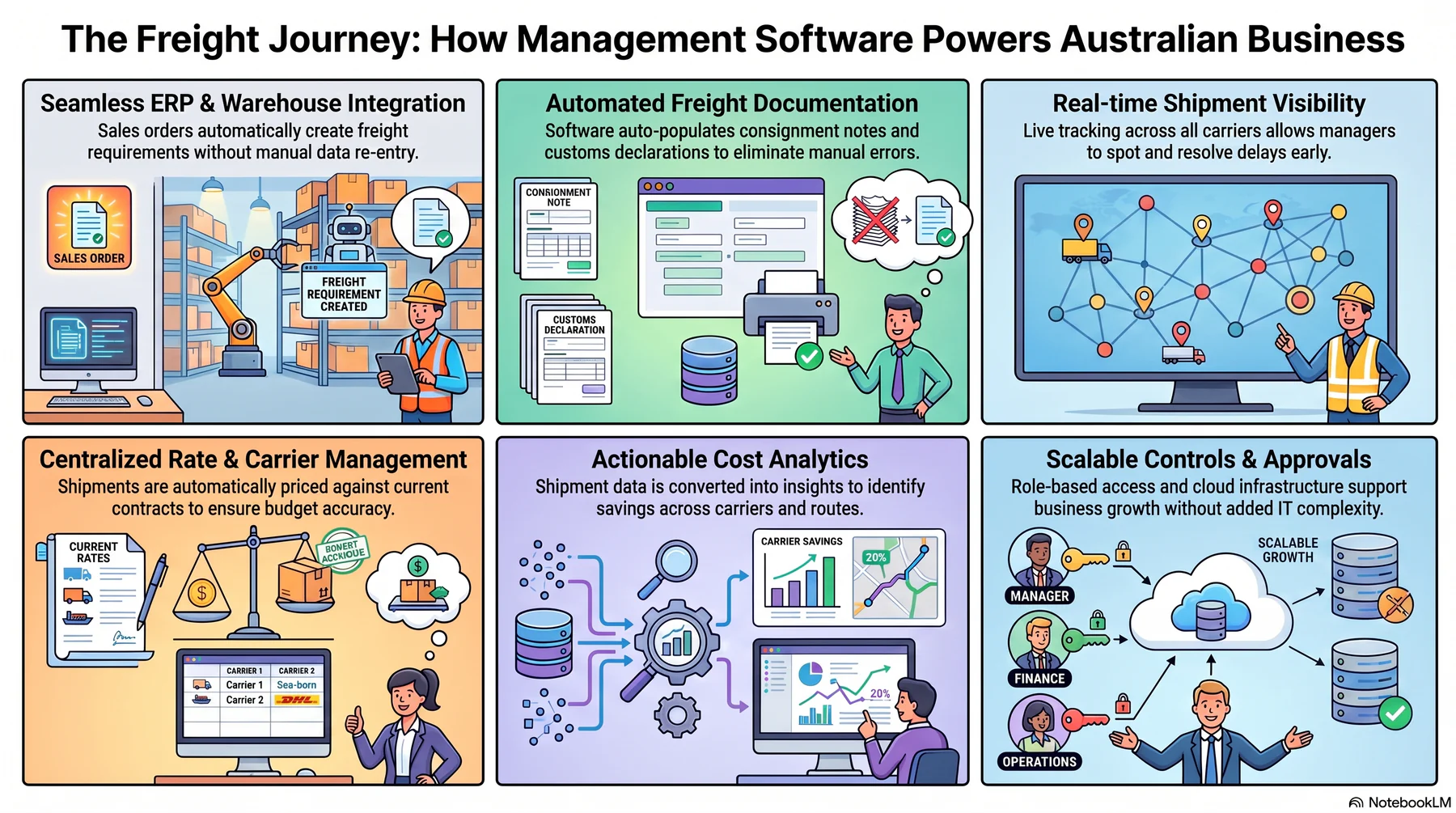
The most effective freight management software combines operational tools with financial controls and integrations that connect freight to the rest of the business. The six features below deliver the most measurable value for Australian businesses.
1. Real-time freight tracking and shipment visibility
Real-time tracking gives businesses a live view of every shipment in transit, regardless of carrier or transport mode. Status updates flow directly into the platform from carrier systems, removing the need to monitor multiple carrier portals or follow up by phone. Visibility dashboards allow logistics managers to spot delays early and act before a late shipment affects a customer commitment or warehouse schedule.
2. Carrier and rate management
Good freight management software stores contracted rates by carrier, lane, and weight break so every shipment is priced against the current agreement automatically. Rate management tools also support carrier performance tracking, helping businesses identify which carriers consistently deliver on time and within budget. When contracts renew, updated rates load centrally rather than being re-entered across spreadsheets or distributed to multiple teams by email.
3. Freight documentation automation
Generating freight documents manually introduces risk, including missing fields, incorrect weights, or wrong consignee details on a consignment note. Freight software auto-populates consignment notes, waybills, and customs declarations from the underlying order data, reducing the chance of errors at the point of dispatch. Templates are pre-configured to carrier and customs requirements so documents are ready to transmit as soon as a booking is confirmed.
4. Freight cost reporting and analytics
Reporting tools convert raw shipment data into actionable cost insights for procurement, logistics, and finance teams across the business. Businesses can break freight spend down by carrier, route, customer, or time period to identify where costs are rising and where savings are available. Detailed reporting also reduces the risk of freight cost surprises at month end and supports more accurate budget forecasting for the year ahead.
5. Integration with ERP, warehouse, and accounting systems
A freight management system delivers its full value when it connects directly with the platforms your business already relies on. ERP integration ensures sales orders and purchase orders automatically create freight requirements without manual re-entry by the logistics team. Accounting integration passes approved freight invoices directly to accounts payable, closing the financial loop without duplicating data entry across multiple systems.
6. User access, approvals, and scalability
Role-based access controls allow businesses to limit what each user can view, book, or approve, which is important for maintaining cost accountability across locations. Approval workflows can route high-value freight bookings or billing exceptions to a logistics manager before dispatch is confirmed or payment released. Cloud-based freight software scales with the business without requiring additional server infrastructure or lengthy IT implementation projects at each growth stage.
Benefits of Freight Management Systems for Australian Businesses
Australian businesses managing freight across long distances and complex carrier networks gain significant operational and financial advantages from a dedicated system. The five benefits below reflect the most consistent improvements businesses report after implementation.
1. Better freight cost control
A freight management system gives businesses a complete view of what they spend on freight, broken down by carrier, route, and shipment type. Rate comparison at the time of booking prevents overpaying when a lower-cost compliant option is available for the same lane and delivery window. Invoice matching catches overbilling before payment is released, recovering costs that would otherwise go unnoticed in a manual reconciliation process.
2. Improved delivery visibility
Real-time tracking means businesses no longer rely on carrier websites or phone calls to find out where a shipment currently sits in the network. All status updates flow into one dashboard, so customer service teams have the same live data as the logistics team at any point during transit. Visibility also supports proactive exception management, allowing businesses to reroute or reschedule before a delay creates a larger operational problem downstream.
3. Fewer billing and invoice disputes
Automated invoice matching compares each carrier charge against the quoted or contracted rate and flags discrepancies before any payment is approved or released. This process removes the back-and-forth that typically follows when a carrier invoice arrives with unexpected surcharges or additional line items. Resolving disputes faster maintains better carrier relationships and keeps accounts payable workflows moving on a predictable schedule.
4. Stronger multi-location freight management
Businesses with warehouses, distribution centres, or retail sites across multiple states need visibility over all freight movements consolidated in a single system. A freight management system brings shipment data from every location together, making it possible to compare costs and carrier performance across the full network. Central reporting helps head office identify where freight volumes can be consolidated to negotiate stronger carrier rates at the next contract renewal.
5. Better customer service from reliable delivery data
Customers expect accurate delivery information, and a freight management system makes that data available without manual tracking work from the service team. Staff can access live shipment status, estimated arrival times, and proof of delivery records from within the platform at any time during business hours. When a customer raises a delivery enquiry, accurate data is available immediately, reducing resolution time and improving the overall service experience.
Freight Management System vs Transportation Management System
The terms freight management system and transportation management system are often used interchangeably, but they serve different operational purposes and suit different business types. The three sections below clarify what each covers and when a business needs one, the other, or a combination of both.
1. What a freight management system focuses on
A freight management system is built around the management of individual shipments, covering booking, carrier selection, documentation, tracking, and invoice reconciliation. Its primary value is freight cost control and shipment visibility, making it the right tool for businesses that use third-party carriers and want better accountability over performance and billing. An FMS suits manufacturers, distributors, and retailers that need tighter control over outbound and inbound freight without managing a full transport network directly.
2. What a transportation management system covers
A transportation management system operates at a broader level, covering route optimisation, load planning, fleet management, and multi-modal transport coordination across a logistics network. TMS platforms are typically used by logistics providers, freight forwarders, and large manufacturers that need to plan how goods move across complex supply chains. The scope extends well beyond individual shipments to include strategic decisions about transport network structure, capacity, and cost efficiency.
3. When your business needs FMS, TMS, or both
Most Australian businesses outside the logistics sector need an FMS rather than a TMS. An FMS handles the day-to-day freight booking, tracking, and billing that a typical manufacturer or distributor requires. A TMS becomes relevant when a business operates its own fleet, manages high-volume multi-modal freight, or needs to optimise routes across a large network with many variables. Some larger businesses implement both, using an FMS for freight booking and invoice management while relying on a TMS for fleet routing and transport network planning. FMS vs TMS comparison table:
Freight Management Software in Australia: What to Consider
Selecting the right freight management software requires more than comparing feature lists. The four factors below are the most important to evaluate before committing to a platform for your business.1. Carrier coverage and freight network
Choose a platform that supports the carriers your business already uses, including domestic and international freight providers. Broad carrier coverage reduces manual work and simplifies shipment management.
2. Australian freight documentation
The system should support key freight documents, such as consignment notes and customs declarations, while keeping shipment records organised for compliance and audits. Businesses with regulated freight should also check for industry-specific documentation support.
3. Integration with business systems
Look for software that integrates with your ERP, WMS, and accounting system. Connected data helps eliminate manual entry, improves accuracy, and streamlines freight operations.
4. Support and ease of use
Choose a solution with an intuitive interface, structured onboarding, and reliable local support. Good training and ongoing assistance help teams adopt the system faster and keep freight operations running smoothly.
If you're looking for a solution that connects freight, inventory, purchasing, and finance in one platform, it's worth exploring an integrated ERP system like HashMicro. With AI Hashy, businesses can quickly retrieve shipment information, generate operational reports, analyse freight costs, and receive AI-powered insights through simple natural language prompts.






Freight Audit, Billing, and Cost Control
Freight audit and cost control are among the highest-value functions in a freight management system, directly reducing what a business overpays on carrier invoices. The three sections below cover how each function works in practice.1. Matching freight invoices with quoted rates
Every freight invoice should be matched against the rate quoted or contracted at the time of booking before any payment is approved by the finance team. An FMS performs this comparison automatically, checking each line item on the carrier invoice against the agreed rate for that shipment, lane, and weight bracket. Discrepancies are flagged immediately for review, preventing overbilling from passing through accounts payable undetected, which is a common and costly problem in manual freight billing processes.2. Tracking freight cost by carrier, route, and customer
Tracking freight spend at a granular level gives businesses the data they need to negotiate better rates, allocate costs accurately, and identify where inefficiencies are occurring across the network. A freight management system records the cost of every shipment against the carrier, route, and customer associated with that order, building a complete cost history over time. This data is particularly valuable at contract renewal time, when actual spend by carrier and lane gives procurement teams a strong basis for rate negotiations rather than relying on estimates.3. Controlling freight approvals and exceptions
Not every freight booking should proceed without review. High-value shipments, urgent bookings outside standard rates, and requests on non-standard routes often require additional sign-off before confirmation. Approval workflows allow businesses to set thresholds or conditions that trigger a review before a booking is confirmed or an invoice is released for payment to the carrier. Exception management reduces unauthorised freight spend, keeps costs within budget, and gives logistics managers a clear audit trail of every decision made outside standard operating parameters.Conclusion
Freight management is one of the highest-cost and most operationally demanding functions for any business that ships goods regularly. A freight management system gives Australian businesses the tools to control those costs, maintain delivery visibility, and hold carriers accountable for performance at every stage of the shipment cycle. The right platform connects freight operations to the rest of the business, from warehouse and inventory through to accounting and customer service, reducing manual work and improving decision-making with accurate, real-time data. To see how freight management software can reduce costs and improve visibility across your operation, contact the HashMicro team for a free consultation.
Frequently Asked Questions
Most Australian businesses that ship goods regularly benefit from freight management software. It reduces manual booking work, tracks shipments without relying on individual carrier portals, and catches billing errors before payment. For businesses managing multiple carriers or locations, the return is typically clear within the first few months.
When an ERP connects to freight management software, sales orders automatically create shipment requirements without manual re-entry. Freight costs flow back into the ERP for job costing or customer billing, and approved carrier invoices pass directly to accounts payable, removing the double handling that slows down logistics and finance teams.
No. A freight management system suits any business that ships goods regularly, including manufacturers, distributors, and retailers of all sizes. The core benefit for smaller businesses is cost control and delivery visibility. Many platforms are scalable and configurable to match the freight volume and carrier mix of a growing business.