



Route optimisation calculates the most efficient delivery paths for vehicles, drivers, and field teams. It factors in stops, time windows, capacity, and traffic before producing a recommended sequence.
Australian fleet teams manage long distances, tight delivery windows, and limited driver availability. Poor routing adds fuel costs, driver overtime, and customer complaints that compound quickly at scale.
This article covers what route optimisation means, why it matters for Australian businesses, how it works, and what to look for in route optimisation software.
Key Takeaways
Route optimisation is the practice of using delivery data and operational rules to calculate the most efficient journey for each vehicle or field team.
How route optimisation works covers stop sequencing, vehicle constraints, time windows, and real-time adjustments to daily delivery plans.
Route optimisation software features to look for include GPS tracking, stop sequencing, driver assignment, delivery updates, and reporting.
HashMicro fleet management software is covered as an ERP-connected option for businesses that need dispatch, GPS, and reporting in one system.
What Is Route Optimisation?
Route optimisation uses delivery data and operational rules to calculate the most efficient journey for each vehicle or field team. The goal is not always the shortest route but the most practical one.
Teletrac Navman describes it as calculating the best possible routes for drivers across their working day. This means weighing stop priority, vehicle suitability, load limits, and time windows together.
Basic route planning tells a driver how to reach a destination. Route optimisation decides which stops to group, which driver should take them, and how the sequence should shift when delays or new orders arrive.
In business terms, route optimisation answers one practical question: which route should each driver take to complete more deliveries with less wasted time, fuel, and distance each day?
"Route optimisation is not only about the shortest path. It is about connecting route planning with real-time fleet visibility, so dispatch teams can act before problems reach the customer."
Why Route Optimisation Matters for Australian Businesses
Route optimisation matters because Australian fleet teams face long travel distances, tight delivery windows, and limited driver availability. The Australian Bureau of Statistics identifies transport and storage as a high operating cost for Australian businesses, particularly those managing deliveries across regional and metropolitan areas.
Geotab highlights route sequencing and reduced unnecessary kilometres as core efficiency drivers for fleet operations. For Australian logistics, distribution, retail, and service teams, inefficient routes directly affect fuel costs, labour time, and customer satisfaction.
1. Delivery distance and fuel cost pressure
Poorly planned routes increase fuel use and driver hours. BITRE identifies road freight as Australia's largest share of domestic freight, making route efficiency a direct concern for fleet operators.
Route optimisation helps businesses avoid repeated backtracking and inefficient grouping of stops. Better routing decisions can reduce unnecessary kilometres without adding drivers or vehicles.
For businesses managing high delivery volumes or regional routes, even small improvements in route efficiency can reduce fuel spend and driver overtime across the working week.
2. Driver scheduling and dispatch delays
Dispatch teams assign routes while managing late orders, driver availability, urgent customer requests, and changing delivery windows. Manual planning under these conditions is where errors most often occur.
Route optimisation gives dispatchers a clearer basis for assigning work. Teams can match routes to driver availability and vehicle capacity more accurately instead of relying on experience alone.
3. Customer delivery expectations
Customers expect accurate delivery times and prompt updates when schedules change. Without reliable route planning, delivery windows become estimates rather than commitments.
Route optimisation improves arrival accuracy and gives dispatch teams the visibility to adjust plans before a delay reaches the customer.
4. Multi-location fleet visibility
Businesses with multiple depots, stores, warehouses, or service teams need visibility across the entire fleet, not only individual drivers or single locations.
Route optimisation is most effective when it connects to GPS tracking, dispatch records, and performance reporting across all locations. This turns route data into a management tool.
How Route Optimisation Works
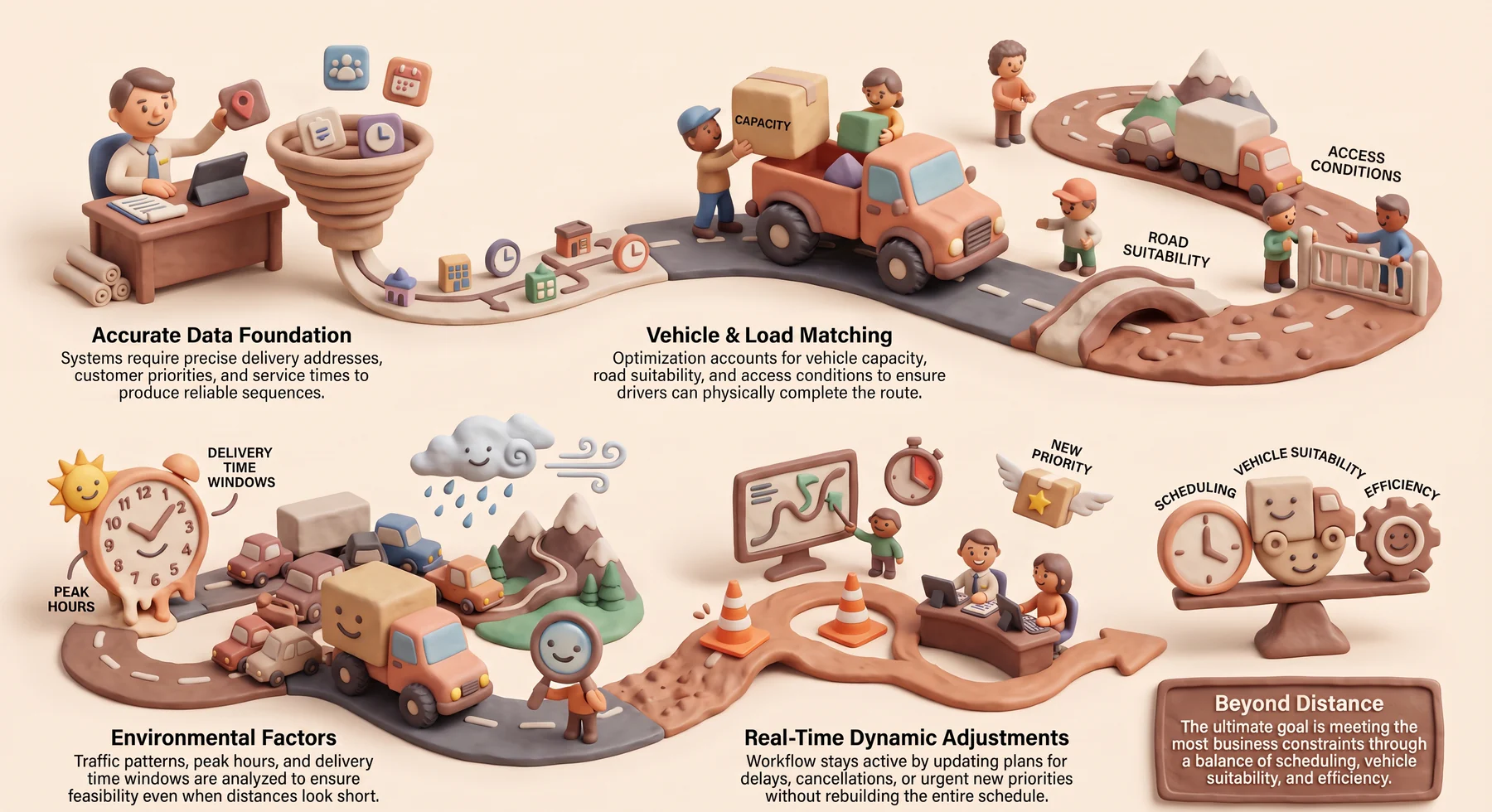
Route optimisation analyses stops, vehicles, constraints, and route objectives before producing a recommended sequence.
Verizon Connect notes that route optimisation considers factors beyond distance, including scheduling, vehicle suitability, and delivery efficiency. The goal is the route that meets the most business constraints.
1. Delivery locations and stop sequencing
Route optimisation begins with stop data. The system needs accurate delivery addresses, service locations, customer priorities, and expected service times before it can produce a reliable route.
If address data is incomplete or service times are underestimated, even a well-designed algorithm will return weak results. Accurate input data is the foundation of reliable routing.
2. Vehicle capacity and route constraints
Every delivery route must match vehicle limits. A route may look efficient on a map but fail in practice if the vehicle cannot carry the load or is unsuitable for the road, goods, or access conditions.
Route optimisation accounts for these constraints before assigning stops. This prevents dispatchers from building routes that drivers cannot complete as planned.
3. Traffic, distance, and delivery time windows
Route optimisation weighs time windows alongside travel conditions. This helps dispatchers avoid assigning routes that drivers cannot complete on time, even when the map distance looks short.
Traffic patterns, peak hours, and road access restrictions all affect route feasibility. A system that factors these in produces routes that work in practice, not only on screen.
4. Real-time route adjustments
Modern route optimisation can update plans when drivers face delays, cancellations, urgent orders, or new stop priorities. This turns routing into an active daily workflow rather than a static schedule.
Dispatch teams can reassign stops, adjust sequences, and communicate changes to drivers without rebuilding the entire route from scratch each time a disruption occurs.
Route Optimisation vs Fleet Optimisation
Route optimisation focuses on how vehicles move between stops. Fleet optimisation is broader and covers vehicle use, driver productivity, vehicle maintenance, fuel, safety, and fleet-wide performance reporting.
1. Route optimisation focuses on journey planning
Route optimisation answers one question: what is the best stop sequence for each driver today? It connects delivery data, vehicle availability, time constraints, and route rules to produce a daily plan.
The scope is the journey itself. Route optimisation helps dispatchers assign work, sequence stops, and adjust plans when field conditions change during the working day.
2. Fleet optimisation covers total fleet performance
Fleet optimisation covers the performance of the entire fleet over time. It includes vehicle use, driver productivity, maintenance planning, fuel control, incident tracking, and management reporting.
Where route optimisation manages the daily journey, fleet optimisation manages the asset. Managers use it to assess whether vehicles, drivers, and budgets are used efficiently across the business.
3. Why businesses often need both
Route optimisation improves daily delivery execution. Fleet optimisation helps managers assess whether the whole fleet is being used efficiently, safely, and cost-effectively over time.
Connecting both gives operations teams better daily control and managers better data for long-term fleet decisions. Businesses that invest in one without the other often miss the wider picture.
Benefits of Route Optimisation

Route optimisation improves daily delivery performance by reducing avoidable travel and giving dispatch teams better control over route decisions.
Salesforce AU describes route optimisation software as a tool that minimises travel time and fuel costs for deliveries and service calls. The benefits extend beyond speed alone.
1. Lower transport costs
Better routing reduces wasted kilometres, unnecessary fuel use, and inefficient driver time. This gives businesses a clearer way to control one of the most variable parts of fleet operations.
For high-volume delivery teams, even small reductions in daily kilometres can compound into significant fuel and labour savings across the working week.
2. Faster deliveries
When stops are sequenced correctly, drivers spend less time crossing the same areas repeatedly. Better stop grouping means more deliveries can be completed in the same operating window.
For businesses managing tight delivery windows, this can mean more jobs completed per shift without adding vehicles or drivers to the schedule.
3. Better driver productivity
Drivers work more effectively when routes are realistic, clearly assigned, and free from last-minute changes. Planned routes reduce confusion, backtracking, and unnecessary dispatch contact.
Route optimisation gives drivers a confirmed plan to follow. This reduces idle time and helps teams complete more stops without extending the working day unnecessarily.
4. Improved dispatch accuracy
Dispatchers need to know which driver can handle specific stops, when a route will finish, and whether a new request fits the current schedule without disrupting existing deliveries.
Route optimisation gives dispatch teams a stronger factual basis for those decisions. Teams assign work more accurately instead of relying on experience or incomplete stop data.
5. Stronger fleet reporting
Route data becomes more useful when captured and reported consistently. Managers can compare planned routes with actual performance and identify recurring delay patterns across the fleet.
Reliable reporting also helps businesses track improvement over time across driver productivity, fuel use, and delivery completion rates across regions and depots.
Common Route Optimisation Challenges
Route optimisation can fail when businesses use poor data, disconnected systems, or manual planning rules that do not reflect real fleet conditions.
The issue is rarely the route map alone. It is usually the operational data and processes behind the route that cause planning results to break down in practice.
1. Incomplete delivery data
Missing addresses, unclear delivery time windows, and inaccurate service durations weaken route planning from the start. If route inputs are unreliable, route outputs will be too.
Businesses need accurate stop data before route optimisation can produce reliable results. Auditing delivery records and service time estimates reduces this risk significantly.
2. Last-minute order changes
Urgent orders, customer cancellations, and late dispatch requests can disrupt even a well-planned route.
The ability to adjust schedules without losing fleet visibility is critical. Without a system that handles changes in real time, dispatchers often rebuild routes manually. This creates delays and reduces the practical benefit of route planning tools.
3. Poor driver visibility
Route plans are harder to manage when dispatchers cannot see the driver's location or delivery progress. Planned routes and actual field conditions can diverge quickly without live visibility. GPS tracking and delivery status updates help close this gap.
Dispatchers can monitor what is happening on the route rather than waiting for driver check-ins to get updates.
4. Disconnected dispatch and inventory systems
Route optimisation becomes harder when dispatch teams do not know whether inventory is ready, which depot should fulfil an order, or whether a delivery has been released for collection.
When dispatch, inventory, and route planning share the same data, teams can build routes based on what is actually available and confirmed. Disconnected systems make this consistently difficult.
Route Optimisation Software Features to Look For
Route optimisation software should support practical fleet workflows, not only draw routes on a map. The most useful tools connect planning with driver assignment, GPS visibility, and reporting.
1. GPS fleet tracking
GPS tracking helps dispatchers compare planned routes with actual driver movement. It also supports customer delivery updates and makes real-time delay management more practical.
For businesses managing multiple drivers across long distances, live fleet visibility is essential for controlling route execution after the working day begins.
2. Route planning and stop sequencing
The system should arrange stops based on business constraints, not only distance. Good routing considers vehicle capacity, driver availability, delivery windows, and stop priority together.
Stop sequencing that reflects real operational rules is what separates route optimisation from basic mapping. The route should work in practice, not only on a screen.
3. Driver assignment
Route planning is incomplete without driver assignment. Businesses need to match the right driver, vehicle, and route based on availability, license type, and current workload across the fleet.
Manual assignment without this data leads to uneven workloads and route conflicts that could have been avoided at the planning stage before dispatch begins.
4. Delivery status updates
Delivery updates help teams see what has been completed, what is delayed, and what still needs attention. This lets dispatchers respond before small route issues become customer complaints.
Without delivery status visibility, dispatch teams depend on drivers to report progress. This creates gaps in how quickly route problems can be identified and addressed.
5. Reporting and analytics
Reporting helps managers understand route performance over time. Useful metrics include planned versus actual route time, delivery completion rates, driver productivity, and recurring delays.
Route reports also support fuel management decisions and fleet planning improvements that build up across the working quarter and improve over the longer term.
How HashMicro Fleet Management Software Supports Route Optimisation
HashMicro's fleet management software connects fleet visibility, dispatch workflows, and operational reporting in a single system. Route optimisation depends on reliable data. HashMicro fleet optimization system gives dispatch teams GPS tracking, vehicle availability records, driver assignment tools, and delivery status updates in one platform.
For growing Australian businesses, the benefit extends beyond faster routes. Better visibility across vehicles, drivers, and delivery status helps managers make decisions based on actual fleet conditions.
When dispatch, tracking, and reporting connect in one system, route decisions improve over time. Teams spend less effort reacting to problems and more time managing the fleet with confidence.
With that connected fleet data in place, Hashy, HashMicro's AI Coworker, helps dispatch teams spot delivery delays, flag underused vehicles, and answer fleet questions instantly, so managers act on live conditions instead of chasing reports.






Conclusion
Route optimisation helps businesses plan better delivery paths, reduce wasted travel, and improve dispatch control across multiple stops, drivers, and delivery windows.
The strongest results come when route optimisation connects to fleet management, linking GPS tracking, driver assignment, dispatch visibility, and reporting in one system.
If you want to deliver better results, you can book a free consultation with us. Start anytime and let us help you learn further about transportation management for your business.
Frequently Asked Questions
FAQ
Route optimisation focuses on the best path and stop sequence for drivers. Fleet optimisation is broader, covering vehicle use, driver productivity, fuel control, and fleet-wide reporting.
Inefficient routes increase fuel use, extend driver hours, and delay deliveries. Route optimisation gives dispatch teams a clearer basis for planning schedules and improving delivery accuracy.
Route optimisation software analyses delivery locations, vehicles, drivers, and time windows. It then recommends a stop sequence that reduces unnecessary travel and supports better delivery planning.
Better routing reduces wasted kilometres, fuel use, and inefficient driver time. While it does not remove every transport cost, it gives businesses more control over variable fleet operating costs.
HashMicro supports route optimisation through fleet management features, including GPS visibility, dispatch coordination, delivery tracking, and reporting across wider fleet operations.