




Australian healthcare faces simultaneous pressure from workforce shortages, rising chronic disease rates, regional access gaps, and administrative overload.
AI is being deployed across all of these areas. The gap between what vendors promise and what health services experience after go-live, however, remains significant.
AI in healthcare covers technologies applied across diagnostics, clinical decision support, administrative workflows, and patient communication, each with different risk profiles and regulatory requirements under Australian law.
Key Takeaways
AI in healthcare refers to artificial intelligence technologies that support clinical, administrative, and operational functions across health services.
Australia's regulatory approach to AI in healthcare is more developed than most realise, with the TGA, Privacy Act, and Department of Health frameworks all applying simultaneously.
The Australian Government's $30 million MRFF investment spans ten AI research projects, most of which are already in active use across Australian health settings.
The Digital Health Blueprint 2023-2033 provides a ten-year framework for digital health adoption, covering governance, TGA compliance, and practical starting points for health services.
What Is AI in Healthcare?
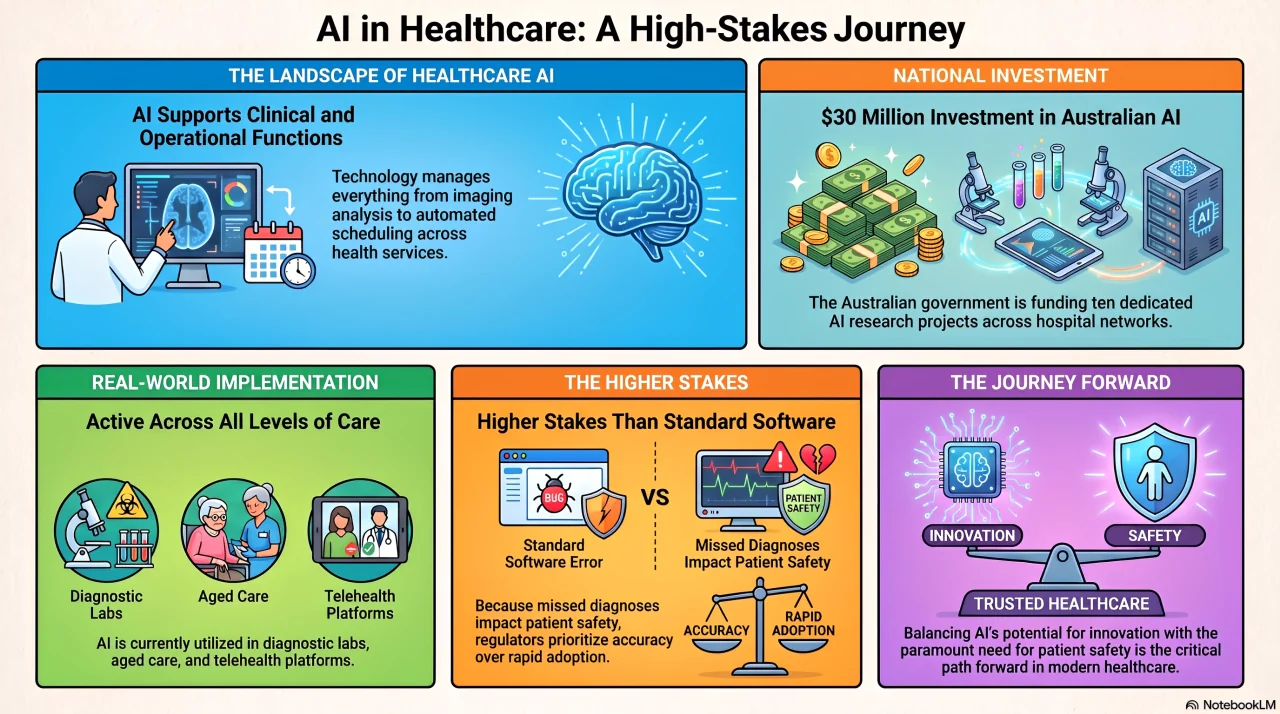
AI in healthcare refers to artificial intelligence technologies that support clinical, administrative, and operational functions across health services, from imaging analysis to automated scheduling.
In Australia, AI is active across hospital networks, aged care facilities, diagnostic labs, and telehealth platforms, backed by $30 million in government funding across ten AI research projects.
Healthcare AI carries higher stakes than most software. A missed diagnosis is a patient safety issue, shaping how regulators, clinicians, and health services approach every adoption decision.
Clinical AI vs Operational AI: The Difference That Matters
| Dimension | Clinical AI | Operational AI |
|---|---|---|
| Focus | Patient diagnosis, treatment, monitoring | Facility management, workflows, finance |
| Primary users | Clinicians, radiologists, GPs | Practice managers, CFOs, HR, operations teams |
| Examples | Imaging AI, clinical decision support, predictive triage | AI scheduling, automated MBS billing, procurement forecasting, workforce rostering |
| TGA classification | High: often classified as a medical device (SaMD) | Lower: generally outside TGA scope unless it directly influences clinical outcomes |
| AHPRA obligations | Direct professional responsibility obligations apply | Indirect: data handling and Privacy Act obligations still apply |
| Primary benefit | Better patient outcomes | Lower cost, fewer manual errors, time freed for clinical staff |
Not all AI in healthcare carries the same risk or sits under the same regulatory framework. The category a tool falls into determines what approval it needs, who is accountable for its outputs, and what due diligence is required before deployment.
Clinical AI assists directly in patient care including diagnosis, image analysis, clinical decision support, and treatment planning. These tools influence clinical outcomes and carry the highest regulatory risk under Australian law.
Administrative AI automates non-clinical healthcare operations, including scheduling, billing, medical coding, patient communications, and healthcare document management. These applications carry lower regulatory risk but remain subject to Privacy Act obligations for healthcare data.
Operational AI supports business functions within healthcare organisations, including workforce management, procurement, supply chain, facilities, and healthcare inventory management, without crossing into clinical territory.
Each category sits under a different regulatory framework. Treating clinical AI like scheduling software creates serious compliance exposure. For clinical tools, the TGA has published guidance on AI regulation as Software as a Medical Device that procurement teams should review before deployment.
The Australian Regulatory Framework for AI in Healthcare
Australia's regulatory approach to AI in healthcare is more developed than most realise. The Department of Health published its final "Safe and Responsible AI in Healthcare" report in July 2025, with several frameworks now applying simultaneously across the sector.
1. TGA and Software as a Medical Device (SaMD)
The TGA regulates AI tools that meet the definition of a medical device under Australian law. AI-assisted diagnostics, clinical decision support, and automated screening tools typically fall under SaMD and require pre-market approval.
Many overseas AI tools hold FDA or CE clearance, not TGA clearance. These are not equivalent. Procurement teams must verify AU regulatory status before any clinical deployment.
2. Department of Health AI review and mandatory guardrails
The Department of Health's final report published July 2025 reviewed legislation across Australia's healthcare AI landscape. The government is considering mandatory guardrails for high-risk AI settings. One finding was clear: 88% of consultation respondents said a human must always be in the loop for clinical decisions. This reflects both regulatory expectation and broader stakeholder consensus across the sector.
3. Privacy Act and healthcare data obligations
Healthcare data is sensitive information under the Privacy Act 1988. The Australian Privacy Principles govern how AI tools collect, store, use, and share patient data.
Many offshore tools store data outside Australia by default, requiring explicit due diligence before procurement. My Health Record data carries additional protections under the My Health Records Act 2012, and AI tools connecting to this infrastructure must meet a higher compliance standard.
4. Anti-discrimination and equity obligations
AI diagnostic or screening tools that produce different outcomes across demographic groups create direct exposure under AU anti-discrimination law. Age, disability, cultural background, and language can all affect model performance if training data was not representative.
The AHRC has flagged this as a specific risk in automated health decisions. Procurement teams should ask vendors for documented bias testing results relevant to Australian patient populations before contract sign-off.
Where AI Is Being Used in Australian Healthcare
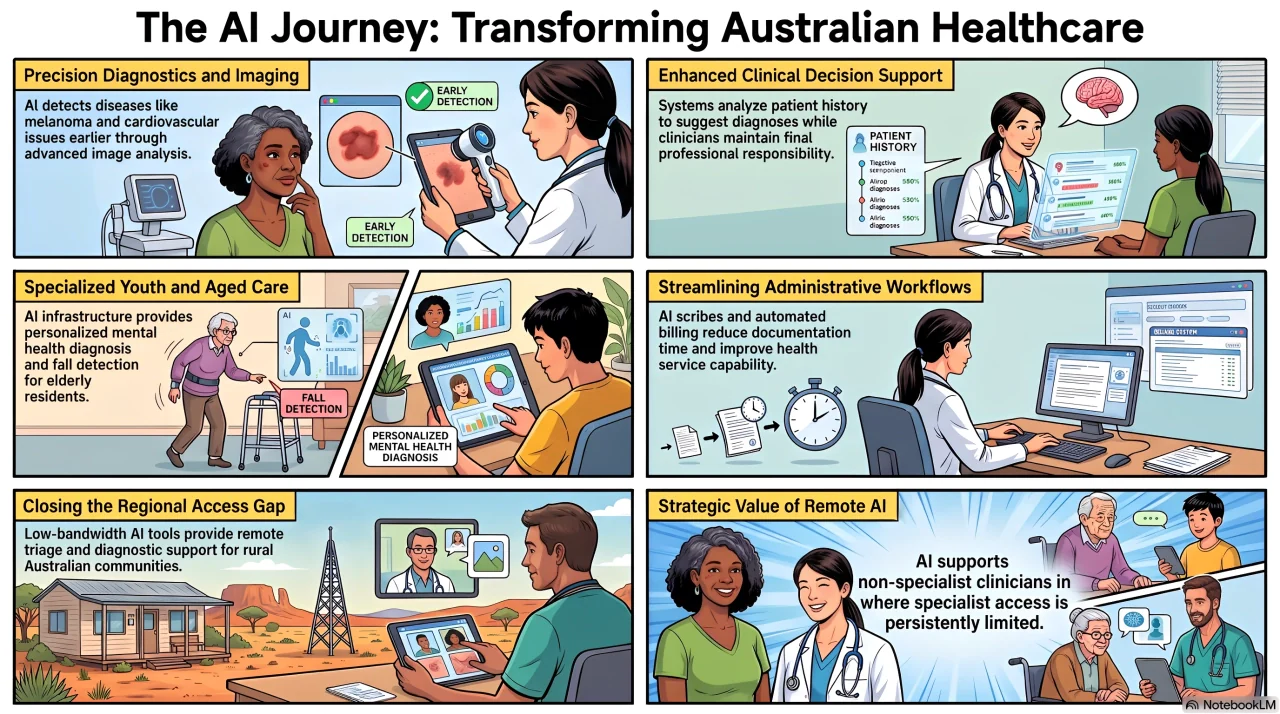
The Australian Government's $30 million MRFF investment spans ten AI research projects, most of which are already in active use across Australian health settings.
1. Medical imaging and diagnostics
AI analyses radiology, pathology, dermatology, and ophthalmology images to help clinicians detect disease earlier and more consistently. The University of Queensland received nearly $3 million to trial AI-supported melanoma detection using 3D skin imaging.
Harrison.ai has developed radiology and pathology tools already deployed across Australian health networks. Navier Medical's Mosaic platform, which detects cardiovascular disease from CT scans, received FDA clearance in June 2025.
2. Clinical decision support
AI combines patient history, disease data, and treatment pathways to suggest diagnoses or next steps for clinicians. It is being used across emergency departments, GP settings, and specialist referral pathways to reduce diagnostic delays.
These tools support clinical judgment rather than replace it. Any action taken on an AI suggestion remains the responsibility of the treating clinician under Australian professional and regulatory frameworks.
3. Mental health and youth services
The MRFF-funded Youth-AI project is building AI infrastructure for personalised diagnosis and preventive treatment of youth mental health conditions. Digital therapeutics and AI-assisted support tools are expanding across Australian platforms.
This area carries additional privacy and consent considerations, particularly for minors. Those deploying AI in mental health settings should apply a higher disclosure and consent standard than general healthcare AI requires.
4. Aged care
AI monitoring tools, fall detection systems, medication management alerts, and companionship robots are being trialled across Australian aged care facilities. Remote wound care monitoring is also active in regional and home-based settings. Effective medical equipment lifecycle management helps facilities monitor these technologies, schedule maintenance, and plan timely replacements.
AI adoption in aged care is accelerating, driven by sector reform and workforce shortages. Automated monitoring tools help maintain care standards where staff availability is limited.
5. Administrative automation
AI scribes generate clinical notes from consultations, reducing documentation time significantly. Automated scheduling, billing code optimisation, and patient communication tools are also widely deployed across Australian health services.
Administrative AI does not require TGA clearance, making it the most accessible starting point for health services building AI capability.
6. Regional and remote healthcare access
AI-assisted telehealth, remote diagnostic support, and automated triage tools are helping address Australia's persistent regional access gap. The Digital Health Blueprint 2023-2033 identifies regional access as a priority area for digital health investment.
AI tools that work in low-bandwidth environments and support non-specialist clinicians carry particular strategic value for Australian regional health settings.
Risks and Limitations of AI in Australian Healthcare
AI in healthcare carries risks that are distinct from those in other industries. Clinical errors have direct patient safety consequences, and Australia's regulatory framework treats certain AI applications as high-risk by default for this reason.
1. Algorithmic bias and unequal outcomes
AI trained on non-representative datasets can produce less accurate results for specific patient groups. Older patients, patients from non-Anglo backgrounds, and patients with disabilities may present differently from the populations the model was trained on.
The AHRC has flagged this explicitly in its guidance on automated health decisions. Healthcare organisations should ask vendors for bias testing results specific to Australian patient populations before any procurement decision.
2. Data privacy and patient consent
Healthcare data is the most sensitive category under Australian privacy law. Patient data used to train or operate AI tools requires explicit consent and clear disclosure of how it is processed, stored, and shared.
Cross-border data transfers need to be documented and legally defensible under the Australian Privacy Principles. Offshore vendors that cannot confirm AU data residency present a compliance risk that should be resolved before contract signing.
3. Clinical accountability and liability
When AI contributes to a clinical decision that harms a patient, liability questions are complex. Australian law has not fully resolved whether responsibility sits with the clinician, the hospital, or the AI vendor.
The safest position is clear: the human clinician remains accountable for every clinical decision, regardless of what an AI tool recommended. This should be written policy, not an assumed practice.
4. Implementation and adoption barriers
Clinician resistance, legacy system integration legacy system integration complexity, and the gap between research-grade AI performance and real-world clinical performance are consistent implementation challenges across Australian health organisations.
Many regional hospitals lack the IT infrastructure to support cloud-based AI tools. Organisations should assess infrastructure readiness before selecting a platform, not after a contract is signed.
"AI in healthcare is not simply a technology decision. Every tool a health service adopts carries regulatory accountability, data obligations, and clinical responsibility that leadership must own from day one. "
How Australian Healthcare Organisations Can Approach AI Adoption
The Digital Health Blueprint 2023-2033 provides a ten-year framework for digital health adoption. For health services, the practical question is where to start and what governance to put in place before deployment.
- Start with administrative AI before clinical AI: Administrative workflows carry lower regulatory risk and faster ROI, making them the right starting point for building internal AI literacy before moving into clinical applications.
- Verify TGA status before procuring any clinical AI tool: FDA or CE clearance does not equal TGA clearance. Procurement teams must confirm AU regulatory status before any clinical deployment.
- Establish a human-in-the-loop policy before deployment: 88% of AU stakeholders require a human in the loop for clinical decisions. This must be a written internal policy, reviewed before any AI tool goes live.
- Conduct a privacy impact assessment for any AI tool handling patient data: Privacy Act obligations, data residency rules, and third-party sharing restrictions all apply. A privacy impact assessment before procurement significantly reduces post-deployment compliance risk.
- Connect AI adoption to existing digital health infrastructure: Confirm My Health Record integration, ADHA frameworks, and system interoperability before selecting any AI platform. Disconnected tools create data silos and cancel out efficiency gains.
AI in Healthcare Administration and Operations
Clinical AI attracts most of the attention, but operational AI often provides a more practical starting point for healthcare organisations.
AI can support workforce scheduling, medical supply procurement, asset management and financial reporting with lower clinical risk and a clearer adoption path.
Effective workforce management in healthcare helps organisations coordinate staffing, workloads and operational resources more efficiently.
Meanwhile, Hashy AI Coworkers use live ERP data to complete governed tasks across HR, procurement, inventory and finance, reducing manual coordination between teams.
Conclusion
AI adoption in Australian healthcare is not a single technology decision. Each tool carries different regulatory obligations, data requirements, and clinical accountability, making a structured, category-by-category approach essential from the outset.
For health services ready to connect workforce, procurement, and operations through AI, a free consultation can help identify the right fit.
Frequently Asked Questions About AI in Healthcare
AI in healthcare refers to artificial intelligence tools that support clinical, administrative, and operational work across health services. These tools can help analyse medical images, summarise patient information, automate documentation, support telehealth, forecast demand, and improve hospital resource planning.
In Australia, AI is used in diagnostic imaging, telehealth triage, hospital scheduling, patient risk prediction, clinical documentation, and administrative automation. Many health services also use AI to improve workforce planning, reduce manual reporting, and manage operational pressure across hospitals, clinics, and aged care facilities.
Yes. AI in healthcare may fall under several regulatory areas, including TGA rules for software as a medical device, AHPRA professional standards, privacy obligations, and clinical safety governance. Health services need clear oversight, data protection, human review, and documented risk controls before using AI in patient-facing workflows.
The main risks include inaccurate recommendations, biased outputs, privacy breaches, poor data quality, unclear accountability, and overreliance on automated decisions. These risks are higher when AI is used without clinical review, proper validation, consent management, or clear policies for how staff should interpret AI-generated information.
Healthcare organisations should begin with low-risk operational use cases such as scheduling, reporting, inventory planning, or administrative automation. From there, they can build governance policies, test data quality, define human review steps, monitor performance, and expand into clinical use cases only when safety and compliance controls are mature.