






A Warehouse Management System is software that helps businesses track, coordinate, and optimise daily warehouse operations. It manages receiving, storage, picking, packing, and shipping to improve efficiency and reduce operational costs.
Australia’s online retail sales hit A$4.7 billion in June 2025, which shows how quickly order volume and fulfilment expectations keep rising. In that environment, a warehouse management system is no longer just a nice operational upgrade; it becomes a practical way to keep inventory, speed, and accuracy in sync.
A good warehouse management system does more than tell you what stock is on hand. It helps your team receive goods faster, place items more logically, and move orders through the warehouse with less friction and better visibility.
That is why more businesses now treat WMS as a growth tool, not just a warehouse tool. If your operation needs a faster, smarter way to stay organised as demand grows, this is the kind of system worth understanding early.
Key Takeaways
A warehouse management system helps businesses improve receiving, putaway, inventory tracking, picking, packing, and shipping with better speed and accuracy.
Compared with basic inventory software, a WMS gives businesses stronger warehouse control, real-time visibility, smarter workflows, and smoother system integration.
With options such as standalone, ERP-integrated, cloud-based, and SCM-suite solutions, a WMS helps businesses improve efficiency, support growth, and prepare for future warehouse demands.
What is a Warehouse Management System (WMS)?
A Warehouse Management System (WMS) is a software that optimizes warehouse operations, from receiving and storing to picking, packing, and shipping goods. By replacing paper-based methods, a Warehouse Management System (WMS) ensures inventory is managed efficiently, accurately, and cost-effectively.
In the past, warehouses relied on human memory to track inventory, a practice that became problematic as businesses grew. Modern WMS systems now use real-time data from barcode scanners and automation, offering precise, up-to-date tracking.
Unlike ERP systems, which handle broader business functions, a WMS focuses solely on warehouse tasks. It translates high-level orders from the ERP into actionable steps for staff and machinery, ensuring smooth and efficient warehouse operations.
How Does a Warehouse Management System Work?

A Warehouse Management System (WMS) streamlines operations by automating warehouse management, improving efficiency and accuracy at every step. From receiving goods to shipping orders, the WMS ensures efficiency and accuracy at every step.
- Receiving goods: When goods arrive at the warehouse, the WMS system generates a receiving order and matches it to the corresponding purchase orders. This ensures that only the correct items are received and properly recorded in the warehouse system.
- Inventory tracking: As inventory is stored, the WMS system tracks each item’s location in real time using barcode scanning or RFID. This allows businesses to monitor stock levels, prevent discrepancies, and ensure the accuracy of inventory records.
- Putaway process: The WMS directs workers to place goods in the most efficient location in the warehouse based on size, weight, and demand. By optimizing storage locations, the warehouse system maximizes space and enhances future picking efficiency.
- Order picking: When an order is placed, the WMS system generates a picking list, directing workers to the right location. The system prioritizes orders and determines the best route for workers to ensure faster and more accurate order fulfillment.
- Packing: Once items are picked, the WMS system assists with packing, ensuring all items are correctly packed and labeled for shipping. It also generates packing slips and labels for a seamless transition to the next stage.
- Shipping and dispatch: The WMS generates shipping labels, tracks packages, and integrates with carrier systems for dispatch. It ensures that all items are shipped on time and provides real-time updates to the business and customers on order status.
- Real-time reporting: The WMS system continuously updates data across the warehouse, providing real-time insights into inventory and operations. This allows managers to monitor performance, adjust workflows, and address any issues as they arise.
- System integration: The WMS integrates with ERP and other business systems to ensure consistent data across the entire business. This connection helps maintain accuracy in financials, inventory, and order management, providing a holistic view of operations.
How Does a Warehouse Barcode System Work?
A warehouse barcode system assigns a unique barcode to every item, pallet, or storage location. Each scan updates the WMS in real time, giving businesses accurate inventory records from receiving through to dispatch.
1. Label Printing and Barcoding
Barcode labels are printed when goods are received, giving every item or pallet a unique ID that can be tracked throughout the warehouse.
2. Receiving Scan
Workers scan incoming goods to automatically record item details, quantities, and supplier information in the WMS, reducing manual data entry.
3. Putaway Scan
Items are scanned again when placed into storage, confirming the correct rack or bin location and keeping inventory records accurate.
4. Pick Scan
During order picking, each item is scanned to verify it matches the order, helping prevent picking errors before dispatch.
5. Dispatch Scan
A final scan confirms the shipment, updates inventory levels, and generates shipping records with an accurate dispatch timestamp.
Most warehouse barcode systems use handheld scanners, forklift-mounted computers, and fixed scanners for high-volume operations. Handheld barcode scanners typically cost around AUD $300–$800 per device, while advanced equipment varies depending on business requirements.
WMS vs Inventory Management Software
WMS and Inventory Management Software serve different purposes, but both are crucial for effective inventory control. A Warehouse Management System (WMS) optimizes warehouse operations like order picking and shipping, improving efficiency and accuracy.
Inventory Management Software tracks stock levels across various locations, while a WMS integrates these tasks with warehouse workflows for better operational control. This integration boosts accuracy and speed in inventory processes.
For Australian businesses, a WMS system can enhance warehouse efficiency, reduce errors, and speed up order fulfillment. It helps streamline operations, offering better control over inventory and warehouse management.
Aspect |
Warehouse Management System (WMS) |
Inventory Management Software |
Primary Purpose |
Optimises end-to-end warehouse operations, including receiving, putaway, picking, packing, and despatch. | Tracks stock quantities and movements across locations to maintain accurate inventory records. |
Scope of Control |
Manages physical workflows, worker tasks, equipment routing, and storage logic inside the warehouse. | Focuses on stock-level data such as on-hand quantities, reorder points, and basic transfers. |
Real-Time Visibility |
Provides live data on bin-level location, task status, and worker productivity. | Offers real-time stock counts, but usually without floor-level detail or task tracking. |
Order Fulfilment |
Directs picking routes, packing, and shipping with carrier integration for faster despatch. | Records stock movements tied to orders, but does not coordinate picking or packing workflows. |
Labour & Equipment Management |
Tracks worker performance, allocates tasks, and coordinates forklifts, scanners, and AMRs. | No labour or equipment management features; focused purely on inventory data. |
Integration with Operations |
Integrates with ERP, TMS, CRM, and shipping carriers for end-to-end supply chain control. | Typically integrates with accounting or POS systems for stock and sales reconciliation. |
Best Suited For |
Mid to large operations with multiple SKUs, complex picking, and high order volumes. | Small businesses or teams that mainly need to track stock levels and reorder triggers. |
Compliance & Traceability |
Supports batch and serial tracking, audit trails, and regulatory reporting (WHS, DG, ACL). | Provides basic traceability through stock movement logs but limited regulatory tooling. |
| Scanning Integration | Native integration with barcode scanners and RFID readers at every movement: receive, putaway, pick, pack, despatch. | Accepts manual scan-to-count entries or basic barcode imports; no real-time movement triggers. |
| Throughput Capacity | Designed for high-throughput environments: 500+ order lines per hour across multi-zone DCs. | Suited to low-to-medium volumes; performance degrades without WMS logic at scale. |
For Australian distribution centres processing more than 500 order lines per hour, the gap between WMS and inventory software is most visible at the scanning layer. A WMS triggers a scan at every movement point from receive to despatch, while inventory software records stock changes only after the fact. At that volume, a missed scan means a mislocated item, not just a delayed count, and the RFID versus barcode debate covered in the WMS Trends section becomes increasingly relevant.
The 5 Types of Warehouse Management Systems

Warehouse Management Systems (WMS) come in various types, each designed to meet different business needs and operational complexities. Understanding these models can help Australian businesses choose the best solution to optimize their warehouse operations and enhance overall supply chain efficiency.
1. Standalone WMS
A standalone Warehouse Management System (WMS) is a specialized tool designed to optimize warehouse operations. These systems offer advanced functionality, making them ideal for complex environments like third-party logistics (3PL) providers or large enterprises.
While they provide deep capabilities, they operate independently and require integration with other systems, such as ERP or accounting software. Standalone WMS systems are best for businesses that need highly customized workflows and are willing to invest in seamless system integration.
2. ERP-integrated WMS modules
ERP-integrated WMS modules offer the advantage of synchronizing warehouse operations with other business functions such as finance, sales, and procurement. This integration streamlines data flow and eliminates the need for complex middleware.
For Australian businesses, this means easier access to real-time data, reducing the risk of errors and ensuring smooth operations. Many modern ERP systems, like HashMicro, provide a unified technology stack that enhances efficiency without the friction of managing separate systems.
3. Cloud-based WMS
Cloud-based WMS systems are transforming the industry by offering flexible, scalable solutions without the hefty upfront costs of on-premise software. These cloud systems, or Software as a Service (SaaS), are easy to deploy, automatically updated, and accessible from anywhere.
With lower initial investment and reduced reliance on dedicated IT teams, Australian businesses can adopt a warehouse system that scales with their needs. Cloud-based WMS systems also provide seamless updates and allow businesses to scale their resources as needed.
4. Supply Chain Management (SCM) suite WMS
SCM Suite WMS combines warehouse management with other critical logistics tools, such as Transportation Management Systems (TMS) and Order Management Systems (OMS). This approach enables businesses to get a comprehensive view of their supply chain, optimizing coordination between warehouse operations and freight movement.
For Australian businesses, this means the WMS can automatically manage tasks such as order picking and freight scheduling. It’s an excellent choice for companies seeking a broader solution to integrate their entire supply chain under one roof.
5. Supply Chain Management (SCM) suite WMS
SCM suite WMS platforms combine warehouse management with tools such as Transportation Management Systems (TMS) and Order Management Systems (OMS). This creates end-to-end visibility across the supply chain.
For Australian businesses, SCM-based WMS solutions enable tighter coordination between warehousing, freight, and order fulfilment, making them ideal for complex, multi-node supply chains.
Key Features of Warehouse Management Software

The best Warehouse Management System (WMS) offers a wide range of features to optimize warehouse operations and improve overall efficiency. These features help Australian businesses streamline their processes, from receiving goods to dispatching orders.
Here are the key features that make warehouse systems indispensable for modern businesses:
1. Receiving and putaway
Receiving and putaway processes are crucial for managing incoming stock and storing it efficiently within the warehouse. As part of the putaway process, the WMS applies slotting logic to assign products to the most suitable bin locations based on turnover rate, weight, and size.
This ensures that fast-moving items are stored within easier reach, improving picking efficiency. With real-time updates, businesses can immediately assess stock availability and location.
2. Inventory tracking and visibility
Inventory tracking and visibility ensure that businesses have an up-to-date view of their stock at all times. A warehouse management system provides real-time data on inventory levels, movements, and locations, enhancing decision-making and reducing stock discrepancies.
This level of visibility is essential for Australian businesses looking to optimize inventory flow and reduce excess stock. By tracking each item’s status, companies can minimize stockouts and improve overall inventory management.
3. Order picking and packing
Order picking and packing are essential for fulfilling customer orders accurately and efficiently. Depending on order volume and warehouse layout, the WMS can apply methods such as wave picking, batch picking, or zone picking to reduce travel time and improve throughput. The system also automates picking routes to help workers select and pack items faster and more accurately.
This not only improves speed but also reduces errors, leading to higher customer satisfaction. For Australian businesses, an optimized order picking system can lead to faster delivery times and more accurate shipments.
4. Shipping and dispatch
Shipping and dispatch features in a WMS help businesses manage outbound logistics with ease. By automating the creation of shipping labels and tracking information, the system ensures that orders are dispatched on time and delivered accurately.
This integration with shipping carriers reduces manual efforts and speeds up the delivery process. For Australian companies, it enhances the customer experience by providing accurate delivery times and updates.
5. Labour management
Labour management is a key aspect of optimizing warehouse operations. WMS systems provide tools to track employee performance, monitor productivity, and allocate resources effectively.
This ensures that warehouse staff are working efficiently and can adapt to changes in demand. By optimizing workforce allocation, Australian businesses can improve operational costs and overall performance.
6. Reporting and analytics
Reporting and analytics are crucial for gaining insights into warehouse operations and making informed decisions. A warehouse management system offers detailed reports on inventory levels, order fulfillment rates, and labor productivity, among others.
With access to real-time data and customizable reports, businesses can identify areas for improvement and track key performance indicators (KPIs). For Australian businesses, these insights enable more effective decision-making and continuous improvement.
7. Integration capabilities
Integration capabilities allow a WMS system to connect seamlessly with other business software, such as ERP, procurement, CRM, or transportation management systems. This ensures that data flows smoothly across all departments, eliminating silos and enhancing coordination.
For Australian businesses, these integrations improve efficiency by providing a unified view of operations and reducing manual data entry. With the right integrations, businesses can create a more cohesive and automated workflow.
Warehouse Management System Use Cases by Australian Industry
Different industries put a WMS to work in very different ways. The right configuration depends on stock type, fulfilment speed, compliance load, and how goods physically move through the site.
Here is how Australian businesses across major sectors apply a WMS day to day:
- Retail and ecommerce: Retailers use a WMS to handle high SKU counts, peak-season volume, and multichannel fulfilment across stores, warehouses, and direct-to-customer orders. Wave picking, returns processing, and live stock visibility keep online and in-store inventory aligned.
- Wholesale and distribution: Distributors lean on the WMS for bulk receiving, cross-docking, and B2B order management with strict despatch windows. Therefore, route-based picking and load planning help meet daily delivery commitments without overstocking.
- Manufacturing: Manufacturers use the WMS to manage raw materials, work-in-progress stock, and finished goods alongside the production line. Just-in-time replenishment and lot tracking keep production running and support traceability for recalls.
Third-party logistics (3PL): 3PLs need multi-client inventory management, activity-based billing for storage, picking, and dispatch, plus SLA tracking and traceability across inbound and outbound operations. A WMS also provides client-specific visibility and integrates with carriers, EDI, and APIs to streamline data exchange and fulfilment.
- Food and beverage: Food businesses depend on FEFO (First Expired, First Out) picking, batch tracking, and temperature-zone management. As a result, the WMS helps reduce spoilage and supports compliance with food safety standards.
- Pharmaceuticals and healthcare: This sector requires serialised tracking, expiry control, and TGA-aligned recordkeeping. A WMS automates batch traceability, controlled-substance handling, and audit-ready reporting.
- Construction and building supplies: Builders’ merchants manage bulky goods, kitting, and yard inventory across multiple branches. The WMS supports trade-counter pickups, project-based reservations, and accurate yard-to-truck movements.
- Automotive parts and aftermarket: Parts distributors handle huge SKU ranges with strict same-day or next-day delivery expectations. Therefore, fast bin-level picking and VIN-linked tracking matter as much as core stock control.
The Benefits of Implementing a WMS

Implementing a Warehouse Management System (WMS) brings significant benefits, transforming warehouse operations into competitive advantages for businesses. Here are the key advantages of adopting a warehouse system:
- Optimized space utilization: A WMS maximizes warehouse space by using advanced algorithms to place items based on demand. It ensures efficient storage, preventing overcrowding and reducing the need for costly facility expansions.
- Real-time visibility and inventory accuracy: With real-time data, a WMS provides transparency into inventory levels and operational status. This eliminates excess stock and helps businesses manage inventory more effectively, reducing both waste and costs.
- Enhanced labor productivity: The WMS directs tasks with clear instructions, reducing idle time and optimizing staff efficiency. It also minimizes unnecessary travel by interleaving tasks, boosting equipment usage and reducing operational delays.
- Improved order accuracy and customer satisfaction: WMS ensures high order accuracy by validating each item through multiple scanning points, reducing picking errors. This results in better customer satisfaction through faster, error-free deliveries.
- Security, traceability, and compliance: For industries with regulatory requirements, a WMS tracks products by batch or serial number for full traceability. It also provides audit trails, improving accountability and reducing shrinkage.
How to Find the Right Warehouse Management System
Choosing the right warehouse management system starts with understanding how your warehouse actually runs today. Order volume, SKU count, picking complexity, and delivery expectations all shape what level of WMS you need, not just business size.
Next, look at how well the system fits into your wider operations. A strong WMS should integrate smoothly with ERP, inventory, accounting, and carrier systems, so data flows without rework or delays. Poor integration quickly turns efficiency gains into manual fixes.
Scalability also matters. A system that works now should still support peak seasons, new sales channels, and additional warehouse locations. Cloud-based WMS options often make it easier to scale without heavy upfront costs.
Finally, assess usability and local support. A WMS only delivers value if warehouse staff can use it daily without friction, and responsive vendor support helps resolve issues before they disrupt fulfilment.
Australia-Specific WMS Buying Considerations
Australian warehouse buyers need to look beyond picking speed and stock accuracy. The right WMS should also support local compliance, tax handling, carrier workflows, and support needs.
- WHS and racking safety: The system should help record inspections, incident notes, zone risks, and rack-location details that support WHS duties and AS 4084 steel storage racking checks.
- GST and tax records: A WMS should pass clean stock, despatch, and invoice data into finance workflows so GST and BAS reporting can be reviewed without rebuilding records later.
- EDI and carrier readiness: For import, export, 3PL, and distribution work, check whether the WMS can support EDI, carrier labels, despatch notices, and freight data exchange.
- Local support: Choose a vendor that understands Australian warehouse terms, time zones, compliance expectations, and fulfilment pressure during peak retail periods.
- Data hosting and access control: Confirm where operational data is hosted, who can access it, and how the system handles user roles across warehouses, branches, and third-party users.
- Common local integrations: Prioritise integrations with ERP, ecommerce, accounting, courier, barcode, RFID, and procurement systems already used in Australian operations.
What Makes a WMS One of the Best Options?
The best WMS for one business is not always the most feature-heavy option. It is the system that matches warehouse complexity, daily users, integration needs, and growth plans.
- Scale of operation: Match the WMS to order volume, SKU count, picking zones, warehouse size, and how many users need to work in the system at once.
- ERP and accounting integration: The WMS should connect warehouse movements with purchasing, sales, finance, and inventory records without repeated manual entry.
- Barcode and RFID support: Check whether the system supports barcode scanning, RFID, label printing, and scan validation at receiving, putaway, picking, packing, and despatch.
- Multi-warehouse control: A strong WMS should manage stock across branches, transfer orders, bin locations, and warehouse-specific rules from one view.
- Australia-based support: Local support helps resolve implementation, training, and operational issues faster when warehouse teams are working under fulfilment pressure.
- Security and roles: User access should be controlled by role, warehouse, task, and approval level so teams only see the records and actions they need.
- Implementation cost: Compare licence fees, setup, migration, scanners, labels, integrations, user training, and support, not just the monthly subscription price.
-
Reporting depth: The system should show stock accuracy, pick rate, despatch delays, warehouse labour productivity, ageing stock, and exception reports in a usable format.
WMS Implementation and Setup Checklist
A WMS setup should follow the way the warehouse really works, not a universal timeline. The checklist below keeps the work practical while reducing migration risk.
1. Map processes and master data: Review receiving, putaway, picking, packing, despatch, returns, SKUs, units of measure, bin locations, and stock ownership before configuration starts.
2. Prepare integrations: Connect the WMS with ERP, ecommerce, carrier, procurement, and finance systems so orders, stock movements, and despatch data move without duplicate entry.
3. Configure locations, barcodes, and roles: Set warehouse zones, racks, bins, barcode rules, user roles, approval access, and exception handling before live transactions begin.
4. Run pilot and UAT: Test real receiving, picking, transfer, packing, returns, and despatch cases with warehouse users, then fix workflow gaps before the wider rollout.
5. Train teams and set KPI baselines: Train warehouse staff on daily workflows, then record baseline metrics for stock accuracy, pick rate, despatch speed, and fulfilment errors before go-live.
The biggest migration risks are inaccurate opening stock, duplicated SKUs, weak barcode data, and missing integration rules. Reduce them with a clean master-data review, test migration, pilot warehouse, and sign-off from both operations and finance.
WMS Trends in 2026
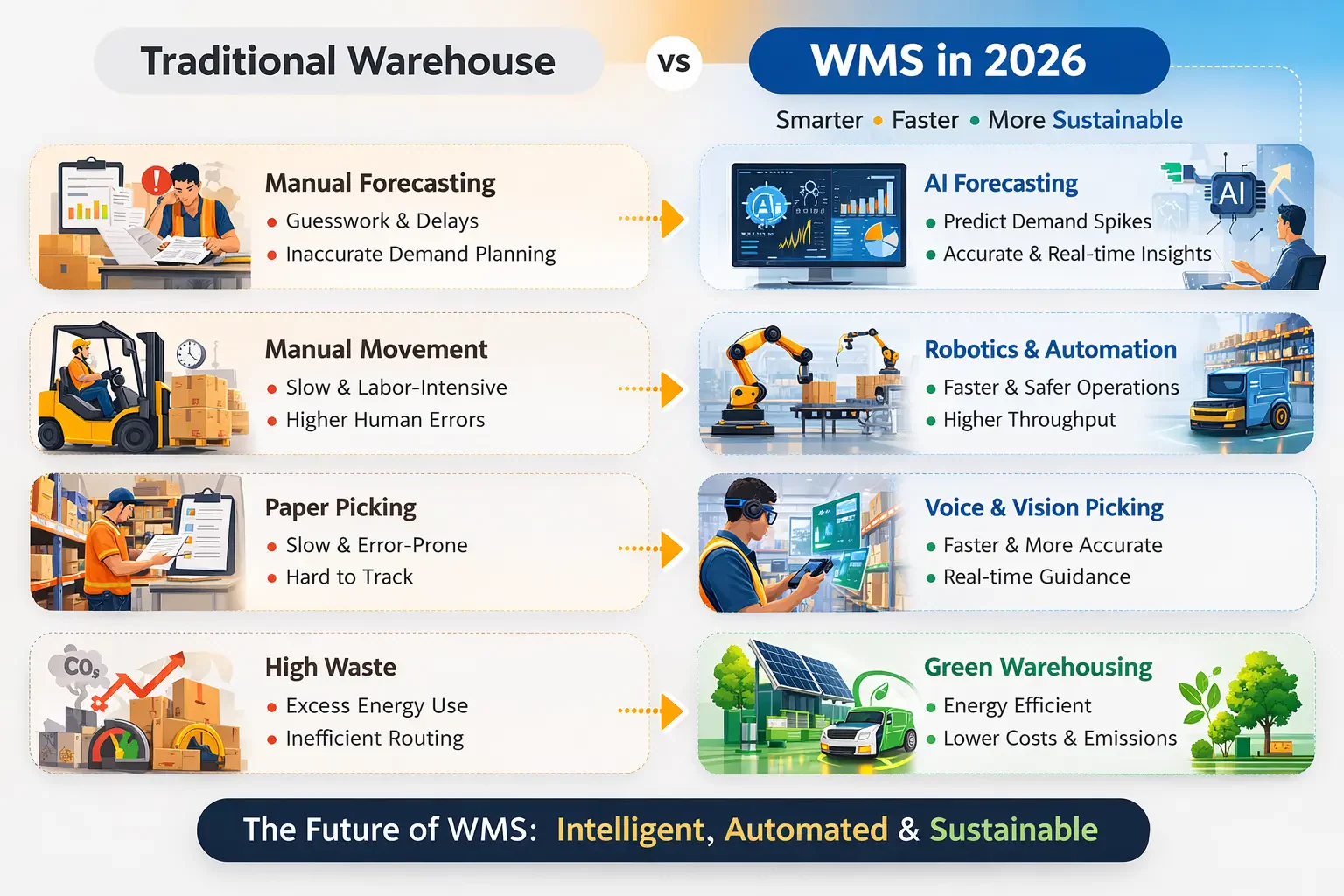
As the world of supply chain management evolves, the Warehouse Management System (WMS) is being revolutionized by emerging technologies. These advancements are setting the stage for smarter, more efficient warehouse operations, bringing automation and intelligence to the forefront.
Here are the key WMS trends shaping the future of warehouse systems in 2026:
1. AI and machine learning in warehouse operations
AI and machine learning are transforming WMS by allowing systems to learn and adapt to changing conditions. With the power of AI, these systems can predict demand spikes, optimize inventory placement, and suggest layout improvements based on historical data.
For Australian businesses, this means more accurate forecasting and the ability to reduce operational bottlenecks. The WMS system’s ability to evolve ensures better efficiency and smarter decision-making.
2. Warehouse automation and robotics
Automation and robotics are driving significant improvements in warehouse efficiency. WMS systems now control fleets of Autonomous Mobile Robots (AMRs) and Automated Guided Vehicles (AGVs), which handle tasks such as transporting pallets and performing cycle counting.
For Australian businesses, this technology reduces human labor dependency and increases throughput, allowing warehouses to operate with greater speed and precision. The integration of robotics within the WMS system is reshaping how tasks are performed, improving both safety and efficiency.
3. Voice and vision picking
Voice and vision picking technologies are enhancing the accuracy and speed of order fulfillment. Voice-directed picking allows workers to receive real-time instructions via headsets, reducing errors and increasing task efficiency.
Vision picking, utilizing wearable devices or augmented reality (AR), helps employees quickly locate items by overlaying visual information onto the warehouse environment. Australian businesses can expect significant gains in productivity and accuracy, thanks to the WMS system’s ability to integrate these innovative technologies.
4. Sustainability and green warehousing
Sustainability is becoming a central focus in warehouse management. The latest WMS trends emphasize energy efficiency, waste reduction, and greener operations, driven by innovations like energy-efficient robotics and optimized routing algorithms.
For Australian companies, adopting these green practices not only helps reduce their environmental footprint but also leads to cost savings through more efficient resource use. WMS systems are playing a pivotal role in creating more sustainable and eco-friendly warehouse environments.
5. RFID vs barcode scanning: which technology fits your warehouse in 2026?
| Aspect | Barcode Scanning | RFID Scanning |
| Read method | Line-of-sight required; one item at a time | Reads multiple tags simultaneously without line-of-sight |
| Scan speed | 200–400 items per hour (manual) | 1,000–3,000 items per hour |
| Hardware cost (AU) | ~AUD $300–800 per handheld scanner | ~AUD $2,000–6,000 per reader + AUD $0.10–0.50 per tag |
| Typical AU ROI threshold | Justified below 500 picks/hour | Typically positive above 500 picks/hour |
| Label requirement | GS1-128 or GS1 DataMatrix barcode | GS1 EPC/RFID tag (GS1 Australia compliant) |
| WMS integration | Standard in all WMS platforms | Requires middleware or RFID-native WMS module |
| Error rate | 1 in 10,000 scans | 1 in 1,000,000 reads |
| Best for | SME warehouses, low-to-mid volume DCs, cold storage (tag failure risk) | High-throughput DCs, fashion/apparel, pharmaceutical, large 3PLs |
| AU compliance note | GS1 Australia barcode standard applies | GS1 Australia EPC standard applies — verify tag spec with supplier |
The scanning technology you choose should be supported natively by your WMS, not bolted on as an afterthought. When evaluating WMS platforms for your Australian operation, confirm scanner compatibility and GS1 compliance before shortlisting vendors. For full labelling specifications and RFID tag standards, the GS1 Australia barcode and RFID guidelines are the authoritative AU reference.
Australian Compliance Standards Your WMS Should Support (2026)
Australian warehouse operations sit under a layered compliance framework that touches safety, transport, goods handling, and reporting. Therefore, the WMS you pick should help you evidence compliance, not just store data.
The table below maps the key 2026 standards and how a capable WMS supports each one:
Standard / Regulation |
What It Covers |
How a WMS Supports Compliance |
WHS Regulations 2022 |
Workplace health and safety duties for employers, including hazard control, incident reporting, and worker consultation. | Logs incidents, tracks PPE issuance, records inductions, and stores task risk assessments tied to each warehouse zone. |
AS 4084 (Steel Storage Racking) |
Design, installation, and inspection requirements for steel pallet racking, including load limits and damage reporting. | Maintains rack inspection schedules, load capacity per location, and damage-incident records against each rack ID. |
NHVR Chain of Responsibility (CoR) |
Holds every party in the heavy vehicle supply chain accountable for safe loading, mass, fatigue, and dimensions. | Captures loading records, weight verification, driver handover details, and proof of safe load distribution per despatch. |
Dangerous Goods (DG) Regulations |
ADG Code rules covering classification, segregation, packaging, labelling, and storage of hazardous goods. | Enforces segregation by class, blocks incompatible putaway, prints DG labels, and stores SDS links per SKU. |
Modern Slavery Act 2018 |
Reporting duty for businesses with annual revenue of A$100M or more on supply chain risk and due diligence. | Tracks supplier records, country-of-origin data, and audit evidence required for the annual modern slavery statement. |
Australian Consumer Law (ACL) |
Guarantees on quality, returns, refunds, and accurate product information for goods sold to consumers. | Manages returns workflows, reason codes, batch recall lists, and traceability needed to honour consumer guarantees. |
Peppol eInvoicing (PINT A-NZ) |
ATO-aligned electronic invoicing standard for B2B transactions across Australia and New Zealand. | Generates Peppol-compliant invoices on despatch, exchanges through accredited access points, and stores audit-ready records. |
How AI is Transforming Procurement Management
How AI is Transforming Procurement Management
Artificial intelligence is changing how procurement teams work, not by replacing them, but by handling the repetitive, data-heavy tasks that slow them down. Modern procurement systems now embed AI directly into the purchasing workflow, giving teams faster decisions and greater spend visibility without adding headcount.
For Australian businesses managing multiple suppliers, project-based budgets, or high transaction volumes, AI-powered procurement removes bottlenecks that manual processes cannot resolve at scale.
Intelligent spend forecasting and demand planning
AI analyses historical purchasing data, seasonal trends, and supplier lead times to predict future procurement needs with far greater accuracy than spreadsheet-based models. Procurement teams can anticipate demand spikes, pre-approve supplier engagements, and avoid emergency purchases that carry premium pricing.
This level of forecasting reduces both stockouts and excess inventory, two of the most common cost drivers in procurement-heavy operations.
Automated three-way matching and anomaly detection
Traditional three-way matching is time-consuming and error-prone when handled manually. AI accelerates the process by scanning purchase orders, goods receipts, and invoices simultaneously, flagging only the exceptions that require human review.
Beyond matching, AI detects spending anomalies, such as duplicate invoices, unapproved vendors, or unusual pricing shifts, and alerts the procurement team before a payment clears.
Supplier risk assessment using live data
AI continuously monitors supplier signals across delivery performance, financial stability indicators, and market conditions. When a supplier's risk profile changes, the system flags it automatically, giving procurement managers time to source alternatives or renegotiate terms before disruption occurs.
For businesses subject to Modern Slavery Act reporting or state-level procurement compliance, AI-driven supplier monitoring builds a defensible, evidence-based audit trail.
Smarter contract management and renewal alerts
AI reads contract terms, identifies renewal windows, and surfaces underperforming clauses before they renew automatically. Procurement teams no longer need to manually track dozens of contract dates across different suppliers.
The system also compares negotiated rates against actual invoice amounts over time, highlighting where contract compliance has drifted and where renegotiation would deliver measurable savings.
HashMicro's Hashy OS: AI built into your procurement workflow
HashMicro's procurement module runs on Hashy OS, the platform's integrated AI layer that connects data across procurement, inventory, finance, and supplier management in real time. Rather than relying on separate AI tools bolted onto an existing system, Hashy OS works from within the same data environment your procurement team already uses.
Hashy OS surfaces spend insights, flags approval bottlenecks, and assists procurement staff with supplier queries directly inside the platform. Because it draws on live transactional data rather than static reports, the recommendations it generates are grounded in your actual purchasing patterns, not generic industry benchmarks.
For Australian businesses looking to move beyond manual procurement management, Hashy OS delivers AI capability that scales with the business without requiring a separate AI platform or additional integration work.
Conclusion
A warehouse management system (WMS) is no longer just for large corporations; it’s a must-have for any business dealing with physical inventory. As supply chains grow more complex and customer expectations rise, precise control over goods is crucial to staying competitive in today’s market.
Moving away from manual processes and embracing smart technology allows businesses to unlock the full potential of their existing facilities. A modern WMS offers real-time visibility, automation, and strategic insights that lower costs while boosting customer satisfaction. These systems are key to driving operational efficiency and responding to the growing demands of the marketplace.
As AI, IoT, and robotics advance rapidly, WMS systems will continue to improve. To find out how a WMS can enhance your business operations, get in touch with our experts today for tailored solutions that suit your needs.
FAQ About Warehouse Management Systems (WMS)
The main purpose of a warehouse management system is to control daily warehouse movement, including receiving, putaway, stock tracking, picking, packing, and despatch, so goods move faster and with fewer errors.
Inventory management software mainly tracks stock quantities and movements. A WMS goes further by controlling warehouse tasks, bin locations, picking routes, packing, labour activity, and despatch workflows.
Start with your order volume, SKU count, warehouse layout, integration needs, barcode or RFID requirements, reporting needs, and local support expectations. The right WMS should fit your real workflow, not just your company size.
Common WMS types include standalone WMS, ERP-integrated WMS, cloud-based WMS, on-premise WMS, and supply chain suite WMS. Each suits a different level of warehouse complexity and integration need.
There is no universal timeline because setup depends on warehouse size, data quality, integrations, scanning requirements, and user training. A safer approach is to plan by readiness milestones, not fixed dates.
Yes, most modern WMS platforms support barcode scanning, and some also support RFID. Businesses should confirm scanner compatibility, label formats, and whether scanning works natively at each warehouse movement point.
Yes, a multi-warehouse WMS can manage stock across branches, bin locations, transfers, replenishment rules, and warehouse-specific workflows from one system view.
Australian businesses should check WHS and racking record support, GST-ready data flow, EDI and carrier integration, local support, data hosting, barcode or RFID readiness, and reporting depth before choosing a WMS.
Yes. A WMS can suit small businesses when manual stock checks can no longer keep up with order volume, stock locations, or multiple sales channels. A cloud-based or modular WMS lets smaller teams start with core warehouse control before expanding.
WMS cost in Australia depends on users, warehouse size, setup complexity, barcode or RFID needs, integrations, training, and support. Businesses should compare total implementation cost, not only the monthly software fee.
SAP is a company and business platform that provides ERP solutions. ERP manages integrated business processes, whereas a WMS manages warehouse operations such as receiving, putaway, inventory management, picking, packing, and shipping. SAP can provide a WMS as a solution or module integrated with the ERP, depending on the specific product and configuration used.