







 Limited to 100 registrants

Warehouse labour costs can quickly increase when staffing levels, workloads, and productivity are difficult to manage. A warehouse labour management system (LMS) helps businesses plan labour, measure performance, and improve workforce efficiency.
Unlike general workforce management software, a warehouse LMS uses operational data such as picking tasks, travel time, equipment usage, and completed work. This provides a more accurate view of labour performance across warehouse operations.
This guide explains what a warehouse labour management system is, how it works, its benefits, and the key features to consider when choosing the right solution.
Key Takeaways
A warehouse labour management system helps businesses plan staffing, track productivity, and optimise workforce performance.
The right labour management system improves workforce planning, labour utilisation, and warehouse efficiency.
Responsible workforce measurement helps businesses improve productivity while supporting employee privacy, fairness, and workplace safety.
Integrating labour management software with WMS and workforce systems provides better visibility and supports more informed labour decisions.

What Is a Warehouse Labor Management System?

A warehouse labour management system (LMS) is software that helps businesses plan, track, and improve workforce performance across warehouse operations. It measures productivity and ensures labour resources are used efficiently.
A warehouse LMS uses data such as warehouse tasks, employee schedules, task completion times, and productivity metrics to compare planned workloads with actual performance. This helps managers identify inefficiencies and optimise labour allocation.
Unlike a warehouse management system (WMS), which manages inventory tasks, a labour management system focuses on the people completing those tasks. It also goes beyond basic scheduling software by measuring workforce performance and matching staffing levels to operational demand.
How Warehouse Labour Standards Measure Work
Warehouse labour standards define how long a task should take under normal operating conditions. They help businesses measure performance more accurately and fairly.
Standard time: Estimates how long a task should take based on observations, historical data, or engineered calculations.
Engineered labour standards: Break tasks into measurable activities, such as travel, scanning, and handling, to create more accurate performance benchmarks.
Historical averages: Use past performance data to estimate task duration, but may reflect existing inefficiencies.
Distance and task complexity: Factors such as travel distance, product size, equipment, and handling requirements should be considered when measuring productivity.
Congestion and system downtime: Delays caused by equipment failures, blocked aisles, or system issues should be recorded separately from employee performance.
Productivity, quality, and safety: Labour performance should be measured alongside order accuracy, product quality, and workplace safety, not just task speed.
"The best warehouse operations balance productivity, accuracy, and workforce efficiency."
Benefits of a Warehouse Labor Management System
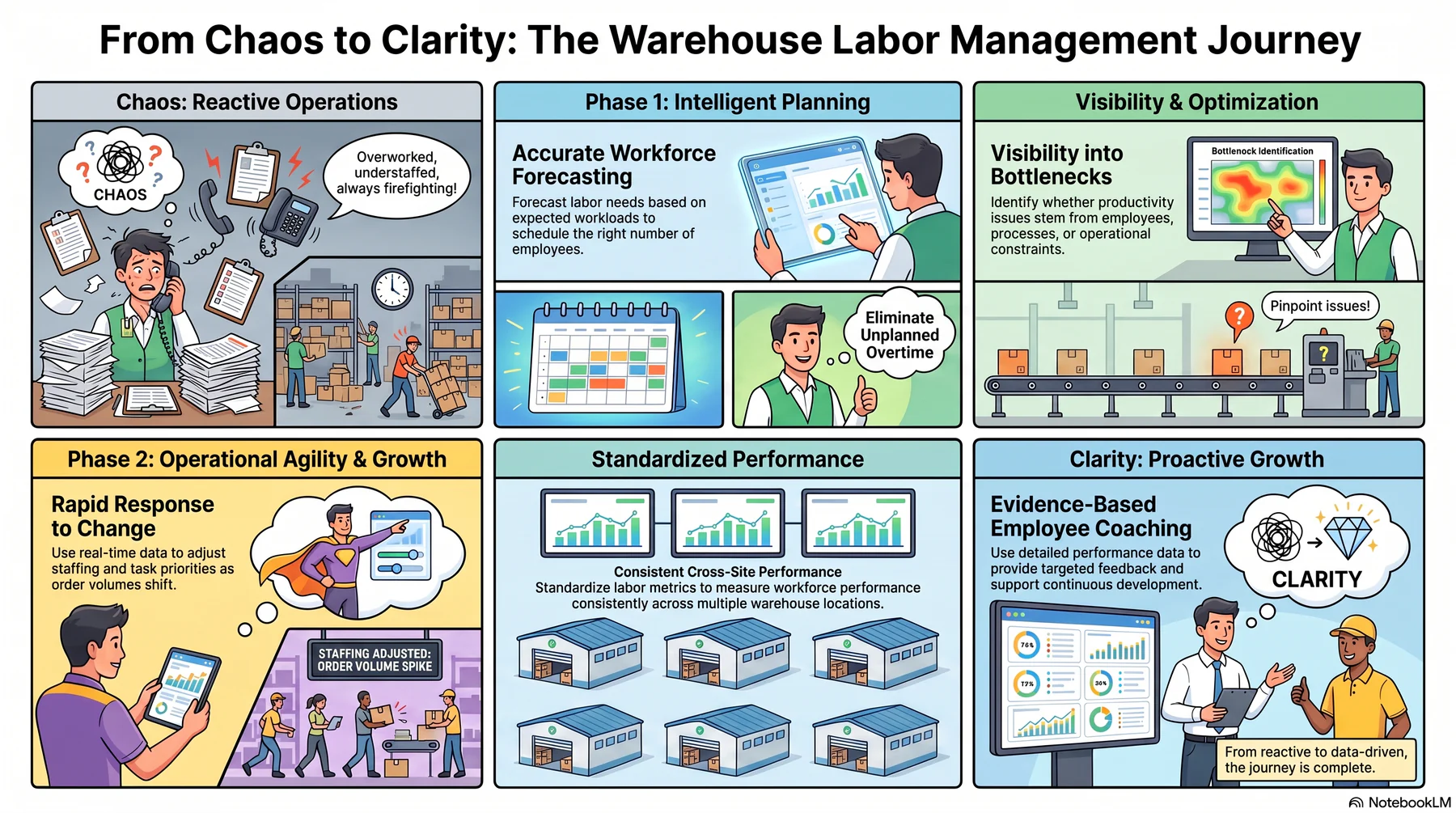
The main benefit of a warehouse labor management system is better operational decision-making. It connects workforce requirements with actual warehouse demand and provides context for performance variations.
1. More Accurate Workforce Planning
A warehouse labour management system forecasts labour needs based on expected workloads. This helps managers schedule the right number of employees for each shift and reduce planning errors.
2. Better Labour Utilisation
The system tracks how labour hours are spent across warehouse activities. This makes it easier to identify inefficiencies and improve workforce productivity.
3. Less Reliance on Unplanned Overtime
By comparing workloads with available staff, businesses can identify capacity gaps early. This helps reduce unnecessary overtime and improve labour planning.
4. Faster Response to Workload Changes
Real-time labour data allows managers to quickly adjust staffing and task priorities when order volumes or operational demands change.
5. Greater Visibility into Productivity Bottlenecks
Task-level insights help identify whether productivity issues are caused by employees, processes, or operational constraints. This supports faster and more targeted improvements.
6. More Consistent Performance Across Sites
Standardised labour metrics enable businesses to measure workforce performance consistently across multiple warehouses while maintaining clear reporting standards.
7. Better Data for Employee Coaching
Detailed performance data gives managers clear insights for coaching and development. This supports continuous improvement through targeted, evidence-based feedback.
When Does a Warehouse Need Labour Management Software?
Not every warehouse requires a dedicated labour management platform. Smaller facilities with stable demand and straightforward workflows may obtain sufficient visibility from their WMS, rostering tools, and operational reports.
1. Labour Planning Depends on Estimates
Many warehouses still rely on spreadsheets or manual judgement to plan staffing. This can make labour forecasts less accurate and increase the risk of overstaffing or understaffing.
2. Staffing Does Not Match Workloads
Some teams may be overstaffed while others are understaffed, leading to lower productivity and higher labour costs. Matching workforce capacity with actual demand helps improve efficiency.
3. Planned and Actual Work Cannot Be Compared
Without clear performance data, it is difficult to understand why actual labour results differ from planned workloads. This limits opportunities to improve planning and operations.
4. Labour Costs Keep Increasing
Higher labour costs may be driven by overtime, delays, equipment downtime, or inefficient processes rather than employee performance. Identifying the cause is essential for controlling costs.
5. Productivity Measures Are Inconsistent
Different warehouses often use different productivity metrics, making performance difficult to compare. Standardised measurements provide more reliable insights across teams and locations.
Warehouse Labour Management KPIs to Monitor
A warehouse should use a balanced set of labour, quality, and safety key performance indicators. No single metric provides a complete assessment.
| KPI | Measures | Why it matters |
|---|---|---|
| Throughput per Labour Hour | Work completed per labour hour | Tracks workforce productivity |
| Planned vs Actual Labour Hours | Planned hours vs hours used | Identifies labour gaps |
| Schedule and Capacity Adherence | Staffing compared with workload | Improves workforce planning |
| Direct, Indirect, and Lost Time | How labour time is spent | Highlights inefficiencies and delays |
| Overtime and Labour Utilisation | Overtime and labour usage | Helps control labour costs |
| Quality Errors and Rework | Mistakes and repeated work | Balances productivity with quality |
| Safety Incidents and Delays | Safety issues and disruptions | Supports safer warehouse operations |
Targets should be based on the warehouse’s layout, processes, workforce, technology, and service requirements. Generic industry benchmarks should not replace internal validation.
Responsible Workforce Measurement in Australia
Workforce monitoring can affect privacy, trust, safety, and employment decisions. Australian warehouses should evaluate applicable Commonwealth, state, and territory requirements before introducing individual monitoring.
The Fair Work Ombudsman’s workplace privacy guide recommends explaining what employee information is collected, why it is collected, how it is stored, and who may access it. The OAIC also notes that workplace surveillance obligations can differ across jurisdictions.
1. Explain What Data Is Collected
Clearly explain what employee data is collected, why it is needed, and how it will be used. Be transparent about data access, storage, and whether it will be used for performance reviews or coaching.
2. Consult Employees Before Implementation
Discuss monitoring practices with employees before rolling out the system. Their feedback can help identify operational challenges and improve adoption.
3. Limit Access to Performance Data
Restrict access to individual performance data to authorised personnel only. This helps protect employee privacy and ensures sensitive information is handled responsibly.
4. Provide Fair Performance Context
Assess performance based on similar roles, workloads, and working conditions. This creates fairer comparisons and provides more meaningful performance insights.
5. Keep Human Oversight
Use system data to support decisions, not replace them. Managers should review performance results alongside operational context before taking action.
6. Prioritise Safety Over Productivity
Set realistic productivity targets that promote safe work practices. Performance should be measured alongside quality and safety, not speed alone.
How Labour Management Software Integrates with WMS and Workforce Systems
Labour management software works best when it connects warehouse demand with workforce availability through effective system integration.
A typical information flow is:
Receive warehouse demand: The WMS sends task information such as picking, packing, replenishment, and shipping to the labour management system.
Calculate labour requirements: The system estimates the workforce needed based on workload, labour standards, and available resources.
Match available employees: Staff schedules, skills, attendance, and leave data are used to allocate the right employees to the right tasks.
Track task progress: RF scanners, mobile devices, and warehouse systems record task completion and real-time labour activity.
Compare planned and actual performance: Managers can monitor productivity, labour utilisation, delays, and remaining workloads.
Integrate with other systems: The LMS shares data with payroll and workforce systems to support reporting and workforce management.
When evaluating integration, businesses should examine data frequency, employee and task identifiers, error handling, permission controls, and the ownership of corrected records.
HashMicro's Warehouse Management System helps businesses integrate warehouse operations, workforce data, and inventory into a single platform. With Hashy AI, managers can instantly access operational insights and make faster labour decisions.






Conclusion
A warehouse labour management system helps businesses improve workforce planning, increase productivity, and gain better visibility into warehouse operations.
By connecting labour data with warehouse activities, businesses can make more informed staffing and operational decisions.
If you're looking to optimise warehouse performance with an integrated solution, consult with our experts for free. Discover how HashMicro's Warehouse Management System can help streamline operations and improve workforce efficiency
FAQ
A warehouse labour management system helps businesses plan staffing, track productivity, and improve workforce efficiency.
It improves labour planning, increases productivity, reduces overtime, and provides better visibility into warehouse performance.
A WMS manages inventory and warehouse tasks, while a labour management system focuses on workforce planning and productivity.
Choose a system that integrates with your WMS, provides real-time insights, and supports accurate labour planning and reporting.