

Financial modelling helps businesses use data and forecasts to understand future performance and make better decisions. Instead of relying on guesswork, businesses can test different scenarios before committing to major plans.
It supports budgeting, cash flow planning, pricing, and growth decisions by showing how changes in revenue, costs, or investments may affect the business.
To produce reliable results, financial models need accurate data. Many businesses use accounting or ERP software to keep financial information centralised and up to date.
Key Takeaways
Financial modelling helps businesses estimate future performance and make better financial decisions.
Financial modelling improves cash flow planning, budgeting, and risk management.
Accounting software provides accurate data to build more reliable financial models.
What Is Financial Modelling?

Financial modelling is the process of using historical data, assumptions, and forecasts to estimate a business's future financial performance. It helps businesses predict revenue, costs, cash flow, and profitability to support better decision-making.
A financial model links key drivers such as sales, expenses, and investments, allowing businesses to see how changes in one area may affect overall performance.
Businesses often use financial modelling to evaluate decisions such as expansion, hiring, financing, or new investments by comparing different scenarios before taking action.
How Financial Modelling Works
Financial modelling starts with a business question and uses data and assumptions to estimate future outcomes. A good model should be easy to update and practical enough to support real decisions.
1. Define the Planning Objective
Start by identifying the goal of the model, such as evaluating an expansion, managing cash flow, or assessing a new investment.
2. Collect Accurate Data
Gather reliable financial and operational data, including revenue, expenses, cash flow, and inventory information, to build a trustworthy model.
3. Set Financial and Operational Assumptions
Create assumptions for factors such as sales growth, costs, and payment terms so you can estimate future performance and test different scenarios.
4. Build the Model Structure
Organise the model to connect revenue, expenses, profit, and cash flow, making it easy to understand and update.
5. Test Different Scenarios
Compare different outcomes, such as changes in sales or costs, to understand potential risks and prepare for different situations.
6. Review and Update with Actual Results
Regularly compare forecasts with actual performance and update assumptions to keep the model accurate and relevant.
"Financial modelling turns assumptions into insights, helping businesses make decisions with greater confidence."
Why Businesses Use Financial Models
Businesses use financial models to make better planning decisions. Instead of looking only at what already happened, financial modelling helps leaders estimate what may happen next.
Common reasons include:
- Cash flow forecasting
- Budget planning
- Business expansion
- Loan or investor readiness
- Pricing and margin decisions
- Inventory purchasing decisions
- Hiring and workforce planning
- Project profitability planning
- Risk analysis and contingency planning
A financial model gives decision-makers a way to test plans before committing money, time, and resources. This is useful for growing businesses that need to balance opportunity with financial control.
For example, a business may appear profitable but still face cash pressure if customers pay late or stock purchases must be made before revenue is collected. A financial model can show these timing gaps before they become operational problems.
Common Types of Financial Models
Businesses use different financial models depending on their goals, such as managing cash flow, planning budgets, forecasting growth, or evaluating investments.
Common models include the three-statement model, cash flow model, budget model, and forecasting model, which help businesses understand financial performance and plan future decisions.
More specialised models, such as scenario planning, valuation, project finance, pricing, and mergers and acquisitions models, are used to assess risks, measure profitability, and support major strategic decisions.
Which Financial Model Is Best for Business Planning?
The best financial model depends on the business decision being made, as no single model suits every situation. Growing businesses often rely on cash flow, budget, and scenario planning models to support day-to-day decisions.
More advanced models, such as valuation, project finance, and mergers and acquisitions models, are typically used for fundraising, investments, or major business changes.
Regardless of the type, a good financial model should answer a specific business question and be built on accurate and reliable data.
Financial Modelling vs Financial Forecasting vs Budgeting
Financial modelling, forecasting, and budgeting are closely related, but they are not the same. Financial modelling tests different assumptions and shows how changes may affect future performance.
Financial forecasting estimates future revenue, costs, or cash flow based on historical data and expected conditions. Budgeting sets financial targets and helps businesses manage spending and resources.
These tools work best together. Businesses can use historical reports to understand past performance, forecasts to estimate future results, and financial models to evaluate different decisions.
Example: Financial Modelling for Cash Flow Planning
A business planning to expand can use financial modelling to estimate the financial impact before committing resources. This helps leaders understand how the decision may affect cash flow and profitability.
The model can test different scenarios, such as changes in sales, costs, or customer payment timing. This provides a clearer picture of potential risks and opportunities.
By identifying possible cash shortages early, businesses can adjust their plans, secure funding, or delay spending if needed.
Benefits of Financial Modelling for Australian Businesses
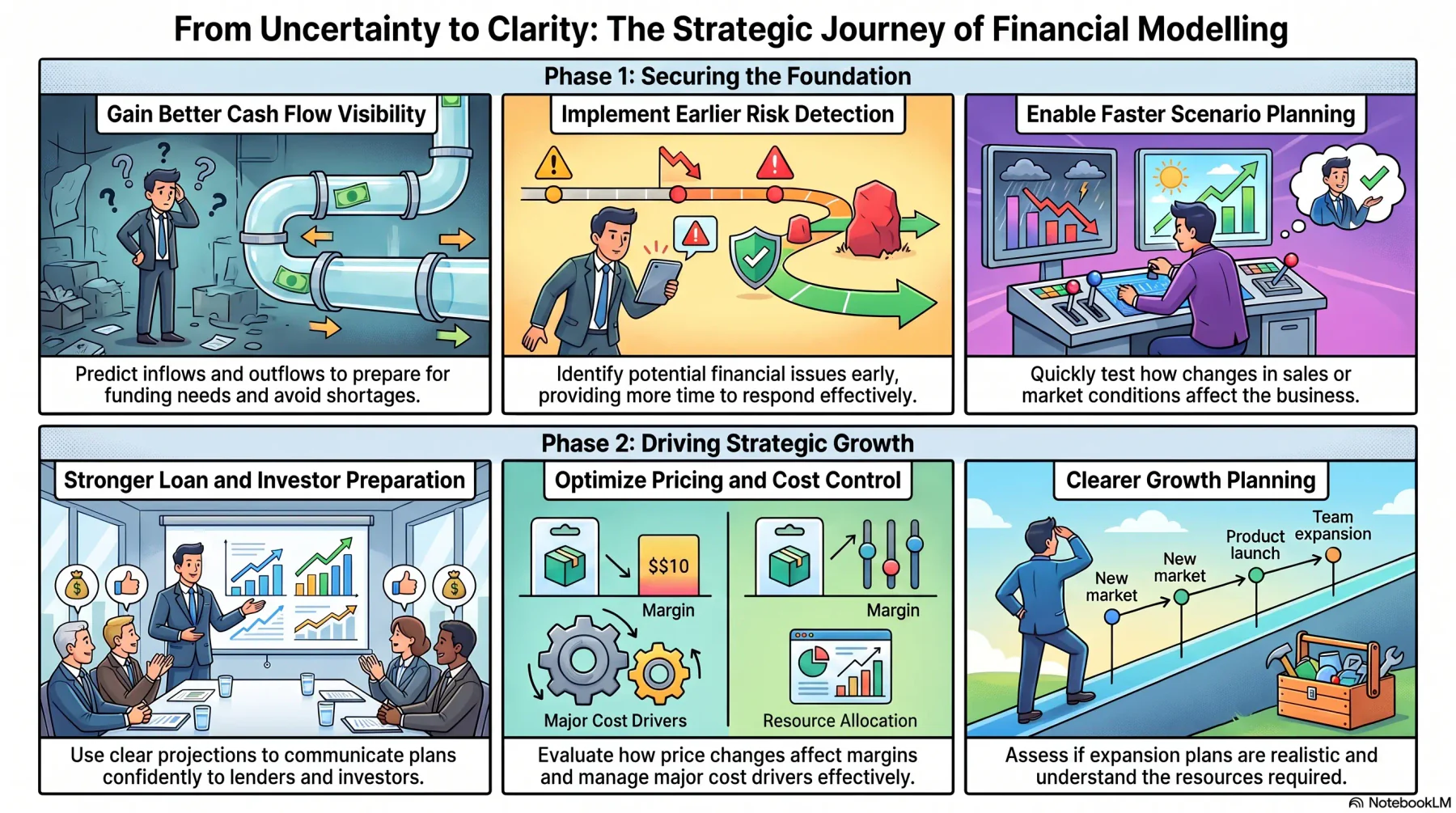
Financial modelling gives businesses a clearer understanding of future performance and helps reduce uncertainty. By testing different assumptions, businesses can improve planning, manage risks, and make decisions with greater confidence.
1. Better Cash Flow Visibility
Financial modelling helps businesses predict cash inflows and outflows so they can prepare for funding needs and avoid cash shortages.
2. More Confident Budgeting
It supports more realistic budgeting by helping businesses set financial targets based on clear assumptions and expected performance.
3. Faster Scenario Planning
Businesses can test different outcomes quickly and prepare for changes in sales, costs, or market conditions.
4. Stronger Loan or Investor Preparation
Financial models provide clear projections that help businesses communicate their plans to lenders and investors.
5. Better Pricing Decisions
Businesses can evaluate how changes in pricing or costs may affect revenue, margins, and profitability.
6. Improved Cost Control
Financial modelling highlights major cost drivers and helps businesses manage expenses more effectively.
7. Earlier Risk Detection
It helps identify potential financial issues early, giving businesses more time to respond.
8. Clearer Growth Planning
Businesses can assess whether expansion plans are financially realistic and understand the resources required.
9. Better Alignment Between Finance and Operations
Financial modelling connects financial and operational data, helping teams make better decisions using the same information.
Common Financial Modelling Mistakes
One common mistake is using outdated or inaccurate data, which can lead to unreliable results and poor decisions. Financial models should always be built on current and reliable information.
Businesses also make mistakes by using unrealistic assumptions or ignoring cash flow timing. Even profitable businesses can face cash shortages if payments and expenses are poorly planned.
Another issue is overcomplicating the model. Simple and well-structured models are often more useful and easier to maintain than highly complex ones.
How Accounting Software Improves Financial Modelling Accuracy
Accounting software helps businesses build more reliable financial models by providing accurate and up-to-date financial information. This reduces manual work and improves data consistency.
When connected with sales, inventory, payroll, and procurement data, businesses gain a more complete view of the factors affecting future performance.
Centralised data also makes financial models easier to update and helps businesses make decisions based on real-time information.
When to Use Financial Modelling Services
Financial modelling services are often useful for complex decisions such as fundraising, acquisitions, major investments, or business restructuring. These situations may require specialist expertise and detailed analysis.
External support can also help businesses create investor-ready models or evaluate high-value opportunities with greater confidence.
However, many businesses can manage everyday planning internally when they have accurate financial data and reliable systems in place.
Conclusion
Financial modelling helps businesses plan with more confidence by showing how different assumptions may affect future performance. It supports decisions around cash flow, budgeting, pricing, expansion, funding, and risk management.
The value of a financial model depends on the quality of the data behind it. A model built from outdated spreadsheets or disconnected reports can create more confusion than clarity.
By keeping accounting, cash flow, sales, inventory, payroll, procurement, and operational records connected, Australian businesses can build financial models that are easier to update and more useful for decision-making.
HashMicro’s accounting software helps businesses centralise financial data, monitor cash flow, and generate real-time reports to support more accurate financial modelling and planning.Contact our experts for a free consultation to discover how the right solution can improve financial visibility and decision-making.
FAQ
Financial models are used to estimate future financial performance and support decisions around budgeting, cash flow, pricing, expansion, investments, and risk management.
Yes. Small businesses can use financial modelling to manage cash flow, plan growth, test different scenarios, and make more informed financial decisions.
Yes. Accounting software provides accurate and up-to-date financial data, making it easier to build, update, and maintain reliable financial models.
Businesses often use financial modelling services for complex decisions such as fundraising, acquisitions, major investments, restructuring, or large expansion projects.