







Debt service coverage ratio helps businesses check whether operating income can cover debt repayments. It shows if the company has enough financial room to manage loans, leases, and other fixed obligations.
The formula is simple: divide net operating income by total debt service. The result becomes more useful when the numbers come from updated reports, repayment schedules, and cash flow records.
This article explains what DSCR means, how to calculate it, how lenders use it, and how accounting software helps Australian businesses monitor repayment capacity with better visibility.
Key Takeaways
Debt service coverage ratio (DSCR) measures a business’s ability to meet its debt obligations by comparing operating income with required debt repayments.
DSCR formula is DSCR = Net Operating Income / Total Debt Service.
DSCR is best understood as a coverage multiple, with a higher ratio indicating greater operating income relative to debt obligations.
What Is Debt Service Coverage Ratio?
Debt service coverage ratio, or DSCR, measures a business’s ability to pay debt obligations from operating income. It compares income from operations with the amount due for debt repayments.
A DSCR above 1 means the business earns more than it needs to cover debt service. A DSCR below 1 means operating income is not enough to cover repayments during the measured period.
For example, if a business has AUD 250,000 in net operating income and AUD 180,000 in annual debt service, its DSCR is 1.39. This means income covers debt repayments 1.39 times.
Debt coverage ratio is often used as another term for debt service coverage ratio. In most business finance contexts, both terms describe repayment capacity from operating income.

DSCR is one of the clearest signals a business has. It tells you, in a single number, whether your operations can actually support the debt you're carrying.
Ricky Halim, B.Sc., Managing Director
Why Debt Service Coverage Ratio Matters for Businesses
Debt service coverage ratio matters because it shows whether debt is manageable before it becomes a cash flow issue. It gives owners, finance teams, and lenders one clear repayment indicator.
A strong DSCR can support borrowing, expansion, equipment purchases, and working capital planning. A weak DSCR can signal thin margins, slow collections, high debt, or unstable cash flow.
For Australian SMEs, DSCR is useful before applying for finance. Lenders often review financial statements, profitability, cash flow trends, and repayment schedules before approving a loan.
The ratio also helps management ask a practical question: can the business service its current debt while still paying suppliers, wages, rent, tax, and operating costs?
Australian businesses face pressure from wage costs, supply costs, and changing demand. The Australian Bureau of Statistics provides economic data that can help teams understand wider market conditions.
Debt Service Coverage Ratio Formula
The debt service coverage ratio formula is:
DSCR = Net Operating Income / Total Debt Service
Net operating income is the income left after operating expenses. Total debt service is the principal and interest due in the same period.
Most businesses calculate DSCR annually, especially for loan reviews. However, monthly or quarterly DSCR can be more useful when cash flow changes throughout the year.
1. Net Operating Income
Net operating income shows how much income the business generates from its core operations after operating expenses. It should exclude unusual gains that do not reflect normal trading.
Many businesses use profit and loss reports to find this number. Some lenders may use EBITDA as a proxy, depending on their policy and the type of finance being assessed.
The most important rule is consistency. If you calculate DSCR monthly, use the same income definition every month so the trend remains reliable.
2. Total Debt Service
Total debt service includes the debt repayments due during the same period as the income figure. It usually includes both principal and interest payments.
This is where many businesses make errors. If principal repayments are excluded, DSCR may look stronger than the company’s real repayment position.
Lease obligations, equipment finance, vehicle loans, and other structured repayments may also need to be included, depending on how the lender assesses debt.
How to Calculate DSCR Step by Step
To calculate DSCR accurately, collect net operating income and total debt service for the same timeframe. Then divide income by debt service to find the coverage multiple.
A clean calculation depends on clean data. If repayments, revenue, expenses, and cash flow sit in separate spreadsheets, the ratio may not reflect the real business position.
3. Step 1: Find your net operating income
1. Find Your Net Operating Income
Start with the report that shows operating revenue and operating expenses. For most businesses, this will be the profit and loss statement.
Remove unusual or non-recurring income that does not reflect normal business performance. For example, a one-off asset sale should not inflate repayment capacity.
If the business has several branches, projects, or trading entities, confirm which income should be included before calculating DSCR.
2. Add Total Debt Repayments
Next, calculate all required debt payments for the same period. Include principal, interest, and fixed debt obligations that must be paid.
If you are calculating annual DSCR, use annual debt service. If you are calculating monthly DSCR, use monthly repayments.
Do not mix annual income with monthly debt service. A mismatched timeframe will produce an incorrect ratio and may lead to poor finance decisions.
3. Divide Income by Debt Service
After both numbers are ready, divide net operating income by total debt service. The result shows how many times income covers repayments.
A DSCR of 1.00 means the business has exactly enough income to cover debt service. A DSCR of 1.50 means income is 50% higher than required repayments.
A DSCR of 0.85 means operating income does not cover debt service for that period. The business may need reserves, refinancing, cost control, or faster collections.
Debt Service Coverage Ratio Example
Here is a simple DSCR example for an Australian business.
Using the formula:
DSCR = 250,000 / 180,000 = 1.39
A DSCR of 1.39 means the business generates 1.39 times the income needed to cover annual debt repayments. This suggests a repayment buffer.
However, the strength of that buffer depends on the lender, industry, margin stability, and cash flow timing. A seasonal business may need stronger coverage.
Now compare that with a weaker scenario:
How to Interpret Your DSCR
DSCR is easiest to read as a coverage multiple. The higher the ratio, the more operating income the business has compared with its debt obligations.
A single DSCR result should not be read in isolation. Finance teams should compare it with cash flow timing, margin stability, industry risk, and upcoming repayment changes.
1. DSCR Below 1.0
A DSCR below 1.0 means the business does not generate enough operating income to cover debt service during the measured period.
This does not always mean immediate default. However, it shows the company may rely on reserves, delayed payments, owner funding, or future revenue to meet obligations.
For lenders, this is usually a warning sign. For management, it is a signal to review margins, repayment timing, cash collection, and debt structure.
2. DSCR Equal to 1.0
A DSCR of 1.0 means the business has exactly enough income to cover debt service. There is no room for lower sales, late payments, or unexpected costs.
This position can become risky if the company has seasonal revenue, rising supplier costs, or customer payments that arrive later than repayment due dates.
A business at this level should monitor cash flow closely. Even a small fall in operating income can push the ratio below 1.0.
3. DSCR Above 1.0
A DSCR above 1.0 means the business has more operating income than required for debt service. For example, 1.30 means income is 30% higher than repayments.
This can support a stronger financing case. However, lenders may still review revenue quality, expense control, existing liabilities, and forecast assumptions.
A healthy DSCR is strongest when it comes from stable operations, not one-off income. Clean reporting helps prove whether the ratio is sustainable.
4. What Is a Good Debt Service Coverage Ratio?
A good debt service coverage ratio depends on the lender, industry, loan type, and cash flow pattern. Many lenders prefer a DSCR above 1.2 or 1.25.
Some businesses may need a higher buffer. Seasonal companies, project-based firms, and businesses with large fixed costs can face pressure even with solid annual coverage.
Recurring revenue businesses may be assessed differently because income is often more predictable. The useful benchmark is the one that matches the company’s risk profile.
How Lenders Use DSCR for Business Loans
Lenders use DSCR to assess whether a business can repay debt from operating income. It helps them look beyond revenue size and focus on repayment capacity.
A company with high sales can still have a weak DSCR if margins are thin or expenses are high. A smaller business may look stronger if profit and cash flow are stable.
DSCR can affect loan size, repayment terms, security requirements, interest risk, and covenant settings. A low ratio may reduce the amount a lender is willing to approve.
For business owners, DSCR should be reviewed before applying for finance. Waiting until the lender calculates it may leave little time to improve the result.
Common DSCR Calculation Mistakes
DSCR is simple in theory, but it can be miscalculated when financial data is incomplete or inconsistent. These errors can make repayment capacity look better than reality.
Most mistakes stem from using the wrong income figure, excluding principal repayments, relying on outdated reports, or ignoring seasonal cash-flow pressures.
1. Using Revenue Instead of Operating Income
Revenue recognition is not the same as repayment capacity. A business may have strong sales but still face high costs, low margins, or delayed customer payments.
DSCR should use operating income, not total revenue. This gives a clearer view of the income available after normal operating expenses are paid.
Using revenue can create a misleading result. It may suggest the business can carry more debt than its margins can actually support.
2. Excluding Principal Repayments
Some businesses include only interest expense when calculating total debt service. This makes DSCR look stronger than it really is.
Debt service should usually include principal and interest. Principal repayments still use cash, even if they do not appear as an expense in the profit and loss report.
Equipment finance, vehicle loans, lease obligations, and other fixed repayment plans may also need to be included in the calculation.
3. Using Outdated Financial Data
Old financial reports can distort DSCR. If revenue has changed, expenses have increased, or new loans have been added, last year’s figures may no longer be useful.
Finance teams should calculate DSCR with current reports. This is especially important before loan applications, refinancing, expansion, or major asset purchases.
Regular updates with the help of financial management tools also help management see trends early. A declining DSCR can be addressed before it becomes a lender concern.
4. Ignoring Seasonal Cash Flow
A business may have a healthy annual DSCR but still struggle in slower months. This matters for retailers, wholesalers, manufacturers, and project-based businesses.
Monthly or quarterly DSCR analysis can show when repayment pressure is highest. It can also reveal whether reserves are needed for low-revenue periods.
Seasonal businesses should compare DSCR with cash flow forecasts. A strong annual ratio is less useful if cash is not available when repayments fall due.
How to Improve Debt Service Coverage Ratio
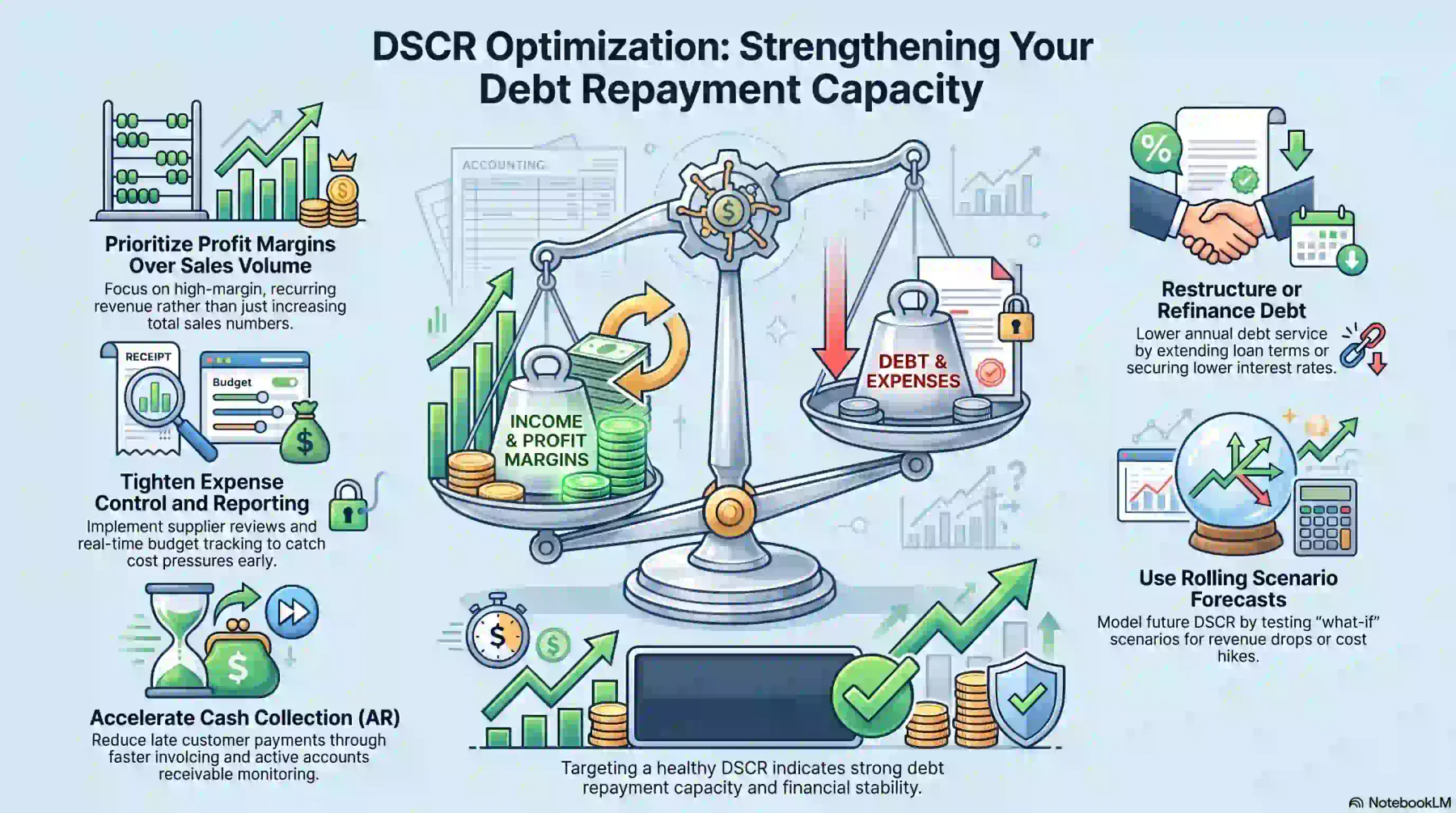
Businesses can improve DSCR by increasing operating income, reducing debt service, or improving cash timing. The best approach depends on the cause of the weak ratio.
If the issue is low margin, the focus should be profitability. If the issue is repayment pressure, the business may need to review debt terms or cash flow planning.
1. Increase Operating Income
Increasing operating income can improve DSCR without changing the loan structure. Businesses can review pricing, product mix, recurring revenue, and gross margins.
The goal is not only to increase sales. It is to increase the income left after operating expenses, because that is the income available to service debt.
Finance teams should also separate profitable and unprofitable revenue. High-volume sales with weak margins may not improve repayment capacity.
2. Reduce Operating Expenses
Expense control can improve DSCR when costs are rising faster than revenue. This may include supplier reviews, approval workflows, and budget variance tracking.
Small recurring costs can become material over time. Regular expense reviews help managers find cost pressure before it affects debt coverage.
Better reporting also improves accountability. If expense data arrives late, the business may only see the issue after cash has already been spent.
3. Improve Cash Collection
Late customer payments can weaken cash flow even when profit looks healthy. Faster invoicing, clear payment terms, and active follow-up can improve repayment readiness.
This is important for businesses that sell on credit. DSCR may look strong on paper, but repayments still need cash available on the due date.
Accounts receivable ageing reports help identify overdue customers, slow-paying segments, and collection risks before they pressure loan repayments.
4. Restructure or Refinance Debt
Some businesses improve DSCR by changing the repayment structure. A longer term may reduce annual debt service, while refinancing may lower interest costs.
This should be assessed carefully. Lower repayments can improve short-term DSCR, but the total cost of debt may increase over the full loan period.
Finance teams should compare DSCR before and after restructuring. They should also review fees, covenants, security requirements, and future rate exposure.
5. Use Better Financial Forecasting
Forecasting, especially when using accounting tools, helps businesses see future DSCR before repayment pressure appears. A rolling forecast can model income, expenses, debt service, and cash timing.
Scenario planning is also useful. Finance teams can test what happens if revenue drops, supplier costs rise, or a new loan is added.
This gives managers time to adjust plans before lenders ask questions. It also supports better decisions around borrowing, expansion, and capital spending.
How Accounting Software Helps Monitor DSCR
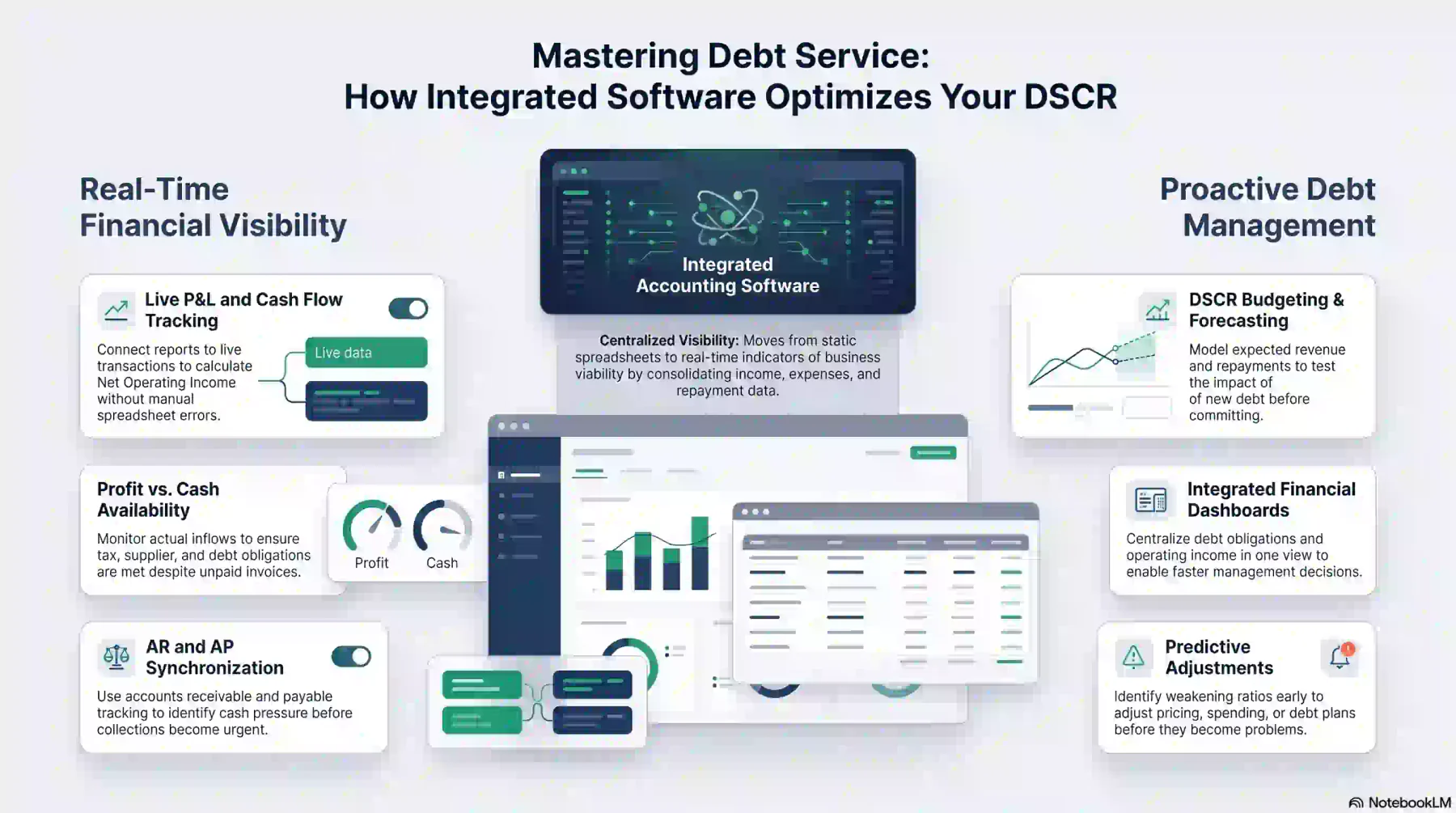
Accounting software helps businesses monitor DSCR by keeping income, expenses, repayments, invoices, and cash flow data in one system.
This reduces the risk of calculating the ratio from disconnected spreadsheets, outdated reports, or incomplete repayment records.
For finance teams, the main value is visibility. DSCR should not only be calculated for loan applications. It should be tracked as part of financial health.
1. Real-Time Profit and Loss Reporting
A reliable profit and loss report helps businesses calculate net operating income more accurately. Updated reporting shows whether income is improving or weakening.
This makes DSCR easier to monitor before it becomes a problem. It also helps finance teams explain movements in the ratio to management or lenders.
When reports are connected to live transactions, businesses can reduce manual work and avoid relying on old spreadsheet exports.
2. Cash Flow Visibility
Cash flow visibility helps businesses plan repayments around actual inflows and outflows. This matters because profit and cash are not always available at the same time.
A company can report profit while still facing repayment pressure from unpaid invoices, stock purchases, tax obligations, or supplier payments.
Cash flow tracking helps managers prepare earlier. It shows whether enough cash will be available when loan and lease payments are due.
3. Accounts Receivable and Payable Tracking
Accounts receivable tracking shows which customers owe money and how overdue invoices affect available cash. This helps teams act before collections become urgent.
Accounts payable tracking shows upcoming supplier payments that may compete with debt obligations. Together, AR and AP give a practical view of cash pressure.
This visibility helps businesses avoid overestimating repayment capacity. It also supports better timing for supplier payments, collections, and debt service.
4. Budgeting and Forecasting
Budgeting and forecasting help businesses project future DSCR. Finance teams can model expected revenue, expenses, repayments, and cash flow by period.
This is useful before taking on new debt, expanding operations, or entering a seasonal trading period. It helps management test decisions before committing cash.
Forecasting also helps identify when DSCR may weaken. The business can then adjust spending, collections, pricing, or debt plans earlier.
5. Debt and Financial Reporting Dashboard
A financial dashboard can help management track debt obligations, operating income, cash flow, and key ratios from one place.
This reduces manual reporting work and helps leaders make faster decisions. It also gives finance teams a clearer way to explain repayment capacity.
HashMicro’s accounting software supports financial reporting, cash flow monitoring, budgeting, AR, AP, and integrated dashboards for Australian businesses.
Conclusion
Debt service coverage ratio shows whether operating income can cover debt repayments. A DSCR above 1 signals a buffer, while a ratio below 1 shows repayment pressure that needs attention.
For Australian companies, accurate DSCR depends on reliable reports, repayment schedules, cash flow forecasts, and AR/AP visibility. HashMicro’s accounting software keeps these data points in one system.
If you are interested in learning further about this subject, you can book a free consultation with our experts to gain more practical business insights and apply it to your business.

FAQs About Debt Service Coverage Ratio
The DSCR formula is DSCR = Net Operating Income / Total Debt Service. Net operating income is income from operations, while debt service includes required repayments.
A good DSCR depends on the lender, industry, and loan type. Many lenders prefer a ratio above 1.2 or 1.25, but riskier businesses may need a higher buffer.
A DSCR below 1 means operating income is not enough to cover debt service during the measured period. The business may need reserves or corrective action.
In many business finance contexts, debt coverage ratio is used as another term for debt service coverage ratio. Both refer to debt coverage from operating income.
A business can improve DSCR by increasing operating income, reducing costs, collecting invoices faster, restructuring debt, and improving financial forecasting.
Lenders use DSCR to assess repayment capacity. The ratio helps them see whether a business can cover current or proposed debt from operating income.