






 Limited to 100 registrants

Moving goods often involves more than one transport mode, especially for businesses importing or distributing products across Australia. Without clear coordination, delays and fragmented shipment information can affect inventory and delivery schedules.
Multimodal transport is the movement of goods using two or more transport modes, such as sea, rail, road, or air, within a single freight journey. It helps businesses manage shipments more efficiently across the supply chain.
This guide explains how multimodal transport works, its benefits, common transport combinations, and the factors to consider when choosing this shipping method.
Key Takeaways
Multimodal transport combines two or more transport modes in one coordinated freight journey.
Multimodal and intermodal transport differ mainly in how each freight journey is managed and coordinated.
Multimodal transport can improve route flexibility, capacity options, and regional distribution.

What Is Multimodal Transport in Freight?

Multimodal transport is the movement of goods using two or more transport modes, such as sea, rail, road, or air, under a single transport contract. Although shipments change between different modes during the journey, the movement is coordinated as one freight service.
For example, imported goods may arrive at an Australian port by sea, travel by rail to an inland terminal, and then be delivered by truck to a warehouse. Instead of managing each transport leg separately, businesses work with one transport provider that oversees the entire journey.
Multimodal transport is commonly used in domestic and international freight because it combines the strengths of different transport modes. It can help businesses improve delivery efficiency, reduce administrative complexity, and maintain better visibility across the supply chain.
When Does Multimodal Transport Fit Your Freight Network?
Multimodal transport is suitable when a shipment needs more than one transport mode to reach its destination. It is commonly used for import and export freight, long-distance domestic deliveries, and supply chains that move goods through ports, rail terminals, and distribution centres.
1. A Shipment-Control Problem Across Multiple Freight Legs
Multimodal transport is useful when shipments pass through several transport stages. Coordinating these handovers helps businesses keep freight moving smoothly and maintain better visibility throughout the journey.
2. Multimodal Transport Defined for Freight Operations
In freight operations, multimodal transport means moving goods by two or more transport modes, such as sea, rail, road, or air, within one shipment. It allows businesses to connect different transport networks while managing the journey more efficiently.
3. When Combining Modes Solves a Real Network Constraint
Using multiple transport modes is often the best option when one mode cannot complete the entire journey. For example, imported cargo may arrive by sea, travel inland by rail, and then be delivered by truck to its final destination.
4. When Single-Mode Transport Is Still More Practical
Single-mode transport is often a better choice for short or direct deliveries. If one transport mode can complete the journey efficiently, adding extra transfers may increase complexity without providing significant benefits.
5. Lane-Fit Screening: Access, Cargo, Delivery Window, Terminals, and Accountability
Before choosing multimodal transport, businesses should consider whether the route, cargo requirements, delivery schedule, transfer facilities, and responsibilities can be managed effectively. A suitable freight network should support smooth handovers and clear accountability from origin to destination.
"Better freight coordination starts with clear visibility across every transport stage, helping businesses respond faster to delays and keep deliveries on track."
How Does Multimodal Transport Differ From Intermodal Transport?
Both multimodal and intermodal transport use two or more transport modes to move goods. The main difference is how the shipment is managed and who is responsible for coordinating the journey.
| Feature | Multimodal Transport | Intermodal Transport |
|---|---|---|
| Contracts | Usually one contract | Usually separate contracts |
| Coordination | One provider manages the journey | Multiple providers manage different legs |
| Responsibility | More centralised | Shared across providers |
| Best suited for | Simpler end-to-end freight management | Greater control over each transport stage |
1. Multimodal Transport: One Broader Journey Under Coordinated Responsibility
With multimodal transport, the shipment is managed as one coordinated journey. Businesses usually work with a single transport provider or operator who oversees the movement from origin to destination, even if different transport modes are used.
2. Intermodal Transport: Separate Legs With Separate Handling or Contracts
Intermodal transport also combines multiple transport modes, but each leg of the journey is often managed separately. Different carriers may handle different stages, and businesses may need to coordinate multiple contracts or service providers.
3. Why the Distinction Matters for Accountability and Documentation
The transport model affects who manages shipment updates, transfer points, and documentation. Understanding these responsibilities helps businesses avoid confusion, especially when delays, damaged goods, or claims occur during transit.
4. Which Model Fits Importers, Distributors, and Freight Managers
Multimodal transport is often suitable for businesses that prefer a single point of coordination, while intermodal transport may suit organisations that want greater control over each transport stage. The right choice depends on the shipment, delivery requirements, and operational preferences.
Which Five Transport Modes Can You Combine in a Multimodal Network?
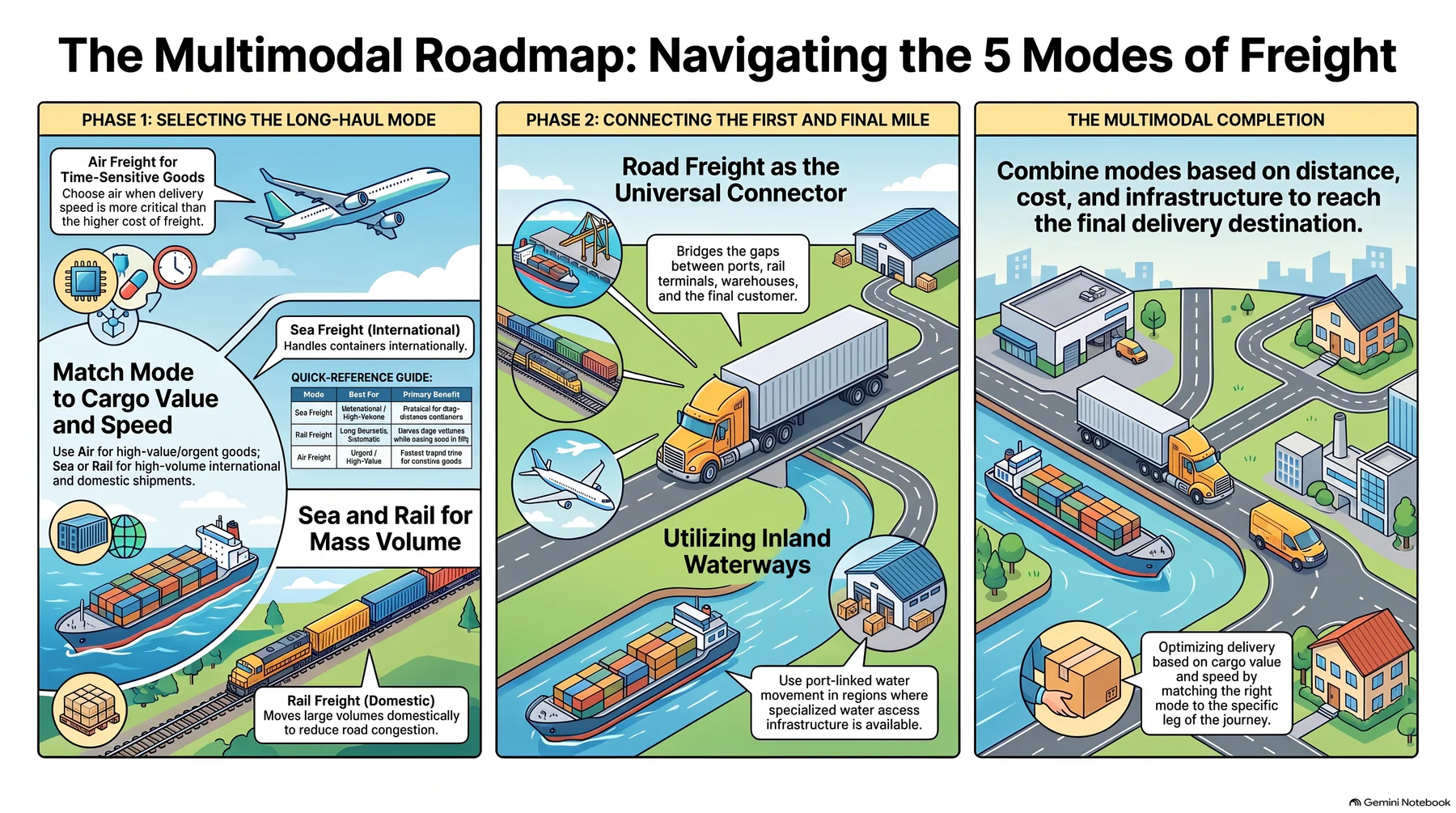
Multimodal transport combines different transport modes to suit the shipment, delivery schedule, and destination. The best combination depends on factors such as cargo type, distance, cost, transit time, and available transport infrastructure.
1. Sea Freight for International or High-Volume Cargo
Sea freight is commonly used for international shipments and large cargo volumes. Although transit times are longer, it is often the most practical option for moving containers over long distances.
2. Road Freight for Pickup, Delivery, and Regional Access
Road freight connects suppliers, ports, rail terminals, warehouses, and customers. It is the most flexible transport mode and is often used for the first and final stages of a multimodal journey.
3. Rail Freight for Long Domestic Distances
Rail freight is suitable for moving large volumes over long distances within Australia. It can reduce road congestion and is commonly used to transport containers between ports and inland distribution centres.
4. Air Freight for Urgent or High-Value Shipments
Air freight is the fastest transport option for time-sensitive or high-value goods. It is commonly used when delivery speed is more important than freight costs.
5. Inland Waterway or Port-Linked Movement Where Available
Inland waterways may be used in regions with suitable infrastructure, although they are less common than road, rail, sea, or air transport. They can support multimodal networks where water access is available.
6. How to Match Each Mode to Cargo Value, Speed, Cost, and Handling Risk
High-value or urgent goods may be better suited to air freight, while large shipments often benefit from sea or rail transport. Road freight provides flexibility for local deliveries, and businesses should also consider handling requirements, transit times, and overall freight costs when planning a multimodal network.
What Benefits Can Growing Enterprises Realistically Expect?
Multimodal transport can improve freight operations when supported by good planning and coordination. While the benefits vary by business and freight network, it can provide greater flexibility and improve how shipments move across different transport modes.
Some of the key benefits include:
Better route flexibility across long freight lanes: Use different transport modes to suit each stage of the journey and respond more easily to disruptions.
More options when direct transport capacity is limited: Switch to alternative transport modes when capacity is constrained or demand increases.
Improved control over regional distribution: Move goods more efficiently between ports, warehouses, distribution centres, and customers.
Potential cost and service balance across route segments: Combine transport modes to balance freight costs, delivery times, and service requirements.
Why multimodal transport still needs active coordination: Multiple transport modes require clear communication, shipment visibility, and well-managed handovers to keep freight moving smoothly.
An ERP or transport management system can support multimodal transport by connecting purchasing, inventory, warehouse, and freight information in one place.
How Can You Plan and Control a Multimodal Transport Operation?
Effective multimodal transport relies on clear planning and coordination. By defining responsibilities and monitoring each stage of the journey, businesses can reduce delays, improve shipment visibility, and respond more quickly when issues arise.
1. Map the Route From Origin to Final Delivery Point
Start by mapping the complete freight journey, including every transport mode, transfer point, terminal, and final destination. This gives all stakeholders a clear understanding of how goods will move.
2. Define the Responsible Party for Each Freight Leg
Assign responsibility for every stage of the shipment, including transport providers, warehouses, freight forwarders, and internal teams. Clear ownership helps prevent confusion when updates or decisions are needed.
3. Set Milestone Checks for Departure, Arrival, Transfer, and Release
Track key shipment milestones throughout the journey. Monitoring departures, arrivals, terminal transfers, and cargo releases helps businesses identify delays early and keep delivery schedules on track.
4. Confirm Documentation Before Cargo Reaches Transfer Points
Ensure shipping documents, customs paperwork, and purchase order details are complete before goods arrive at each transfer point. Accurate documentation helps avoid unnecessary delays and processing issues.
5. Prepare Exception Rules for Delay, Damage, or Missed Connections
Define how the business will respond if shipments are delayed, damaged, or miss a scheduled transfer. Having a clear escalation process allows teams to make decisions quickly and communicate changes to customers.
6. Review Cost, Delivery, and Service Performance After Completion
After each shipment, review freight costs, delivery times, and service performance to identify improvement opportunities. Regular reviews help businesses refine transport planning and strengthen future multimodal operations.
Multimodal Transport Example: Import to Warehouse in Australia
A typical multimodal transport journey in Australia involves several transport stages before goods reach their final destination. Each stage requires clear coordination to keep shipments moving and minimise delays.
1. Import Cargo Arrives by Sea at an Australian Port
The journey begins when a container arrives at an Australian port by sea. After customs clearance and terminal processing, the cargo is prepared for inland transport.
2. Goods Move From Port to Rail or Road Transfer
Once released from the port, the shipment is transferred by rail or truck depending on the destination and available transport network. This stage connects the port with inland warehouses or distribution centres.
3. Final Delivery Reaches Warehouse, DC, or Regional Branch
The final leg is usually completed by road, delivering goods to a warehouse, distribution centre (DC), or regional branch where they are received, inspected, and prepared for storage or fulfilment.
4. Where Delays and Hand-Off Risks Usually Appear
Delays often occur during customs clearance, terminal release, or when goods are transferred between transport modes. Missing documents, limited terminal capacity, or poor communication between transport providers can also slow the shipment.
5. What Teams Should Track From Shipment Booking to Warehouse Receipt
Throughout the journey, businesses should monitor shipment bookings, departure and arrival dates, transfer milestones, customs clearance, proof of delivery, and warehouse receipt. Keeping these updates in one system helps logistics, warehouse, procurement, and customer service teams stay aligned and respond quickly if issues arise.
Conclusion
Multimodal transport helps businesses move goods more efficiently by combining different transport modes within a single freight journey. When planned well, it can improve delivery flexibility, shipment visibility, and supply chain coordination.
Success depends on more than choosing the right transport modes. Clear responsibilities, accurate shipment data, and consistent inventory tracking are essential for managing transfers and reducing delays.
If you're planning to improve your freight operations, consult with HashMicro's experts for free to discover how an integrated ERP system can help manage multimodal transport more effectively.

Frequently Asked Questions
Multimodal transport uses two or more transport modes under one coordinated shipment, while intermodal transport usually involves separate providers or contracts for each transport leg.
Multimodal freight can combine sea, road, rail, air, and inland waterway transport, depending on the shipment and destination.
Businesses should use multimodal transport when goods need more than one transport mode to reach their destination, such as imported cargo moving from ports to warehouses.
Common risks include shipment delays, transfer issues, damaged cargo, missing documents, and poor communication between transport providers.
An ERP system helps businesses track shipments, manage inventory, and keep freight information in one place so teams can work with accurate, up-to-date data.