




A slow quote-to-cash process can quickly turn a profitable sale into delayed revenue. Pricing errors, approval gaps and poor handoffs also weaken margins before delivery even begins.
Australian businesses need each commercial promise to survive the move from Sales to Operations and Finance. A connected workflow keeps price, quantity, tax and payment terms aligned.
This article explains what is quote to cash, how the eight stages work and where control commonly breaks down. It also shows how software can shorten the path from quote to applied cash.
Key Takeaways
Quote-to-cash is the end-to-end process linking quotation, order fulfilment, invoicing, payment application and reconciliation.
The Q2C process flow covers eight stages, from configuring an offer to fulfilment, invoicing, collection, cash application and reconciliation.
Improving the Q2C cycle requires mapping handoffs, unifying records, standardising exceptions, connecting team data, testing scenarios and tracking results.
HashMicro supports connected Q2C by linking CRM, Sales, Inventory and Accounting so approved terms flow through orders, fulfilment, invoices and payments.

What Is the Quote-to-Cash Process?
Quote to cash is the end-to-end process that starts when a seller configures an offer. A consistent quotation format then carries the approved offer through acceptance, order processing, fulfilment, invoicing and payment.
The process ends only after Finance applies the receipt to the correct invoice or account and reconciles it. Issuing an invoice alone does not fully complete the quote to cash cycle.
Q2C links Sales, Customer Service, Operations, Warehouse and Finance around one commercial record. Each team can see the terms agreed with the customer and the work still outstanding.
Strong controls keep approved prices, quantities, delivery terms, GST treatment and payment conditions consistent. They also create an audit trail for discounts, changes and exceptions.
"The quote-to-cash process only works when pricing, quotation and approval share one commercial record. Once every team sees the same agreed terms, fewer errors reach the final invoice"
Quote-to-Cash Process Flow
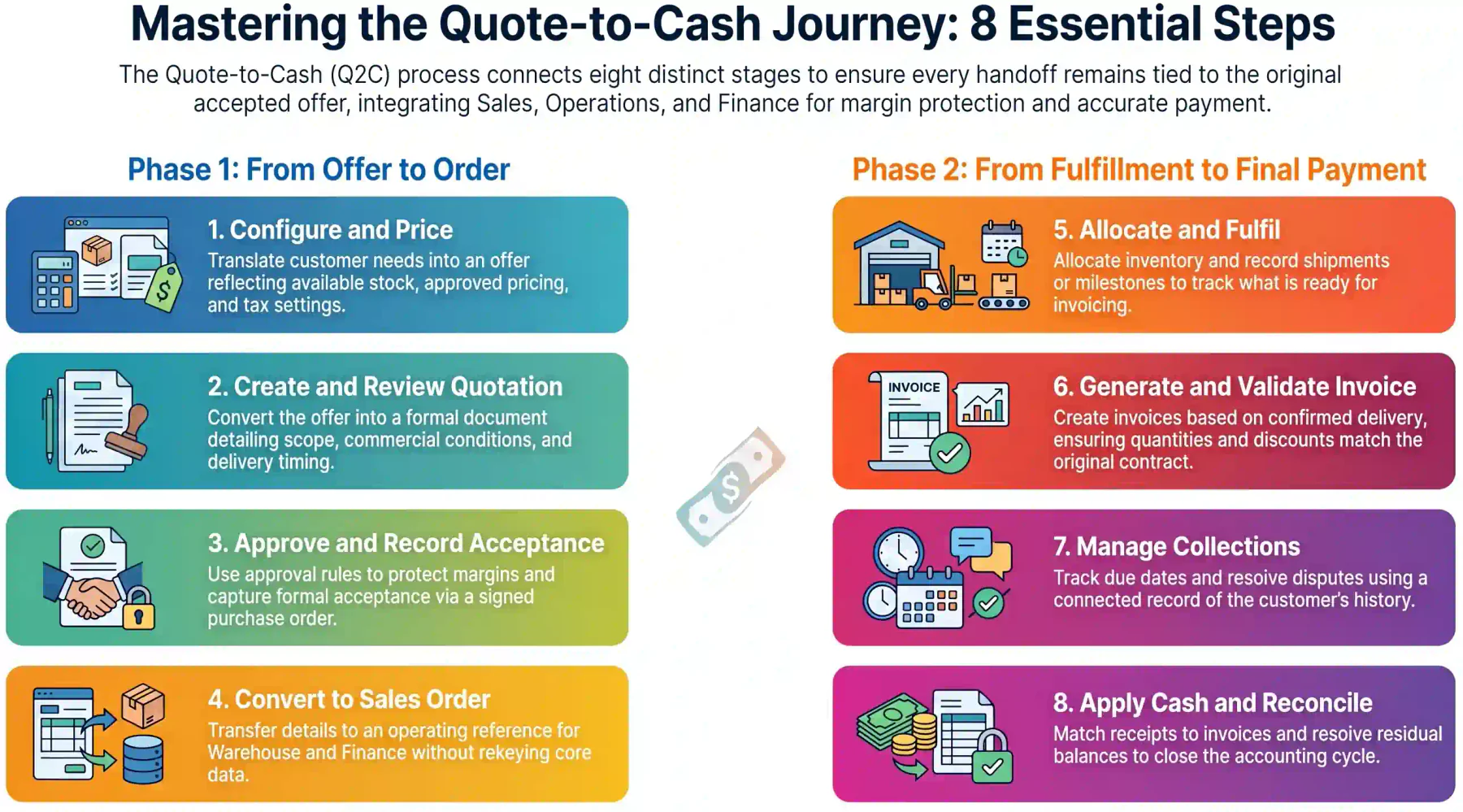
Most B2B businesses move through eight connected stages, although the exact controls vary by industry. This quote to cash process flow keeps each handoff tied to the accepted offer.
1. Configure the Offer and Determine Pricing
Sales first translates the customer’s needs into a configured offer covering products, services, bundles, quantities and delivery dates. The offer should reflect available stock and capacity.
Approved catalogues, price lists and tax settings give representatives a reliable starting point. Customer pricing and discounts should follow policy, with exceptions routed for review.
2. Create and Review the Quotation
Sales converts the configured offer into a formal quotation that explains the scope and commercial conditions. Clear wording helps the customer assess value without guessing what is included.
The quotation should state quantities, unit prices, discounts, GST treatment, validity, delivery timing and payment terms. Add exclusions, warranties and service boundaries where relevant.
Before sending the quote, check calculations, customer details and operational feasibility. Give extra scrutiny to custom pricing, several delivery sites or non-standard fulfilment commitments.
3. Approve the Quote and Record Customer Acceptance
Approval rules protect margin by escalating discounts, extended terms and low-margin deals to the right decision-maker. The reason, reviewer and outcome should remain attached to the quote.
After approval, capture acceptance through a signed quote, customer purchase order or authorised digital confirmation. This evidence prevents fulfilment from starting on a verbal assumption.
If the customer requests a change, revise the quote and repeat the relevant approvals. Preserving earlier versions shows who changed the commercial promise and why the change was accepted.
4. Convert the Approved Quote into a Sales Order
Convert the accepted quote into a sales order without rekeying its core commercial details. The order becomes the operating reference for Warehouse, Procurement, delivery teams and Finance.
For credit sales, check the customer’s limit, overdue balance and approved terms before release. Place exceptions on hold until an authorised person accepts the exposure and records the reason.
The sales order should retain products, quantities, prices, taxes, delivery instructions and terms. Control later changes through amendments so teams can compare the new commitment with the original.
5. Allocate, Fulfil and Deliver the Order
Operations allocates inventory, schedules services or triggers procurement and production from the approved order. Every task should retain a clear link to the customer and promised delivery date.
Record picks, shipments, installations, milestones and proof of delivery as they occur. Accurate fulfilment data shows what can be invoiced now and what remains open, delayed or backordered.
Partial delivery needs particular discipline because the order and shipment no longer match in full. Update delivered and outstanding quantities so neither billing nor customer service relies on estimates.
6. Generate and Validate the Invoice
Finance creates the invoice after confirmed fulfilment progress or an agreed billing milestone. The billing basis should match the contract, sales order, fulfilment record and any earlier invoices.
Validate quantities, approved discounts, GST treatment, credits and customer references before issue. Duplicate checks and billing tolerances can catch errors before they become disputes.
Where one order has several deliveries, invoice only the eligible quantities or milestones. Keep the balance open against the order so Finance can bill it later without recreating information.
7. Manage Collections and Receive Payment
Accounts Receivable tracks due dates, sends reminders and assigns disputed items to clear owners. Collection activity should reflect customer risk, value and the reason payment remains outstanding.
A connected record helps teams distinguish genuine credit risk from missing purchase orders, delivery issues or invoice errors. That context supports a faster, more appropriate customer response.
Payment promises and dispute outcomes should be logged against the account and invoice. Sales, Operations and Finance can then act from the same position without repeating customer conversations.
8. Apply Cash and Reconcile the Transaction
Finance matches each receipt to the correct invoice or customer account, then posts and reconciles it. The work may involve one invoice, several invoices, deductions, credits or partial payments.
Unidentified receipts should enter a controlled exception queue instead of remaining invisible in a bank feed. Clear ownership and remittance matching prevent paid invoices appearing overdue.
The quote to cash cycle closes when the receivable, bank receipt and accounting entries agree. Finance should review residual balances and resolve short payments before marking the case complete.
A Quote-to-Cash Example for an Australian Distributor
A distributor supplying industrial equipment to several customer branches shows how Q2C handles real operational complexity. The example includes a discount, credit terms and split fulfilment.
1. From Customer Quote to Partial Delivery
A representative quotes 100 units with customer pricing, GST and 30-day payment terms. Because the discount exceeds policy, the Sales Manager reviews the margin and approves the exception.
The customer accepts with a purchase order, and Finance confirms available credit before release. Warehouse has 60 units, so it ships them and records the remaining 40 as backordered.
The sales order keeps both quantities visible, preserving the original commitment while separating delivered stock from the balance. This prevents staff treating a partial shipment as a completed order.
2. From Partial Invoice to Applied Payment
Finance invoices only the 60 delivered units, then issues another invoice after the remaining 40 ship. Both invoices retain links to the same quote, order, deliveries and customer purchase order.
The customer pays both invoices in one receipt but deducts an agreed freight credit. Finance posts the credit, allocates the balance across both invoices and reconciles the bank transaction.
At completion, the order, delivery records, customer account and general ledger show the same result. That consistency gives Sales and Finance a defensible view of revenue and outstanding cash.
Quote-to-Cash vs CPQ, Order-to-Cash and Lead-to-Cash
CPQ, quote to cash, order-to-cash and lead-to-cash describe overlapping but different scopes. Knowing their start and end points helps businesses assign systems, controls and owners correctly.
| Process | Main Scope | Starting Point | End Point |
|---|---|---|---|
| CPQ | Configure, price and quote | Product configuration | Customer quotation |
| Quote-to-Cash | Quotation through payment reconciliation | Offer and quotation | Applied cash and reconciliation |
| Order-to-Cash | Order fulfilment through payment | Confirmed sales order | Payment and reconciliation |
| Lead-to-Cash | Prospect acquisition through payment | Lead generation | Payment and revenue record |
CPQ supports product configuration, pricing and quotation, so it usually sits inside Q2C. The customer order lifecycle begins with a confirmed sales order, while lead-to-cash reaches back to prospect generation.
Quote to cash starts before the customer order exists and ends after payment reconciliation. Its broader scope exposes how an early pricing decision can affect fulfilment, billing and cash collection.
Common Quote-to-Cash Problems and How to Resolve Them
Most Q2C failures begin at a handoff where data, ownership or approval evidence becomes unclear. Fixing these points reduces rework while protecting the customer promise and financial record.
1. Pricing, Discount and Approval Errors
Spreadsheets and outdated price lists allow incorrect prices or unauthorised discounts to enter quotations. Email approvals can also leave downstream teams unsure whether an exception is valid.
Centralise catalogues, price lists, tax settings, discount thresholds and approval routes. Store each decision with the quote so reviewers can verify who approved the exception and on what basis.
2. Quote-to-Order Handoff Errors
Manual re-entry can change quantities, delivery dates, discounts or terms between the quote and order. The error often appears later as a fulfilment delay, invoice dispute or margin variance.
Use controlled conversion to copy approved details into the sales order and lock sensitive fields. Route later changes through a documented amendment that retains the original agreement.
3. Fulfilment and Billing Mismatches
Billing the full order after a partial delivery overstates what the customer owes, while missed milestones delay cash. Both failures arise when invoices are disconnected from operational evidence.
Link each invoice line to a shipment, delivery confirmation or completed service milestone. Define tolerances and exception rules for returns, substitutions, short shipments and backorders.
4. Invoice Disputes and Delayed Collections
Customers often withhold payment when an invoice differs from their purchase order, delivery proof or agreed terms. Slow internal ownership can then extend a simple query across several teams.
Give Accounts Receivable access to the quote, approvals, order, delivery record and correspondence. Assign dispute categories, owners and due dates so the root cause is corrected, not merely chased.
5. Unapplied and Unidentified Payments
A receipt may lack an invoice reference, cover several invoices or include an unexplained deduction. Leaving it unapplied distorts receivables and may trigger an inappropriate collection message.
Use remittance matching rules and an exception queue for partial, consolidated and unidentified payments. Reconcile customer accounts regularly and assign every unresolved receipt to an owner.
How Quote-to-Cash Software Connects Sales and Finance
Quote to cash software connects commercial and financial records so teams do not rebuild the transaction at each stage. Approved data can move from quotation into ordering, delivery and billing.
A capable platform should control products, prices, discounts, approvals, credit terms and order conversion. It should also connect fulfilment, invoicing, collections, cash application and reporting.
The main value comes from shared context, not automation alone. Sales can view delivery and credit constraints, while Finance can trace every invoice back to the customer’s accepted commercial terms.
Start with the standard path, then configure clear routes for partial delivery, returns, credit notes and disputed invoices. This approach improves control without pretending every exception is identical.
Once Sales and Finance share this context, Hashy AI can monitor the cycle for stalled approvals, fulfilment gaps, invoice disputes and unapplied payments. It then surfaces the responsible owner and next action for review





Australian Quote-to-Cash Considerations
Australia had more than 2.7 million actively trading businesses at 30 June 2025. Reliable Q2C controls help this varied market manage growth without losing visibility across commercial handoffs.
Local workflows should reflect the business model, customer contracts, accounting policies and regulatory obligations. Configuration should also receive professional tax or accounting review where needed.
1. GST and Tax Invoice Information
GST settings should flow consistently from the product and customer record into the quote and invoice. Teams must verify supplier, recipient, price and tax details before issuing tax documentation.
The ATO explains tax invoice requirements for GST reporting and credit claims. Businesses should test discounts, mixed-tax supplies, credits and adjustments before launch.
2. eInvoicing and Peppol
Structured invoice exchange moves standardised invoice data directly between supplier and buyer software. It can reduce rekeying, but it cannot correct inaccurate order, delivery or customer information.
Australia uses the Peppol framework, with the ATO acting as the national Peppol Authority. Both trading parties must connect through compatible services before they can exchange eInvoices.
3. Credit Terms and Audit Trails
Credit controls should record who approved limits, extended payment terms and overdue-balance overrides. The same audit trail should cover discounts, order amendments, write-offs and credit notes.
Access should follow role and authority, while logs preserve the date, reason and outcome of each decision. These records support internal review, external audit and faster customer dispute resolution.
Quote-to-Cash Metrics to Track
Metrics should reveal where commercial value waits, changes or leaks across the full quote to cash cycle. Review measures together, because improving one stage can create pressure somewhere else.
1. Sales and Quotation Metrics
Track quote turnaround, approval time, acceptance rate, average discount and quote-to-order conversion. Segment results by customer, product, representative and exception type to expose the cause.
A faster quote is not automatically better if margin falls or amendments increase. Pair speed with approval compliance, pricing accuracy and conversion quality before changing targets or incentives.
2. Fulfilment and Billing Metrics
Track order accuracy, on-time delivery, partial fulfilment, billing cycle time and invoice error rate. These measures show whether Operations delivers what Sales promised and Finance bills correctly.
Compare order, delivery and invoice quantities to locate handoff failures. Review backorders, unbilled milestones and credit notes to identify revenue delayed by incomplete operational evidence.
3. Collection and Cash Metrics
Track days sales outstanding, overdue receivables, dispute age, collection effectiveness and unapplied cash. Add payment application time to show how quickly receipts become accurate account balances.
Use ageing bands and root-cause categories rather than one headline total. Separate credit risk from invoice errors, missing documents and unresolved deductions so each delay reaches the right owner.
How to Improve the Quote-to-Cash Cycle
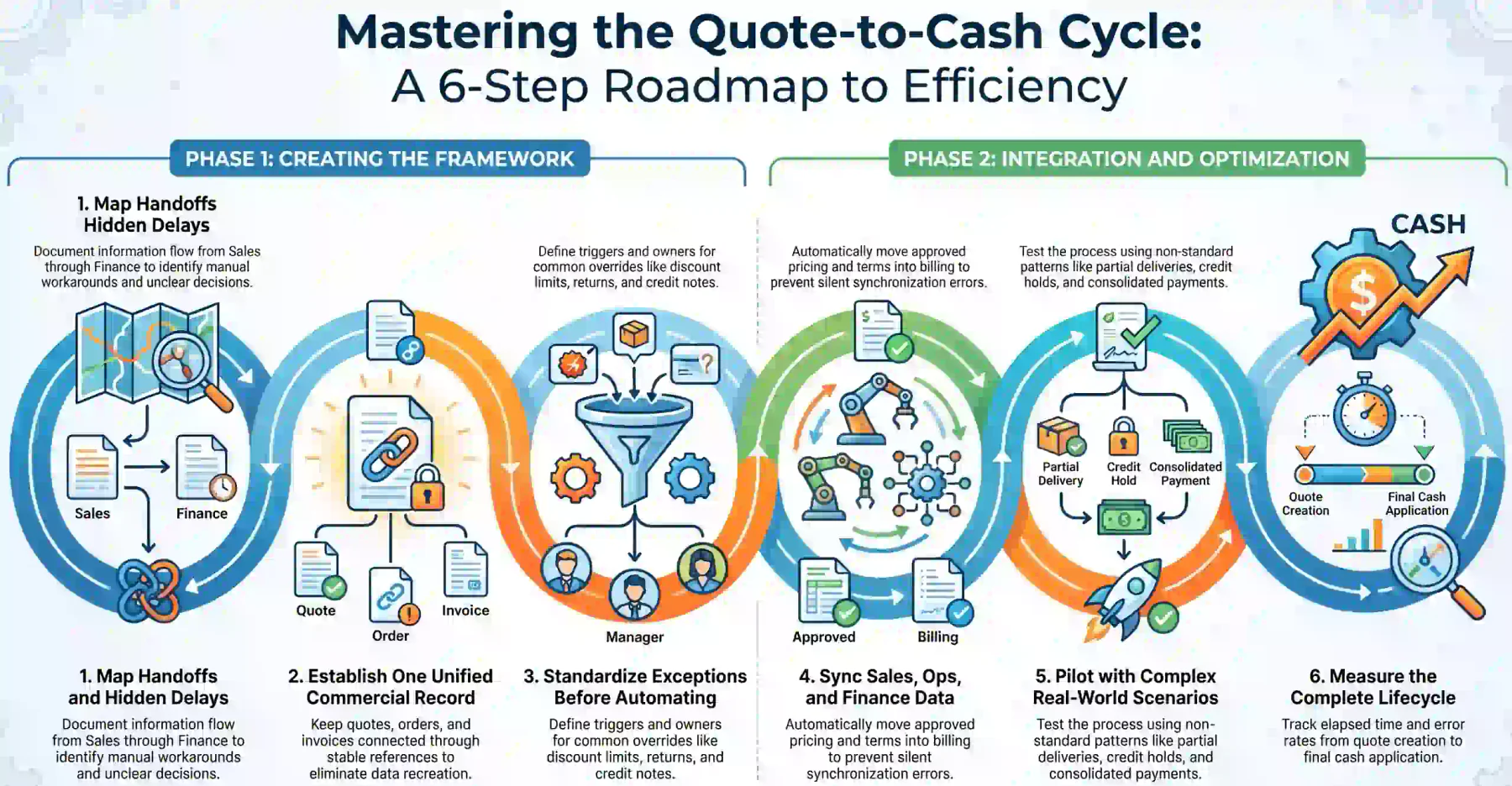
Improvement starts with process clarity, accountable ownership and reliable data. Technology then enforces the agreed rules, reduces manual work and exposes exceptions that still need judgement.
1. Map the Current Process and Handoffs
Document how information moves from Sales through Operations and Finance, including every approval and data entry point. Mark delays, duplicate work, unclear decisions and invisible customer commitments.
Interview the people who perform and receive each handoff, not only process owners. Their evidence reveals workarounds, missing fields and controls that look sound on paper but fail during busy periods.
2. Establish One Commercial Record
Keep the approved quote, sales order, fulfilment, invoice and payment connected through stable references. Users should move between records without searching separate files or recreating context.
Define which fields can change, who can change them and what approval a revision requires. Version history should preserve the original promise while displaying the current authorised commitment.
3. Standardise Exceptions Before Automating
List common exceptions such as discount overrides, backorders, returns, credit notes, disputes and deductions. Give each case a trigger, owner, response time, evidence requirement and approval path.
Standard rules make automation safer because the system can route expected cases and isolate genuine judgement calls. They also prevent teams resolving similar problems in conflicting ways.
4. Connect Sales, Operations and Finance Data
Move approved prices, quantities, terms and tax settings into fulfilment and billing without manual re-entry. Feed delivery, invoice and payment status back to Sales so customer updates remain accurate.
Use shared identifiers and validation rules when several platforms remain necessary. Monitor failed integrations and unmatched records, because a silent sync error can be worse than visible manual work.
5. Pilot the Process Using Real Scenarios
Test the design with actual order patterns, including partial delivery, several sites, credit holds and consolidated payments. Include disputes and returns so the pilot covers more than the happy path.
Ask users to complete each scenario from quotation to reconciliation and record every workaround. Correct data, authority and exception gaps before expanding the workflow to more teams or customers.
6. Measure the Complete Cycle
Use connected performance reporting to measure elapsed time, error rates and unresolved value from quote creation through cash application. Review stages together so one improvement does not shift risk elsewhere.
Set a baseline, assign owners and investigate the causes behind movement in each measure. Combine operating data with user feedback and customer disputes to decide which improvement should come next.
How HashMicro Supports a Connected Quote-to-Cash Process
HashMicro supports connected sales operations by linking CRM, Sales, Inventory and Accounting across one quote-to-cash workflow. Teams can carry approved commercial details forward while retaining their source and status.
Users can approve quotations, create sales orders, track fulfilment, issue invoices and monitor receivables from connected data. Finance can then apply payments and investigate exceptions with context.
This connected approach reduces manual handoffs while improving control over prices, delivery commitments and customer balances. Explore HashMicro solutions against your real Q2C scenarios and policies.
Conclusion
A completed sale is not the end of the quote-to-cash process. The cycle closes only when delivery, invoicing, payment application and accounting reconciliation match the accepted customer commitment.
Australian businesses can shorten the cycle by standardising approvals, connecting commercial records and controlling exceptions. This creates faster resolution, clearer ownership and stronger cash visibility.
To learn further about the quote-to-cash process, you can book a free consultation with our experts today. Start today and learn more with us.

Frequently Asked Questions
CPQ focuses on configuring products, calculating prices and producing an accurate quotation. Quote to cash includes those activities, then continues through ordering, fulfilment, billing and payment.
Order-to-cash begins once a customer order is confirmed, while quote to cash starts with offer configuration and quotation. Both continue through fulfilment, invoicing, collection and reconciliation.
The quote to cash process ends when Finance receives the payment, applies it to the correct invoice or account and reconciles the entries. Sending an invoice or receiving unmatched cash is not enough.
Delays commonly arise from manual pricing, slow approvals, stock shortages, billing errors, disputes and unidentified payments. Unclear ownership can extend each problem across several departments.
Map the current handoffs, centralise commercial data and define rules for approvals and exceptions. Then connect fulfilment, invoicing and cash application while measuring the complete cycle.