





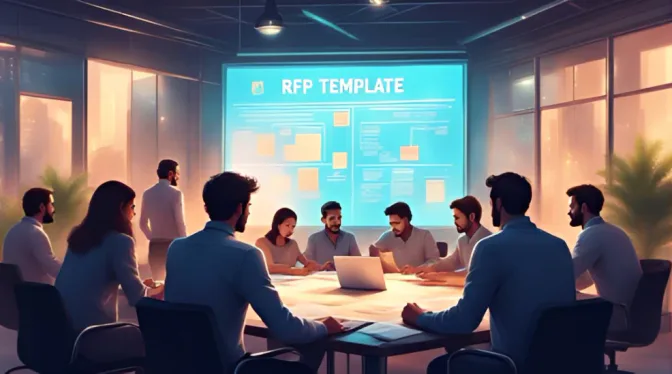
A 10-section RFP template gives finance, IT, procurement, and operations the same fields to complete, so vendors respond against one scope instead of competing assumptions.
The framework below stays visible and copy-ready. You can transfer it into your document system without submitting a form, and use it before requesting a formal discussion.
This article covers document selection, scope, requirements writing, vendor response formats, evaluation criteria, and governance for enterprise buyers.
Key Takeaways
A useful RFP template standardises scope, vendor responses, evaluation rules, and governance before proposals begin.
Each template section should identify its internal owner, required vendor response, and effect on evaluation.
Enterprise software RFPs must address implementation, migration, integration, security, and support responsibilities.
Independent scoring, panel moderation, and a central decision record make selection easier to review and explain.

What Is an RFP Template, and When Should You Use One?
Use an RFP when requirements are understood, but suppliers may differ in solution design, implementation approach, and delivery risk.
An RFP template organises the information vendors need and sets out how their responses will be evaluated.
| Document path | Requirement maturity | Purchasing situation | Primary focus |
|---|---|---|---|
| RFI | Low, solutions unclear | Need market information before setting scope | Approaches, capabilities, options |
| RFQ | High, spec and quantities fixed | Suppliers pricing the same item or service | Price, delivery, terms |
| RFP | Medium to high, approaches may vary | Multiple stakeholders or implementation risk | Fit, delivery, risk, cost |
| Direct quote or panel | High and simple | Risk is limited, market is known | Proportionate price validation |
Two ERP software vendors may both claim to support inventory planning, yet propose different migration and integration methods entirely.
We would not recommend a long RFP for a low-risk purchase with a fixed spec. An RFQ or direct quote may be more proportionate.
The Australian Department of Defence's RFP contracting guidance offers a useful reference for when this document type suits a procurement.
Why RFP Templates Break After the Document Goes Out
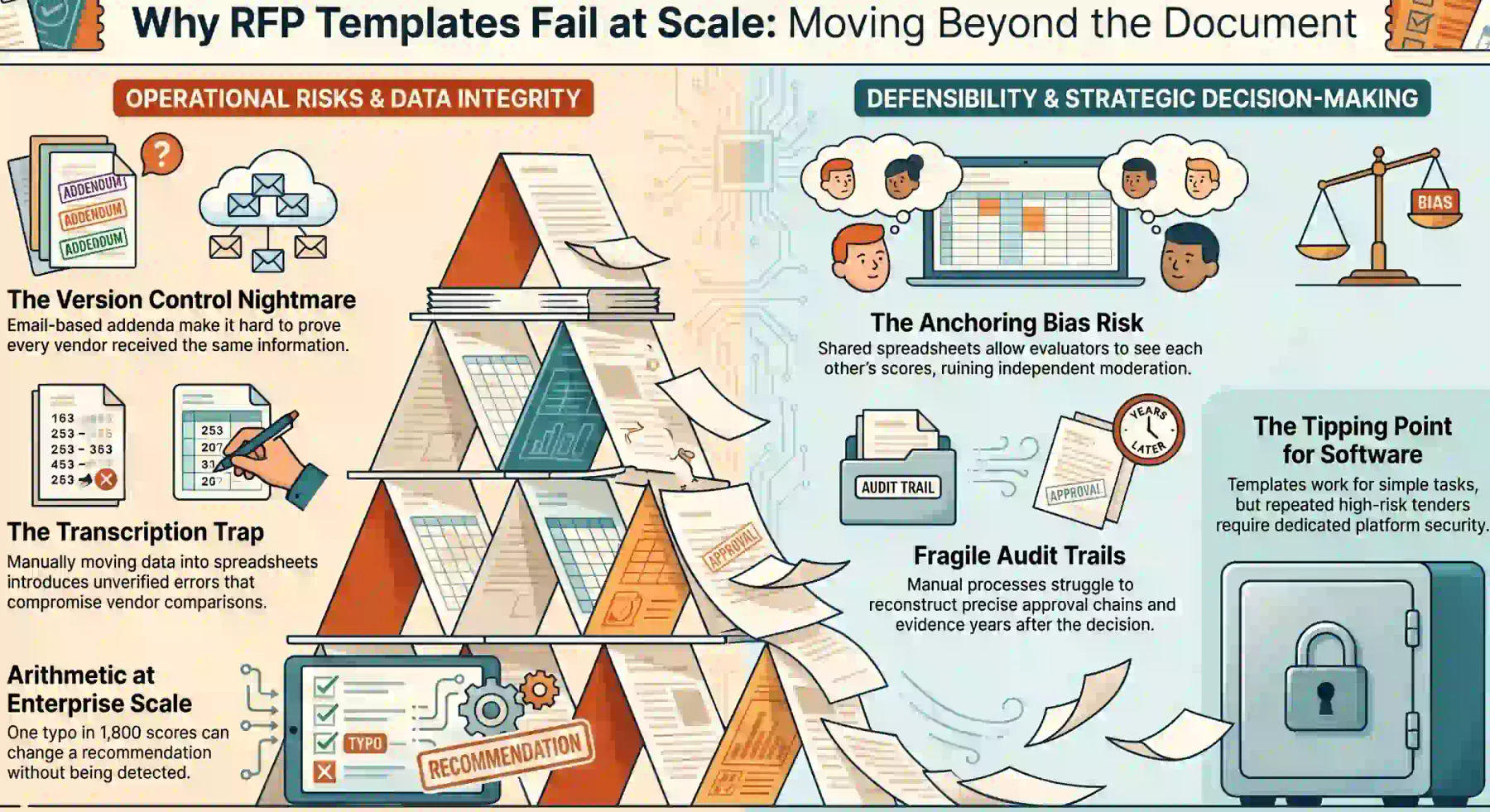
A template solves the document. It does not solve the tender, and those are two different problems.
An RFP produces at least five artefacts: the issued document, the addenda, the proposals, the score records, and the decision. Only the first sits comfortably in a file.
What follows covers everything after issue, where a spreadsheet-based process starts costing time and, more importantly, defensibility.
1. Addenda and the version every vendor actually holds
Clarifications change the brief. Once an addendum is issued, comparability depends on every vendor holding the same version before they finalise their response.
Email makes that hard to prove. A vendor left off one distribution list, or a reply thread that split, and two vendors are answering different questions.
For Commonwealth buyers this is not just untidy. The Commonwealth Procurement Rules require equal and non-discriminatory treatment of tenderers.
Suppliers can also challenge covered procurements under the Government Procurement (Judicial Review) Act 2018, which makes your distribution record part of the evidence.
A tender platform issues one controlled version, records who downloaded it and when, and pushes each addendum to every registered respondent at once.
2. Responses that arrive in six different shapes
Your template can specify a numbered response structure. It cannot make vendors follow it.
Six submissions will typically arrive as some mix of PDF, Word, spreadsheets and slide decks, each with its own numbering and its own attachments.
Comparing a single requirement across all of them means opening six documents and finding six differently labelled sections.
The usual fix is to transcribe everything into a master spreadsheet. Transcription is precisely where errors enter, and nobody re-checks a cell that already looks filled.
3. Independent scoring that is not actually independent
Independent scoring followed by moderation only works if the two stages stay separate. A shared spreadsheet cannot enforce that sequence.
If one evaluator opens the file and sees a colleague has given vendor B a 4, that number becomes the reference point for their own score.
Anchoring of this kind is quiet and hard to detect afterwards. The scores look independent because they were entered separately.
Evaluation software locks each panel member's scores until moderation opens, then shows the spread. The disagreement becomes visible, which is the point of moderating.
4. The arithmetic nobody double-checks
Weighted scoring at enterprise scale involves more cells than most people picture.
Six vendors, sixty requirements and five evaluators produce 1,800 raw scores before a single weight is applied across the six criteria.
One sum range that stops a row short, one weight entered as 0.2 instead of 20, and the recommendation changes without anyone seeing why.
The error is rarely caught, because the output still looks like a plausible ranking. There is nothing obviously wrong with a wrong number.
5. The decision record you may need two years later
A recommendation has to be traceable to evidence long after the panel has moved on. What a folder of emails cannot reliably reconstruct includes the following.
- Version control: which document and which addenda each vendor held when they responded
- Receipt evidence: the exact time each proposal arrived and whether it met the stated deadline
- Raw scores: what each evaluator gave before moderation, with the evidence reference attached
- Moderation history: which scores moved, by how much, and the reason recorded at the time
- Approval chain: who endorsed the recommendation and what they saw when they did
Every one of those exists somewhere in a manual process. The problem is retrieval, and retrieval is what an unsuccessful vendor or an internal auditor will test.
6. When the template is still the right answer
None of this argues for buying software to run one tender. A single low-risk procurement with three vendors and a short requirement list does not need a platform.
The template and a spreadsheet are proportionate there, and proportionality is a reasonable procurement principle in its own right.
The calculation changes on repetition and exposure. Several tenders a year, panels of more than three or four, or any purchase where a challenge is plausible.
At that point the cost is not the licence. It is the hours spent transcribing responses and the risk of a decision you cannot fully reconstruct.
Downloadable RFP Template: 10 Sections to Include
A complete enterprise RFP needs 10 connected sections covering business context, scope, requirements, and governance.
Map every field to an evaluation decision. If information will not affect scoring or contracting, ask whether vendors genuinely need to provide it.
10-SECTION FRAMEWORK
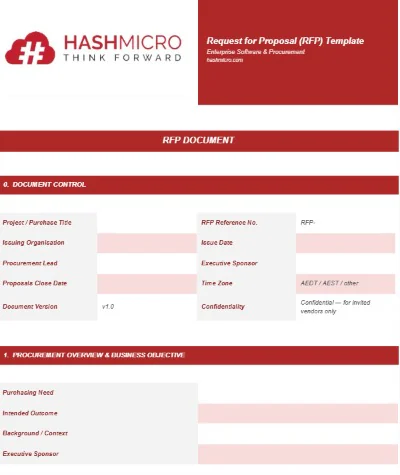
Each section below should identify its internal owner and how it affects the final evaluation, so nothing in the framework exists without a purpose.
- Procurement overview: why the procurement exists, owned by the sponsor and procurement lead, tests whether the proposal fits the business case.
- Current-state context: a consistent baseline for vendors, owned by operations, finance, and IT, exposes assumptions that affect price.
- Scope and exclusions: what is and isn't purchased, owned by the project owner, supports scope comparison across vendors.
- Business requirements: capabilities users need, owned by process owners, drives functional-fit scoring and demonstrations.
- Technical requirements: operating and technology constraints, owned by IT and security, supports technical screening.
- Implementation plan: delivery work split between business and vendor, owned by the project lead, tests feasibility and hidden effort.
- Vendor capability: who delivers and supports the service, owned by procurement, informs capability and service scoring.
- Response format: makes proposals comparable, owned by procurement and finance, reduces ambiguity during evaluation.
- Timeline and governance: communications and deadlines, owned by the procurement lead, determines submission compliance.
- Evaluation criteria: how proposals progress, owned by procurement and the sponsor, supports approval and probity.
Before release, complete this readiness check:
- Confirm the business objective and executive sponsor
- Approve the project scope, exclusions, and dependencies
- Assign an owner to each requirement group
- Remove duplicate or non-evaluable questions
- Agree on mandatory gates, weights, and scoring definitions
- Reconcile the commercial schedule with the requested scope
- Obtain procurement, security, finance, and legal review
- Test whether an evaluator can trace every score to evidence
How Should You Define Project Scope and Business Requirements?
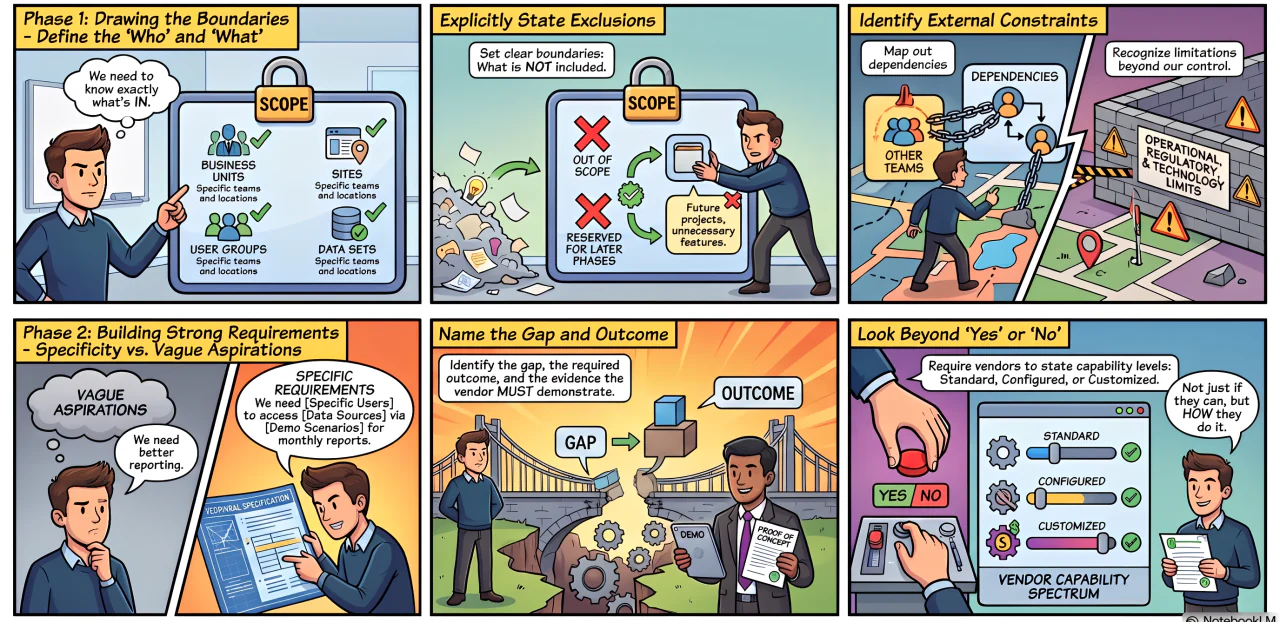
A testable requirement identifies the current problem, affected process, required capability, and acceptable evidence.
- Included entities and locations: business units, sites, and user groups in scope
- Processes and data in scope: what the vendor is actually being asked to address
- Explicit exclusions: boundaries and possible later phases
- Dependencies: other projects, suppliers, or internal teams involved
- Constraints: operational, regulatory, timing, and technology limits
Avoid vague aspirations. A weak requirement says "we need better reporting." A strong one names the users, data sources, formats, and demo scenario expected.
Apply the same approach to inventory visibility, approvals, integrations, and access control by naming the gap, the required outcome, and the evidence a vendor must demonstrate.
Ask vendors to state whether a capability is standard, configured, customised, or delivered through another product, not just yes or no.
These constraints also shape how vendors design system integration between the new platform and your existing tools.
What Vendor Response Format Should the RFP Require?
Every vendor should respond in the same numbered structure, using defined compliance codes and one consolidated schedule of exceptions.
- Executive response: concise narrative on proposed outcome and key dependencies
- Compliance matrix: compliant, partially compliant, not compliant, or alternative proposed
- Solution and integration response: architecture, interfaces, and monitoring approach
- Implementation and migration plan: phases, resources, testing, and acceptance
- Resource and support model: named roles, escalation, and service coverage
- Risk register: risk, cause, impact, owner, and treatment
- Commercial response: fees, units, timing, and optional items
- Exceptions and declarations: all deviations and qualifications in one schedule
Require vendors to reference every attachment by section number, separate confirmed inclusions from optional ones, and state whether integrations are included or estimated.
A compliance code marked "compliant" should still include the proposed method and supporting evidence for any requirement affecting a critical process.
How Do You Build Fair Vendor Evaluation Criteria?
Fair criteria are agreed before release, applied consistently, and supported by evidence through a documented panel process.
- Business and functional fit: 30%
- Technical, integration, and security fit: 20%
- Implementation and migration approach: 20%
- Commercial value and total cost: 15%
- Service and support model: 10%
- Risk and contractual exceptions: 5%
Use mandatory gates only where a condition is genuinely non-negotiable, such as an essential security standard. Treating every preference as mandatory eliminates viable alternatives.
0-5 scoring model:
- 0: no response or unacceptable
- 1: substantial gaps, no credible treatment
- 2: partial, material limitations or risk
- 3: meets requirement, acceptable assumptions
- 4: strong evidence, low identified risk
- 5: exceeds the defined outcome, evidenced
Require evaluators to record an evidence reference and reason for each material score. A low headline price may exclude work another vendor has included.
Security-sensitive purchases should weight technical fit more heavily. The Australian Cyber Security Centre's Essential Eight guidance can inform internal security reviews.
"A vendor scoring 87 overall can still be the wrong choice if it fails a required licence check. The arithmetic never overrides the mandatory gate."
Timeline, Governance, and Submission Rules for a Controlled RFP
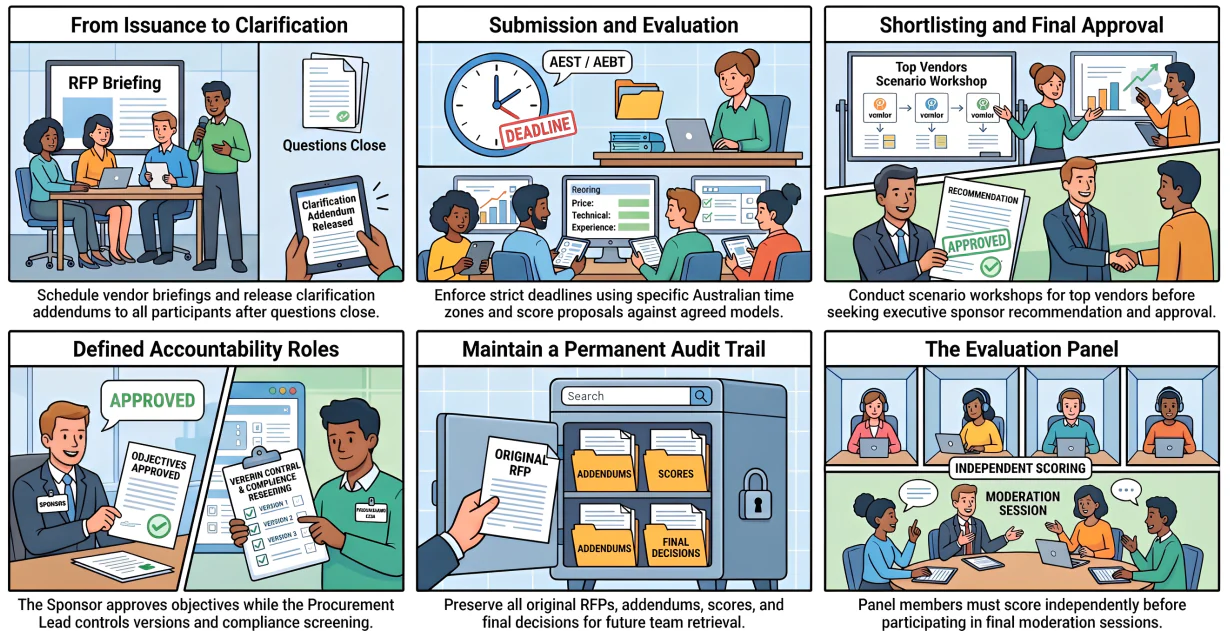
A controlled RFP needs one authorised vendor contact, fixed milestones, and consistently distributed clarifications.
- RFP issued and vendor briefing scheduled
- Questions close, then a clarification addendum is issued to all vendors
- Proposals close at a stated Australian time zone deadline
- Compliance screening and evaluation against the agreed scoring model
- Demonstrations or scenario workshops for shortlisted vendors
- Recommendation and approval through internal governance
Specify the Australian time zone rather than "close of business," particularly when vendors or reviewers operate across states.
- Executive sponsor: approves objectives and the final recommendation
- Procurement lead: controls versions, communications, and compliance screening
- Evaluation panel: scores independently and participates in moderation
- Single vendor contact: receives questions and distributes authorised responses
Preserve the original RFP, each addendum, submitted proposals, score records, and the final decision in an audit trail your team can retrieve later.
How Do You Customise an RFP Template for Enterprise Software?
An enterprise software RFP must evaluate implementation, migration, integrations, and security alongside functional fit.
Consider a wholesale business that receives an order, checks inventory, allocates stock, and posts the transaction to finance. Ask vendors to explain the complete flow, not isolated features.
| Process area | Required outcome | Acceptance evidence |
|---|---|---|
| Multi-entity finance | Controlled processing and consolidated reporting | Scenario demonstration, sample outputs |
| Inventory visibility | Timely stock availability across locations | End-to-end order and allocation scenario |
| Approval workflow | Policy-based routing with audit history | Demonstration using exception cases |
| Integration | Reliable exchange with named systems | Interface design, test evidence |
| Data migration | Validated opening and historical data | Reconciliation, exception reports |
| Security and access | Role-based access aligned to responsibility | Access matrix, test results |
Ask for detail across discovery, configuration, integration build, data migration, testing, training, and post-go-live support.
Readers evaluating enterprise software should retain control of their requirements and scoring model rather than adopting a vendor's proposal template as-is.
How Should You Review Vendor Proposals After Submission?
Begin with compliance screening, then move to independent evaluation. Do not rewrite a vendor's response to fit the scoring model.
- Register submissions and confirm they meet stated rules
- Check mandatory gates, declarations, and required schedules
- Identify material omissions and pricing assumptions
- Complete independent scoring with evidence references
- Moderate scores and record reasons for material adjustments
- Run scenario-based demonstrations using the same core tasks
- Compare total commercial scope, including customer responsibilities
- Document the recommendation, approvals, and retained risks
Give shortlisted vendors the same core scenario. Demonstrations should test what matters, not become unrestricted product tours.
Common RFP Template Mistakes to Avoid
A longer RFP is not automatically a better one. Length can discourage careful responses when questions are duplicated or disconnected from evaluation.
- Unclear outcomes: describes a product category, not the operational result
- Hidden scope: interfaces or migration needs surface only during demonstrations
- Feature-count scoring: equal-weight requirements obscure the highest-risk processes
- Unstructured pricing: vendors use different units and time horizons
- Scattered exceptions: qualifications buried across attachments
- Late evaluation design: scoring priorities decided after seeing the vendors
- Missing decision record: the recommendation can't be traced to evidence
Before issuing the template, ask a colleague who didn't draft it to follow the instructions. Confusion at this stage predicts vendor confusion later.
Keeping this discipline consistent across purchases is easier with connected procurement software, not a one-off spreadsheet.
Conclusion
A useful RFP connects the business objective to testable requirements, comparable responses, and a documented decision.
Start with the 10-section framework, assign owners, and remove questions that won't influence the outcome.
Once your stakeholders have reviewed it, request a requirements consultation with HashMicro to test the brief before approaching the market.

Frequently Asked Questions About RFP Templates
Define business outcomes, process conditions, and acceptance evidence in detail, but avoid dictating a technical design unless it is a genuine requirement. Ask vendors to explain their proposed method and any alternative that changes scope or risk.
An RFQ is used when the specification and quantities are fixed and suppliers are mainly pricing the same item. An RFP is used when outcomes are known but delivery approaches may vary, so vendors need to explain how they would deliver, not just the price.
Use separate weighted criteria for commercial value, implementation approach, and risk rather than letting the lowest price determine the result. Review assumptions and exclusions so proposals are compared on a consistent basis.
It can provide a general starting structure, but it is not a substitute for the rules that apply to a specific government entity. Public-sector organisations should review the Commonwealth Procurement Rules and obtain procurement and legal review before release.
A mid-complexity enterprise software RFP typically runs 8 to 12 weeks from issue to recommendation, covering a briefing period, a clarification window, evaluation, and demonstrations. Complex or regulated procurements often take longer.