






Managing suppliers requires more than collecting quotations and issuing purchase orders. Procurement teams must also verify documents, monitor delivery commitments, review performance, manage risk, and follow up on incomplete actions.
AI Supplier Management uses artificial intelligence to analyse supplier and transaction data, recommend actions, and automate controlled procurement tasks. For Australian small and mid-sized businesses, it can reduce administration while giving procurement teams earlier visibility into delivery, quality, pricing, and compliance concerns.
The technology works best within an integrated procurement system. Reliable records, clear approval boundaries, and human oversight help businesses use AI without losing control of supplier decisions.
Key Takeaways
AI Supplier Management analyses supplier records, transactions, risks, and incomplete actions to support faster procurement decisions.
AI can support supplier onboarding, risk monitoring, performance reviews, delivery tracking, document reminders, and communication.
Reviewable supplier scorecards can measure delivery, quality, pricing, response time, contract fulfilment, and service performance.
Permissions, explainable recommendations, audit trails, and human approval keep important supplier decisions controlled.
What Is AI Supplier Management?
"AI supplier management strengthens procurement by turning supplier data into timely risk alerts, consistent performance reviews and controlled follow-up actions. "
AI Supplier Management applies artificial intelligence to supplier onboarding, monitoring, evaluation, communication, and decision support. It helps procurement teams identify important changes without manually reviewing every record.
The technology may use machine learning, document processing, natural language processing, anomaly detection, and workflow automation. These capabilities can analyse supplier profiles, quotations, purchase orders, receipts, invoices, contracts, certifications, and communication histories.
Traditional vendor management usually depends on periodic reviews and manually maintained records. AI adds continuous analysis, allowing procurement teams to identify incomplete tasks or emerging risks sooner.
AI should support rather than replace commercial judgement. Procurement professionals still need to assess supplier relationships, market conditions, operational priorities, and contractual consequences before making material decisions.
How AI Supplier Management Works
AI Supplier Management converts connected supplier records into recommendations and controlled actions. The following workflow shows how information moves from collection to a recorded procurement outcome.
Collects supplier and transaction data: The platform retrieves supplier profiles, purchase orders, delivery records, invoices, contracts, certifications, quality results, and communication history.
Standardises supplier records: AI can identify inconsistent names, duplicate profiles, missing fields, expired documents, and incompatible data formats.
Identifies risks or incomplete actions: The system looks for late deliveries, unresolved quality issues, unusual price movements, missing approvals, and approaching contract dates.
Recommends follow-ups and decisions: AI can suggest contacting a supplier, requesting a document, reviewing a price variance, or escalating a delayed commitment.
Escalates exceptions: Higher-risk issues move to the appropriate procurement, finance, quality, legal, or operational employee according to predefined rules.
Records the outcome in the procurement system: Approved messages, decisions, documents, and follow-up activities remain attached to the relevant supplier or transaction.
This process reduces the gap between detecting a problem and responding to it. However, the business must define which activities AI can complete and which require human approval.
Traditional Supplier Management vs AI Supplier Management
Traditional and AI-supported approaches can manage the same supplier lifecycle, but they differ in speed, coverage, and level of automation. The comparison below highlights the main operational distinctions.
AI does not make the traditional process unnecessary. Instead, it improves how quickly employees can apply established supplier policies across a larger volume of records.
AI Use Cases Across the Supplier Lifecycle
Supplier management covers activities from initial discovery to contract renewal or exit. AI can support each area when the company has reliable data and clear decision rules.
1. Supplier discovery and classification
AI can review supplier profiles, product categories, service capabilities, operating regions, certifications, and previous sourcing activity. It can then group suppliers according to category, criticality, spend, or operational relevance.
Procurement employees can use this classification to build a shortlist for further assessment. However, the system should not treat an AI-generated category as evidence that a supplier meets every commercial or compliance requirement.
2. Onboarding document checks
Supplier onboarding often involves bank details, insurance records, licences, tax information, declarations, and policy acknowledgements. Document-processing tools can extract relevant fields and identify missing, inconsistent, or expired information.
Employees should verify material details before approving the supplier. Changes to bank accounts or ownership information deserve additional checks because incorrect updates can create financial and fraud risks.
3. Supplier risk monitoring
AI can monitor internal signals such as repeated delays, quality failures, disputes, unfulfilled orders, and unusual invoice activity. Approved external sources may add information about insolvency, cybersecurity incidents, sanctions, or broader supply disruption.
Risk alerts should explain which signals changed and when. Procurement teams can then determine whether the issue requires monitoring, a supplier discussion, alternative sourcing, or formal escalation.
4. Performance evaluation
AI can calculate supplier scores using delivery, quality, cost, communication, and service records. Continuous updates give procurement teams a more current view than an annual review alone.
Performance results should remain open to correction. For example, a delivery may appear late because the business changed its requested date after the purchase order was issued.
5. Delivery commitment tracking
AI can compare promised delivery dates with purchase-order status, shipment updates, goods receipts, and production requirements. It can flag orders that may arrive too late to support planned operations.
An early warning gives employees time to request an update or consider another supply arrangement. The procurement team should still verify the situation with the supplier before changing an order.
6. Contract and certification reminders
AI can identify contract renewal dates, notice periods, price-review clauses, insurance expiries, and certification deadlines. The system can then create reminders before an obligation becomes urgent.
Contract interpretation needs careful review because commercial language can depend on context. Legal or authorised commercial employees should confirm any action that affects contractual rights.
7. Supplier communication and follow-up
Generative AI can prepare requests for missing documents, delivery updates, quotation clarifications, and corrective-action responses. Using approved templates helps maintain an appropriate and consistent tone.
Routine messages may proceed automatically within agreed boundaries. Disputes, commercial negotiations, contract changes, and sensitive performance discussions should remain under human control.
How AI Agents Monitor Supplier Risk

An AI agent monitors defined supplier signals and responds according to approved instructions. Unlike a static report, the agent can continue checking records, create tasks, prepare communication, and escalate issues as new information arrives.
The monitoring process usually starts with risk categories such as operational, financial, quality, compliance, cybersecurity, and concentration risk. Each category needs specific indicators, thresholds, data owners, and escalation rules.
For example, an agent may flag a supplier after three late deliveries, an unresolved quality rejection, or an expired insurance document. The alert should identify the affected purchase orders and provide the underlying records.
Risk severity should reflect business impact as well as the number of alerts. A minor delay from a replaceable supplier may require routine follow-up, while a disruption involving a critical component may need immediate management attention.
Australian businesses must also consider personal information contained in supplier contacts, sole-trader records, and communication histories. The OAIC’s guidance on AI products explains that privacy obligations can apply to personal information entered into or generated by an AI system.
AI-Assisted Supplier Performance Evaluation
AI can consolidate supplier results into a scorecard that updates when new transactions occur. The following measures provide procurement teams with a balanced view of operational and commercial performance.
1. On-time delivery
On-time delivery measures whether goods or services arrive by the agreed date. AI can calculate the rate by supplier, item, location, order type, or reporting period.
The calculation must use an agreed definition of on time. Changes to requested dates, split deliveries, and customer-caused delays should not distort the supplier’s result.
2. Quality and rejection records
Quality measures may include rejected quantities, inspection failures, returns, corrective actions, and repeat defects. AI can identify patterns across products, locations, or production batches.
A high rejection rate may indicate a supplier problem, but internal handling or unclear specifications can also contribute. Quality employees should validate the cause before assigning responsibility.
3. Price variance
Price variance compares agreed or historical prices with current quotations, purchase orders, and invoices. AI can highlight unusual increases, inconsistent rates, or deviations from contract terms.
A variance does not always indicate poor performance. Exchange rates, raw materials, freight, order volumes, and specification changes may provide a reasonable explanation.
4. Response time
Response time measures how quickly a supplier acknowledges requests, resolves questions, or responds to incidents. It can help procurement teams assess communication reliability alongside physical delivery.
The business should define which messages count and when the timing begins. Automated acknowledgements should not receive the same value as a complete operational response.
5. Contract fulfilment
Contract fulfilment assesses whether the supplier meets agreed pricing, delivery, documentation, service-level, and reporting obligations. AI can connect contract terms with actual procurement records to identify possible exceptions.
Authorised employees should confirm each suspected breach. Contractual decisions require context that a data comparison may not fully capture.
6. Service Performance
Service suppliers may require measures such as completion time, availability, issue resolution, rework, and stakeholder satisfaction. AI can combine structured service records with approved feedback sources.
Subjective feedback needs careful interpretation. A transparent evaluation should separate measured results from employee opinions.
7. Reviewable weighted scoring
Weighted scoring lets procurement teams assign greater importance to measures that affect operations most. For example, a critical materials supplier may receive more weight for quality and delivery than for small price differences.
The scorecard should display each measure, weight, data period, result, and calculation. Procurement employees must be able to adjust incorrect data and explain why a supplier received its rating.
How AI Automates Supplier Follow-Up
AI can monitor incomplete actions and initiate follow-up according to urgency, supplier category, and business impact. Common examples include missing quotations, unconfirmed orders, late deliveries, expiring documents, unresolved quality cases, and unanswered contract questions.
The automation may create an internal task, prepare a supplier email, assign an owner, and set a due date. If the action remains incomplete, the system can notify a manager or increase the escalation level.
Connecting follow-up with purchase order management gives the AI access to order dates, quantities, approvals, receipts, and outstanding commitments. This context helps prevent generic reminders that do not reflect the actual transaction.
Businesses should limit automated communication to approved scenarios. An AI agent should not independently accept revised prices, waive contractual rights, or promise future orders.
Data, System, and Integration Requirements
AI Supplier Management depends on accurate supplier and transaction records. A capable model cannot compensate for inconsistent supplier codes, incomplete delivery dates, missing quality results, or outdated contract information.
The foundation should include a central supplier master, documented field ownership, validation rules, and duplicate controls. Procurement teams should also define which platform serves as the official record for each data type.
Integration may connect the following systems:
- Procurement and purchase-order management
- Inventory and warehouse management
- Accounting and accounts payable
- Contract and document management
- Quality and inspection records
- Logistics and delivery tracking
- Enterprise resource planning
- Approved external risk sources
A connected procurement management system gives AI access to supplier, purchasing, receiving, invoice, and approval records within a consistent workflow. This reduces the need to match information manually across spreadsheets and separate applications.
Data quality monitoring should continue after implementation. New suppliers, changed item codes, altered workflows, and incomplete integrations can gradually reduce recommendation accuracy.
Governance and Approval Boundaries
AI governance determines how the system accesses supplier information and what it may do with that information. The following controls help businesses maintain accountability while using automation.
1. Who may contact suppliers
The business should define which employees, departments, and AI agents may communicate with suppliers. Access may vary according to supplier category, transaction value, contract ownership, or issue type.
An AI agent should act under a named business owner. Suppliers should receive communication through approved company channels rather than unmonitored accounts.
2. Which messages require approval
Routine requests for documents or delivery updates may follow approved templates automatically. Negotiations, disputes, contract amendments, payment commitments, and performance warnings should require review.
Approval rules should also consider tone and commercial impact. A technically accurate message can still damage a supplier relationship if the context or wording is unsuitable.
3. Explainable recommendations
An AI recommendation should show the relevant data, assumptions, and rule that produced it. Procurement employees need this context before accepting a supplier score, risk alert, or suggested action.
The Australian Government’s Guidance for AI Adoption outlines responsible practices covering accountability, risk management, transparency, testing, and human oversight. Businesses can use these principles when defining procurement controls.
4. Supplier data permissions
Role-based permissions should limit supplier data according to job responsibilities. Bank details, pricing agreements, personal information, contracts, and performance records may require different access levels.
The AI system should inherit the requesting user’s permissions. It should not reveal information that the employee could not access through the procurement platform directly.
5. Audit trails
Audit trails should record the data reviewed, recommendation produced, message prepared, approval received, and action completed. Time stamps and user details make the process easier to investigate.
A complete history also supports internal audits and supplier discussions. Employees can confirm what occurred without relying on personal inboxes or memory.
6. Human approval for material decisions
Supplier selection, suspension, contract awards, material price changes, and termination decisions should remain under authorised human control. AI can prepare evidence and recommendations without becoming the final decision-maker.
Businesses should also provide a process for challenging an inaccurate recommendation. Clear correction procedures improve both accountability and future model performance.
How to Implement AI Supplier Management
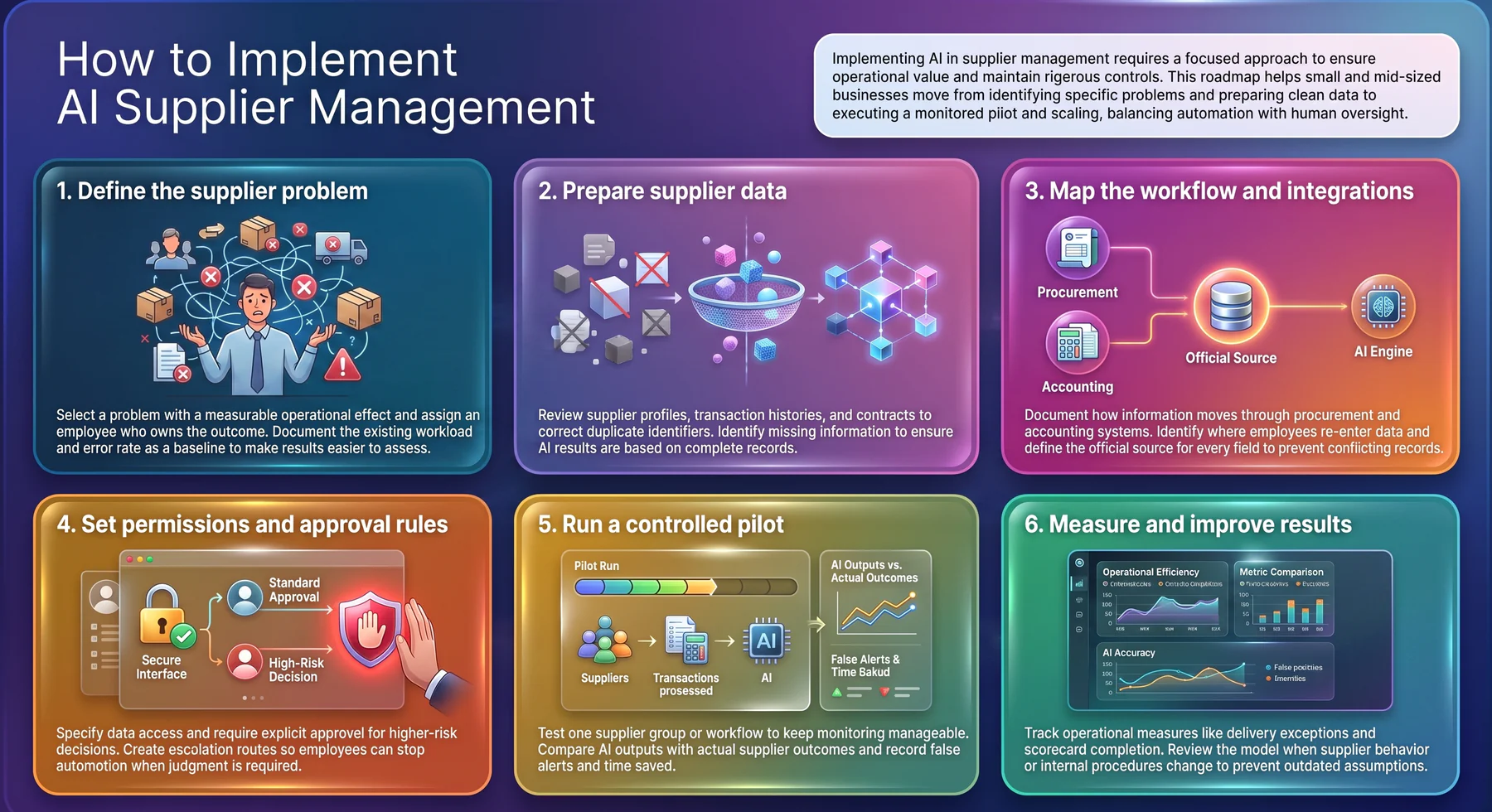
A focused implementation allows a business to test value and controls before expanding automation. The following actions provide a practical path for small and mid-sized companies.
1. Define the supplier problem
Select a problem with a measurable operational effect, such as late confirmations, expired documents, slow onboarding, or inconsistent performance reviews. Assign an employee who owns the outcome.
Document the existing workload, error rate, response time, and supplier impact. This baseline will make later results easier to assess.
2. Prepare supplier data
Review supplier profiles, transaction histories, delivery dates, quality results, contracts, and communication records. Correct duplicate suppliers and inconsistent identifiers before using the data for AI.
The review should also identify missing information. A supplier score based on incomplete receipts or quality records may produce an unfair result.
3. Map the workflow and integrations
Document how supplier information moves through procurement, inventory, accounting, quality, and contract systems. Identify where employees currently re-enter data or lose visibility.
Define the official source for every field. Clear ownership prevents the AI from choosing between conflicting records without guidance.
4. Set permissions and approval rules
Specify which data the AI may access and which actions it may prepare or complete. Higher-risk communication and commercial decisions should require explicit approval.
Create escalation routes for uncertain cases. Employees need a simple way to stop automation when the situation requires judgement.
5. Run a controlled pilot
Test one supplier group, category, or workflow before wider deployment. A limited scope makes training, monitoring, and error investigation more manageable.
Users should compare AI outputs with actual supplier outcomes. Record false alerts, missed issues, unsuitable messages, and time saved.
6. Measure and improve results
Track operational measures such as follow-up time, missing-document rates, delivery exceptions, scorecard completion, and user adoption. Accuracy measures should include false positives, false negatives, overrides, and corrected records.
Review the model when supplier behaviour, purchasing patterns, or internal procedures change. Continuous monitoring helps prevent outdated assumptions from influencing decisions.
How HashMicro’s Procurement AI Agent Supports Supplier Management
HashMicro connects supplier records with purchasing, inventory, accounting, approvals, and receiving workflows. This integrated structure gives procurement teams operational context beyond standalone supplier profiles.
HashMicro’s Procurement AI Agent operates through Hashy OS, the AI work layer connected to the ERP environment. It can help authorised users identify suppliers requiring attention, compare performance information, prepare follow-ups, and move approved actions through procurement workflows.
For example, the agent can flag a supplier with repeated late deliveries, show the affected orders, and prepare a request for an updated commitment. Procurement employees can review the evidence before approving communication or adjusting the sourcing plan.
The system can also connect supplier performance with quotation history, purchase orders, goods receipts, invoices, and inventory requirements. This gives growing businesses a clearer basis for supplier discussions and sourcing decisions.
Explore HashMicro Procurement Software to connect supplier management, purchasing, approvals, inventory, accounting, and AI-supported workflows.






Conclusion
AI Supplier Management helps procurement teams monitor more supplier information without relying on constant manual checking. It can improve onboarding, risk detection, performance evaluation, delivery tracking, document control, and follow-up.
Successful adoption requires accurate data, connected systems, transparent scoring, role-based permissions, and practical approval boundaries. Human employees should retain responsibility for decisions that affect supplier selection, contracts, commercial commitments, or business continuity.
HashMicro combines supplier management with procurement, inventory, accounting, and Hashy OS within one connected platform. Discuss the right setup for your supplier workflows through a free procurement software consultation with HashMicro.
Frequently Asked Questions
AI can automate supplier data checks, document reminders, delivery monitoring, scorecard calculations, routine communication, task creation, and exception escalation. Businesses should require human approval for negotiations, contracts, supplier suspension, and other material decisions.
AI can evaluate delivery, quality, price variance, response time, contract fulfilment, and service records. Procurement teams should review the source data, scoring method, and business context before relying on the final result.
AI monitors agreed indicators such as repeated delays, quality failures, unusual invoice activity, expired documents, and unresolved disputes. Each alert should include supporting records so procurement employees can verify the issue and select an appropriate response.
AI does not replace the commercial judgement, negotiation ability, accountability, and relationship skills of procurement professionals. It handles repetitive analysis and administration while employees retain control of important supplier decisions.
The system may require supplier profiles, quotations, purchase orders, delivery records, goods receipts, quality results, invoices, contracts, certifications, risk records, and communication history. Accurate identifiers and consistent dates help AI connect these records correctly.