







 Limited to 100 registrants

A single vendor decision can involve 12 weighted criteria, input from procurement, finance, IT, operations, and compliance, and evidence spread across purchase orders, receipts, and invoices.
A vendor evaluation scorecard template brings that information into one structured workbook, so decision-makers can compare suppliers consistently instead of relying on gut feel.
This downloadable file works in Excel and Google Sheets. It includes 12 criteria, an adjustable weighting formula, decision thresholds, and a completed example for local and APAC suppliers.
Key Takeaways
A vendor evaluation scorecard converts evidence into a documented score and recommendation.
Twelve weighted criteria cover cost, quality, delivery, compliance, security, and continuity risk.
The scoring formula multiplies each criterion score by its weight for a result out of 100.
A spreadsheet supports comparison, but it does not validate evidence or govern vendors on its own.

What Is a Vendor Evaluation Scorecard Template?
A vendor evaluation scorecard template is a structured worksheet that compares vendors against weighted commercial, technical, and compliance criteria.
It converts evidence, not opinion, into a documented score and an approval recommendation that procurement and finance can both stand behind.
A practical template records vendor identity, twelve criteria with editable weights, scores from 1 to 5, evaluator comments, evidence links, risk flags, and a corrective action log.
| Template tab | Purpose |
|---|---|
| Instructions | Defines the scoring scale, required evidence, and approval rules |
| Weight Configuration | Allocates weights totalling 100% with profiles for vendor types |
| Vendor Evaluation | Records scores, comments, evidence links, and recommendations |
| Completed Example | Demonstrates the formula using AU and APAC supplier scenarios |
| Summary | Compares weighted totals and final approval outcomes |
| Corrective Action Log | Tracks agreed improvements, owners, and verification evidence |
Related terms are often used interchangeably. A vendor scorecard is a broad selection tool, while a supplier scorecard usually tracks ongoing performance after appointment.
This template is most useful during selection, onboarding, or renewal. A continuous vendor management process draws on actual delivery data throughout the relationship.
12 Vendor Evaluation Criteria for Enterprise Decisions
Effective vendor evaluation criteria look beyond the quoted price. They test whether a vendor can meet requirements and stay reliable under changing conditions.
The weight ranges below are illustrative, not universal benchmarks. Adjust them by vendor category, contract value, and risk exposure.
| Criterion | Sample KPI | Evaluator | Weight | |
|---|---|---|---|---|
| 1 | Total cost and commercial value | Evaluated total cost; price variance | Procurement, finance | 10-25% |
| 2 | Product or service quality | Defect rate; rejection rate | Operations, quality | 10-20% |
| 3 | On-time delivery | On-time delivery percentage | Procurement, operations | 8-20% |
| 4 | Lead-time reliability | Actual vs promised lead time | Supply chain | 5-15% |
| 5 | Service responsiveness | Response and resolution time | Business owner | 5-15% |
| 6 | Regulatory compliance | Certificate status; audit findings | Legal, compliance | 5-20% |
| 7 | Financial stability | Credit rating; liquidity evidence | Finance | 5-15% |
| 8 | Cybersecurity and data protection | Security assessment result | IT, security | 5-20% |
| 9 | Technical fit and integration | Integration readiness | IT, process owner | 5-20% |
| 10 | Invoice accuracy | Invoice exception rate | Finance | 5-12% |
| 11 | Capacity and continuity | Capacity utilisation; recovery objective | Operations, risk | 8-20% |
| 12 | ESG or responsible sourcing | Policy status; verified corrective actions | Procurement, ESG | 3-15% |
Businesses comparing local and APAC vendors may weight regional delivery consistency, currency exposure, and customs dependency more heavily.
Cybersecurity evidence should match the access granted to the vendor. The Essential Eight guidance can inform internal security reviews.
How to Determine Weights, Scores, and Decision Thresholds
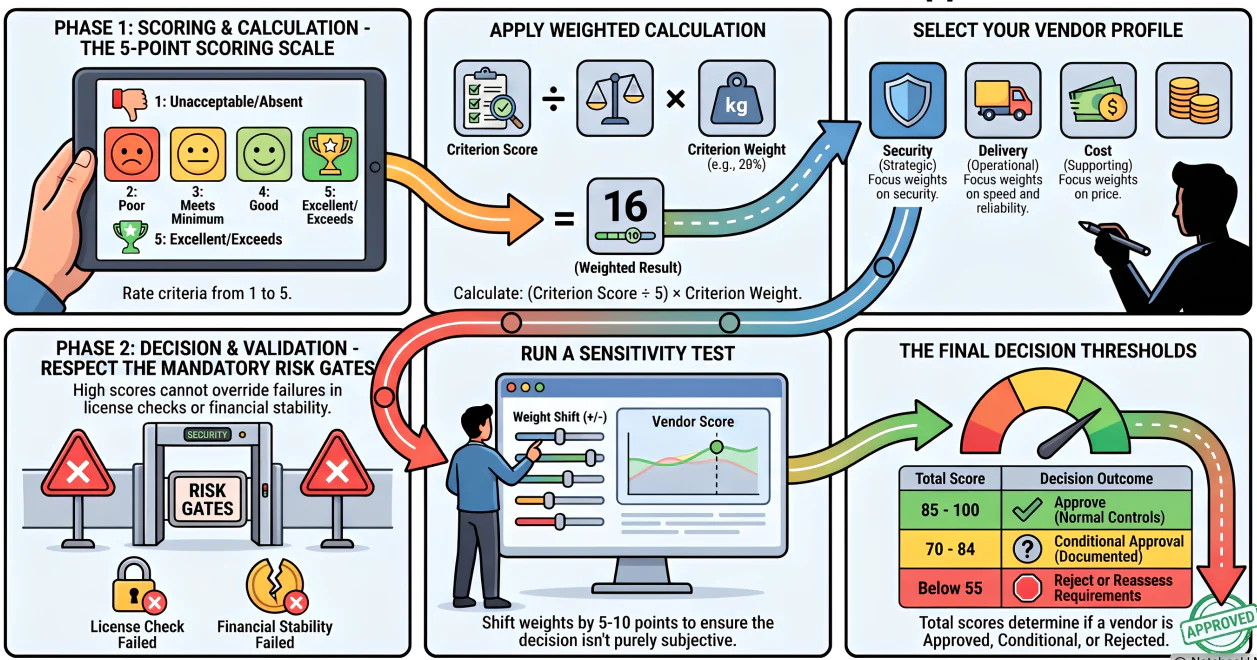
Weights must total 100%, but they should not be spread evenly. A business-critical vendor and an office supplies vendor carry different risk.
Scoring scale:
- Unacceptable: requirement not met or evidence absent
- Weak: material gaps, substantial remediation required
- Acceptable: minimum requirements met, manageable limitations
- Strong: requirements met with reliable evidence
- Excellent: requirements exceeded with verified evidence
Weighted result = Σ ((criterion score ÷ 5) × criterion weight)
For example, on-time delivery has a weight of 20%. A vendor scoring 4 contributes 16 points (4 ÷ 5 × 20). Repeat for all 12 criteria and sum the results.
A vendor scored strongly across most criteria might land around 81 out of 100 once every weighted result is added together.
Decision thresholds:
- 85-100: Approve, subject to normal contract controls
- 70-84: Conditional approval with documented conditions
- 55-69: Remediation or further due diligence required
- Below 55: Reject or reassess requirements and alternatives
Thresholds should not override mandatory risk gates. A vendor scoring 87 may still be unsuitable if it fails a required licence check or shows financial distress.
The template includes three editable profiles: strategic vendors emphasise security and continuity, operational vendors emphasise delivery and quality, and supporting vendors emphasise cost and service.
Run a sensitivity test before approval. Adjust cost or compliance weights by 5-10 points and recalculate. If the preferred vendor changes repeatedly, the decision may rely too heavily on subjective assumptions.
Record the test as part of a documented procurement approval workflow, and route exceptions through a defined authority.
Role Allocation and Scorecard Workflow in Procurement
A vendor evaluation workflow should give each function responsibility for the criteria it can actually verify.
- Procurement: owns cost and commercial value, reviewed by finance
- Operations: owns quality, delivery, and flexibility scores
- Finance: owns financial stability and invoice accuracy
- IT or security: owns cybersecurity and technical fit
- Legal or compliance: owns regulatory and document compliance
The process typically follows onboarding, request and approval, evaluation, purchase order issuance, receiving, invoice matching, performance review, corrective action, renewal, and offboarding.
In a multi-entity AU and APAC business, local teams may verify receipt and quality while a central procurement function controls commercial scoring.
The point where vendor evaluation outgrows a workbook
Vendor evaluation does not break all at once. It degrades in stages, and each stage is tied to how many vendors, entities, and reviewers the business is carrying.
The scorecard below stays useful throughout. What changes is how much work sits around it, and how much of that work nobody has been assigned.
1. Under 20 vendors, one entity
The workbook is genuinely sufficient here. One procurement lead knows every supplier, remembers who was reviewed last quarter, and can find the contract without asking anyone.
The only real risk at this size is the single point of failure. When that person leaves, the reasoning behind every score leaves with them, because only the number was ever written down.
2. 20 to 100 vendors, multiple reviewers
Scoring consistency is the first thing to go. Two evaluators reading the same delivery history will score on-time performance differently unless the evidence rule is enforced, not just documented.
Certificate expiry becomes the second problem. Insurance certificates, licences, and security attestations all have dates, and a spreadsheet cell holding an expiry date does not tell anyone when it passes.
This is also where scores stop matching reality. A vendor scored highly in March may have missed four deliveries since, but the workbook still shows March.
3. Beyond 100 vendors or multiple entities
Businesses operating across states or into New Zealand and Singapore hit a different wall. The same supplier exists as three vendor records, with three ABNs or registration numbers and three different scores.
Consolidated spend becomes unanswerable. Nobody can say what the group actually spends with that supplier, which means nobody can negotiate as one buyer or assess real concentration risk.
Modern slavery reporting sharpens this. Businesses with consolidated revenue of $100 million or more must report annually on their operations and supply chains, and that statement needs a defensible view of who the suppliers actually are.
4. What each stage actually needs
The requirement shifts as the business grows. Small operations need a common format. Mid-sized ones need enforced evidence and expiry alerts. Multi-entity groups need one vendor master.
A workbook delivers the first requirement well and the second only through discipline. The third is structural, and no amount of spreadsheet discipline produces a single vendor record across separate files.
5. The question worth asking
Look at your last three vendor approvals. Can you show, without opening an inbox, who scored each criterion, what evidence they relied on, and whether that evidence is still current?
If the answer takes more than a few minutes to assemble, the evaluation is already happening outside the template. The scorecard is recording a decision that lives somewhere else.
Download the Vendor Evaluation Scorecard Template
The downloadable workbook is designed for procurement managers, CFOs, IT leaders, operations teams, and compliance reviewers.
VENDOR EVALUATION SCORECARD TEMPLATE
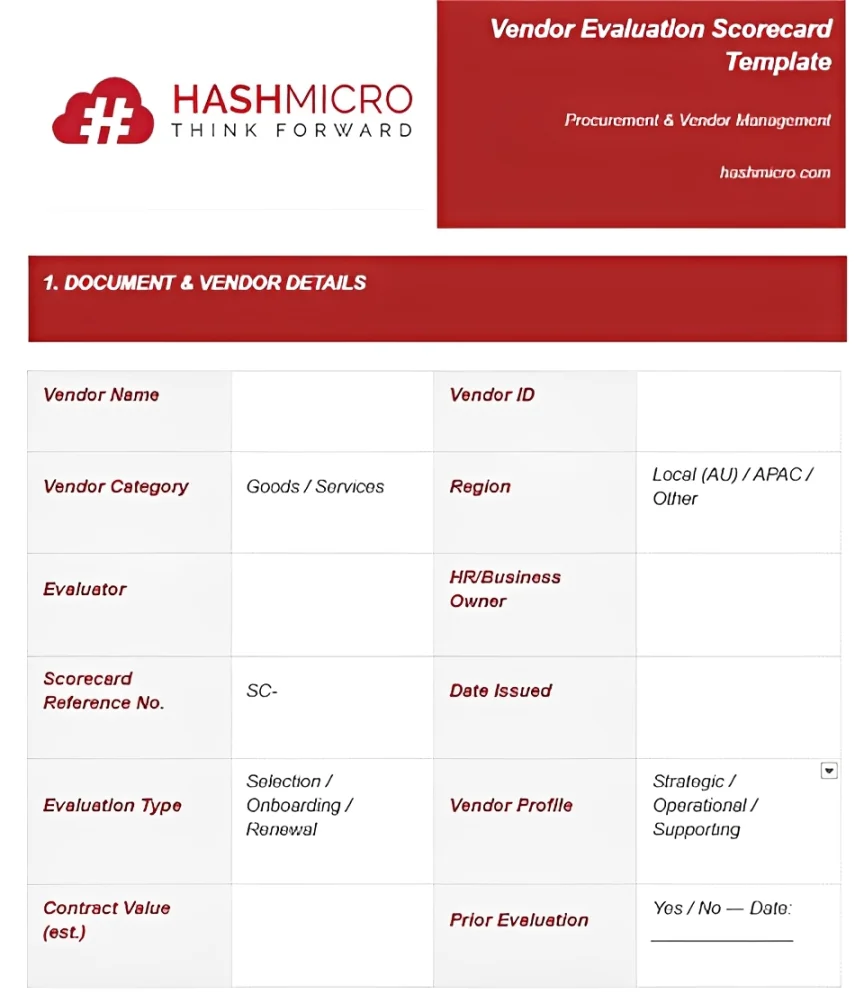
The workbook includes:
- Twelve preconfigured evaluation criteria
- Editable weights that validate against a 100% total
- Dropdown scoring options from 1 to 5
- Automatic weighted totals and decision classifications
- Profiles for strategic, operational, and supporting vendors
- Fields for comments, evidence links, and risk flags
- A corrective action log with owners and due dates
The example uses AUD values, but currency cells remain editable for New Zealand, Singapore, and other APAC operations.
Example of Vendor Evaluation Scorecard
Consider an Australian manufacturer comparing Vendor A, a local supplier, with Vendor B, an APAC supplier offering a lower unit price.
| Evaluation result | Vendor A | Vendor B |
|---|---|---|
| Total cost and value | 3 | 5 |
| Quality | 5 | 4 |
| On-time delivery | 5 | 3 |
| Lead-time reliability | 4 | 2 |
| Compliance | 5 | 4 |
| Cybersecurity | 4 | 3 |
| Invoice accuracy | 5 | 3 |
| Weighted score | 86 | 73 |
| Recommendation | Approve | Conditional |
The lower quoted price does not automatically make Vendor B the stronger choice. The scorecard exposes lead-time and invoice risks that could create expediting costs.
Procurement could still recommend Vendor B as a secondary source, subject to a trial order and a verified continuity plan.
How to Make the Scorecard Audit-Ready and Actionable
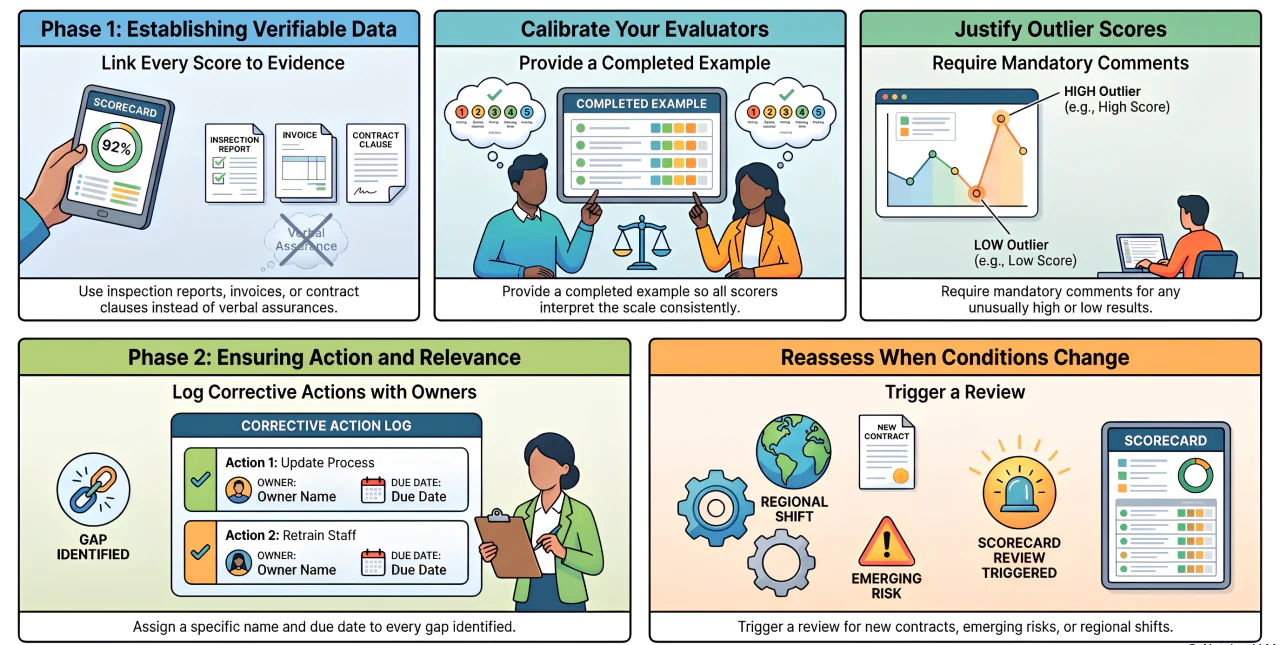
A score only holds up under review if it is backed by evidence, not just an evaluator's impression.
- Link every score to evidence: an inspection report, invoice, or contract clause, not a verbal assurance
- Log corrective actions with owners: assign a name and due date to every gap identified
- Justify outlier scores: require comments for unusually high or low results
- Calibrate evaluators: use one completed example so scorers interpret the scale consistently
- Reassess when conditions change: a new contract, risk, or region should trigger a review
ESG scores need the same treatment. The Sustainable Procurement Guide sets out what counts as acceptable evidence for recycled-content or circular-economy claims.
"A score without evidence is just an opinion. What makes a scorecard defensible is being able to show exactly what backed each number."
Implementation Checklist for Procurement and Finance
The same score can mean different things to different evaluators unless the business defines evidence and scoring rules first.
- Define which vendor categories require a full evaluation
- Separate selection criteria from ongoing performance metrics
- Assign one accountable owner to each criterion
- Describe the evidence required for scores 1 through 5
- Configure weights for each vendor profile
- Identify mandatory pass-fail gates before totalling scores
- Require comments for unusually high, low, or changed scores
- Set approval thresholds and exception authorities
- Record the final recommendation and approval date
An on-time delivery score of 5 might require at least 98% performance across a minimum order count. A single delivery is not enough evidence to justify a perfect score.
Keeping that evidence organised over time is easier with an audit trail that timestamps every score change and approval.
When a Spreadsheet Is Not Enough for Vendor Evaluation
A scorecard template is useful for establishing common criteria. Its limits become visible as vendor numbers and entities grow.
- Different teams maintain conflicting versions of the workbook
- Evidence links break or documents expire without notice
- Procurement cannot trace a score back to an order or invoice
- Approval decisions remain in email instead of a shared record
- Vendor data differs across branches or legal entities
At this stage, connecting the scorecard to a broader business process automation setup reduces manual reconciliation and keeps evidence traceable.
When vendor data is scattered across emails and separate files, consistent scoring becomes hard to defend. The banner below shows how procurement software can centralise evaluation, approvals and supplier records in one place.






Conclusion
A sound vendor decision shows more than the highest score. It explains the criteria, weights, evidence, and approval authority behind the recommendation.
Start with the downloadable template to standardise comparison. If evaluation is already spread across procurement, finance, IT, and operations, consult with us about connecting it to your workflow.

Frequently Asked Questions About Vendor Evaluation Scorecards
A scorecard applies weighted scoring to produce one recommendation per vendor, while a comparison matrix simply lists vendor attributes side by side without a calculated result. Scorecards are built for a decision; matrices are built for reference.
Weights should reflect the vendor'"'"'s risk and business impact, not be spread evenly by default. A business-critical supplier typically carries higher weights on compliance, security, and continuity than a low-risk vendor.
Yes, with adjusted weights. Goods suppliers usually score higher on delivery and quality criteria, while service suppliers weigh more heavily on SLA performance and responsiveness.
Most businesses review criteria and weights annually, or whenever a contract, risk profile, or operating region changes. Individual vendor scores are typically reassessed at renewal or after a significant performance issue.
This depends on internal policy and contract terms. Some businesses disclose the evaluation criteria to encourage compliance, while others keep scoring internal to avoid vendors optimising for the metric instead of actual performance.
A tie should trigger a documented tiebreaker, such as prioritising the vendor with stronger continuity evidence or lower total cost. The tiebreaker rule should be defined before evaluation starts, not decided after scores are in.