




When a legacy platform slows your growth, finding a capable Pronto ERP alternative becomes urgent for Australian enterprises. Pronto Xi still runs many local operations, yet your needs have moved on.
This Pronto ERP review compares seven alternatives without hype, then sets out eight evaluation criteria for your demonstrations. You will also find comparison tables, compliance checks and a migration checklist.
If you are shortlisting platforms now, book a free ERP consultation with our Australian specialists to map your exact requirements. It can reveal whether you need replacement, modernisation or integration.
Key Takeaways
Pronto ERP suits stable, high-volume operations, yet many Australian enterprises now test alternatives for cloud access, mobility and easier integration.
Assess each Pronto ERP alternative on functional fit, integration, reporting, support and total cost before you shortlist any vendor.
Australian compliance is decisive: confirm GST, BAS and ATO reporting, plus data residency and Privacy Act controls, in writing.
Migration works best as a staged programme: audit data, run parallel, validate go-live, and keep a hypercare period after cutover.

What Is Pronto ERP?
Pronto ERP, known as Pronto Xi, is an ERP platform built for operationally complex businesses. Pronto Software has served Australian manufacturers, distributors and service firms for decades.
A single Pronto Xi database links sales, purchasing, inventory, finance and service, so one transaction can update several ledgers at once. This integration is why many enterprises trust it for high-volume work.
Deployment varies by version and contract, from customer-managed servers to hosted or cloud delivery, so confirm the exact model in writing. Review the modules you truly use before you compare rivals.
"Pronto Xi still earns its place in plenty of Australian businesses, but the real question isn't whether it works, it's whether it still fits how the business runs today."
Pronto Xi Review: Strengths and Limitations
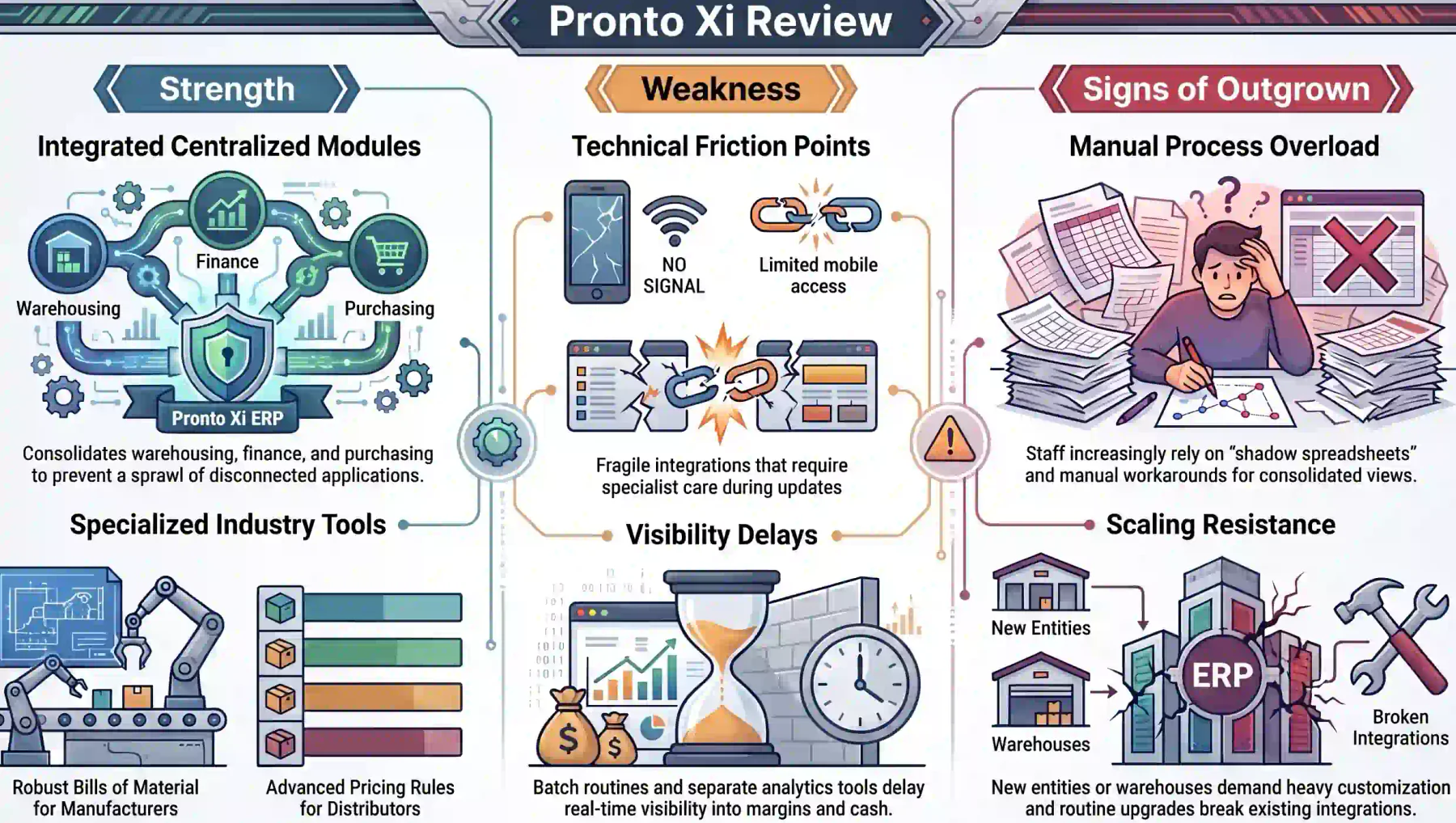
A fair Pronto ERP review weighs genuine operational strengths against the cost of change. The sections below separate where Pronto Xi still earns its place from the limits your team should test first.
1. Where Pronto Xi Performs Well
Pronto Xi rewards businesses with mature controls and a skilled internal team. Its modules cover products, warehousing, purchasing and finance in one place, so departments avoid a sprawl of disconnected apps.
Manufacturers gain bills of material, production planning and inventory valuation, while distributors value order processing, pricing rules and supplier control. The real asset is accumulated process knowledge.
2. Limitations to Verify Before Buying
A solution can keep working smoothly while quietly becoming expensive to change and slow to adapt. Test these common friction points with your own transactions, not a polished vendor script.
- Mobile access that leans on remote desktop tools or thin interfaces.
- Point-to-point integrations that need specialist care whenever a connected app changes.
- Custom reports and scripts that make upgrades, testing and documentation harder.
- Batch routines that delay visibility of stock, margins, service jobs and cash.
- Separate analytics tools that force repeated exports and reconciliation.
- Support that depends on a small number of key individuals.
Ask for proof with your real workflows: a multi-site transfer, a backorder, a partial receipt and an intercompany journal. Count the manual steps, the audit trail and the time to fix an error.
3. Signs Your Business Has Outgrown Pronto ERP
You may have outgrown Pronto Xi when a consolidated view still needs spreadsheets, or when routine upgrades break your integrations. New entities and warehouses that demand heavy customisation are a warning sign.
Other signals include rising support invoices, slow month-end closes, inconsistent master data and staff running shadow spreadsheets. Replacement pays off when it lowers operational risk and total cost.
Why Australian Businesses Look for Pronto ERP Alternatives
Australia has more than two million actively trading businesses, and many now expect cloud-era software as they scale. Against that backdrop, a Pronto ERP alternative is often commercial as much as technical.
1. Cost and Licensing Pressure
Licences, infrastructure and specialist administration can make Pronto Xi costs hard to forecast. Every new entity, site or interface tends to spawn another project, another dependency and another support cost.
2. Cloud, Mobility, and AI Expectations
Operations leaders now want secure browser and mobile access for warehouse, sales, service and finance teams. Executives expect near real-time dashboards, while IT wants documented APIs and identity controls.
Practical AI is now part of the brief too, from demand forecasting to exception handling and natural-language analysis. These features still need clean source data and clear governance to be trustworthy.
3. Industry Fit Gaps in Complex Operations
Fit often breaks in specific operating models. A wholesaler with complex rebates needs flexible pricing and claims, while a manufacturer needs finite-capacity planning, traceability, and subcontracting.
Construction and field service teams prioritise project cost control, mobile timesheets and progress billing. Retailers need high-volume point of sale, promotions and omnichannel visibility, so test your scenarios.
How to Assess a Pronto ERP Alternative
Score every demonstration against the same criteria, so opinion alone never decides a major purchase. Rate each area from one to five, use your own sample data, and revisit the ERP fundamentals before you compare.
| Criterion | Validate in the demo | Strong-score signal |
|---|---|---|
| Functional fit | Can it handle your order, purchasing, inventory, manufacturing and finance exceptions? | Critical processes run on configuration, not heavy custom code. |
| Integration | Are APIs, webhooks, import tools and monitoring ready for your applications? | Interfaces are documented, observable and supported through upgrades. |
| Deployment | Is it cloud, hosted or on-premises, and who owns backups and releases? | Responsibilities, recovery targets and release steps are explicit. |
| Implementation | What is the delivery method, your internal workload and the escalation path? | A phased plan covers data, testing, training and governance. |
| Reporting | Can finance and operations self-serve reports without exporting to spreadsheets? | Role-based dashboards use consistent, drillable, audit-ready data. |
| Scalability | How does it add entities, sites, users and transaction volume? | Growth needs no redesign of the chart of accounts or core flows. |
| Support | What local hours, service levels and specialist resources apply? | Named ownership, response targets and post-go-live help are documented. |
| Total cost of ownership | What are subscription, implementation, integration, training and upgrade costs? | A five-year model shows assumptions, exclusions and change costs. |
Bring finance, IT, operations and frontline users into the scoring, then record where they disagree. A weak integration or implementation score can outweigh a single strong module on its own.
1. Finance, Inventory, and Supply Chain Depth
Push the core where daily work happens: general ledger, payables, receivables, inventory and supply chain. Ask the vendor to run your exceptions, from backorders to partial receipts and multi-site transfers.
2. Integration, Reporting, and Data Ownership
Interfaces should be documented, observable and stable through upgrades, not fragile point-to-point links. Confirm that finance can build controlled reports without exports, and that you can extract your data.
3. Support, Governance, and Implementation Readiness
Look for named ownership, measurable response targets and genuine post-go-live help, not a vague service promise. A phased plan should set out data ownership, testing, training and governance from day one.
Quick Comparison of the Best Pronto ERP Alternatives
The table below sets a shortlist in context before the detailed reviews that follow. Read it as a starting map, since licensing, localisation and implementation quality can change the result for your business.
Treat every row as a hypothesis to test with your own data, not a finished verdict. The detailed reviews that follow weigh pros, cons and the type of business each platform genuinely suits.
7 Best Pronto ERP Alternatives in Australia
Each Pronto ERP alternative below suits a different operating model, so match capability to your processes rather than brand names. Every pro, con and best-fit note is a prompt to test with your own data first.
1. HashMicro
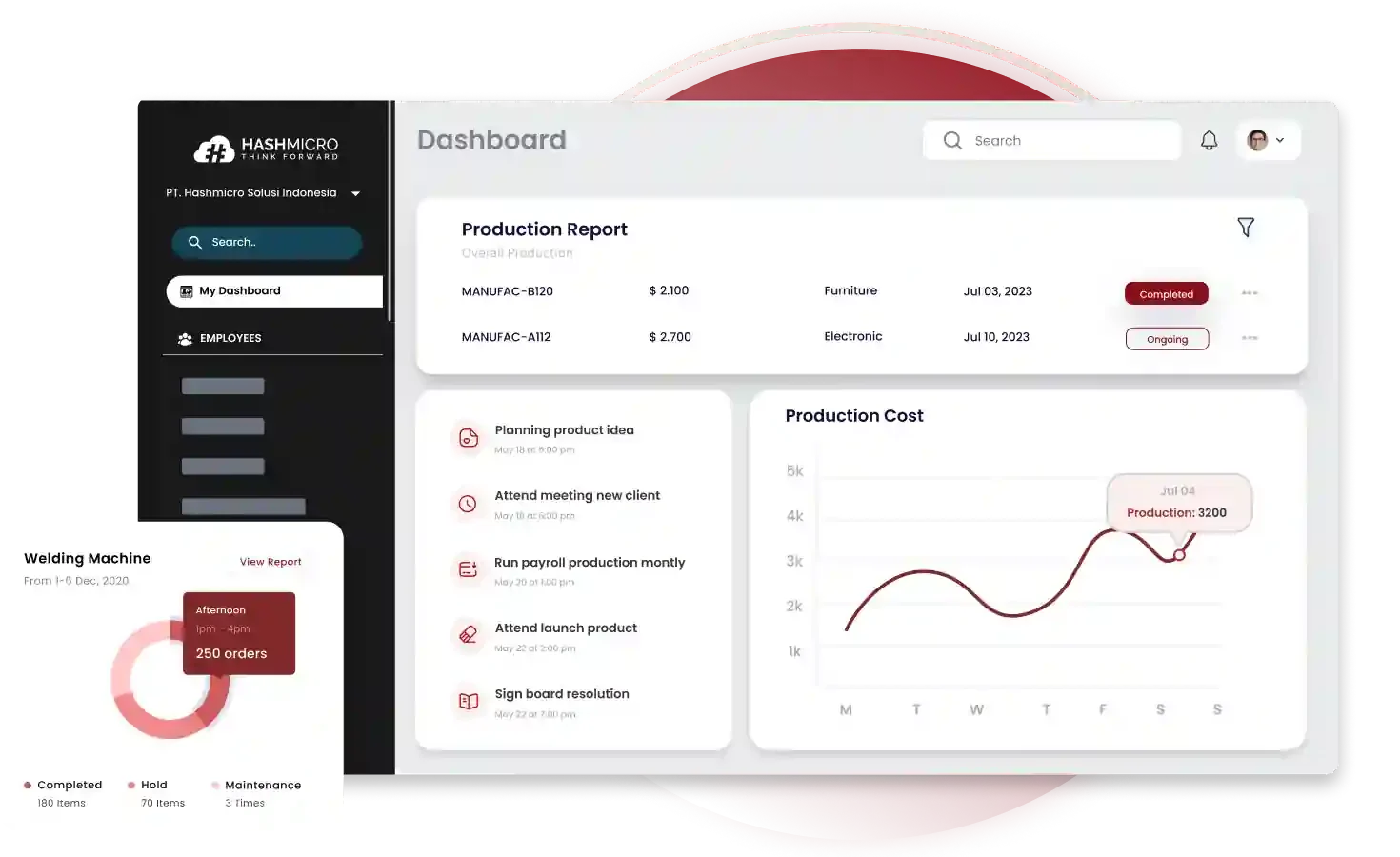
HashMicro is a cloud enterprise platform covering finance, purchasing, inventory, sales, manufacturing and projects in one system.
What sets it apart for Australian buyers is Hashy OS, an AI layer with Coworkers that assist with routine analysis, approvals and exception handling rather than sitting outside the core workflow.
| Pros | Cons |
|---|---|
|
|
Best for: mid-market and multi-entity businesses that want a single cloud platform for finance and operations, with governed AI support built in rather than bolted on.
2. MYOB Acumatica
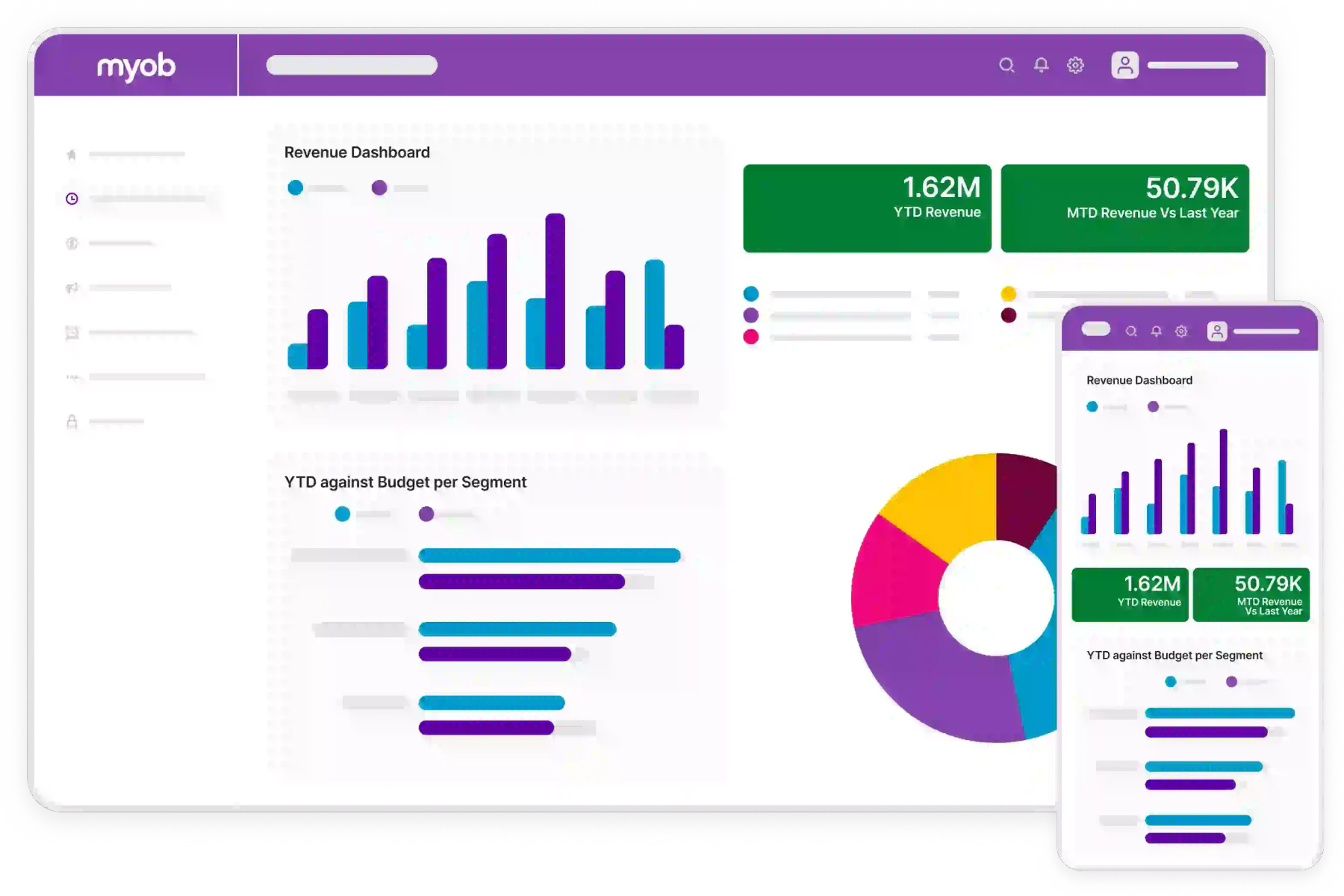
MYOB Acumatica is a familiar name for Australian and New Zealand finance teams, particularly in distribution, construction and professional services.
Standard configuration covers a lot of ground here, so the real question during evaluation is how much of your process actually needs partner customisation to work.
| Pros | Cons |
|---|---|
|
|
Best for: ANZ mid-market businesses in distribution, construction or professional services that want strong local finance fit without heavy customisation.
3. NetSuite
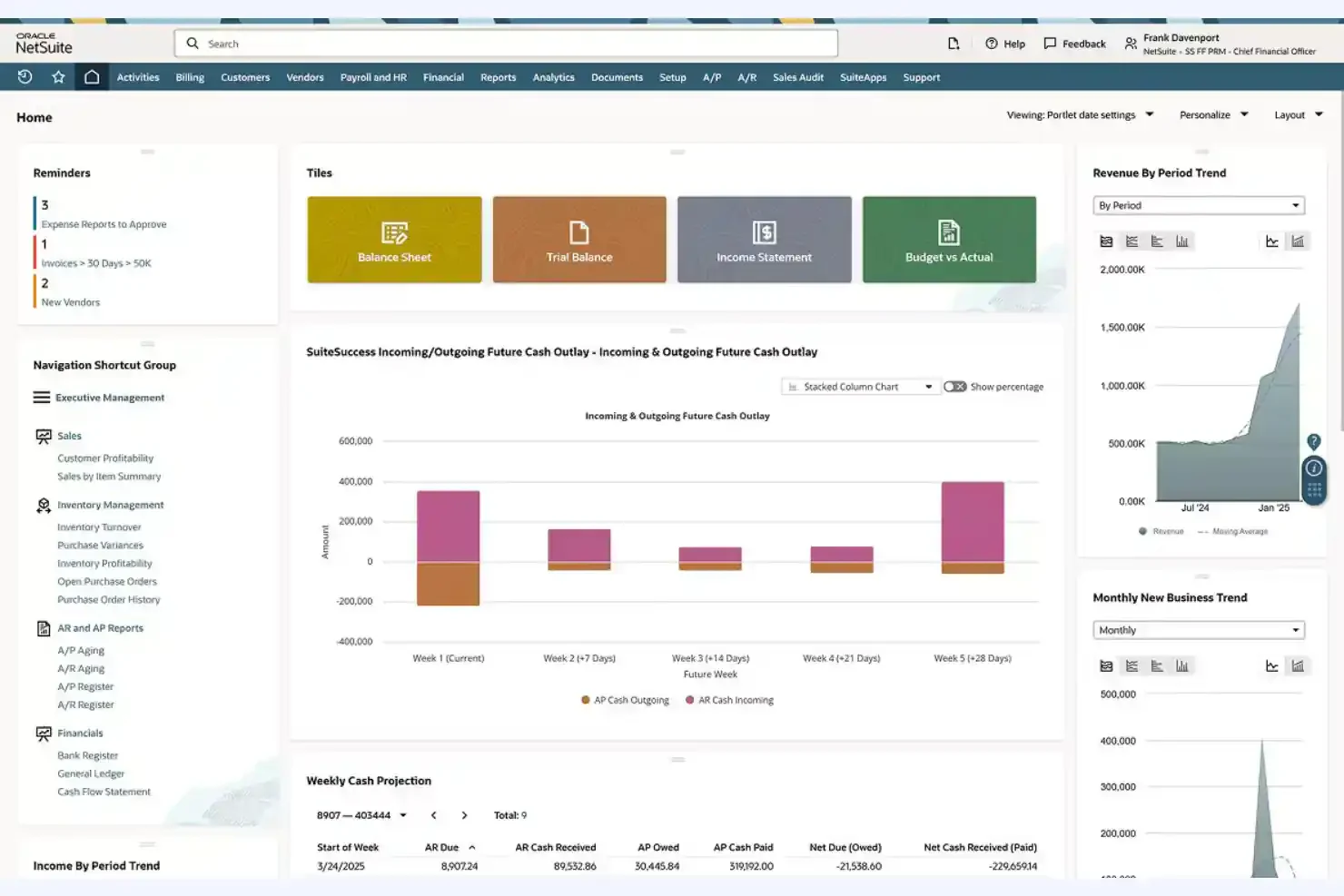
Businesses with multiple subsidiaries or international operations tend to shortlist NetSuite for one reason: consolidated financial reporting.
It's a strong pick when finance transformation and global controls are the priority, though warehouse and manufacturing depth deserve a closer look before you commit.
| Pros | Cons |
|---|---|
|
|
Best for: multi-entity and international businesses that need consolidated reporting across subsidiaries more than deep local operational detail.
4. Microsoft Dynamics 365 Business Central
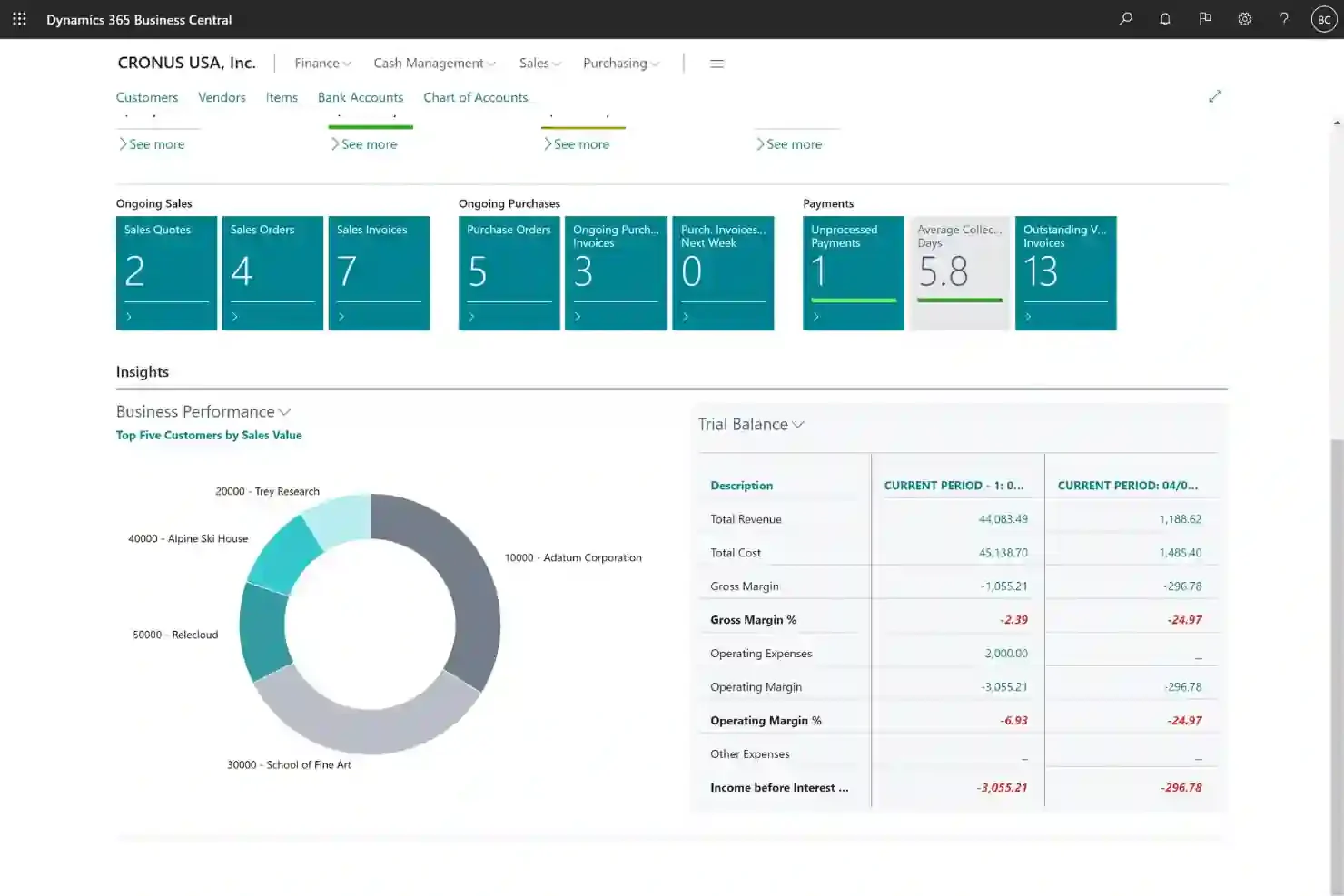
If your business already runs on Microsoft 365, Business Central slots in with less friction than most alternatives.
Finance, sales, purchasing and inventory come standard, but manufacturing and other industry-specific needs usually arrive through extensions, so the partner delivering them matters as much as the product itself.
| Pros | Cons |
|---|---|
|
|
Best for: small and mid-sized Microsoft-centric businesses that want unified finance and operations without leaving their existing environment.
5. SAP Business One
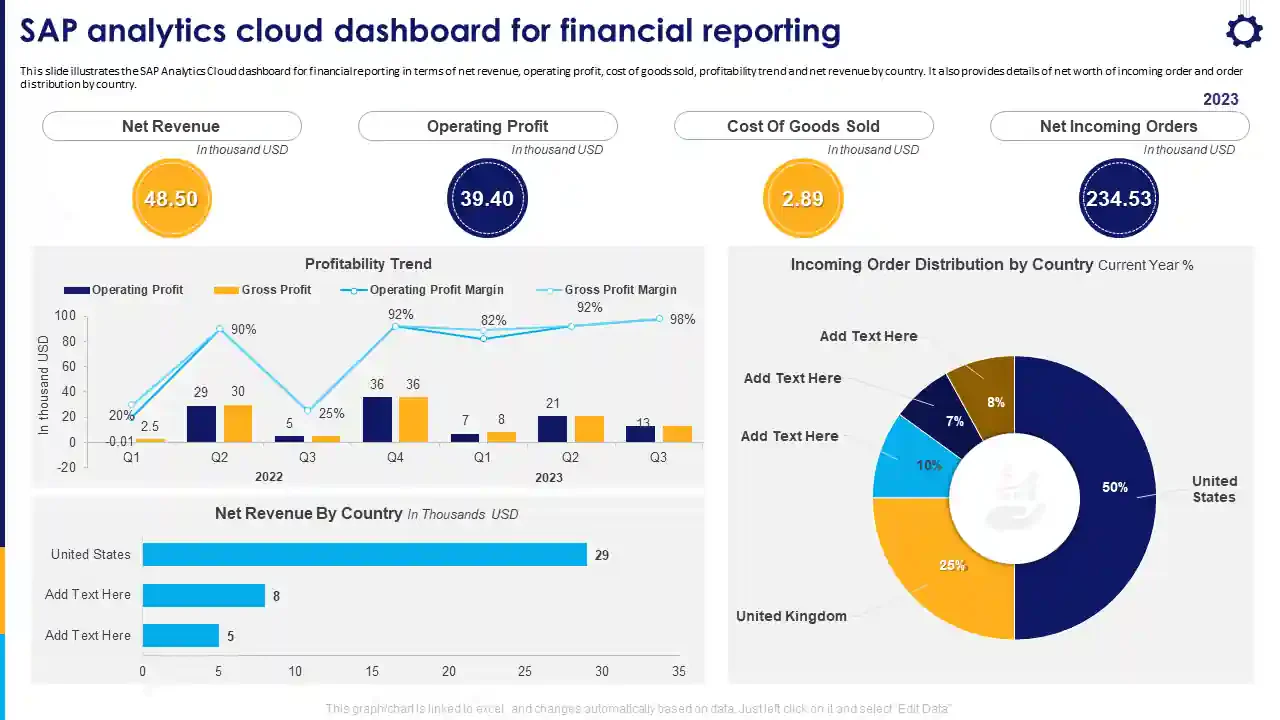
SAP Business One gives growing businesses a structured core across finance, purchasing, sales, inventory and production.
The catch is that a lot of what makes it work well or poorly comes down to the partner implementing it, so ask for references before assuming the product alone will deliver the result.
| Pros | Cons |
|---|---|
|
|
Best for: growing businesses that want a proven, structured core ERP and are prepared to invest time choosing the right implementation partner.
6. TechnologyOne
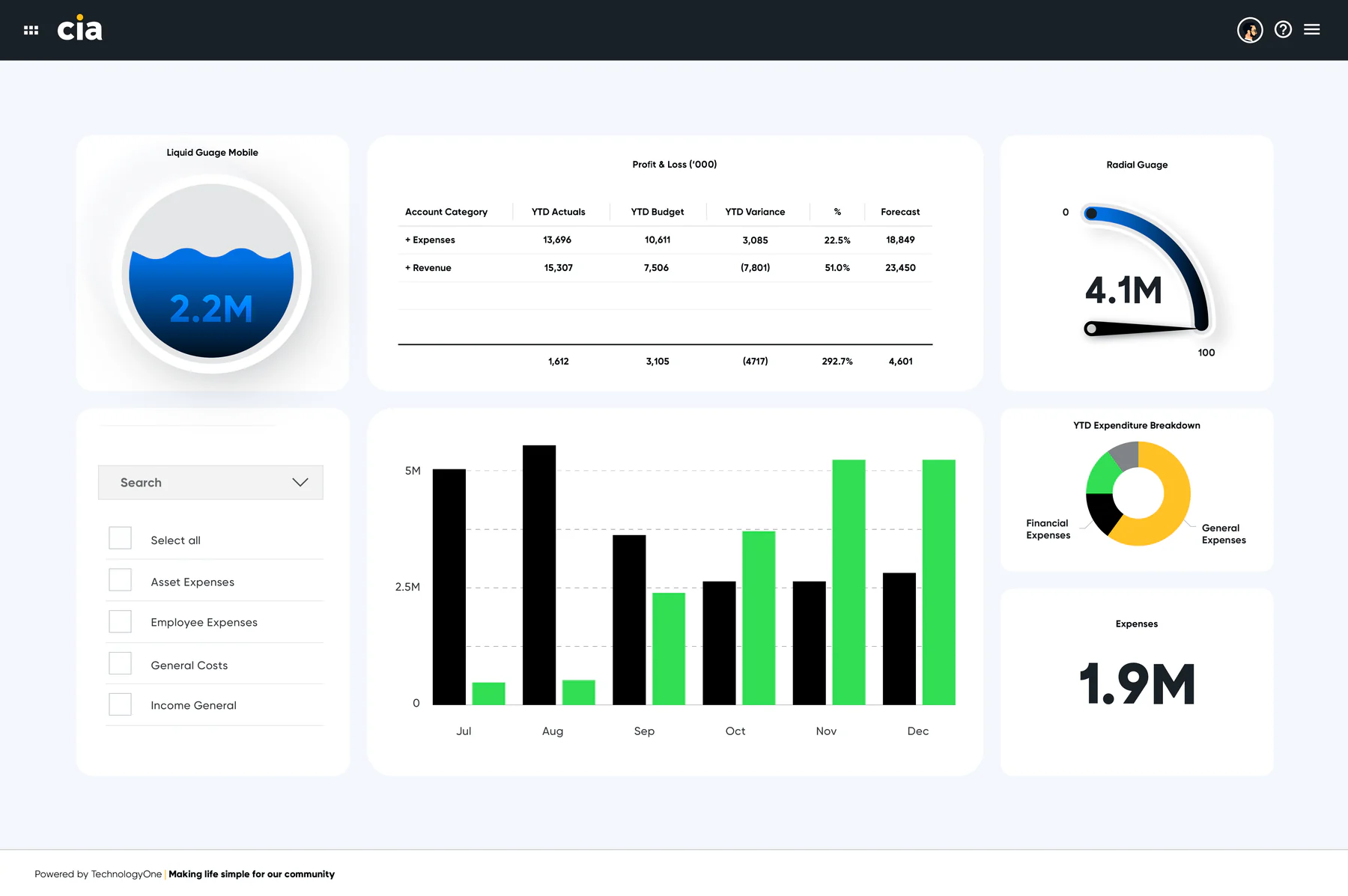
TechnologyOne has built its reputation in larger Australian and New Zealand organisations, especially the public sector and asset-intensive environments.
It's less commonly seen in private-sector manufacturing or wholesale, so that fit is worth testing rather than assuming from its enterprise track record alone.
| Pros | Cons |
|---|---|
|
|
Best for: larger Australian and New Zealand organisations, particularly public sector and asset-intensive teams.
7. Epicor Kinetic
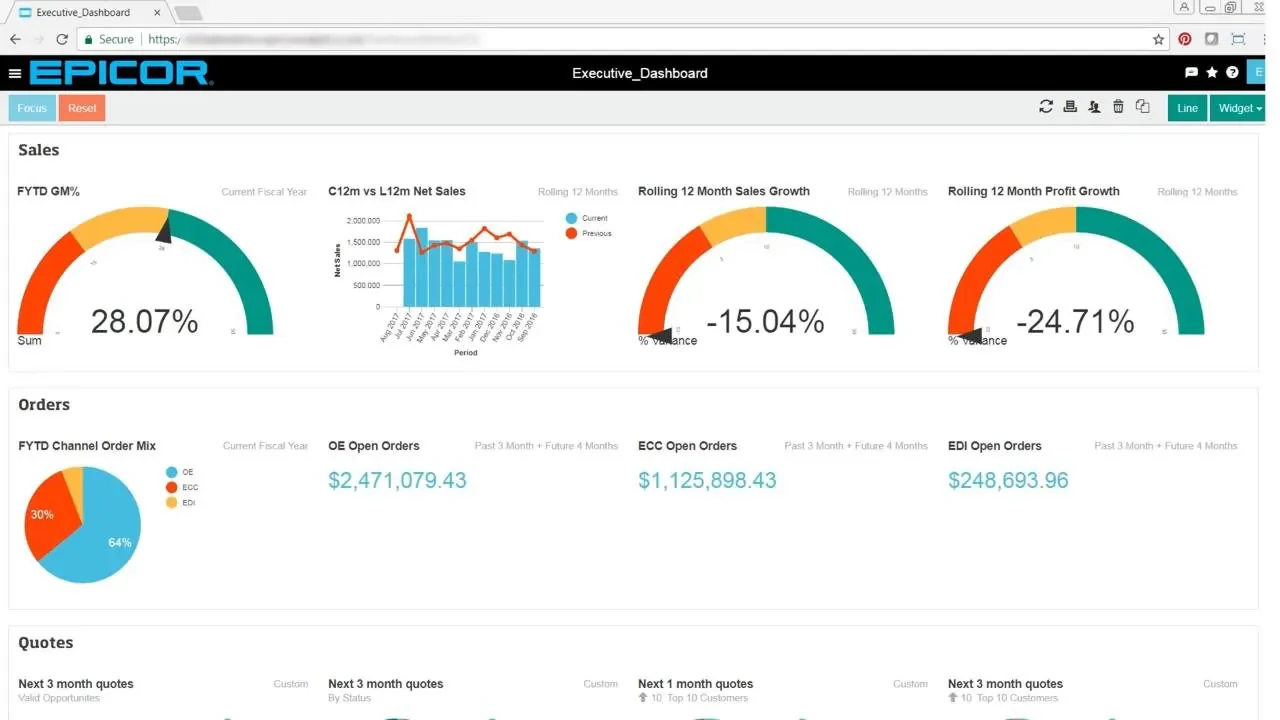
Epicor Kinetic leans hard into manufacturing and industrial operations, which makes it worth a look when production scheduling, shop-floor visibility and quality control matter more to you. Australian finance localisation and CRM or ecommerce integration are the areas to pressure-test in a demo.
| Pros | Cons |
|---|---|
|
|
Best for: manufacturers and industrial distributors where production complexity outweighs the need for a broad, general-purpose suite.
Pronto ERP vs HashMicro: Which System Fits Your Business Better?
The right pick depends on the gap you want to close. Pronto Xi can stay sensible when processes are stable and users are productive, while HashMicro fits a cloud-first operating model with broader automation.
1. Module Coverage
Compare like for like: general ledger, payables, receivables, purchasing, inventory, sales, manufacturing, assets and projects. Ask for a fit-gap matrix marking each standard, configurable, integrated or custom.
2. Total Cost of Ownership
Evaluate Pronto ERP pricing and HashMicro pricing over the same period. Include subscriptions, implementation, migration, integrations, testing, training, upgrades and internal project time.
3. AI-Native Capabilities
Hashy OS and AI Coworkers add an AI layer to HashMicro, so ask which use cases exist now and how outputs are reviewed. Treat AI as support for controls, not a replacement, and read our note on AI integration.
That AI layer is the clearest break from legacy ERP. When finance, inventory, and operations share one system, Hashy AI reads across them and flags the exceptions a batch report would only show days later.






Australian Compliance and Data Questions to Confirm
Use this checklist with every vendor and implementation partner, since requirements vary by entity, industry and transaction type. Obtain professional tax and legal advice where your situation is complex.
| Area | Questions to confirm |
|---|---|
| GST | Does it support Australian GST codes, tax-inclusive and tax-exclusive entries, adjustments and a clear audit trail? |
| BAS | Can finance prepare accurate BAS figures, reconcile activity and export or integrate with your accounting process? |
| ATO reporting | What supported formats or integrations exist for ATO-related reporting, and who maintains them after rule changes? |
| Payroll and PAYG | If payroll is separate, how are journals, PAYG withholding and employee-cost allocations transferred and reconciled? |
| E-invoicing | Does it support the Peppol or third-party e-invoicing workflow your customers and suppliers require? |
| Privacy Act | Where is personal and financial data held, who can access it, and how are requests, retention and breaches handled? |
| Data residency | Can the vendor contractually confirm Australian or approved-region storage, backups and disaster recovery? |
| Audit and security | Are role-based access, approval history, immutable logs, encryption and independent assurance reports available? |
1. GST, BAS, and ATO Reporting Fit
Confirm native handling of GST codes, BAS preparation and reconciliation before you shortlist. Ask how ATO reporting formats are supported and who maintains them after regulatory changes.
2. Data Residency and Privacy Act Considerations
Confirm in writing where personal and financial data is hosted, who can access it, and how backups and disaster recovery are managed. Map access, retention and breach response to Privacy Act obligations.
Migration Checklist Before Switching from Pronto ERP
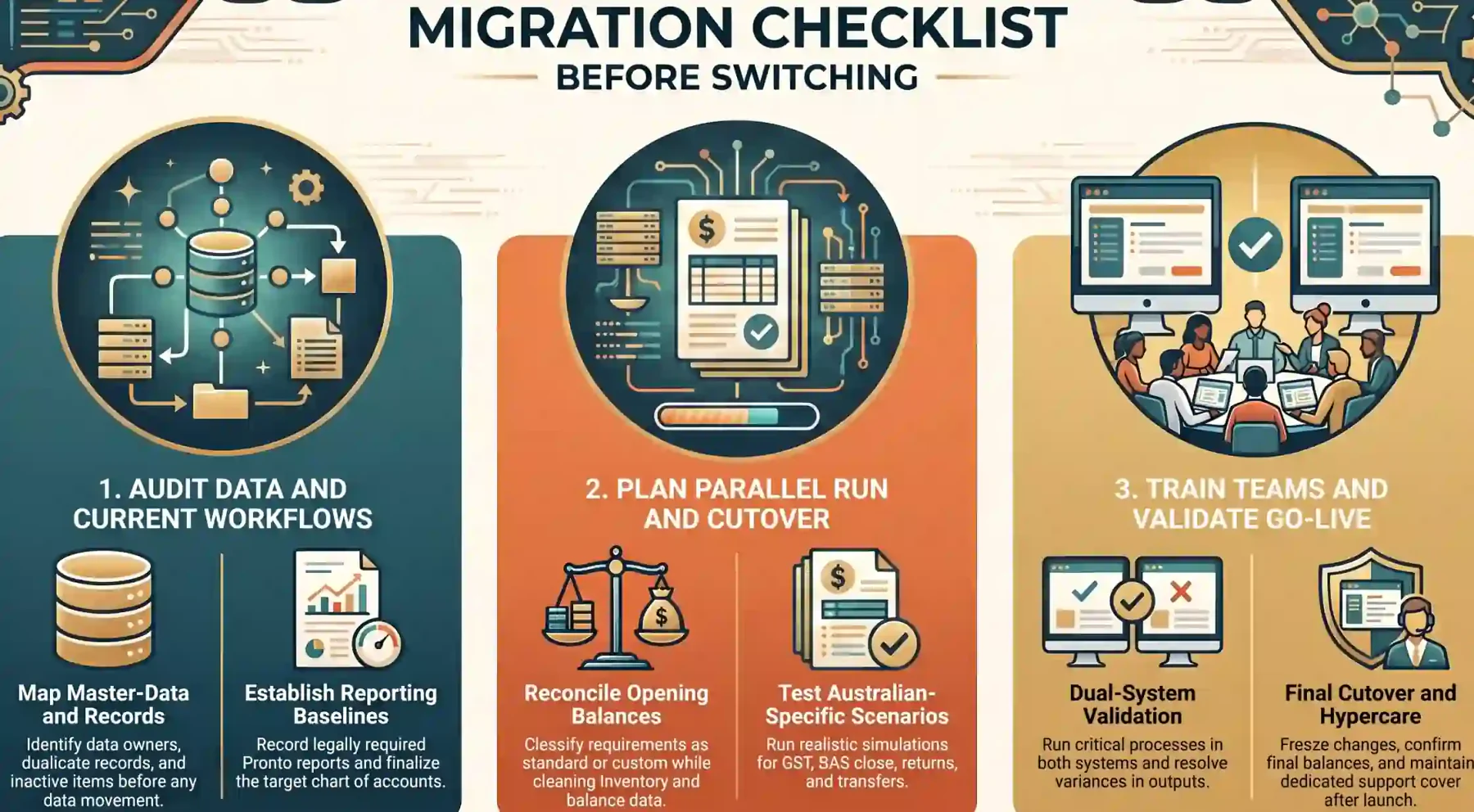
A controlled Pronto ERP migration is a business programme, not just a data export. Sequence the work below to cut disruption, and use our ERP deployment steps to assign clear ownership.
1. Audit Data and Current Workflows
Map master-data owners, duplicate records, inactive items, open orders and custom fields before anything moves. Record which Pronto reports are legally required, then agree the target chart of accounts.
2. Plan Parallel Run and Cutover
Classify each requirement as standard, configurable, integrated or custom, then clean and reconcile opening balances and inventory. Run realistic Australian scenarios: GST, BAS close, returns and transfers.
3. Train Teams and Validate Go-Live
Let finance and operations run critical processes in both systems for an agreed period, then compare outputs and resolve variances. Freeze changes per the cutover plan, confirm balances and keep hypercare cover.
Conclusion
Pronto Xi remains a credible operational ERP when its processes, integrations and support model still fit your business. Yet cloud mobility, faster reporting and new compliance push firms to look wider.
Use the eight criteria to weigh fit, integration, deployment, reporting, scalability, support and total cost. Test your shortlist with your own data, then ask HashMicro to map requirements before you commit.
If you want to learn more, you can book a free consultation with our team today. Gain expert business insight and improve your business today.

Frequently Asked Questions
Pronto Xi can run as customer-managed, hosted or cloud, depending on your version and contract, so confirm the exact deployment and upgrade model in your proposal rather than assuming one setup.
Pronto Xi pricing depends on modules, users, deployment and support rather than a flat published figure, so ask for a five-year total cost of ownership model.
Pronto Software continues to develop and support Pronto Xi, but still review the roadmap, release cadence and your local support terms in writing before committing to another cycle.
Timelines vary with entities, data quality, integrations and user count, so a responsible plan covers audit, configuration, testing, training, a parallel run and go-live validation.
You should not lose historical data when migration is planned properly, with records cleaned, mapped and reconciled to approved Pronto reports before go-live.
Yes. HashMicro can run a demonstration using your own scenarios, then map requirements, integrations and a phased or parallel-run migration path for businesses leaving Pronto.