







 Limited to 100 registrants

A lease portfolio becomes difficult to govern when renewal dates, contract terms, accounting inputs and approval records sit across separate spreadsheets, inboxes and systems.
A property manager may discover an option notice deadline while finance is still working from an older contract version, then operations gets asked for a site decision without the full cost picture.
This guide provides a selection framework for Australian organisations managing commercial property, retail networks, construction locations, healthcare facilities or mixed portfolios.
Key Takeaways
Lease management software should connect contract records, renewal actions, compliance evidence and reporting across finance, property and operations.
A practical implementation plan covers data cleansing, workflow design, integration mapping, testing, training and post-launch validation.
Compare platforms using weighted requirements and real business scenarios rather than relying on feature counts or unsupported vendor rankings.
Australian buyers should validate accounting treatment, data governance, security requirements and support arrangements before selecting a platform.

What Is Lease Management Software?
Lease management software is a control layer that connects finance, property, operations and IT around one shared lease record rather than a digital filing cabinet for signed agreements.
A working system tracks obligations, assigns actions, retains evidence, supports reporting, and surfaces exceptions before they turn into expensive surprises at a site or entity level.
This shared record is what lets property, finance, and operations act on the same facts, instead of reconciling separate spreadsheets only after a decision has already been made.
What Should Lease Management Software Help Your Team Control?
A central lease register should show commercial terms, sites, entities, responsible owners, key dates and supporting documents for each agreement, all from one shared record.
| Approach | What it controls well | Common limitation |
|---|---|---|
| Document storage | Keeps signed agreements in one location | Doesn't track obligations, owners, or deadlines |
| Spreadsheet tracking | Basic list of dates, amounts, and sites | Version conflicts, weak audit history |
| Integrated lease workflow | Connects records, alerts, tasks, and evidence | Needs structured implementation and adoption |
1. Key dates: expiry, option exercise, rent review, and notice periods
These dates should sit in one record rather than a personal calendar reminder, since missing an option window can permanently change a site's negotiating position.
2. Obligations: outgoings, make-good, insurance, and reporting duties
Recurring obligations need a named owner and a review cadence, not just a mention buried somewhere in the original contract's fine print.
3. Document storage and version control against each lease
A lease may be extended or amended after signing, so the system should preserve the original record and show which terms are currently in effect.
4. Approvals, reminders, and ownership of each action
Basic lease tracking might remind someone a date is approaching. A stronger approach also records who owns the action and what evidence was supplied.
5. Audit trail: who changed what, when, and on what basis
An audit trail that shows the reason behind a change is what separates a defensible record from a spreadsheet cell someone quietly overwrote. A proper audit trail also helps teams trace changes when lease records are reviewed internally or externally.
Which Lease Tracking and Renewal Features Deserve Priority?
Consider a retail network with rent reviews approaching at several sites, each needing a different owner, market data, and a finance check before any decision.
1. Critical date alerts and lead-time configuration
Alerts are only useful when they create accountable work. A reminder with no assigned owner becomes another inbox message teams learn to ignore.
2. Option to renew
An option notice often needs legal or property review before its deadline, so the workflow should distinguish it from a routine renewal reminder.
3. Rent review types
Market reviews, fixed increases, and CPI-linked reviews each need different supporting information, so the system should track which type applies per lease.
4. Rent escalation schedules and forecast payments
Forecasting future payments against the escalation schedule gives finance a defensible number well before the next budget cycle starts.
5. Notice generation and correspondence records
Correspondence with a landlord should attach to the relevant lease record, so nobody has to search an inbox to confirm what was actually agreed.
6. Make-good and end-of-lease obligation tracking
Make-good obligations are easy to underestimate until the final months of a lease, when the cost and timeline both become urgent at once.
7. Holdover and month-to-month situations
A lease running past its expiry into holdover status needs its own visibility, since terms and notice periods can shift once that happens.
How Does Lease Management Software Support Accounting and Compliance Control?
Lease management software supports compliance by improving data completeness, approval evidence, and auditability, though it doesn't determine accounting treatment on its own.
Finance teams need confidence that data feeding calculations under AASB 16 is complete, current, and traceable back to the original agreement and any amendment. This also makes accurate financial reporting important when lease data flows into broader finance processes.
Software can organise information and document controls, but it can't confirm the correct accounting interpretation. Obtain qualified advice on applicable standards before finalising the design.
How Can Portfolio Dashboards Improve Decisions for Finance, Property and Operations?
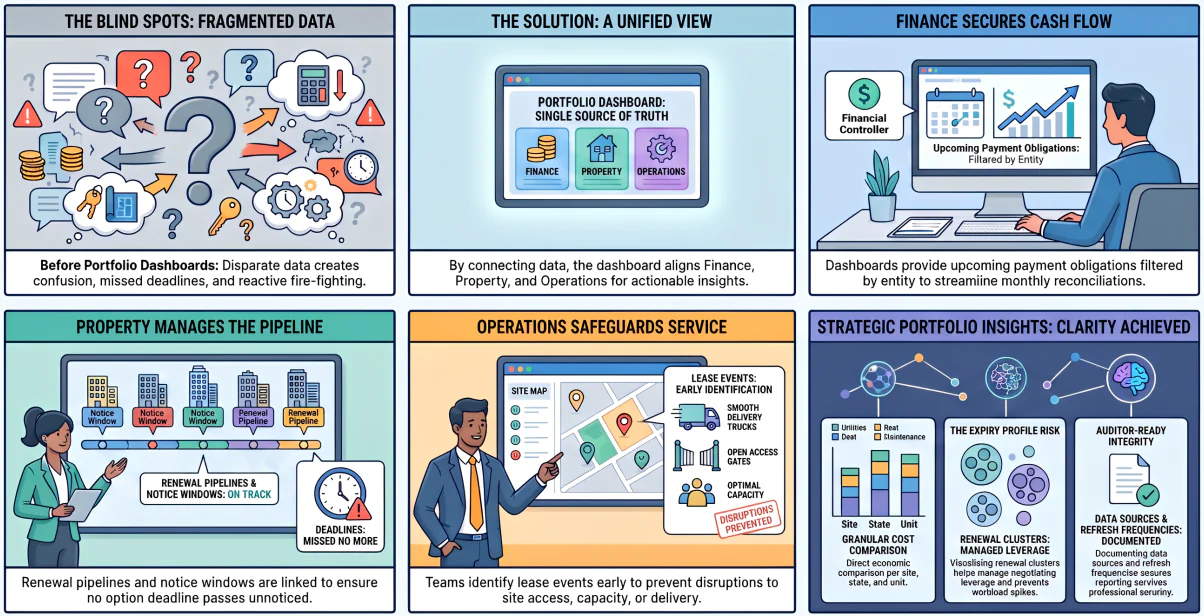
A dashboard is valuable when it turns lease data into a decision, not merely a collection of charts nobody acts on.
1. What finance needs to see: liability, commitment, and cash outflow
Finance needs upcoming payment obligations and cost exposure filtered by entity, so a reconciliation doesn't start from a blank spreadsheet each month.
2. What property needs to see: expiries, options, and portfolio exposure
Property teams need the renewal pipeline and notice windows visible together, so no option deadline gets discovered after it's already passed.
3. What operations needs to see: sites, occupancy, and upcoming change
Operations needs to know which sites face an upcoming lease event that could affect access, capacity, or service delivery in the near term.
4. Cost per site, per state, and per business unit
Breaking cost down this way lets a business compare site economics directly, instead of only seeing one aggregated portfolio-wide number.
5. Lease expiry profile across the portfolio
An expiry profile shows whether renewals cluster in a single year, which matters for negotiating leverage and workload planning alike.
6. Reporting that survives an auditor's question
Document the source, refresh frequency, and reconciliation method behind each metric, since a polished report can't compensate for unclear data ownership.
Which Integrations Should You Assess Before Selecting a Lease Platform?
An integration is only useful when ownership, field mapping, and error handling are clearly defined between the two connected systems.
1. General ledger and accounting system connection
Confirm which system is authoritative for the lease liability and right-of-use asset figures once they post to the ledger.
2. Accounts payable and scheduled rent payments
Rent payment schedules should flow into AP without manual re-entry, so a missed payment doesn't trace back to a data-entry gap.
3. ERP and financial consolidation
Multi-entity businesses need lease data to consolidate cleanly at group level, without manual mapping each period. Strong ERP integration connects lease data with finance and operations.
4. Document management and e-signature
A signed amendment should attach automatically to the correct lease record, rather than living in a separate document system nobody cross-references.
5. Fixed asset register alignment
Right-of-use assets recognised under lease accounting should reconcile against the fixed asset register rather than existing as two disconnected numbers.
6. Export, API, and reporting flexibility
Confirm whether reporting tools can pull approved lease data directly, or whether every management pack still needs a manual export first.
What Does Implementation Involve for an Australian Lease Portfolio?
Rollout depends on portfolio scope, data readiness, and integrations. A structured data migration process ensures lease records, amendments, and key dates transfer accurately before go-live.
- Scope: Define entities, sites, lease types, users, and success measures.
- Prepare: Inventory active contracts, amendments, dates, and owners.
- Configure: Set fields, statuses, permissions, and escalation rules.
- Validate: Clean duplicates and test calculations with finance.
- Launch: Pilot with representative leases and provide go-live support.
- Improve: Review adoption and data quality after launch.
Testing should cover a renewal alert, an amendment, a payment change, and an integration failure, not only a successful data import on day one.
Which Property and Portfolio Scenarios Are a Good Fit for Lease Management Software?
Fit depends on portfolio and governance complexity, not just the raw number of leases a business happens to hold.
| Scenario | Complexity signals | What to test |
|---|---|---|
| Commercial property | Multiple landlords, options, make-good | Renewal pipeline, financial exposure |
| Retail network | Many sites, different owners and dates | Site filtering, bulk reporting |
| Industrial or logistics | Operational dependencies, compliance duties | Obligation workflows, evidence capture |
| Healthcare facilities | Sensitive approvals, continuity needs | Permissions, audit history |
| Construction sites | Temporary premises, project-linked costs | Effective dates, integrations |
| Corporate offices | Consolidated multi-entity reporting | Entity controls, exports |
A business with only a few stable leases may not need a full platform yet. Reassess as obligations become time-sensitive, while also considering relevant Australian workplace requirements.
"An option notice missed by one week doesn’t just cost a renewal. It costs the negotiating leverage the business spent years building at that site."
How Should You Compare Lease Management Software Vendors and Alternatives?
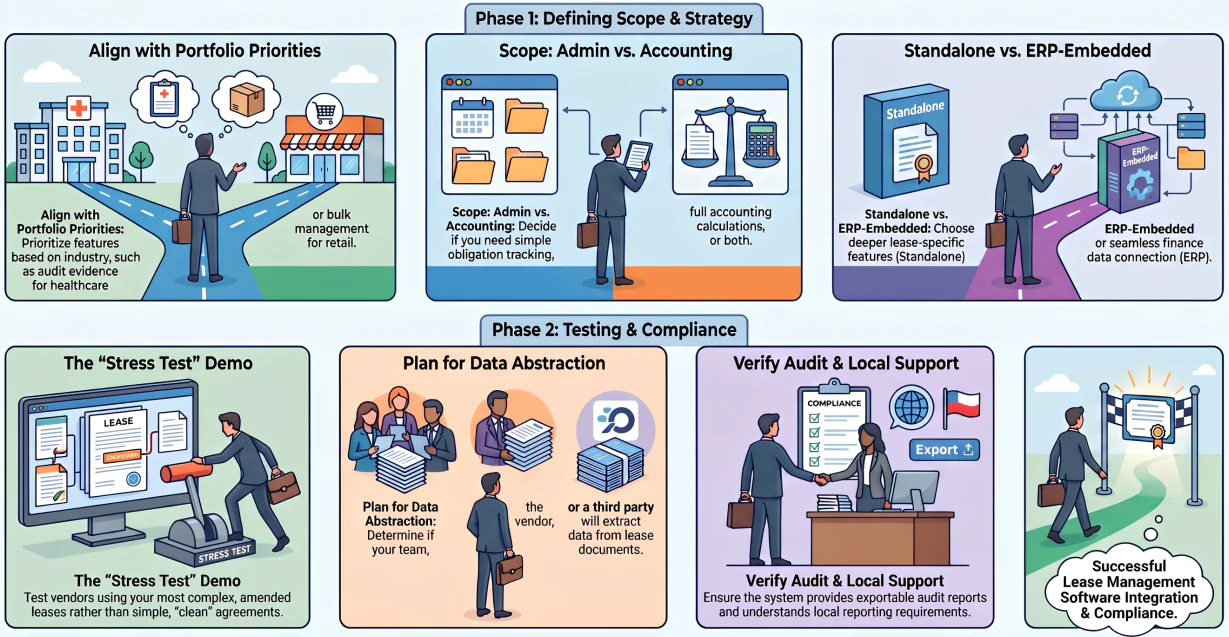
Compare platforms using weighted requirements and representative scenarios rather than a feature count or an unsupported vendor ranking.
1. Start from your portfolio size, lease types, and reporting obligations
A healthcare group may weight audit evidence heavily, while a retail network may prioritise site-level workflows and bulk date management instead.
2. Lease administration only, lease accounting only, or both
Some platforms handle dates and obligations well but leave accounting calculations to a separate tool, so confirm scope before assuming coverage.
3. Standalone platform versus lease capability inside an ERP
A standalone tool may offer deeper lease-specific features, while an ERP-embedded option supports business process management by keeping lease and finance workflows in one connected system.
4. Test the system against your most complicated lease, not a simple one
A demo built around a clean, simple agreement won't reveal how the platform handles an amended, multi-option lease with a disputed clause.
5. Check who does the lease abstraction and what it costs
Lease abstraction, pulling key terms out of the original document into structured fields, can be done by your team, the vendor, or a third party.
Ask what's included in the price and what happens if a lease later needs re-abstracting after an amendment or a disputed clause.
6. Confirm audit support, controls, and user permissions
Role-based access and an exportable audit report matter more once a lease decision faces scrutiny from an external auditor or regulator.
7. Assess local support, accounting familiarity, and product roadmap
A vendor familiar with Australian reporting requirements can shorten implementation, since fewer concepts need explaining from first principles.
How Can You Build an Internal Business Case for Lease Management Software?
Start with a one-page requirements brief before approaching any vendor for a quote or demonstration.
- Entities and sites covered by the portfolio today.
- Lease types and critical dates already known to be problematic.
- Current systems and known data or reporting gaps.
- Approval roles across finance, property, and operations.
Select three to five representative leases for demonstrations, including one with an amendment and one with an approaching renewal, to test real complexity.
How HashMicro Supports Lease and Contract Visibility
HashMicro's ERP context is relevant where lease data needs to sit alongside finance, procurement, and broader contract management workflows in one connected system.
A configured workflow can connect lease obligations with accounting inputs, approval routing, and reporting, without treating the lease register as an isolated standalone tool.
This fits organisations already running other operations through an ERP and wanting lease obligations visible in the same reporting environment, not a separate disconnected system.
Conclusion
A lease management platform succeeds when finance, property, operations, and IT trust the same record and know who owns the next action.
If renewals, reporting, or data hand-offs remain difficult across your portfolio, book a consultation with HashMicro's team to review the right next step.

Frequently Asked Questions
A shared lease record can connect contract data, renewal actions, payment information, approvals and reporting for property and finance users. Confirm the exact accounting workflow and system integrations against your organisation’s requirements and the vendor’s documented capabilities.
Prepare active contracts, amendments, key dates, payment schedules, entities, sites, responsible owners, supporting documents and existing accounting references. Resolve duplicates, missing clauses and inconsistent naming during validation rather than carrying them into the new system.
Software can organise the data, dates and calculation inputs that AASB 16 requires, but it doesn’t determine the correct accounting treatment on its own. Confirm applicable standards and disclosure requirements with a qualified accountant before finalising the design.
Lease abstraction is the process of pulling key terms, dates, and obligations out of the original lease document into structured, searchable fields. It can be done internally, by the software vendor, or by a third-party service, and the cost varies accordingly.
Use weighted requirements and representative scenarios, including a renewal alert, lease amendment, accounting review, management report and integration exception. Ask each vendor to demonstrate the workflow, evidence, permissions and reporting result instead of accepting unqualified feature claims.
Some platforms extend beyond property leases to cover equipment and vehicle agreements, but the depth of support varies widely. Confirm whether asset-specific fields, depreciation links, and lease-end options are actually supported before assuming coverage.
Not necessarily. A small, stable portfolio with one accountable owner can often run on a well-maintained spreadsheet. The case for dedicated software strengthens once obligations become time-sensitive, entities multiply, or reporting starts requiring manual reconstruction each period.