




A single contaminated ingredient or mislabelled lot can trigger a recall that spreads across every pallet a manufacturer has shipped that month. Batch tracking software gives Australian manufacturers the traceability to trace any unit back to its source materials and forward to every customer who received it, often within minutes rather than days.
For food, beverage, pharmaceutical, and chemical producers, that speed is not optional. Regulators expect a documented audit trail, and buyers increasingly ask for lot-level evidence before they sign a supply contract. This guide explains what batch tracking software does, the features that matter, where compliance applies, and how an integrated system compares with a standalone tool.
Key Takeaways
Evaluate traceability from supplier lot to customer invoice, not merely whether a system can assign batch numbers.
Australian traceability obligations vary across food, pharmaceuticals, industrial chemicals and general manufacturing, so compliance claims require sector-specific verification.
ERP-integrated tracking becomes more valuable when batch data must connect procurement, production, quality, warehousing, costing and finance.
Ask every shortlisted vendor to complete a backward-and-forward trace using your own product, warehouse and quality-control scenario.

What Is Batch Tracking Software?
"People assume batch tracking is about printing a code on a box. The real work starts when something goes wrong and you need to prove, in minutes, exactly where every affected unit came from and where it went. That trace is what protects the business, not the label"
Batch tracking software is a system that assigns a unique identifier to each production run or received lot, then records every movement, transformation, and quality check tied to that identifier. It lets a manufacturer answer two questions instantly: where did this batch come from, and where did it go.
The software captures supplier lot numbers at goods receipt, links them to the batches produced, and follows those batches through storage, dispatch, and sale. As a result, a producer can trace a finished product back to the exact delivery of raw material that made it.
This matters most during a recall or a quality investigation. Instead of manually cross-checking paperwork, a business filters by batch number and immediately sees the affected stock, the customers who received it, and the suppliers involved. Therefore, containment happens faster and with far less guesswork.
Batch tracking also supports everyday operations beyond compliance. For example, it enables accurate expiry management, tighter cost analysis per production run, and cleaner stock rotation across warehouses.
Key Features to Look for in a Batch Tracking System
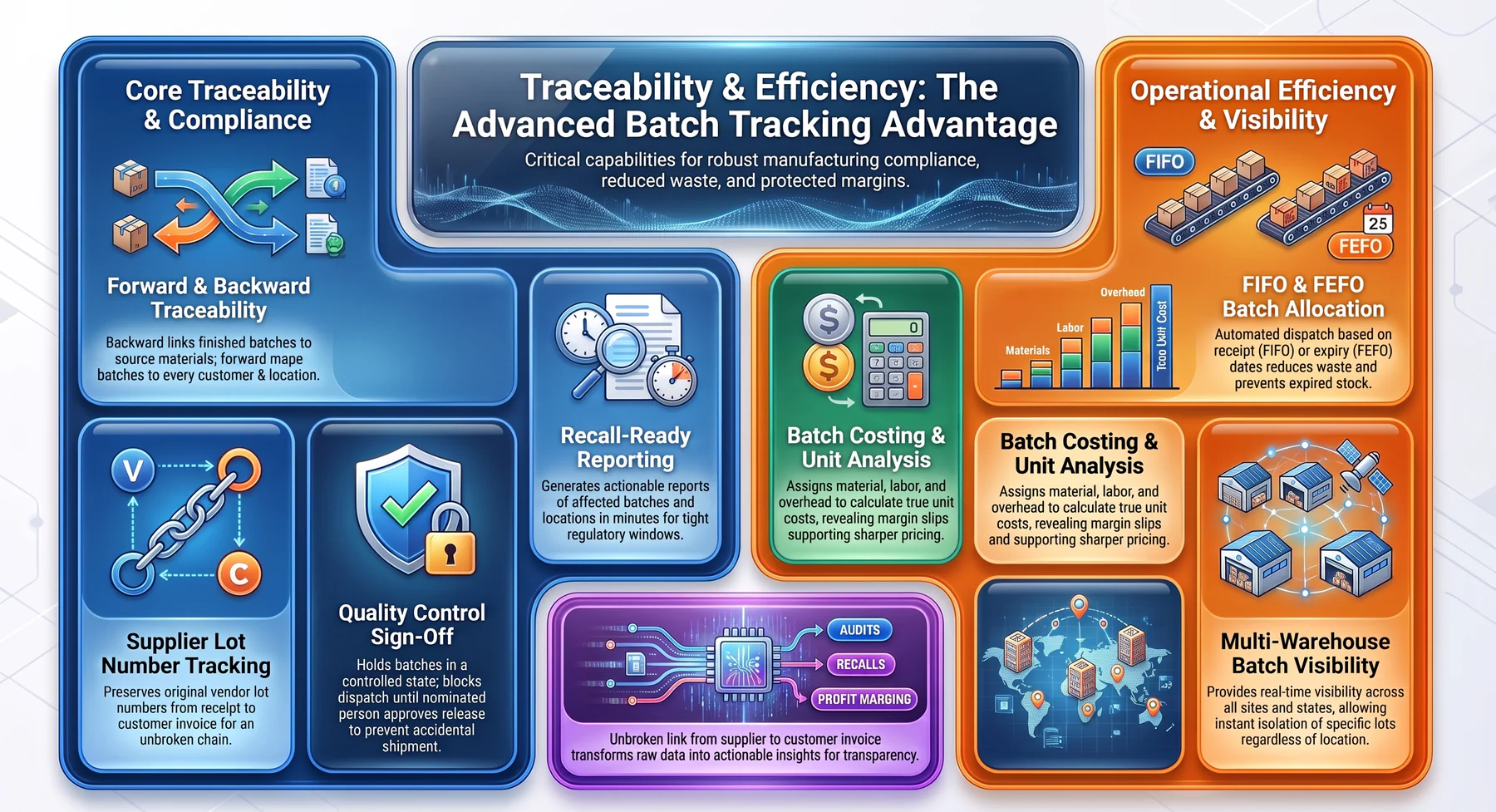
Not every batch tracking tool offers the same depth, so it helps to know which capabilities separate a basic log from a genuine traceability system. The features below are the ones Australian manufacturers rely on most when audits, recalls, and margins are on the line.
1. Forward and backward traceability
Forward and backward traceability is the core function of any batch tracking software worth considering. Backward traceability links a finished batch to its source materials, while forward traceability maps that batch to every customer and location that received it.
Together, they let a manufacturer reconstruct a product's entire history from one screen. For example, a beverage producer can trace a suspect bottle back to a specific water source and forward to the distributors holding that run.
2. Recall-ready reporting
Recall-ready reporting turns traceability data into an actionable list the moment a problem surfaces. The system should generate a report showing every affected batch, its current location, and the customers who received it.
Speed is the point here, because recall windows are tight and regulators expect prompt action. A tool that produces this report in minutes gives a business a real advantage during a stressful event.
3. FIFO and FEFO batch allocation
FIFO and FEFO allocation controls which batch leaves the warehouse first, based on either receipt date or expiry date. FEFO, first expired first out, is essential for perishable and dated goods where shelf life drives dispatch order.
Automated allocation reduces waste and prevents expired stock reaching customers. Therefore, producers of food, pharmaceuticals, and cosmetics gain both compliance protection and lower write-off costs.
4. Supplier lot number tracking through to customer invoice
Supplier lot tracking preserves the original vendor lot number across the entire production chain, from receipt to the customer invoice. This unbroken link is what auditors and major buyers look for when they assess a supplier.
Without it, a break appears in the chain and traceability weakens at exactly the point that matters. A capable system carries that lot reference all the way to dispatch documentation.
5. Batch costing and unit cost analysis
Batch costing assigns the true cost of materials, labour, and overhead to each production run, then calculates the resulting unit cost. This reveals why one batch cost more than another and where margins slipped.
For growing manufacturers, this insight supports sharper pricing and better supplier decisions. As a result, finance and production teams work from the same cost data rather than separate estimates.
6. Quality control sign-off per batch
Quality control sign-off holds each batch in a controlled state until a nominated person approves its release. The system blocks dispatch of any batch that has not passed inspection.
This creates a documented release record for every lot, which supports both internal standards and external audits. Therefore, no unapproved product moves to customers by accident.
7. Multi-warehouse batch visibility
Multi-warehouse visibility shows the same batch across every site and location in real time. A business operating across several states can see exactly which warehouse holds which lot without ringing each site.
This visibility is critical during a recall, because affected stock rarely sits in one place. Consequently, the business isolates every unit of a batch regardless of where it is stored.
Is Batch Tracking Mandatory in Australia?

Batch tracking is not a single blanket law, yet several Australian regulatory frameworks effectively require it for specific industries. The sections below outline where traceability obligations apply and what each regulator expects.
Food and beverage: FSANZ and the Food Standards Code
Food Standards Australia New Zealand sets the Food Standards Code, which requires food businesses to trace product one step forward and one step back through the supply chain. This one-up, one-down principle underpins the national recall system. For a full breakdown of what F&B businesses must record and track, see the guide to food traceability requirements in Australia.
In practice, a food manufacturer must identify its immediate suppliers and immediate customers for any given product. Batch tracking software records this automatically, so a producer can meet the requirement without manual reconstruction.
Pharmaceutical manufacturing: TGA traceability requirements
The Therapeutic Goods Administration regulates medicine manufacturing and requires batch records under its Good Manufacturing Practice expectations. Every therapeutic batch needs documented history covering materials, production, testing, and release.
These records must remain available for inspection and support rapid recall if a defect emerges. Therefore, pharmaceutical manufacturers treat batch traceability as a core licensing obligation rather than an optional feature.
Chemical products: AICIS compliance
The Australian Industrial Chemicals Introduction Scheme governs the introduction and manufacture of industrial chemicals. Businesses must keep records that demonstrate compliance, including information that supports traceability of chemical products.
Batch tracking helps chemical manufacturers document lot composition, handling, and distribution. As a result, they can respond to safety queries and demonstrate a controlled supply chain when regulators ask.
General manufacturing: ISO 9001 and quality audit trail
ISO 9001 does not mandate batch tracking by name, but its requirement for traceability and control of production makes lot records a practical necessity. Certified businesses must show a documented, auditable trail.
For manufacturers outside regulated industries, batch tracking still strengthens quality management and customer confidence. Consequently, many pursue it to win contracts with buyers who demand ISO-aligned suppliers.
Standalone Batch Tracking vs ERP-Integrated Batch Tracking
Choosing between a standalone tool and an integrated system is one of the biggest decisions a growing manufacturer faces. The comparison below shows where each approach fits and what changes when batch data connects to the wider business.
| Capability | Standalone Batch Tracking | ERP-Integrated Batch Tracking |
|---|---|---|
| Traceability | Records batch movement and lot numbers | Links batches to purchasing, production, sales, and finance |
| Batch costing | Usually limited or absent | Full material, labour, and overhead cost per batch |
| Quality control | Basic pass or fail flags | Controlled release workflow with sign-off |
| Data entry | Often re-keyed into accounting and stock systems | Entered once, shared across every module |
| Recall response | Traces stock, but customer and invoice links may sit elsewhere | Traces batch to customer invoice in one system |
| Best fit | Small producers with simple stock and few SKUs | Growing manufacturers scaling volume and compliance |
What standalone tools cover (and where they stop)
Standalone batch tracking tools do one job well: they record lot numbers and track batch movement through the warehouse. For a small producer with a handful of products, that focus can be enough to meet basic traceability needs.
However, these tools usually stop at the warehouse boundary. Batch costing, quality release workflows, and the link to customer invoices often live in separate systems, which means staff re-enter data and reconcile records by hand.
What ERP-integrated batch tracking adds
ERP-integrated batch tracking connects lot data to purchasing, manufacturing, quality, inventory, and accounting in a single platform. A batch number entered at goods receipt flows through every process without re-keying.
This connection is where the real value appears. For example, a recall query instantly returns affected batches, their costs, their quality status, and the customers who bought them, because all of that data shares one source.
When to upgrade from a standalone tool to an ERP
Manufacturers usually outgrow a standalone tool when volume, SKU count, or compliance pressure rises. Signs include duplicated data entry, slow recall simulations, and difficulty answering buyer audit questions quickly.
An integrated system suits businesses that need batch data joined to cost, quality, and sales. Therefore, the upgrade often coincides with entering regulated retail channels or scaling across multiple sites.
How HashMicro Handles Batch and Lot Tracking
For manufacturers ready to connect batch traceability with the rest of their operations, HashMicro's inventory and manufacturing software tracks every lot from purchase through to customer dispatch in one system. The capabilities below show how that traceability works in practice.
1. Full procurement traceability
HashMicro captures supplier lot numbers at goods receipt and links them to the batches produced from those materials. This preserves the original vendor reference across the entire production chain.
As a result, a business can trace any finished batch back to the exact supplier delivery that supplied its inputs. This unbroken link supports both audits and supplier performance reviews.
2. Batch costing and yield analysis in the manufacturing module
The manufacturing module assigns material, labour, and overhead costs to each production run, then reports the true unit cost. It also compares expected yield against actual output for every batch.
This visibility helps production and finance teams spot costly runs and material losses early. Consequently, they can act on margin issues while the data is still current.
3. Quality control per batch and release workflow
HashMicro holds each batch in a controlled state until a nominated approver signs off on quality. The system blocks dispatch of any batch that has not passed its inspection.
This creates a documented release record for every lot, which supports internal standards and external audits alike. Therefore, unapproved product cannot move to customers by accident.
4. Real-time multi-warehouse batch visibility
The inventory module shows every batch across all warehouses and locations in real time. A manufacturer operating across several states sees which site holds which lot without contacting each location.
This matters most during a recall, when affected stock is rarely in one place. For example, the business isolates every unit of a batch across all sites from a single view.
5. FIFO/FEFO enforcement and dispatch traceability to customer invoice
HashMicro enforces FIFO or FEFO allocation so the correct batch leaves first, based on receipt or expiry date. This reduces waste and keeps expired stock away from customers.
The system also carries the batch reference through to the customer invoice, completing the forward traceability chain. As a result, a full trace from supplier lot to buyer sits in one connected record.
Connecting procurement, costing, quality, and warehouse data across every lot creates the foundation. Hashy, HashMicro's AI Coworker, draws on that connected batch data through the Company Nexus to surface expiring stock, flag batches held for quality review, and answer traceability questions instantly, so your team acts before a small issue becomes a recall.






How to Choose Batch Tracking Software: Australian Buyer's Checklist
Selecting the right system is easier with a clear set of criteria to score each option against. Use the checklist below to compare batch tracking software against the needs of an Australian manufacturer.
- Confirm regulatory fit: Check that the software supports the traceability expectations of your industry, whether FSANZ, TGA, or AICIS applies.
- Test recall speed: Ask each vendor to demonstrate how fast the system isolates an affected batch and lists affected customers.
- Check FEFO support: For dated goods, confirm the system enforces first expired first out, not just first in first out.
- Verify the invoice link: Ensure batch numbers carry through to customer invoices so forward traceability stays intact.
- Review costing depth: Decide whether you need batch costing and yield analysis, which standalone tools often lack.
- Assess multi-site visibility: If you operate across locations, confirm real-time batch visibility across every warehouse.
- Plan for growth: Choose a system that connects to accounting, purchasing, and sales so you avoid a painful migration later.
Conclusion
Batch tracking software gives Australian manufacturers the traceability they need to meet compliance obligations, respond to recalls quickly, and control cost at the production-run level. The right system turns a stressful audit or recall into a routine query rather than a scramble through paperwork.
Standalone tools suit small producers, yet growing manufacturers gain far more when batch data connects to costing, quality, and sales in one platform. To see how integrated batch and lot tracking could work across your operations, schedule a free consultation with HashMicro.
Frequently Asked Questions
The terms are often used interchangeably, although some organisations define a production batch separately from a supplier or inventory lot. Buyers should focus on whether the software preserves parent-child relationships between incoming materials, production runs, finished goods, warehouse movements and customer dispatches.
No universal law requires every Australian manufacturer to purchase batch tracking software. However, FSANZ, TGA, AICIS, product-safety, contractual or certification requirements may create sector-specific traceability and record-keeping obligations that software can help an organisation manage. The applicable requirements should be verified for the product and jurisdiction.
Software may support batch identification, quarantine, forward and backward tracing, report preparation and inventory reconciliation. Authorised staff remain responsible for recall decisions, regulator engagement and communications. Buyers should verify the depth of any automation during a demonstration using their own recall scenario.
FIFO allocates the earliest received eligible stock first. FEFO instead prioritises the eligible batch with the earliest expiry date and is often more appropriate for expiry-sensitive products. The correct rule depends on shelf life, quality status, customer requirements, warehouse processes and applicable compliance obligations.
Standalone software provides bounded traceability functions, while ERP batch tracking can connect purchasing, production, quality, inventory, costing, finance and invoicing. Upgrade signals include repeated data entry, multi-site growth, slow recall reconciliation and difficulty matching batch activity to financial results.