










 Limited to 100 registrants

Intercompany accounting is the process of recording, matching, and reconciling transactions between separate legal entities under common control.
Each side of a transaction is captured in the relevant entity's ledger, with balances confirmed to agree before group finance eliminates them at consolidation.
The real challenge for finance teams rarely sits in the debits and credits themselves. Policy, master data, currency, and close ownership decide whether balances actually agree.
Key Takeaways
Intercompany accounting records transactions between legal entities in the same group, then reconciles both sides before consolidation.
Due to and due from accounts should mirror each other, and mismatches usually point to timing, coding, FX, or approval issues.
Australian groups should separate process guidance from AASB, IFRS, and ATO transfer pricing obligations that require adviser review.
ERP-managed controls work best after entities align master data, cut-off rules, approval workflows, and close ownership.

What Is Intercompany Accounting and Which Transactions Qualify?
Each entity in a group keeps its own accounting records, but group finance must prevent internal balances from appearing as dealings with outside parties.
1. Intercompany accounting defined
Suppose Entity A Pty Ltd provides payroll administration to Entity B Pty Ltd. Entity A records income and a receivable from Entity B, while Entity B records the matching expense and payable.
The two records are reciprocal. The amount Entity A expects to receive should mirror the amount Entity B expects to pay, and both sides need supporting evidence before either can close.
2. What qualifies: the principal transaction types
Common intercompany transactions include:
- management fees and shared-service charges
- loans, cash advances, and interest accruals
- inventory transfers between group entities
- payroll, rent, technology, or procurement cost recharges
- royalties and other intellectual-property charges
- transfers of property, equipment, or other assets
- dividends and distributions between group entities
- payments or settlements made by one entity on another's behalf
A transaction should not be classified solely by its description in a spreadsheet. The legal entities, underlying agreement, and economic substance also matter.
This distinction should be reflected in entity and counterparty master data, since it determines whether ordinary accounts payable, an internal allocation, or the formal intercompany workflow applies.
- Intercompany: two separate legal entities in the same group, such as Entity A charging Entity B for central IT support.
- Intracompany: divisions or cost centres within one legal entity, such as a Sydney department allocating costs to Brisbane.
- Third-party: a group entity dealing with an unrelated external party, such as Entity B buying materials from an outside supplier.
A well-structured general ledger structure supports that classification, though the process guidance here remains separate from transaction-specific tax advice.
Types of Intercompany Transactions
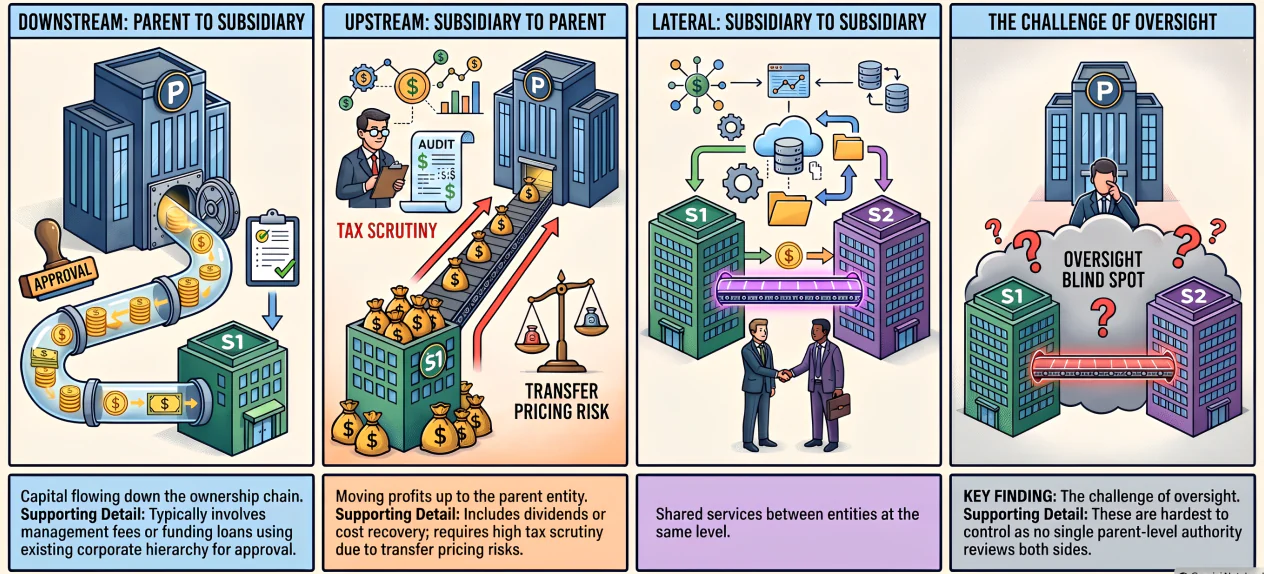
Beyond the transaction category, the direction of the relationship also shapes who approves it and how closely it gets reviewed.
1. Downstream transactions (parent to subsidiary)
A downstream transaction flows from the parent entity to a subsidiary, such as a management fee or a funding loan charged down the ownership chain.
Approval usually follows the existing corporate hierarchy, since the parent already holds authority over the subsidiary's operations and reporting.
2. Upstream transactions (subsidiary to parent)
An upstream transaction flows the other way, such as a subsidiary paying a dividend or recovering a cost from the parent entity.
These deserve closer transfer pricing attention, since profit moving up the chain is exactly the pattern tax authorities review most carefully.
3. Lateral transactions (subsidiary to subsidiary)
A lateral transaction sits between two subsidiaries at the same level, such as a shared-service charge between sister companies.
These are often the hardest to control, because no single parent-level authority automatically reviews the transaction on both sides.
The Intercompany Accounting Lifecycle
A transaction moves through recording, matching, reconciliation, and settlement before group finance receives it for consolidation.
1. Record: capturing the transaction in both entities
The initiating entity identifies the legal counterparty and selects the correct transaction type, including an invoice reference, currency, and service period.
The counterparty entity then records the reciprocal entry. Some systems can propose the corresponding entry, but both entities still need proper review.
2. Match: pairing corresponding entries across entities
Matching compares fields such as entity, counterparty, amount, and period. Exact matches proceed, while differences enter an exception queue, increasingly flagged by AI-assisted accounting controls for review.
3. Reconcile: resolving mismatches, cut-off, and coding differences
Finance teams investigate whether an exception arose from timing, an incorrect amount, duplicate posting, or a disputed allocation. Each exception needs an owner and a target resolution date.
4. Settle: netting and clearing intercompany balances
Entities may settle balances individually, use an approved netting process, or carry them under agreed terms. Cross-border cash movements typically need treasury and tax review.
Once balances are matched and approved, group finance receives a reliable package for consolidation, with mappings identifying accounts for elimination. This works best when ERP go-live planning already accounts for this ownership model.
Intercompany Journal Entries: A Worked Example
The examples below are deliberately simplified and use Australian dollars. Actual account names and recognition policies depend on the group's approved accounting framework.
1. Due to and due from accounts
A due from account is the receivable recorded by the entity expecting payment. A due to account is the payable recorded by the entity that owes the amount.
If Entity A reports A$11,000 due from Entity B but Entity B reports only A$10,000 due to Entity A, that difference must be investigated before elimination.
2. Worked example: Entity A charges a management fee to Entity B
Assume Entity A Pty Ltd charges Entity B Pty Ltd an illustrative A$10,000 management fee. This simplified example excludes GST to keep the reciprocal mechanics clear.
| Entity | Debit | Credit |
|---|---|---|
| Entity A Pty Ltd | Due from Entity B: A$10,000 | Management fee income: A$10,000 |
| Entity B Pty Ltd | Management fee expense: A$10,000 | Due to Entity A: A$10,000 |
At group level, the internal income and expense are candidates for elimination, along with the reciprocal receivable and payable if still outstanding at reporting date.
3. Worked example: intercompany loan
Assume Entity A advances A$500,000 to Entity B under a documented loan agreement.
| Event | Entity A entry | Entity B entry |
|---|---|---|
| Initial advance | Debit loan receivable A$500,000; credit cash A$500,000 | Debit cash A$500,000; credit loan payable A$500,000 |
| Interest accrual | Debit interest receivable; credit interest income | Debit interest expense; credit interest payable |
The interest amount should follow the documented terms, with data covering the lender, borrower, currency, rate, and maturity date all supporting reconciliation.
Caution:
Caution:
Caution: These examples illustrate process mechanics only. Professional review may be required for GST, transfer pricing, withholding, financing terms, and classification.
Keeping these entries mapped correctly starts with consistent chart of accounts mapping across every entity in the group.
How Do Reconciliation and Elimination Affect the Financial Close?
Reconciliation compares the corresponding records of participating entities and resolves differences. Elimination then removes internal balances when the group consolidates.
| Attribute | Reconciliation | Elimination |
|---|---|---|
| Purpose | Make ledgers agree or explain differences | Remove internal activity from group reporting |
| Typical owner | Entity finance or shared services | Group finance or consolidation team |
| Timing | Before or during the close | During consolidation |
| Output | Matched, disputed, or explained items | Elimination journals and adjusted results |
1. What intercompany reconciliation resolves
Common statuses include matched, unmatched, disputed, pending approval, and FX variance. Typical exceptions arise when one entity posts in June and the other in July, or when entities translate currency at different rates.
2. What elimination does
Elimination entries address reciprocal receivables and payables, internal income and expenses, according to the facts and consolidation policy. Inventory transfers may also create internal profits requiring separate treatment.
3. Why unreconciled balances delay the close
- Entities complete cut-off and submit balances
- Finance matches reciprocal accounts and transactions
- Owners investigate and approve exceptions
- Controllers confirm balances for the consolidation package
- Group finance posts and reviews eliminations
When step three remains unresolved, the consolidation team may lack dependable inputs and needs late adjustments under time pressure.
"A due from balance that does not match its due to counterpart is not a rounding error. It is a signal that someone needs to look at the transaction before it reaches consolidation."
Common Challenges in Intercompany Accounting
Four risk families cause most intercompany problems: incomplete recording, inconsistent data, currency differences, and weak approval controls.
1. One-sided entries and unmatched balances
A one-sided entry usually means the counterparty was never notified or no reciprocal workflow exists. The fix is generating a linked entry or acknowledgement task automatically, with resolution stored against the transaction rather than in email.
2. Different cut-off dates and entity coding
Entities closing on different schedules, or using incomplete counterparty codes, create mismatches that look like errors but are really governance gaps. Publishing group cut-off rules and governing master data resolves most of these before they surface.
3. FX timing differences in multi-currency groups
When entities use different rates, sources, or translation dates, the reciprocal balances stop matching even though both sides recorded correctly. Defining rate rules centrally and routing variances for review keeps this from becoming a recurring dispute.
4. Disputed cost allocations between entities
A disputed recharge often means the allocation basis was never approved in the first place. Storing agreements, calculations, and approvals with the transaction gives both entities a record to point back to.
Exception count alone does not explain risk. Teams should also monitor ageing, value, and whether an item blocks another close activity, which is easier with connected system architecture rather than a standalone spreadsheet.
Intercompany Accounting in Australia
Australian groups may need to consider AASB requirements, IFRS-aligned policies, related-party disclosures, and ATO transfer pricing obligations. These areas require adviser confirmation.
1. AASB and IFRS treatment for related-party transactions
AASB 10 sets the Australian standard for consolidated financial statements, including elimination of intragroup assets, liabilities, and income, while AASB 124 covers related-party disclosures, including outstanding balances.
These standards do not replace transaction-level analysis. Finance teams should maintain relationships, classifications, and mappings in a form that supports professional review.
2. ATO transfer pricing obligations for related-party dealings
Cross-border related-party dealings may attract ATO transfer pricing rules and documentation requirements, so groups should confirm obligations with qualified tax advisers.
Systems should retain the parties, agreement, and pricing basis, since software can preserve evidence and apply configured rules, but it does not determine whether a price is compliant.
3. Shared-service centres, holding companies, and multi-entity AU groups
A holding company, operating subsidiaries, and a shared-service entity may each play different roles, with the shared-service entity often incurring costs before allocating them out.
Process design should identify which entity initiates each transaction type, who owns the supporting agreement, and which mappings group finance needs for disclosure and consolidation.
Governance and Best Practices
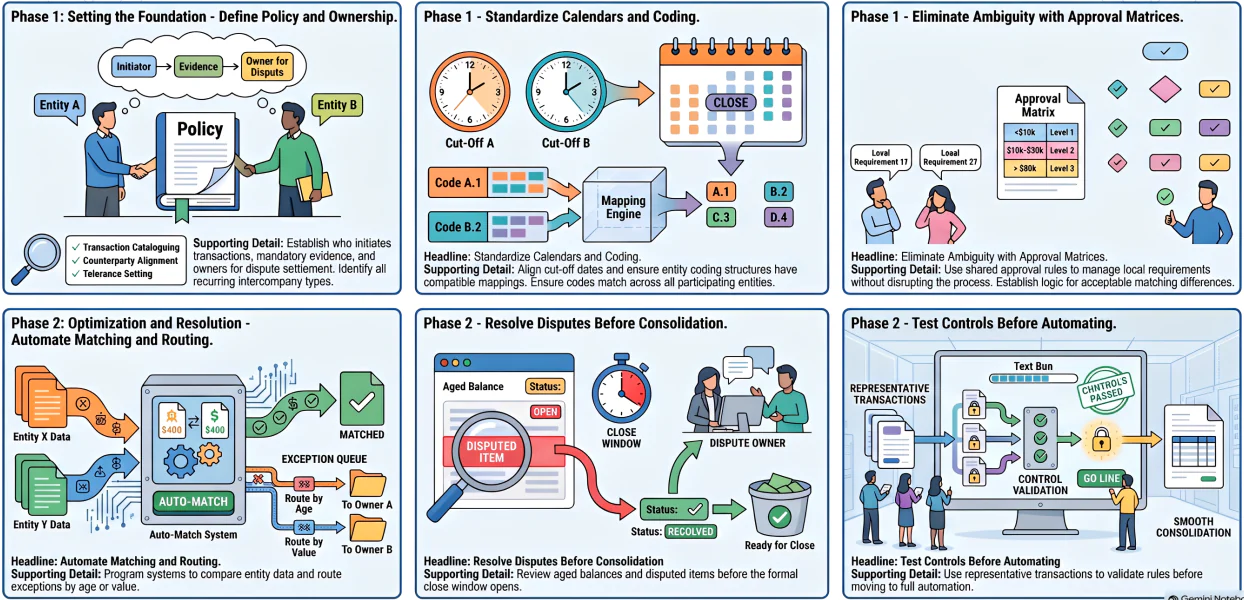
Technology becomes more effective after entities agree on ownership, master data, cut-off, and the evidence required to close an exception.
1. Setting an intercompany policy and clear ownership
Define which transactions enter the intercompany process, who initiates them, and what evidence is mandatory. The policy should also assign owners for disputes and settlement.
2. Standardising cut-off, coding, and approval
Entities do not need identical structures, but they need compatible mappings. A common close calendar and approval matrix removes ambiguity while allowing local requirements where necessary.
3. Automate matching and escalate unresolved differences
Automation can compare entity, counterparty, amount, and period, then route exceptions by value, age, and responsible entity. It is only useful when teams can explain the rules behind it.
4. Resolving disputes before they delay consolidation
A central register showing open balances, owners, and approval status can begin as a controlled process register before larger volumes justify full system integration.
- Catalogue recurring intercompany transaction types and participating entities
- Assign an accountable owner to each transaction and exception
- Align counterparty codes, account mappings, and cut-off rules
- Define supporting documents and approvals for each category
- Establish matching logic, tolerances, and exception statuses
- Review aged and disputed balances before the formal close window
- Confirm consolidation mappings and elimination responsibilities
- Test controls using representative transactions before automating them
A dependable audit-ready record is what turns this checklist into evidence an auditor can actually rely on.
How Multi-Entity ERP Automates Intercompany Accounting
ERP software supports intercompany accounting through governed entity data, linked transaction records, automated matching, and consolidated reporting inputs, reinforcing a reviewed process rather than automating unresolved policies.
A multi-entity ERP helps finance and IT teams maintain consistent counterparty identifiers, route approvals across legal entities, and present balances by entity pair, currency, and reconciliation status.
Instead of digging through dashboards for the answer, finance teams can simply ask. See how Hashy AI turns that question into an instant response below.






Before configuring automation, assess readiness across four areas:
- Process: transaction types, cut-off rules, and settlement methods are documented
- Data: legal entities, counterparties, and tax settings are governed
- Ownership: finance, treasury, and IT responsibilities are explicit
- Technology: integrations, security roles, and reporting outputs are understood
An ERP project may expose historic data problems, so representative data cleansing should be part of implementation.
Reliable results also depend on connected finance systems that keep procurement, banking, and consolidation data flowing without manual re-entry.
Conclusion
Reliable intercompany accounting depends on both sides of every transaction being identifiable, supported, and accountable. Reciprocal balances must be matched before group finance can prepare dependable eliminations.
Start by identifying where differences originate: policy, ownership, master data, cut-off, or software functionality. Then standardise the process before expanding automation.
If spreadsheets or repeated close adjustments are limiting visibility, book a free consultation with HashMicro to map your entities and reconciliation controls.

Frequently Asked Questions About Intercompany Accounting
Intercompany accounting records transactions between separate legal entities in the same corporate group, then reconciles both sides so group finance can prepare consolidated reports. For example, if Entity A Pty Ltd provides IT support to Entity B Pty Ltd, Entity A records a receivable and Entity B records the matching payable.
Due from is the receivable recorded by the entity expecting payment, while due to is the payable recorded by the entity that owes payment. The balances should mirror each other for the same counterparty, amount, currency, and reporting date.
Intercompany reconciliation compares entity ledgers and resolves timing, amount, coding, foreign exchange, or approval differences. Elimination then removes confirmed internal balances and transactions from the consolidated group financial statements.
Australian groups may need to consider ATO transfer pricing rules for related-party dealings, especially cross-border arrangements. The requirements depend on the facts, so businesses should confirm their obligations with qualified tax advisers and current official ATO guidance.
ERP software can maintain shared entity and counterparty data, route approvals, match reciprocal entries, flag exceptions, handle configured FX rules, retain audit trails, and provide inputs for consolidated reporting. These capabilities work best after policies and ownership have been agreed.