









 Limited to 100 registrants
The average Australian recruiter now receives more than 250 applications per open role, a volume that has climbed sharply since 2023 as one-click applications on SEEK made manual screening unworkable.
AI in recruitment covers tools that screen, sort, schedule, and communicate at scale. In Australia, that also means navigating anti-discrimination law, the Privacy Act 1988, and Fair Work record-keeping obligations few vendor pitches address upfront.
Key Takeaways
AI in recruitment spans a wide range of technologies with very different risk profiles.
Australia's employment discrimination laws do not carve out an exception for AI.
AI applies at multiple stages of the hiring process, from before a role is posted through to a new hire's first week.
Before deploying any AI in recruitment, these are the questions every Australian employer should be able to answer.
What AI in Recruitment Covers
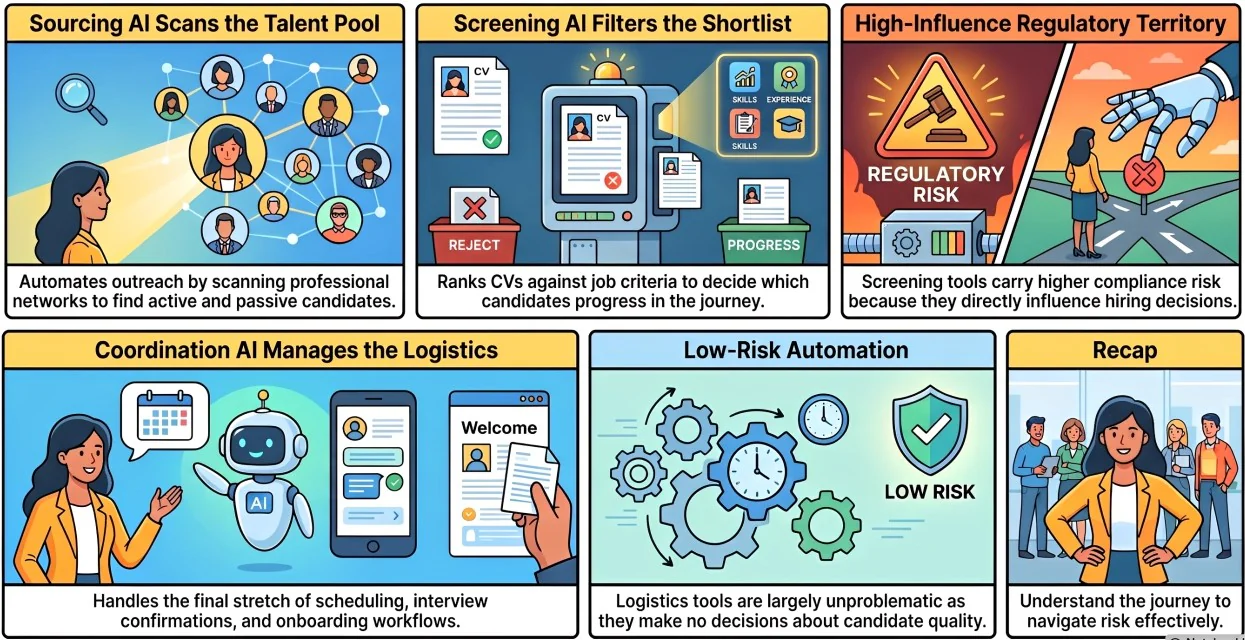
AI in recruitment spans a wide range of technologies with very different risk profiles. Understanding how AI for HR is applied and which category a tool falls into is the starting point for any due diligence.
- Sourcing AI scans job boards, LinkedIn, GitHub, and professional networks to identify candidates who match a role, including people who have not applied. It automates initial outreach and follow-up sequences at scale.
- Screening AI reads and ranks applications, matches CVs against job criteria, and produces shortlists. Some tools also analyse job ad language before a role is posted.
- Coordination AI handles scheduling, interview confirmations, reschedules, and onboarding workflows once a hire decision is made. It manages logistics only and makes no decisions about candidates.
The distinction matters because each category carries a different compliance risk level. Scheduling automation is largely unproblematic. AI that influences whether candidates progress sits in different regulatory territory.
The Australian Compliance Framework for AI in Recruitment
Australia's employment discrimination laws do not carve out an exception for AI. The same HR compliance obligations that govern every other part of hiring apply here.
1. Anti-discrimination law
The Age Discrimination Act, Racial Discrimination Act, Sex Discrimination Act, and Disability Discrimination Act all apply to recruitment decisions, whether made by a person or generated by an algorithm.
An employer cannot use AI as a defence against a discrimination complaint. If a tool's screening eliminates candidates based on age, name, or background patterns, the employer remains fully liable.
2. AHRC and APSC guidance
The Australian Human Rights Commission recommends that employers disclose AI use in screening, and that no candidate be removed from consideration based solely on an automated decision.
The APSC requires human review before any final shortlist for Commonwealth employers. Many state government bodies now use this as a benchmark. See how human oversight in AI systems applies in hiring contexts.
3. Privacy Act obligations
Under the Privacy Act 1988 and the Australian Privacy Principles, AI-collected candidate data must be disclosed in a privacy policy and used only for the stated purpose.
Many SaaS recruitment tools store candidate data offshore by default, which needs addressing in vendor due diligence.The Fair Work Act s535 also requires recruitment records to be retained for seven years.
The core principle across every decision about AI in recruitment: if AI makes the decision, the employer is still liable.
"Using AI in recruitment does not transfer legal risk to the vendor. Australian employers remain accountable for every hiring outcome, automated or not."
How AI Is Used in Australian Recruitment: Six Use Cases
AI applies at multiple stages of the hiring process, from before a role is posted through to a new hire's first week. The compliance complexity and ROI profile vary significantly at each stage.
1. Resume screening and candidate shortlisting
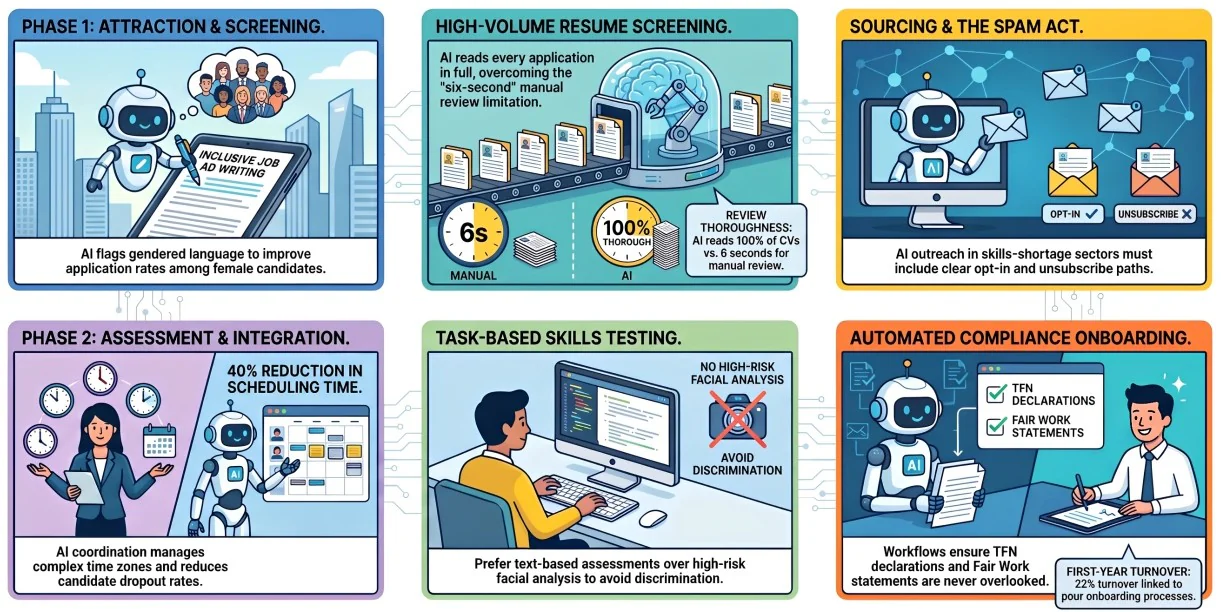
At 250-plus applications per role, manual review gives each CV roughly six seconds, leaving most candidates effectively invisible to a time-poor recruiter.
AI screening tools remove that ceiling by reading every application in full, rather than skimming based on time constraints alone.
2. Job ad writing and language optimisation
Job ad AI is the lowest-risk starting point. Tools flag gendered language, exclusionary phrasing, and reading level. WGEA research links words like "competitive" and "dominant" to lower female application rates.
The compliance picture is clean: AI assists, a human approves. For most Australian employers, this is the safest first step into AI recruitment tools.
3. Candidate sourcing and passive talent outreach
In Australian skills shortage sectors including tech, healthcare, trades, and engineering, sourcing AI is often used alongside broader recruitment processes to fill roles within a reasonable timeframe.
The Spam Act 2003 covers unsolicited commercial messages, and recruitment outreach falls within scope. Require opt-in language, a clear unsubscribe path, and human personalisation before sending.
4. Interview scheduling and coordination
This is the lowest regulatory complexity use case with the fastest ROI. Scheduling AI coordinates calendars, sends confirmations, and manages reschedules.
It makes no decisions about candidates. Greenhouse data shows scheduling AI cuts recruiter time by 30 to 40 per cent. The cross-timezone spread across Perth, Sydney, and remote areas adds friction. A slow scheduling process drives candidate dropout.
5. Skills assessment and testing
AI-administered assessments replace early-stage phone screens. Every candidate gets the same test, conditions, and criteria, which is meaningful for graduate programs and high-volume entry-level roles.
Facial and emotion analysis in video interviews is high-risk per AHRC. These tools create direct discrimination risk for neurodivergent, disabled, and ESL candidates. Prefer task-based or text-based assessments.
6. Onboarding automation
Post-offer Australian compliance obligations include the TFN declaration, superannuation choice form, and Fair Work Information Statement. Each has a set timeframe. Automated workflows make them impossible to overlook.
AHRI data shows 22 per cent first-year turnover in high-volume roles, with poor onboarding as a contributing factor. This is where payroll system integration and the broader HR stack connect to recruitment.
Australian Employer Compliance Checklist Before Using AI in Recruitment
Before deploying any AI in recruitment, these are the questions every Australian employer should be able to answer. This is a due-diligence starting point, not an exhaustive legal checklist.
| Compliance Area | What to Verify | Australian Framework |
|---|---|---|
| Candidate disclosure | Are candidates informed that AI is used at each stage of the process? | Anti-discrimination law; AHRC guidance |
| Bias testing | Has the vendor conducted independent bias testing on Australian recruitment populations? | Anti-discrimination law; AHRC guidance |
| Data privacy | Is candidate data stored in Australia or a jurisdiction with equivalent protections? | Privacy Act 1988 |
| Human review | Does a human review each rejection decision before it is communicated to the candidate? | Anti-discrimination law; AHRC guidance |
| Record keeping | Are AI shortlists, scores, and decisions logged through a clear audit trail and retained for seven years? | Fair Work Act 2009 |
| Video AI | Does the tool use facial expression or emotional analysis in any part of the assessment? | Anti-discrimination law; AHRC guidance |
| Consent | Does the consent clause cover third-party data sharing for matching or benchmarking? | Privacy Act 1988 (APPs) |
The Fair Work Act requires recruitment records to be retained for seven years. AI tool decisions, shortlists, and candidate data all qualify, and they need an Australian data residency guarantee, not just vendor cloud storage.
If an AI tool shares candidate data with third parties, explicit consent is required under the Australian Privacy Principles. A vendor unable to answer questions about bias testing or data storage is a red flag.
Standalone AI Recruitment Tools vs Integrated HRIS
Most Australian employers adopt AI in recruitment by adding tools to an existing stack. Each solves a specific problem but also creates a new data silo, and those silos carry compliance risk.
| Candidate data flow | Compliance tracking | Job-band/budget validation | Analytics | Cost structure | |
|---|---|---|---|---|---|
| Standalone AI Recruitment Tool | Separate system; manual export to HRIS required | Manual; relies on HR team to flag each obligation | Not connected to payroll or approved headcount | Recruitment metrics only; no downstream visibility | Per-seat or per-hire fee on top of existing HRIS costs |
| Integrated HRIS + AI | Single candidate record from application through onboarding | Automated triggers for TFN forms, superannuation, and Fair Work documents | Validated against approved salary bands and headcount | End-to-end from sourcing through to retention | Included in unified platform licence |
Manual handoffs between recruitment and onboarding raise the risk of TFN declarations or superannuation choice forms being missed or delayed past the legal window. Each handoff is where errors occur.
For many Australian employers, the first move is evaluating whether current recruitment tech can pass data to an integrated HRIS without manual re-entry.
How HashMicro Supports AI-Connected Recruitment and Onboarding
HashMicro's HR module connects recruitment, onboarding, payroll, and performance management in one system, so a hire decision triggers the onboarding checklist and payroll setup without manual re-entry.
Within that connected environment, an AI agent for HR can flag upcoming compliance deadlines, surface candidate and onboarding status, and answer routine HR questions on request, instead of a manager tracking each one manually.
For Australian employers, TFN declarations, superannuation choice forms, and Fair Work Information Statements are tracked with timestamps automatically, rather than depending on a manager remembering each one.
Conclusion
AI recruitment tools are a standard part of hiring in Australia, not a future consideration. The compliance obligations, from disclosure through to data residency, apply regardless of which tool a team adopts.
HashMicro connects recruitment, onboarding, and payroll in one compliant system. Book a free consultation to see how it fits your workflow.
FAQ
AI in recruitment refers to software that automates parts of the hiring process, including screening CVs, ranking candidates, scheduling interviews, and triggering onboarding steps. It ranges from low-risk scheduling tools through to higher-risk screening algorithms that influence which candidates progress.
The main risks are discrimination liability, privacy breaches, and record-keeping failures. AI tools trained on historical data can reflect past biases and eliminate candidates based on age, name, or background. Under Australian anti-discrimination law, the employer, not the AI vendor, remains liable for every hiring outcome.
Yes, but with significant obligations. Australian employers must disclose AI use to candidates, ensure human review before any rejection, store candidate data in a compliant jurisdiction, and retain recruitment records for seven years under the Fair Work Act. No candidate should be eliminated based solely on an automated decision.
No. AI can automate screening, scheduling, and administrative workflows, but candidate assessment and final hiring decisions still require human judgment. Both the AHRC and APSC specify that human review must occur before any shortlisting decision is finalised.
The lowest-risk starting point is job ad language optimisation, which flags gendered or exclusionary phrasing before a role is posted. Scheduling automation offers fast ROI with minimal compliance risk. Higher-risk tools like CV screening should be introduced only after reviewing a vendor's bias testing methodology and data storage arrangements.
At 250-plus applications per role, manual review gives each CV roughly six seconds, leaving most candidates effectively invisible to a time-poor recruiter.
AI screening tools remove that ceiling by reading every application in full, rather than skimming based on time constraints alone.