









 Limited to 100 registrants

When one delivery record is missing the recipient, timestamp or order reference, your team may need to reconcile sales orders, carrier scans and customer emails by hand.
Proof of delivery is the record that confirms goods reached the intended recipient or agreed delivery location, and it isn't limited to a paper signature.
This guide explains what a reliable POD record should contain, compares four common evidence types, and distinguishes POD from proof of shipment and a bill of lading.
Key Takeaways
Proof of delivery confirms receipt, while proof of shipment confirms dispatch or carrier handover.
A reliable POD record connects delivery evidence with the sales order, customer, timestamp, location and exception notes.
The right POD type depends on delivery risk, recipient availability, goods value, connectivity and privacy requirements.
Digital POD works best when it supports exception management and finance workflows rather than sitting in a separate file store.

What Is Proof of Delivery and What Problem Does It Solve?
Proof of delivery is a record confirming goods reached the recipient or agreed location. A useful record identifies the delivery, recipient, time, location, and evidence used to confirm completion.
Consider a wholesaler sending a pallet from its Melbourne warehouse to a regional customer. The event isn't fully useful if the system only says "delivered", each team needs different detail from the same record.
A POD record helps answer four practical questions: was the correct order delivered, who accepted it, when and where, and were there shortages, damage, or other exceptions.
The evidence can be captured by a driver, carrier, warehouse employee, or recipient, and the right combination depends on the goods, environment, and dispute risk involved. POD becomes more valuable once it connects to the rest of the order-to-cash process.
What Information Should a Proof of Delivery Record Include?
At minimum, a POD record should include a delivery reference, order or invoice reference, recipient, location, date, item details, evidence type, and exception notes that support effective delivery management.
| Field | Why it matters | Likely owner |
|---|---|---|
| Delivery reference | Unique identifier for reconciliation | Operations and IT |
| Sales order or invoice reference | Connects evidence to order-to-cash activity | Finance |
| Recipient name | Shows who accepted the goods | Customer service |
| Delivery address or location | Confirms the agreed destination | Operations |
| Item, quantity, or carton details | Supports shortage investigation | Warehouse |
| Exception notes | Explains damage or unattended placement | Driver or service teams |
A metro delivery may only need a recipient name and electronic signature. A regional or unattended delivery may need a photo, timestamp, and a note explaining where goods were left.
To assess your current POD record, review a sample of recent deliveries and count how many are missing a reference, recipient, timestamp, or exception note as an internal discovery metric.
What Are the 4 Types of Proof of Delivery?
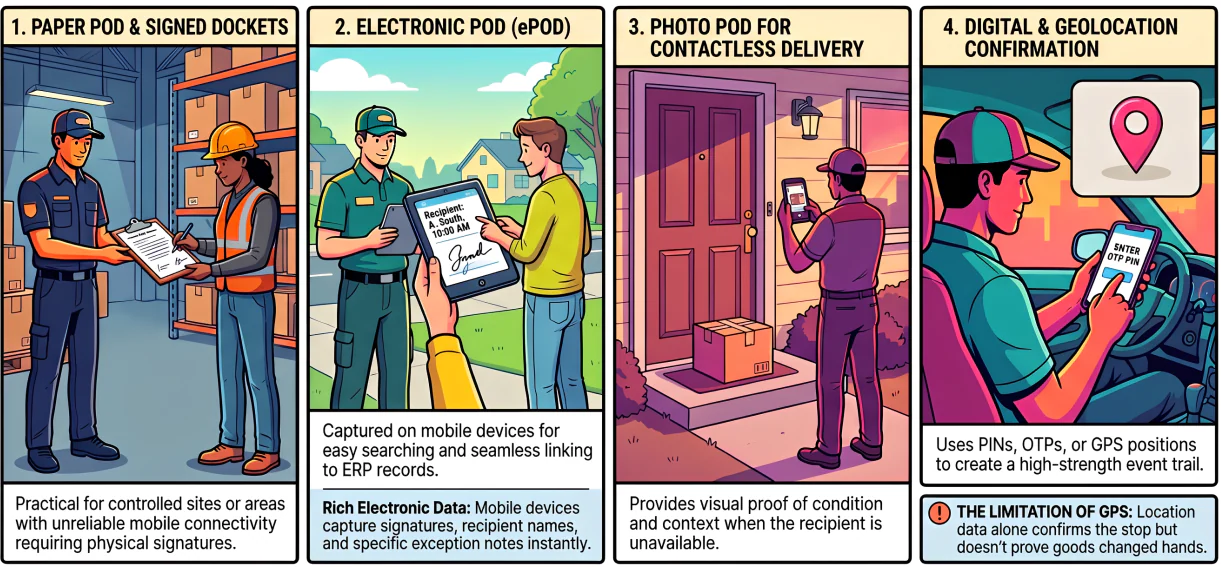
Each POD type supports a different combination of recipient availability, delivery risk, connectivity, and privacy requirements.
1. Paper POD and signed delivery dockets
Paper POD remains practical on controlled sites where recipients sign documents or connectivity is unreliable, though staff still need to scan or manually enter the record afterward.
2. Electronic POD captured on a mobile device
Electronic POD can capture a signature, recipient name, quantity, and exception note on a mobile device, and it's usually easier to search and link to an ERP record.
3. Photo POD for unattended or contactless delivery
Photo POD is useful when no recipient is available, showing the condition and context of the drop-off, especially for replacement parts or building materials left at a loading bay.
4. Digital confirmation: PIN, OTP, scan, or geolocation
A PIN, one-time code, scan event, or GPS position can strengthen the event trail, but location data alone doesn't prove the correct goods actually changed hands.
Why Does Proof of Delivery Matter for Australian Businesses?
Proof of delivery gives Australian teams a shared record for confirming receipt, resolving disputes, and deciding what downstream action is appropriate.
1. Faster invoicing and fewer payment delays
A policy might allow standard invoices to proceed once required fields are complete, supporting accounts receivable processing while placing damaged or disputed deliveries into a review queue instead.
2. Resolving short-delivery, damage, and non-delivery claims
A complete POD lets the team check recipient, location, and exception notes, so a partial delivery gets investigated instead of treating the whole order as unresolved.
3. Meeting customer and contract delivery obligations
Some contracts specify delivery windows, site access rules, or acceptance criteria, and POD evidence is what confirms those obligations were actually met on the day.
4. Supporting audit trails and internal accountability
Managers can review recurring exceptions by route, carrier, or customer site, and identify whether staff are missing fields because a form is too long or connectivity is poor.
5. Multi-state deliveries, third-party carriers, and long transit routes
A shipment crossing several states or handed to a subcontracted carrier passes through more hands, so a consistent reference matters more the longer the route runs.
Australian businesses should track their own operating measures rather than assume an industry benchmark applies:
- Disputes per 1,000 deliveries to spot recurring patterns early.
- Average time to retrieve a POD when a customer calls in.
- Invoice holds caused specifically by missing delivery evidence.
- Percentage of deliveries with all mandatory fields complete.
How Is Proof of Delivery Different From Proof of Shipment and a Bill of Lading?
These three documents describe different events and shouldn't be treated as interchangeable when a dispute needs resolving.
| Document | Event recorded | Likely users |
|---|---|---|
| Proof of shipment | Goods dispatched or handed to a carrier | Warehouse, dispatch |
| Bill of lading | Freight accepted under transport terms | Shipper, carrier, consignee |
| Proof of delivery | Goods reached the recipient or destination | Customer service, finance |
1. Proof of delivery confirms goods were received
POD answers whether the delivery was completed and whether any exceptions occurred, which is the specific question customer service and finance actually need answered during order fulfilment.
2. Proof of shipment confirms goods left your facility
A carrier scan showing a consignment left the warehouse is not proof of delivery, it only confirms the sender released the shipment for transport.
3. Bill of lading as a transport contract and title document
A bill of lading supports the transport record without confirming the customer actually received every carton in acceptable condition at the destination.
4. Delivery confirmation vs proof of delivery
A carrier status showing "delivered" is a delivery confirmation, not full POD, unless it also carries recipient, quantity, and exception detail behind it.
5. Which document to use in a dispute
A construction supplier investigating a shortage should follow the same reference across the purchase order, consignment, bill of lading, and site delivery confirmation.
Which POD Evidence Type Fits Each Delivery Scenario?
The best evidence type depends on goods value, recipient availability, connectivity, and privacy obligations at the point of delivery.
1. Attended B2B delivery to a warehouse or site
A digital signature with recipient name and quantity check captures acceptance and item detail in one event, provided the person is actually authorised to accept the order.
2. Unattended or contactless residential delivery
Photo POD with timestamp and location context shows where goods were placed, though photography permissions and approved drop points still need confirming beforehand.
3. High-value, controlled, or serialised goods
A signature combined with photo or scan evidence provides stronger context for a disputed handover, useful for anything expensive enough to justify the extra step.
4. Bulk, palletised, or partial deliveries
Partial deliveries need carton or pallet counts recorded against the original order, so the outstanding balance stays visible instead of getting marked complete by mistake.
5. Third-party carrier and subcontracted deliveries
When a subcontracted carrier handles the final leg, confirm which system captures evidence and how it flows back to your own delivery reference without a manual step.
6. Choosing the evidence level by risk and value
Use current operational data, unattended-delivery percentage, high-value order volume, and recurring dispute categories, to decide where extra evidence is worth the friction.
"A GPS ping tells you a vehicle was near an address. It does not tell you whether the right pallet, in the right condition, actually changed hands."
How Can You Build a Reliable Digital POD Process?
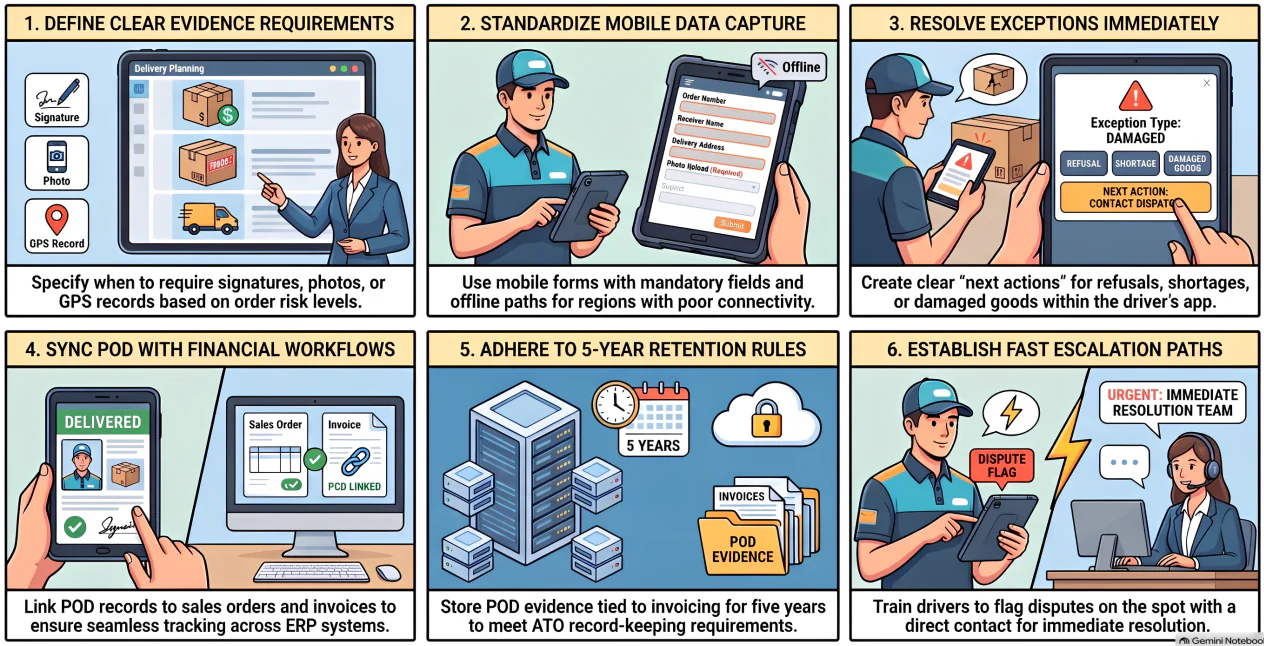
A reliable digital POD process links each delivery to an order, captures approved evidence, and makes records available to authorised teams with a clear audit trail.
1. Define what counts as acceptable proof for each delivery type
Specify when a signature, photograph, location record, or condition note is required, without making every delivery form unnecessarily long for low-risk orders.
2. Standardise capture at the point of handover
Mobile forms should support the required fields, clear exception options, and an offline path where regional connectivity drops out mid-delivery.
3. Handle exceptions: refusals, shortages, and damaged goods
Partial delivery, refusal, and visible damage should each create a clear next action and owner, rather than sitting unresolved in a driver's notes.
4. Link POD records to delivery orders and invoices
Carry a consistent sales order or delivery reference into the driver, carrier, ERP, and finance workflows so nobody has to guess which records belong together.
5. Set storage, retention, and retrieval rules
Under ATO record-keeping rules, most business records need retention for five years, and POD evidence tied to invoicing should follow the same discipline.
6. Train drivers and set the escalation path
Drivers need a clear, fast way to flag a refusal or dispute on the spot, with an obvious escalation contact rather than a note that surfaces days later.
What Should You Review When a Delivery Is Disputed?
A structured review keeps a dispute from turning into a drawn-out back-and-forth between customer service, operations, and the customer.
1. Retrieve the POD record and delivery order
Start from the delivery reference and pull the full record alongside the original order before contacting the customer or the carrier.
2. Check recipient identity and authority to receive
Confirm the name on the record matches someone actually authorised at that site, not just any person who happened to be present.
3. Compare items and quantities against the dispatch record
Match what left the warehouse against what the POD shows arrived, since a mismatch here often points to where the shortage actually happened.
4. Review timestamp, location, and photo evidence
Check whether the timing and location are consistent with the delivery route, and whether any photo evidence actually supports the claim being made.
5. Check exception notes and driver comments
Driver notes often explain context a customer never sees, such as a locked gate or an alternative drop point agreed on the day.
6. Decide the outcome and record the resolution
Document the decision against the same delivery reference, so the next person reviewing the account sees the full history in one place.
7. Turning recurring disputes into process fixes
If the same route, carrier, or product keeps generating disputes, that pattern is worth fixing at the source rather than resolving case by case.
How HashMicro Supports Delivery Records and POD Control
An ERP-led process can provide the shared reference point while preserving specialist carrier, warehouse, or mobile capture tools already in place.
An ERP system for centralising order and delivery records can hold the sales order and invoice status, while CRM software lets service teams work from the same delivery history when a customer calls.
Businesses should also confirm delivery obligations against the Australian Consumer Law requirements that apply to their goods and services before finalising a POD policy.
Conclusion
Proof of delivery is only useful when it connects to the order, the customer, and the exception process your business actually follows day to day.
The goal isn't collecting the maximum data on every delivery. It's collecting enough reliable evidence to support the decisions your business makes, and making it available where those decisions happen.
If delivery evidence is fragmented across carriers and inboxes, discuss your ERP requirements with HashMicro's team to map a more controlled process.

Frequently Asked Questions
Mandatory fields commonly include the order or delivery reference, recipient, address or location, date and time, evidence type, item details and exception notes. They should match the organisation’s invoicing, customer-service and retention rules.
No. A bill of lading is generally tied to freight handover and transport documentation, while proof of delivery supports confirmation that goods reached the recipient or agreed destination.
Photo POD with timestamp and location evidence often gives clearer context for unattended delivery. Privacy rules, customer consent, site restrictions and item value should guide the final requirement.
Digital POD can store evidence centrally, link it to orders and invoices, and make records available to authorised service, operations and finance teams. It does not automatically eliminate disputes.
POD can support a legal or contractual position, but its weight depends on what evidence it contains and how it was captured. Businesses with high-value or disputed deliveries should confirm requirements with a legal adviser.
Retention periods depend on invoicing, contractual and tax obligations. Many Australian businesses align POD retention with broader record-keeping rules, which commonly require five years for tax-related records.
Without POD, a business has less evidence to resolve a dispute, support an invoice, or confirm a contractual obligation was met, which usually means a slower, less certain outcome for both sides.