





Paying a supplier invoice should confirm more than the amount shown on the bill. Accounts payable needs evidence that the purchase was authorised, the goods were received and the supplier charged the agreed price. This control is known as 3-way matching.
Three-way matching compares a purchase order, a goods receipt note and a supplier invoice before payment is approved. When the important details agree, the invoice can move forward. When they do not, it is held for review.
The process helps Australian businesses detect quantity, price and tax discrepancies before they affect cash flow or financial records.
Key Takeaways
Three-way matching verifies invoices by comparing the purchase order, goods receipt, and supplier invoice before payment.
Understanding the differences between 2-way, 3-way, and 4-way matching helps businesses choose the right invoice verification process.
Three-way matching reduces payment errors and strengthens financial controls, while automation makes the process faster and more efficient.
What Is 3-Way Matching in Accounts Payable?
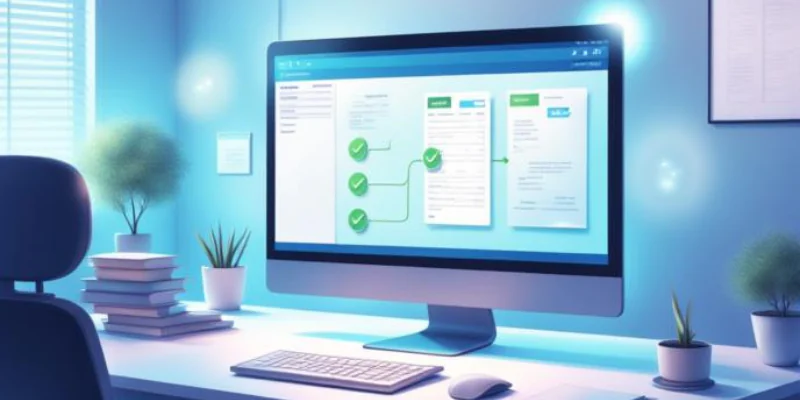
Three-way matching in accounts payable processes checks that a supplier invoice matches an approved purchase order and a goods receipt note. It is done before an invoice is approved for payment.
The purchase order confirms what was ordered, the goods receipt note confirms what was received, and the supplier invoice shows the amount to be paid.
The system compares key details like the supplier, items, quantities, prices, and taxes. If they match, the invoice can be approved for payment.
How Does the Three-Way Matching Process Work?
The three-way matching process follows a purchase from authorisation to payment.
Create and approve the purchase order:
The purchase order records the supplier, items, quantities, prices and terms authorised by the business.Record the delivery:
Receiving staff check the shipment and create a goods receipt note for the quantities accepted. They should also record partial, damaged or rejected items.Receive the supplier invoice:
Accounts payable captures the invoice number, line items, GST, total amount and payment due date.Compare the three records:
The business checks using accounting tools available in Australia that the invoice relates to the correct purchase order and that the billed quantities and prices are supported by the order and receipt.Approve or hold the invoice:
A matched invoice proceeds through the payment approval workflow. A mismatch is held and assigned to the person responsible for resolving it.
Practical Three-Way Matching Example
Here's a simple example of three-way matching.
A business orders 100 units at A$50 each. The supplier delivers all 100 units, and the invoice also charges for 100 units. Since the purchase order, goods receipt, and invoice all match, the invoice can be approved for payment.
If only 80 units are delivered but the invoice charges for 100 units, the invoice is put on hold or adjusted until the missing 20 units are confirmed. This helps prevent overpayments.
"Accurate matching is the foundation of accurate payments."
What Happens When the Documents Do Not Match?
A mismatch does not always mean there is fraud or a supplier error. It simply means the issue needs to be reviewed before payment is approved.
The person responsible depends on the type of mismatch. For example, procurement handles price differences or missing purchase orders, receiving teams check quantity differences or partial deliveries, and accounts payable reviews GST errors, duplicate invoices, or requests corrected invoices from the supplier.
Once the issue is resolved, the invoice can be updated, approved, or held until the correct information is provided. This helps prevent payment errors while keeping the approval process accurate.
How matching tolerances work
A matching tolerance allows small differences between documents without requiring manual review. It can apply to minor changes in price, quantity, freight, or tax.
The right tolerance depends on the business, transaction value, and supplier risk. High-value purchases often require an exact match, while lower-value purchases may allow small differences.
Businesses should clearly define and regularly review their tolerance rules. Any approved difference should also be recorded in the audit trail for future reference.
2-Way vs 3-Way vs 4-Way Matching
The correct matching method depends on what the business needs to verify before releasing payment.
| Method | Documents Used | Best For |
|---|---|---|
| 2-Way Matching | Purchase order + Invoice | Services and low-risk purchases |
| 3-Way Matching | Purchase order + Goods receipt + Invoice | Inventory and physical goods |
| 4-Way Matching | Purchase order + Goods receipt + Inspection record + Invoice | High-value or quality-sensitive purchases |
Using more documents is not automatically better. Applying four-way matching to routine office supplies could add work without reducing a meaningful risk.
Conversely, relying only on two-way matching for inventory could allow the business to pay for goods that have not arrived. The control should match the nature and risk of the purchase.
Benefits and Limitations of Three-Way Matching
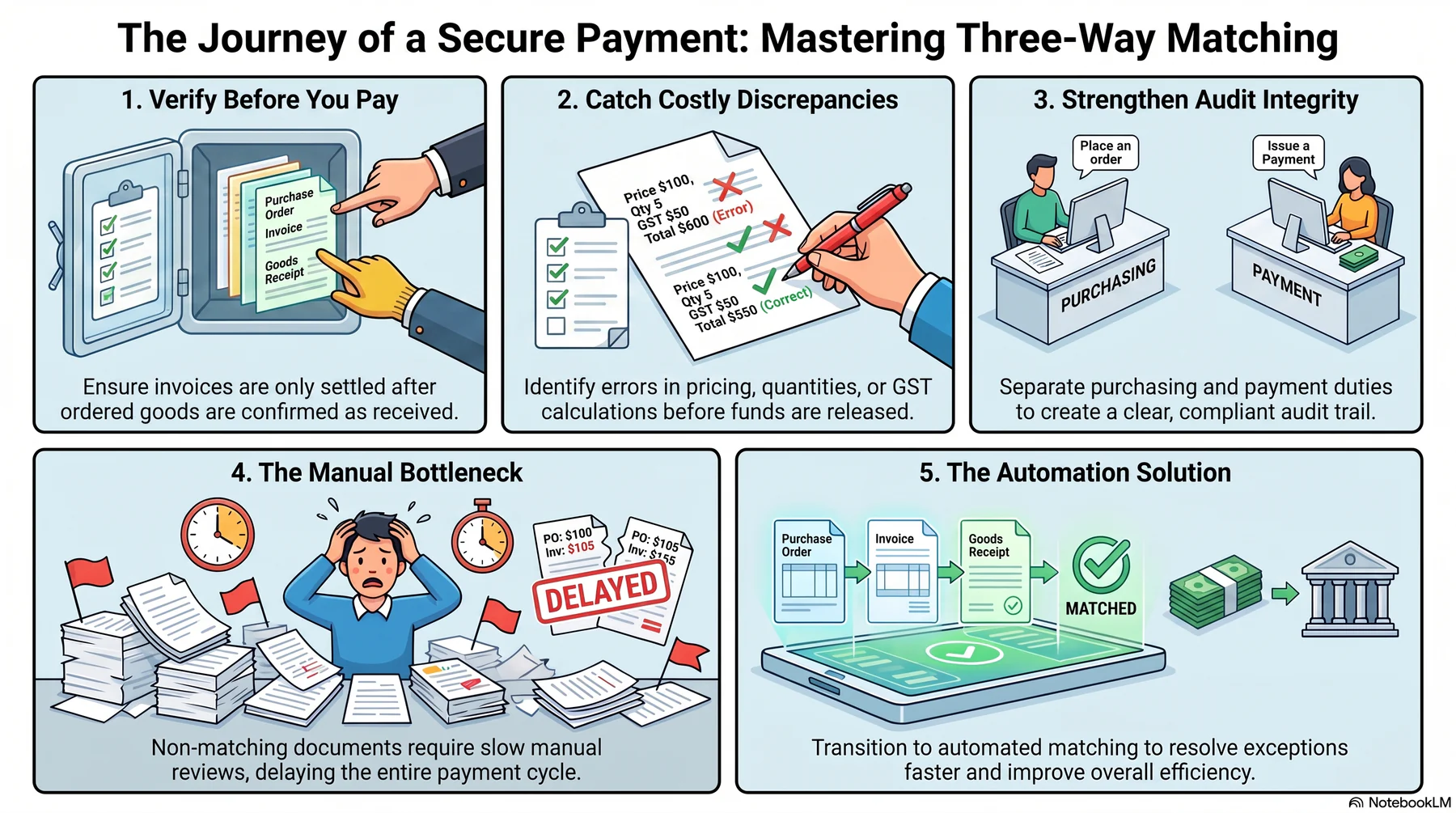
Three-way matching helps businesses improve payment accuracy and reduce financial risk. However, it also has some limitations, especially when handled manually.
1. Prevent Payments for Undelivered Goods
Three-way matching ensures invoices are only paid after the ordered goods have been received, helping prevent overpayments.
2. Detect Invoice Errors
It helps identify errors such as incorrect prices, quantities, or GST before payment is approved.
3. Improve Segregation of Duties and Audit Evidence
The process separates purchasing, receiving, and payment tasks while creating a clear audit trail for compliance.
4. Manual Work and Exception Management
When documents do not match, manual reviews can slow the payment process. Automating three-way matching helps reduce delays and improve efficiency.
Manual vs Automated 3-Way Invoice Matching
Manual 3-way invoice matching usually requires accounts payable to locate the purchase order, retrieve the receiving record, compare each line, document any variance and contact another team.
This approach may work at low transaction volumes. However, relying on spreadsheets, shared folders and email makes it harder to apply consistent rules and maintain a complete history.
| Task | Manual Matching | Automated Matching |
|---|---|---|
| Data Entry | Enter invoice details manually | Pull data automatically |
| Document Matching | Compare documents by hand | Match documents automatically |
| Handling Errors | Review and follow up manually | Flag issues and route for approval |
| Partial Deliveries | Check quantities manually | Track received quantities automatically |
| Audit Trail | Gather records manually | Keep all records in one system |
Automation using modern accounting system should not approve every invoice without oversight. Its main purpose is to move routine matches through a consistent process while directing staff towards transactions that require judgement.
How connected accounting and procurement software helps
Three-way matching is faster and more accurate when purchasing, receiving, and accounts payable are connected in one system. Linked purchase orders, goods receipts, and invoices reduce manual work and make it easier to review payment requests.
Hashy, HashMicro's AI assistant, helps teams quickly find purchasing records, invoice details, and approval history. Together with HashMicro Accounting and Procurement Software, it gives reviewers the information they need to approve, hold, or correct invoices with confidence.






Best Practices for Australian Businesses
Australian businesses can improve three-way matching without making the process unnecessarily complicated by following these practices:
- Require suppliers to include the correct purchase order number.
- Record all goods received, including partial or damaged deliveries.
- Separate purchasing, receiving, and payment approvals where possible.
- Assign the right team to resolve invoice mismatches.
- Set and regularly review matching tolerance rules.
- Check GST details before approving invoices.
- Keep purchase, receipt, invoice, and approval records together for auditing.
The Australian Taxation Office states that a tax invoice is generally required to claim GST credits for purchases over A$82.50, including GST. The ATO also states that GST records generally need to be retained for 5 years from the date they were prepared or obtained, or from the date the related transaction was completed, whichever is later. Businesses should confirm how these requirements apply to their circumstances using current ATO tax-invoice and record-keeping guidance.
Conclusion
Three-way matching helps businesses ensure invoices match approved purchase orders and received goods before payment. This reduces errors and improves financial accuracy.
Automating the process makes invoice approvals faster, reduces manual work, and provides a clear audit trail for every transaction.
If you're ready to improve your accounts payable process, consult with our experts to discover how the right solution can streamline three-way matching for your business.
FAQ
Three-way matching is a process that compares a purchase order, goods receipt, and supplier invoice before an invoice is approved for payment.
Three-way matching uses a purchase order (PO), goods receipt note (GRN), and supplier invoice.
If the documents do not match, the invoice is put on hold until the issue is resolved.
No. It is mainly used for physical goods, while services often use two-way matching instead.