







 Limited to 100 registrants

LMS pricing in Australia can start from several dollars per learner each month. However, the licence rate rarely represents the complete cost.
Choosing a learning platform becomes difficult when vendors calculate charges differently. LMS pricing may depend on registered accounts, active learners, storage, feature tiers, implementation requirements, or a custom enterprise agreement.
Australian small and mid-sized businesses should compare the total cost over three years rather than relying on the advertised subscription alone. This approach reveals the financial impact of migration, integrations, administration, course content, support, and future growth.
Key Takeaways
LMS pricing includes subscriptions, implementation, migration, integrations, content, support, and internal administration costs.
The right pricing model depends on learner numbers, training frequency, workforce changes, and required cost certainty.
Storage limits, internal administration, contract renewals, and exit fees can increase the actual LMS cost.
A three-year calculation provides a more accurate comparison than monthly fees or advertised per-user prices.
How Much Does an LMS Cost in Australia?
"The cheapest LMS plan may not deliver the lowest overall cost. Compare subscriptions, implementation, integrations, support, and administration before choosing."
There is no standard LMS price because each platform serves different user volumes, training requirements, and support expectations.
Small businesses with straightforward employee development needs may use a self-service system, while larger enterprises often need custom integrations, reporting, security controls, and dedicated assistance.
Current public prices show how wide the range can be. MoodleCloud’s published plans range from USD 170 annually for 50 users to USD 2,100 annually for 750 users, although its support documentation states that subscriptions are invoiced in Australian dollars and local taxes may apply.
Meanwhile, TalentLMS publishes a starting price of USD 119 per month for up to 40 users when billed yearly. The platform calculates flexible plans according to the number of users who log in during the month.
These examples are not market averages or direct comparisons. They show why Australian businesses must check the currency, user definition, billing period, feature limits, and tax treatment behind every advertised figure.
A small self-service plan may cover standard course delivery and progress tracking. However, a mid-market deployment may also require data migration, single sign-on, custom reports, compliance content, technical integrations, and administrator training.
What LMS Pricing Models Are Available?

LMS vendors use several pricing structures, and each model responds differently as learner numbers change. Understanding how each structure works will help a business avoid paying for unused accounts or unexpected activity.
Per registered user: The vendor charges for every learner account stored in the system. This model provides predictable access but may become expensive when many registered users rarely complete training.
Per active user: The charge applies only to learners who access the LMS during a defined billing period. This option can suit companies with contractors, seasonal workers, or training campaigns that involve different groups each month.
Flat or tiered subscription: The business pays a fixed monthly or annual amount for a user bracket and feature package. Costs remain predictable until learner numbers or required capabilities exceed the selected tier.
Usage-based pricing: Charges depend on factors such as course enrolments, training hours, data storage, video streaming, or completed modules. This structure can work for occasional training but may fluctuate during busy periods.
Perpetual licence and open-source LMS: A perpetual licence involves an upfront software payment, while open-source software may have no licence fee. However, both approaches can require separate spending on hosting, maintenance, security, updates, technical support, and customisation.
Which LMS Pricing Model Fits Your Organisation?
The right model depends on workforce size, training frequency, learner turnover, and the level of cost certainty required. The comparison below highlights where each pricing structure generally fits.
A stable workforce that trains throughout the year may benefit from a registered-user or tiered subscription. Conversely, active-user pricing can provide better value when participation changes considerably between months.
Businesses should also model future headcount before selecting a tier. A cheaper entry plan may offer poor long-term value if modest workforce growth triggers a substantial upgrade.
What Is Included in an LMS Price?
An LMS subscription usually covers access to a defined group of platform features. However, vendors differ in how they package implementation services, content, integrations, and ongoing support.
1. Platform features
Standard features commonly include course delivery, user management, assessments, completion tracking, certificates, and basic reports. Higher plans may add automated enrolment, advanced analytics, custom branding, multiple portals, learning pathways, and extended administrator controls.
The quote should identify every feature required from the first day of operation. Otherwise, the business may discover that essential reporting, automation, or security functions sit in a more expensive package.
2. Implementation, Migration, and Training
Implementation may cover platform configuration, account structures, permissions, branding, and initial workflows. More complex data migration projects can also require historical learning records, course files, certificates, and user data to move from an existing system.
Administrator training may be included, limited to several sessions, or charged separately. Therefore, the proposal should state the number of training hours, delivery format, participant limit, and access to recorded materials.
3. Content, Integrations, and Support
Some vendors provide an empty learning platform, while others include ready-made course libraries. Businesses should confirm whether compliance subjects, workplace safety modules, leadership courses, and content updates require additional licences.
Integrations with HR, payroll, identity management, video conferencing, or business intelligence tools may also carry setup and maintenance costs. In addition, support levels can range from self-service articles to dedicated account management.
4. Included vs Add-On Cost Table
The following table provides a practical checklist for separating standard platform access from possible additional charges:
No feature should be treated as included unless the vendor lists it in the proposal or contract. A detailed scope reduces disagreement during implementation and makes competing LMS quotes easier to assess.
What Hidden LMS Costs Should You Budget For?
Subscription prices rarely represent the complete cost of running a learning platform. The following areas should appear in the budget even when they do not appear on the vendor invoice:
Internal administration: Employees need time to manage accounts, enrol learners, upload content, answer questions, monitor completion, and maintain accurate records.
Storage, feature, and usage limits: Video files, certificates, backups, API calls, branded portals, and reporting capacity may exceed the standard allowance. For example, MoodleCloud plans apply both user and storage quotas.
Renewal, contract, and exit costs: Price increases, minimum commitments, early termination conditions, data exports, and migration assistance can affect the cost of changing platforms.
Internal labour deserves particular attention because it continues throughout the contract. Manual account updates and duplicate data entry can make a low-cost platform expensive to operate.
What Affects LMS Pricing in Australia?
Australian businesses face several local considerations when comparing global and domestic LMS providers. Currency, tax treatment, hosting arrangements, support availability, and compliance requirements can all change the final cost.
1. AUD, GST, and Currency Exposure
A vendor that bills in USD or another foreign currency exposes the customer to exchange-rate changes. Therefore, businesses should record the quote currency, conversion method, payment fees, and whether renewal pricing remains tied to that currency.
Every proposal should also state whether its prices include GST. For public price displays, the Australian Competition and Consumer Commission says the minimum total price must include taxes and unavoidable or pre-selected fees.
2. Australian Hosting and Local Support
Australian hosting may support internal data policies, procurement requirements, or customer contracts. However, buyers should confirm the actual hosting region, backup location, security arrangements, and subcontractors instead of relying on general claims about local service.
Support availability can also affect price and operational risk. A lower subscription may be less attractive if critical assistance operates outside Australian business hours or requires a separate premium package.
3. Compliance Content and Seasonal Training
Businesses in construction, healthcare, food service, manufacturing, and other regulated sectors may require industry-specific learning materials. These courses can involve separate content licences, regular updates, assessments, and certificate renewal rules.
Seasonal compliance campaigns can also affect active-user charges. For example, annual safety training may place most employees into one billing month and increase the cost under a usage-based plan.
How to Calculate the Three-Year Cost of an LMS
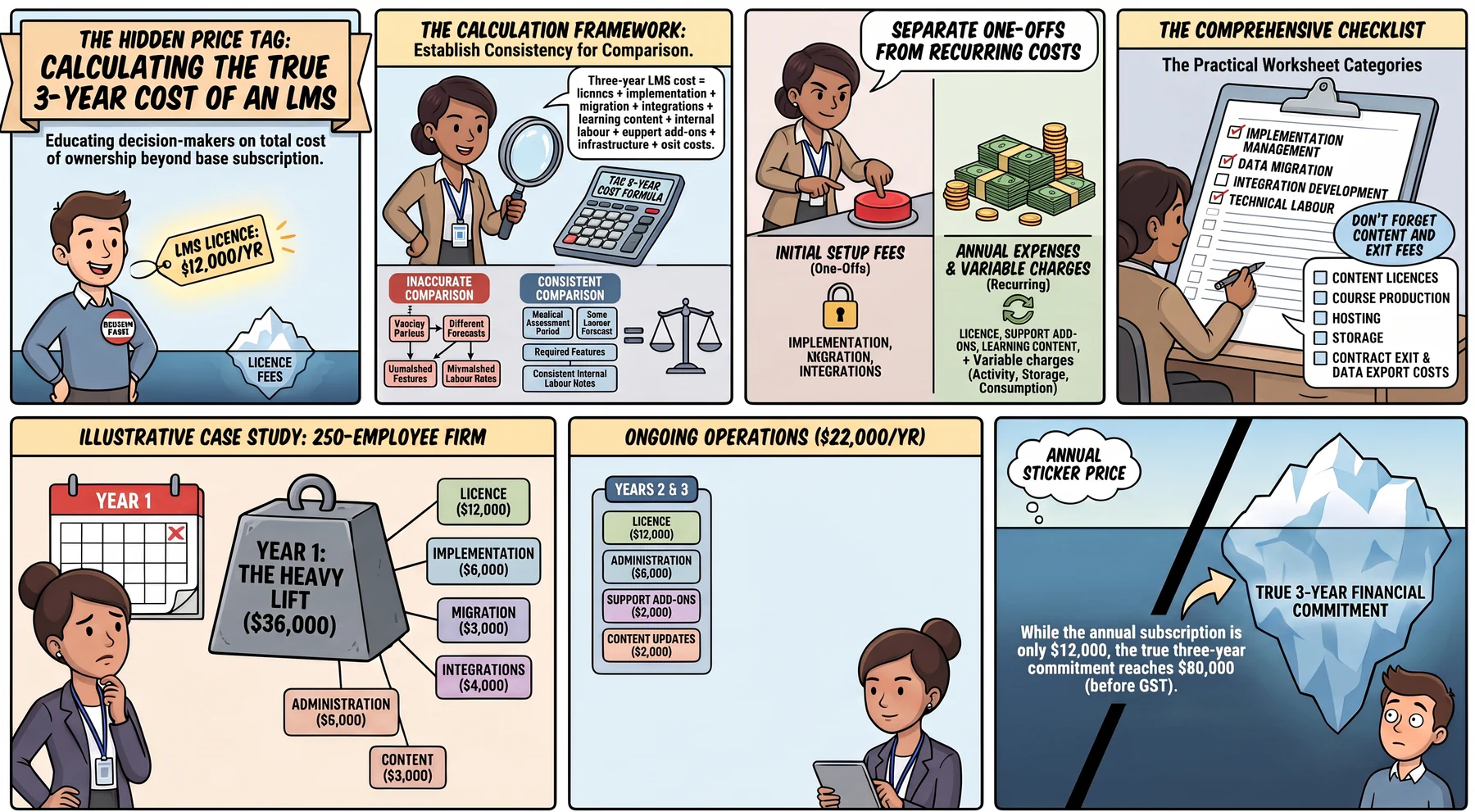
A three-year calculation combines initial project expenses with recurring operational costs. This method prevents a low subscription price from hiding a costly implementation or administration burden.
Three-year LMS cost = licence or subscription fees + implementation + migration + integrations + learning content + internal labour + support add-ons + infrastructure + exit costs
Businesses should apply the same calculation to every shortlisted provider. The assessment period, learner forecast, required features, and internal labour rate must remain consistent across all options.
Three-Year Cost Formula
Start by separating one-off costs from annual expenses. Then add any variable charges based on forecast learner activity, storage growth, integrations, or course consumption.
A practical worksheet should include:
- Subscription or licence charges for each year
- Implementation and project management
- Data and course migration
- Integration development and maintenance
- Administrator and technical labour
- Content licences and course production
- Training, support, hosting, and storage
- Contract exit and data export expenses
Illustrative Cost Example
Consider a hypothetical business selecting an LMS for 250 employees. The example uses invented figures for budgeting purposes and does not represent a vendor quote or market average.
The business expects an annual subscription of $12,000, implementation of $8,000, migration of $3,000, integrations of $4,000, internal administration of $6,000 per year, and content costs of $3,000 in the first year.
First-year expenditure would total $36,000. If the second and third years each include a $12,000 subscription, $6,000 of administration, $2,000 of support add-ons, and $2,000 of content updates, the three-year total would be $80,000 before GST.
This example shows why comparing only the $12,000 annual subscription would understate the financial commitment. It also gives management a clearer basis for comparing an integrated platform with a standalone LMS.
How to Compare LMS Quotes Like for Like
A fair LMS pricing comparison requires every vendor to respond to the same assumptions. Before requesting quotes, prepare a short requirements document covering learner numbers, expected activity, features, content, integrations, security, and service expectations.
Then review each proposal against the following points:
- Confirm whether charges use registered, active, concurrent, or completed-course users.
- Record the billing currency, GST treatment, payment schedule, and contract length.
- Match every required feature to the plan or package that includes it.
- Separate one-off implementation costs from recurring subscription expenses.
- Identify user, storage, course, portal, API, and reporting limits.
- Compare migration responsibilities, training hours, and support response times.
- Model workforce growth and high-activity months across three years.
- Review renewal increases, termination conditions, and data export assistance.
Businesses should also request written clarification for vague terms such as standard integration or basic support. Precise definitions prevent a seemingly cheaper quote from becoming more expensive during delivery.
How Can an Integrated LMS Reduce Administration Costs?
A standalone LMS may require employees to copy learner records between HR, payroll, competency, and reporting systems. An integrated platform can reduce this work by sharing employee profiles, training assignments, completion records, and certification status.
Automation can enrol new employees during onboarding, assign courses according to their role, and update competency records after completion. As a result, HR and training teams spend less time maintaining spreadsheets or reconciling separate databases.
HashMicro’s Learning Management System includes course delivery, assessments, progress monitoring, attendance, and learner database capabilities. The platform also supports connections with competency management, accounting, school management, and certification functions.
For growing businesses that need connected learning and workforce data, exploring an integrated LMS can provide a natural next move beyond separate training tools and manual records.
Conclusion
LMS pricing depends on more than the advertised monthly amount. User definitions, feature tiers, implementation, migration, content, storage, integrations, support, internal labour, and contract terms all influence the actual investment.
Australian businesses should compare each option using the same three-year assumptions and request written confirmation of every included service. This approach provides a clearer view of affordability, scalability, and long-term operational value.
To discuss an LMS configuration suited to your workforce, training requirements, and growth plans, book a free consultation with HashMicro.

Frequently Asked Questions
The cost depends on whether the vendor charges for registered accounts, active learners, or users within a subscription tier. Businesses should divide the complete annual cost, including mandatory services, by the expected number of learners to calculate a meaningful per-user figure.
Per-user subscriptions and tiered plans are common among cloud-based LMS providers. However, the most suitable model depends on whether learner numbers remain stable or change throughout the year.
Open-source LMS software may have no licence fee, but operating it still creates costs. Businesses may need to pay for hosting, configuration, development, security, updates, migration, technical support, and internal administration.
Many vendors charge implementation separately, especially when a project involves data migration, integrations, custom workflows, or administrator training. Buyers should request an itemised scope that clearly identifies included services and additional charges.
Public prices and business quotations should clearly state whether GST is included or excluded. Australian businesses should compare all proposals using the same GST treatment to avoid inaccurate cost differences.
An LMS pricing comparison should cover subscriptions, user definitions, features, implementation, migration, integrations, content, storage, support, internal labour, renewal terms, exit costs, and the expected three-year total.