










 Limited to 100 registrants

AI spend management uses machine learning to classify, monitor, and control company spending before money leaves the business. It turns scattered purchase records into decisions finance teams can act on.
Australian businesses run spend across procurement, accounting, expenses, and payments, so leaks stay hidden until month end. AI shortens that gap by flagging risk while approvals are still open.
This article explains how AI spend management works, where it differs from spend analysis, and which controls still need a human approver. It also covers what good spend management software must deliver.
Key Takeaways
AI spend management uses machine learning to classify, monitor, and control company spending before money leaves the business.
Spend visibility alone shows what happened, but AI helps control spend earlier by flagging risks before approval or invoice payment.
AI improves spend control by classifying purchases, detecting exceptions, and recommending actions inside finance and procurement workflows.
HashMicro supports AI spend management with Purchase Intelligence, budget controls, supplier visibility, and AI-assisted recommendations.

What Is AI Spend Management?
AI spend management applies machine learning to purchasing, invoices, budgets, and expenses so teams can see and steer spend. It works across the full commitment cycle, not just the reporting stage.
Traditional spend control depends on static rules and manual review, which struggle once volume grows. AI adds pattern recognition, so unusual supplier behaviour surfaces without someone hunting for it.
The aim is not automatic approval of every purchase. The aim is earlier detection, better context for approvers, and tighter control over commitments before a supplier invoice ever arrives.
"AI's real value isn't approving purchases faster. It's catching problems early, while there's still time to act, instead of finding out after the invoice already landed."
1. AI Spend Management Defined
AI spend management combines transaction data, approval workflows, supplier records, and budget limits with models that learn from past decisions. That mix is what separates it from plain reporting.
If several teams buy similar items from different suppliers at different prices, the system can flag category fragmentation. That single signal often exposes thousands of dollars in avoidable cost.
2. How AI Turns Spend Data Into Recommendations, Alerts, and Actions
A dashboard shows that costs rose. AI goes further by naming the supplier, branch, project, or buyer behind the movement, then proposing the action that matches the size and risk of that variance.
That action might be a budget warning, an approval escalation, a supplier review, or a prompt to consolidate buying under a contracted vendor. Reporting describes spend; this begins to manage it.
AI Spend Management vs Spend Analysis vs Expense Management
These three terms overlap in vendor marketing, yet they solve different problems. Buying the wrong one leaves a real gap, usually in control rather than reporting. The table below sets the boundaries.
| Dimension | Spend Analysis | Spend Management | Expense Management |
|---|---|---|---|
| Core question | Where did the money go? | Should this spend proceed? | Is this claim compliant? |
| Timing | After the transaction settles | Before and during commitment | After the employee spends |
| Typical records | Historical invoices and supplier ledgers | Requests, purchase orders, budgets, contracts | Receipts, corporate cards, travel claims |
| Primary owner | Finance analysts and category managers | Procurement and finance jointly | Finance operations and line managers |
| Value delivered | Savings ideas and negotiation leverage | Committed cost control and policy enforcement | Policy compliance and faster reimbursement |
1. Spend Analysis: Understanding What Happened
Spend analysis reviews historical purchasing to show how much was spent, with which suppliers, in which categories, and by which teams. It underpins category planning and supplier negotiation.
The limitation is timing. By the time a clean analysis exists, the purchase orders are raised, the goods are received, and the invoices are already sitting inside accounts payable.
2. Spend Management: Controlling What Happens Next
Spend management governs how spend is requested, approved, committed, purchased, invoiced, and paid. It covers budget checks, approval limits, purchase orders, invoice matching, and payment controls.
AI spend management strengthens each of those steps. It flags maverick buying, recommends the right approver, and shows budget pressure while the request can still be changed or rejected.
3. Expense Management: Employee Claims, Cards, Travel, and Reimbursements
Expense management is a subset of spend management. It handles employee claims, corporate cards, travel bookings, reimbursements, receipt capture, and the policy checks that sit behind each of them.
AI reads receipts, detects duplicate claims, and routes approvals well. The bigger prize appears when those signals connect to supplier spend, purchase orders, budgets, and cash forecasting.
Why Spend Visibility Alone Is Not Enough
Visibility does not create control. A business can run polished dashboards and still lose money through slow approvals, weak supplier governance, duplicate buying, and budget breaches caught too late.
Scale makes this harder. The Australian Bureau of Statistics counts more than 2.5 million actively trading businesses, and most of them now run spend across several disconnected systems.
1. The Gap Between Seeing Spend and Controlling Spend
Spend visibility shows what is happening. Spend control changes what happens next, and the distance between those two states is where most avoidable cost quietly accumulates each quarter.
A CFO may see a department overspending, but an alert that lands after approval leaves little room to act. The decision point has passed, and the business now owns a commitment it cannot reverse.
Useful AI spend management closes that gap. It moves detection earlier, into the request and approval stage, where a decision can still be reversed at no cost to the supplier relationship.
2. Budget Leakage, Maverick Spend, Duplicate Buying, and Supplier Concentration
Budget leakage builds slowly through many small approvals, urgent purchases, and untracked commitments. No single transaction looks wrong, which is exactly why the pattern survives manual review.
Maverick spend happens when teams buy outside approved suppliers or contracts. Duplicate buying happens when two departments order the same item because neither can see the other's open orders.
Supplier concentration adds a different risk, since too much spend rests on too few vendors. The Commonwealth Procurement Rules show why value for money and transparency need documented, testable controls.
How AI Improves Spend Control Across Finance and Procurement
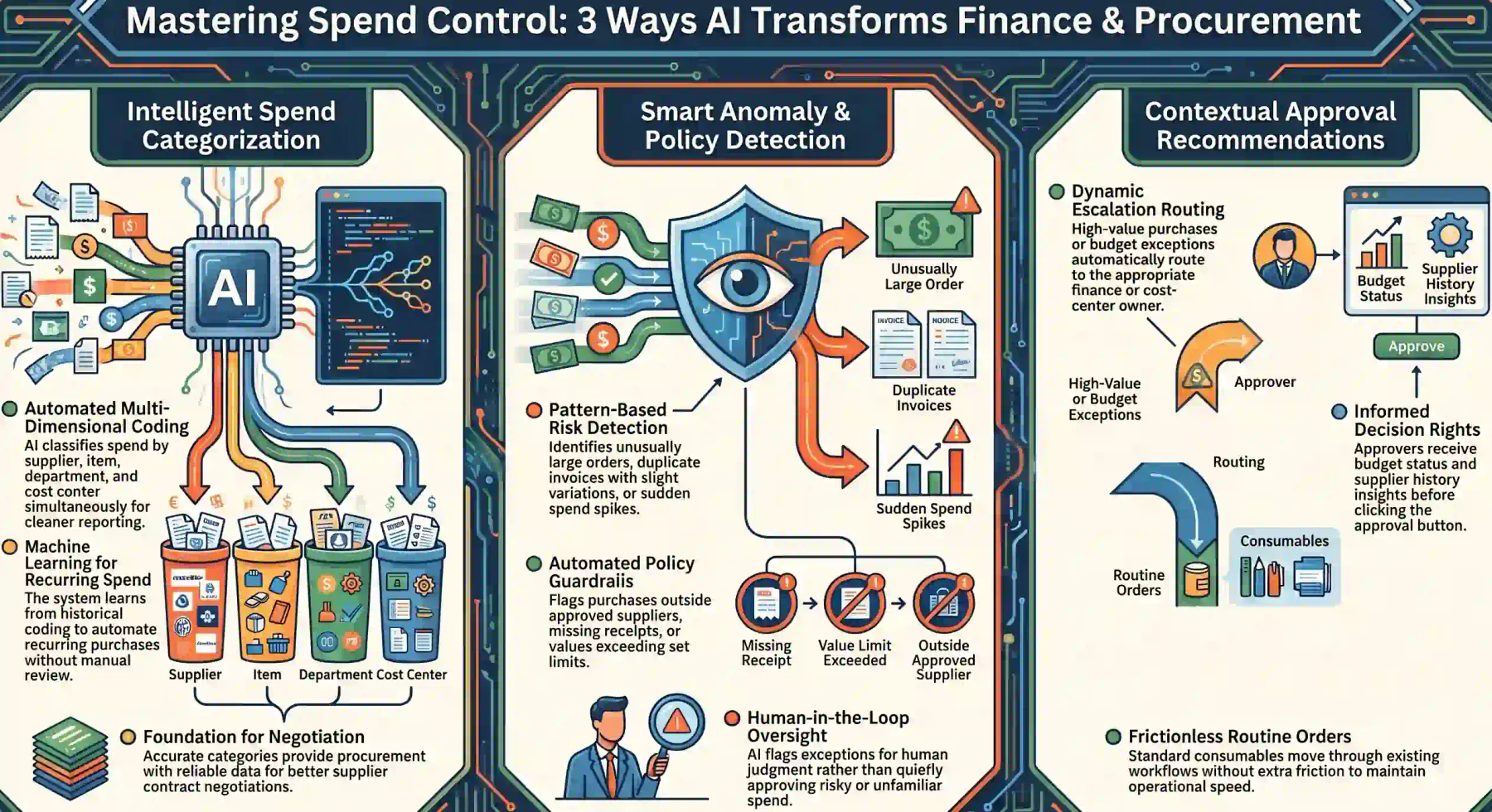
AI improves control in three practical ways. It classifies spend consistently, detects exceptions faster than a human reviewer, and recommends the next action inside the existing approval workflow.
1. Categorising Spend Across Suppliers, Teams, and Cost Centres
Accurate categorisation is the foundation. When spend is coded inconsistently, reports lose credibility, category strategy collapses, and finance spends month end correcting entries instead of analysing them.
AI classifies purchases by supplier, item, category, department, branch, project, and cost centre. It also learns from past coding, so recurring purchases land in the right place without review.
Procurement gains reliable category data for negotiation. Finance gains cleaner budget tracking, cost allocation, and management reporting, which shortens the close and reduces reconciliation work.
2. Flagging Anomalies, Policy Breaches, and Duplicate Purchases
AI detects patterns a fixed rule would miss. Examples include an unusually large order for a known supplier, a duplicate invoice worded slightly differently, or a sudden spend spike at one branch.
Policy breaches follow the same logic. The system can flag purchases outside approved suppliers, values above an approval limit, claims without receipts, or requests coded to the wrong cost centre.
One principle matters above the rest. AI raises the exception for a person to judge; it should never quietly approve risky spend on the assumption that the pattern looks familiar enough.
3. Recommending Approval Routes, Budget Actions, and Supplier Decisions
Recommendations depend on context: spend type, value, department, budget position, supplier history, and policy. A routine consumables order follows the standard route with no extra friction.
A high value purchase escalates to finance. A budget exception routes to the cost centre owner, and a supplier risk signal holds the request until procurement has reviewed the vendor properly.
Speed and control improve together here. Approvers keep the decision rights they already hold, but they receive the budget position, supplier history, and policy status before they click approve.
AI Spend Management Use Cases
AI spend management software delivers most value when it is wired into live procurement and finance workflows. Used only as a reporting layer, it produces charts and very little behaviour change.
| Use Case | Signal AI Detects | Recommended Action | Accountable Owner |
|---|---|---|---|
| Budget variance detection | Committed spend trending above the approved plan | Escalate the request and freeze discretionary lines | Cost centre owner and finance |
| Supplier and category monitoring | Rising share of spend concentrated in one vendor | Trigger a category review and test alternate suppliers | Procurement category manager |
| Maverick spend detection | Purchases raised outside approved suppliers or contracts | Route to procurement before the order is committed | Procurement lead |
| Contract leakage detection | Invoice pricing that departs from agreed contract terms | Hold the invoice and reconcile against the contract | Accounts payable and procurement |
| Expense and invoice exceptions | Duplicate claims, missing receipts, or invoice mismatches | Return the item for evidence before payment release | Finance operations |
1. Budget Variance Detection
AI monitors planned, committed, consumed, and available budget in one view. Instead of discovering an exhausted budget at close, finance receives a signal while the trend is still correctable.
This matters most for businesses running several departments, branches, or projects. A small variance repeated across fifteen cost centres becomes a material number long before anyone names it.
2. Supplier and Category Spend Monitoring
AI tracks supplier share, category concentration, price movement, and dependency risk. It shows which vendors are quietly gaining wallet share and which categories are fragmented across too many suppliers.
Fragmentation is a negotiation opportunity in disguise. Consolidating five overlapping vendors into two contracted suppliers usually improves pricing, service levels, and delivery reliability at once.
3. Maverick Spend and Contract Leakage Detection
Maverick spend bypasses approved suppliers or procurement process. Contract leakage is quieter, since purchases follow the right supplier but drift away from the agreed pricing, terms, or volumes.
AI compares requests, purchase orders, invoices, and supplier records against expected contract behaviour. Anything that departs from the agreement is held for review before the business commits further.
4. Employee Expense and Invoice Exception Review
Claims and supplier invoices sit at the end of the spend cycle, where errors are cheapest to catch. AI screens for duplicate claims, unusual reimbursement patterns, missing receipts, and mismatches.
Treat this as one branch of spend management rather than the whole discipline. The real gain appears when expense and invoice exceptions feed back into budgets, suppliers, and procurement policy.
What AI Can Recommend and Where Humans Must Approve
AI spend management works best as decision support, not delegated authority. Finance and procurement leaders keep accountability, and the system earns trust by making their judgement faster and better informed.
| Decision Type | AI Role | Human Role | Why the Split Matters |
|---|---|---|---|
| Spend classification and coding | Assign category, cost centre, and supplier | Spot check and correct exceptions | Volume is high and errors are cheap to fix |
| Anomaly and duplicate detection | Surface the exception with evidence | Judge intent and decide the outcome | Context and supplier history sit outside the data |
| Approval routing | Recommend the route and the approver | Give or withhold the approval | Authority must stay with a named person |
| Budget override | Model the impact and flag the breach | Approve or reject the override | The override changes an agreed financial limit |
| Vendor master and bank detail changes | Flag the change and any mismatch | Verify and authorise under dual control | Payment fraud most often enters here |
| Payment release | Prepare the batch and flag exceptions | Release the funds | Money leaves the business at this step |
1. What AI Can Classify, Flag, Forecast, and Recommend
AI handles the high volume work well. It classifies transactions, matches spend to categories, detects anomalies, forecasts budget risk, summarises supplier activity, and highlights policy exceptions.
It also answers questions that would otherwise take an analyst a full day. Which suppliers drove the largest category increase, which cost centres are trending above plan, and which requests need review.
2. What Finance and Procurement Leaders Must Still Approve
Humans retain authority over anything that changes money, risk, or policy. That includes budget overrides, vendor master changes, supplier bank detail updates, and purchases above the approval threshold.
Non-standard contracts and payment release belong in the same group. AI can prepare the recommendation and assemble the evidence, but a named person signs off and carries the consequence.
3. Guardrails for Budget Overrides, Vendor Changes, and High-Risk Spend
Guardrails turn intent into enforceable control. Approval thresholds need clear definition, budget policies need consistent application, and vendor changes need genuine segregation of duties.
Audit trails complete the picture by recording who approved what, when, and on what basis. Australian record keeping obligations make that evidence a compliance asset, not just internal housekeeping.
One test settles most design debates. If AI can move money or change a supplier record without a person confirming it, the guardrail is missing altogether rather than merely set too light.
What to Look For in AI Spend Management Software
Evaluate AI spend management software on workflow depth, not dashboard polish. The question is whether insight reaches the approval screen in time to change a decision, or arrives after the fact.
1. ERP, Procurement, AP, and Expense Data Integration
The software must connect where spend is created and approved. That usually means ERP, procurement, accounts payable, accounting, inventory, expense claims, supplier records, and project systems.
A tool that only reads exported spreadsheets can analyse spend but cannot control it. ERP-native or deeply integrated platforms win here, because insight and workflow share the same live records.
2. Budget Controls, Approval Workflows, and Audit Trails
Insight becomes governance through controls. Look for budget limits, approval hierarchies, escalation rules, exception handling, and audit trails that survive an external review without manual reconstruction.
Test it with one scenario. When a purchase request exceeds budget, the system should show the variance, route it to the right approver, record the decision, and update the committed position.
3. Supplier Intelligence, Spend Dashboards, and Exception Alerts
Strong platforms explain supplier performance, category movement, savings potential, risk signals, and budget pressure. They also tell the right person when something needs attention today.
Dashboards inform, but alerts and workflow actions are what change outcomes. A duplicate purchase caught by an alert saves money; the same duplicate found in a quarterly report only explains a loss.
How Australian Businesses Should Evaluate AI Spend Control
Australian buyers should weigh finance governance, procurement ownership, and local reporting duties alongside the AI capability itself. The compliance layer is where generic tools most often fall short.
1. GST, BAS, Multi-Entity, and Cost-Centre Visibility
Spend data has to support Australian reporting duties. That means correct GST treatment, records ready for the business activity statement, accurate cost-centre allocation, and clear multi-entity separation.
The Australian Taxation Office sets out how the business activity statement must be prepared and lodged. Misclassified spend forces finance to unwind entries later, which is slow and audit sensitive.
AI reduces that risk by coding spend consistently at the point of entry. It cannot fix a broken chart of accounts, weak tax setup, or approval rules that were never defined properly.
2. Local Approval Policies and Finance-Procurement Ownership
Approval rules differ by business. Some depend on amount, others on department, project, branch, supplier type, or remaining budget, and the software should model those rules rather than replace them.
Ownership matters just as much. Finance usually owns budget governance while procurement owns supplier and purchasing control, so the best setup shares visibility without blurring accountability.
3. Reporting Needs for CFOs, Procurement Managers, and Cost Controllers
Each role needs a different view of the same spend. CFOs want budget risk, cash impact, and trend; procurement managers want supplier and category insight; department heads want approval status.
Cost controllers sit between them, tracking variance, commitments, and available budget. Good AI spend management translates one data set into the view each of these roles actually acts on.
How HashMicro Supports AI Spend Management Through Purchase Intelligence
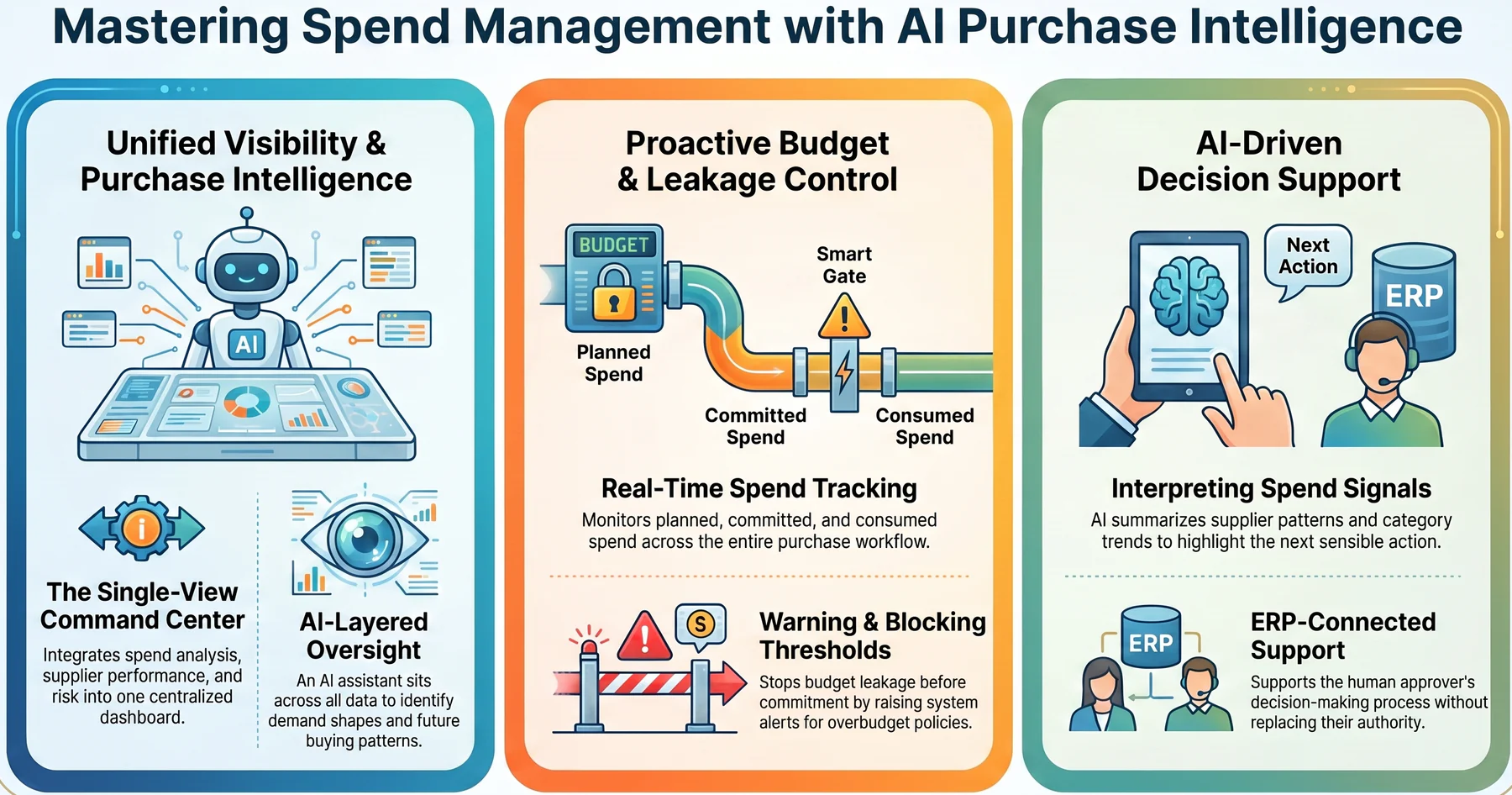
HashMicro approaches spend management from inside the procurement workflow. Spend data sits beside purchase orders, supplier records, budgets, approvals, and reporting rather than in a separate tool.
1. Spend Overview, Supplier Performance, Risk, Savings, Budget, and Forecast Visibility
Purchase Intelligence brings spend analysis, supplier performance, demand analysis, risk, savings, contracts, forecasts, and budgets into one view. An AI assistant layer sits across all of it.
That breadth matters because spend management is not only about totals. Procurement leaders need to see where spend concentrates, where supplier risk is rising, and how demand shapes future buying.
2. Purchase Budget Controls: Planned, Committed, Consumed, and Available Spend
Purchase Budget tracks planned, committed, consumed, and available amounts across purchase workflows. Finance and procurement can therefore see what has been requested, locked in, and already used.
It also supports overbudget policy controls with warning and blocking thresholds. That converts budget leakage from an accounting clean-up problem into a decision the system raises before commitment.
3. AI Assistant for Procurement Insights and Spend-Control Recommendations
The AI Assistant helps teams interpret spend signals, summarise supplier or category patterns, and identify the next sensible action. It supports the decision rather than replacing the approver.
For Australian businesses this ERP-connected approach carries real weight. Spend control stays close to the path from request to payment, where requests, budgets, suppliers, invoices, and approvals already live.
Spend control works best when every approval carries context. Hashy AI reads budgets, suppliers, requests, and invoices together, then shows what needs review before commitment.






Conclusion
AI spend management moves finance and procurement from reactive reporting to active control. Spend analysis explains what happened; AI spend management detects what is happening and recommends the next step.
The guardrail stays constant: AI classifies, flags, forecasts, and recommends, while people approve overrides, vendor changes, and payment release. HashMicro links that insight to real procurement action.
To learn more about AI spend management, you can book a free consultation with our team and improve your efficiency.

Frequently Asked Questions
AI spend management uses artificial intelligence to monitor, classify, analyse, and control business spending across procurement, finance, expenses, suppliers, and invoices. It detects risk and recommends action.
Spend analysis reviews historical spend to explain what happened. AI spend management is active, detecting budget risk, flagging exceptions, recommending approvals, and controlling spend before commitment.
AI spend management software is a platform that uses AI for spend categorisation, anomaly detection, budget monitoring, and supplier analysis. It also recommends approvals and connects finance to procurement.
AI helps detect and reduce maverick spend by flagging purchases outside approved suppliers, contracts, budgets, or policies. It should not be the only control, since approval workflows still matter.
AI tracks spend against planned, committed, consumed, and available amounts. It flags budget pressure early, recommends approval escalation, and highlights patterns that need a supplier or category review.
No. AI expense management focuses on employee claims, receipts, cards, travel, and reimbursements, while AI spend management also covers procurement, supplier spend, purchase orders, invoices, and budgets.
Look for ERP and procurement integration, budget controls, approval workflows, and audit trails. Add supplier intelligence, GST and BAS ready reporting, multi-entity visibility, and human approval guardrails.