






A shipment can leave its origin port on schedule and still arrive late in Australia. The cause is often transhipment, where cargo moves onto a different vessel partway through the voyage.
A transhipment leg changes more than the route. The arrival estimate moves, custody passes to a different carrier, and the documents travelling with the cargo change too.
This article is written for importers, operations leaders and finance teams who need a reliable arrival date. It walks through the transhipment process, compliance controls in Australia and the risks worth planning for.
Key Takeaways
Transshipment transfers cargo between services at an intermediate port, so the carrier, route leg, and responsible party change while the commercial owner stays the same.
Transshipment process runs across origin booking, hub discharge and dwell, reloading onto the onward service, then Australian clearance and inland delivery.
Main risks include ETA drift, unclear custody at the hub, document mismatch, cargo damage, and landed-cost variance from extra handling charges.
Tracking across ERP and warehouse workflows keeps one shipment reference, records milestone dates, links purchase orders and landed cost, then closes at goods receipt.

What Is Transshipment?
Transshipment is the transfer of cargo between transport services at an intermediate point on its journey. The goods keep the same commercial owner, but the carrier, the route leg and the responsible party change.
The transhipment meaning used by Australian authorities is narrower. The Australian Border Force applies the term to goods that arrive in Australia and depart again without being entered for home consumption.
Both senses matter for planning. A container routed through Singapore or Port Klang on the way to Sydney is transshipped in the commercial sense, even though it is imported cargo in the customs sense.
Four related terms are often used interchangeably, and carrier glossaries define them slightly differently. The table below separates them by what physically happens and what the shipment record should show.
| Term | What Physically Happens | Change of Transport Service | Typical Setting |
|---|---|---|---|
| Transshipment | Cargo is discharged at an intermediate port and loaded onto a second service. | Yes, always | International sea and air freight |
| Transit cargo | Goods pass through a territory or facility on the way somewhere else. | Not always | Border crossings and land corridors |
| Cross-docking | Inbound goods are unloaded and reloaded outbound with minimal storage. | Yes | Domestic distribution centres |
| Direct shipment | Cargo travels from origin to destination on one booked service. | No | Lanes with a direct sailing or flight |
The distinction is not academic. A carrier note reading “transshipped” tells procurement a second booking exists, tells the warehouse the arrival window has moved, and tells finance that charges may follow.
"Transshipment adds a second carrier and a second record to every shipment. Treat it as a planning input, not a footnote on the booking confirmation."
How Does the Transshipment Process Work from Origin to Final Delivery?
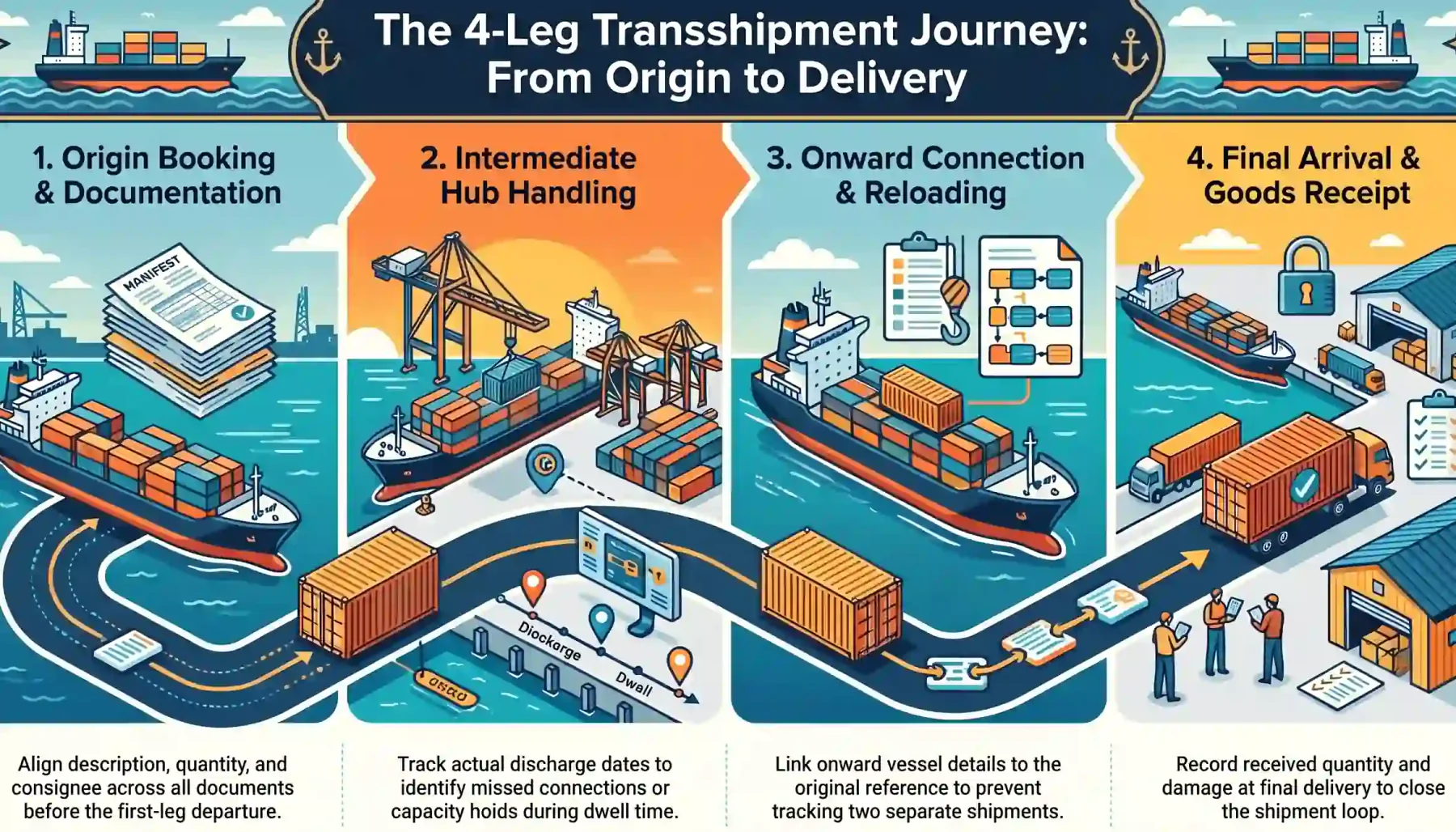
The transshipment process runs across four legs, each with a physical event and a record that must be updated. Treat each leg as a control point rather than a line in a carrier tracking feed.
1. Origin Booking, Documentation and First-Leg Departure
The shipper or forwarder books the first leg and prepares the commercial invoice, packing list and transport document. The booking already names the intended transfer port, so record it at this stage.
Most delays that surface later start here as a document gap. Check that the description, quantity, origin and consignee match across all three documents before the container leaves the origin port.
2. Arrival, Discharge and Handling at the Intermediate Hub
The vessel arrives at the hub, and the container is discharged to the terminal yard. Dwell time begins here, and it is the single largest source of variance in a transshipment schedule.
Ask the forwarder for the actual discharge date rather than the planned one. A gap of more than a few days between discharge and the next loading usually signals a missed connection or a capacity hold.
3. Connection, Reloading and Second-Leg Departure
The container is loaded onto the onward service and a second bill of lading or booking reference is issued. This is the point where a single shipment can split into two sets of carrier records.
Capture the onward vessel name, voyage number and revised arrival date against the original shipment reference. Without that link, purchasing and warehouse teams end up tracking two different shipments.
4. Final Port Arrival, Clearance and Inland Delivery
The cargo reaches an Australian port and is reported to the Australian Border Force. Clearance and any biosecurity intervention follow before the container is released to the transport operator.
Goods receipt closes the loop. Record the actual received quantity, any damage found on unpacking, and the final landed cost inputs against the same shipment reference used at origin.
When Is Transshipment Used in Supply Chains?
Transshipment in shipping is rarely a free choice. It is driven by network design, service availability and economics, and knowing which driver applies tells you how much schedule risk to carry.
1. No Direct Service Between Origin and Destination
Australia sits at the end of long trade lanes, and many origin ports have no direct sailing to Australian ports. Cargo from smaller European, South American or inland Asian origins almost always transfers.
When no direct option exists, the planning question is not whether to accept a transfer. It is which hub the carrier uses, how often the onward service sails and what buffer that frequency demands.
2. Cost, Consolidation and Volume Economics
Carriers consolidate cargo at hubs so larger vessels run full on the main leg. That economy is often passed on as a lower rate, which is why a transshipped booking can undercut a direct one.
Compare the saving against the carrying cost of extra buffer stock. A rate advantage of a few hundred dollars per container rarely covers a week of additional safety stock on a fast-moving line.
3. Capacity, Schedule and Port-Restriction Constraints
Vessel size, draught limits and berth availability all restrict which ships can call at which ports. Larger vessels serve deepwater hubs, and feeder services cover the shallower or lower-volume ports.
Disruption adds a second layer. Blank sailings, congestion and weather routinely push cargo onto an unplanned transfer, so a direct booking can still become a transshipped one after departure.
4. Regional Distribution and Multi-Destination Splits
A single origin consignment often serves several destinations. Splitting it at a regional hub lets one shipment feed Australian, New Zealand and South East Asian receivers without separate origin bookings.
The trade-off is allocation risk. If the hub splits the consignment incorrectly, the Australian portion arrives short, and the shortage is only discovered at goods receipt weeks later.
Scale explains the exposure. Australian Bureau of Statistics figures on international merchandise trade set out monthly import volumes by country, so you can see which origin lanes carry the largest exposure.
What Are Transshipment Hubs and Why Do They Matter?
A transshipment hub is a port built to move containers between vessels rather than to serve local cargo. Its efficiency sets the schedule reliability of every route that passes through it.
1. What a Transshipment Hub Actually Does
The hub receives containers from many feeder services, holds them in the yard, and reloads them by destination onto the next main-line vessel. Very little of that cargo enters the local economy.
That design has a consequence for you. The hub optimises for vessel turnaround, not for any single container, so your box waits for the next sailing that suits the carrier network.
2. Major Hubs on Australian Trade Lanes
Most Australian imports from Europe, the Middle East and North Asia transfer at one of a small set of hubs. Singapore, Port Klang, Tanjung Pelepas, Colombo and Shanghai handle the bulk of that traffic.
Domestic legs matter too. Cargo landed in Melbourne or Fremantle is often trucked or railed onward, which adds a further hand-off that sits outside the ocean carrier's tracking feed.
3. Hub Dwell Time and Its Effect on Your ETA
Dwell time is the gap between discharge at the hub and loading onto the onward service. On a well-connected lane it can be two or three days; on a thin lane it can stretch past a fortnight.
Ask your forwarder for the historical dwell on the specific hub and lane, not a network average. That figure is what should drive your reorder point, not the carrier's published transit time.
Transshipment vs Direct Shipment
Neither routing is automatically better. Direct shipment removes a hand-off; transshipment often buys frequency, coverage, or a lower rate, and the right answer depends on what your commitment can absorb.
Compare the two on the factors that change a decision, not on headline transit time alone. The table below sets out where each routing carries more risk and what control closes the gap.
| Factor | Direct Shipment | Transshipment | Control That Closes the Gap |
|---|---|---|---|
| Transit time | Shorter and more predictable. | Longer, and hub dwell adds variance. | Plan to historical hub dwell, not the quoted transit time. |
| Freight rate | Often higher on thin lanes. | Often lower through consolidation. | Weigh the saving against buffer stock carrying cost. |
| Service frequency | Limited to available direct sailings. | Wider choice of departures and origins. | Confirm onward sailing frequency before you book. |
| Handling exposure | One load and one discharge. | At least two extra container moves. | Match packaging and cargo type to the transfer. |
| Documentation | One carrier record set. | Two or more record sets to reconcile. | Hold one shipment reference across every leg. |
| Exception ownership | A single accountable carrier. | Can shift between carriers at the hub. | Name an internal owner and an escalation deadline. |
| Buffer stock | Standard lane buffer. | Larger, actively monitored buffer. | Recalculate the reorder point from actual arrivals. |
Cargo characteristics decide most cases. High-value, fragile or temperature-controlled goods favour a direct sailing, while stable, high-volume commodities absorb an extra transfer with little consequence.
Commitment dates decide the rest. If a promotion launch, production run or contract delivery date sits behind the shipment, price the risk of a missed connection before you accept the cheaper routing.
What Australian Compliance and Visibility Controls Apply to Transshipped Goods?
Australian requirements depend on the cargo, the route and whether the goods are entered for home consumption. Treat the points below as operating checks and confirm the detail with a licensed broker.
1. Import Declarations, Customs Value and Duty Treatment
Goods entering Australia for home consumption need an import declaration regardless of how many legs the journey took. The transfer itself does not create a separate declaration or a second duty liability.
Customs value is where transshipment bites. Extra handling, storage and onward freight can change the value built up to the place of export, so keep every charge tied to the shipment record.
2. Biosecurity Requirements for Goods Routed Through Intermediate Ports
Biosecurity risk follows the route, not just the origin. A container that sits in a tropical hub yard can pick up soil, seeds, pests or moisture that were never present at the point of loading.
The Department of Agriculture, Fisheries and Forestry sets conditions for goods transshipped through Australia. Check the commodity and country requirements before booking, because treatment cannot be retrofitted.
3. Documentation Chain: Bill of Lading, Packing List and Certificates of Origin
A transshipped consignment can generate two bills of lading, one for each leg. Both must reconcile to the same commercial invoice and packing list, or the entry stalls at the broker.
Certificates of origin travel with the goods and must survive the transfer intact. Ask the forwarder to confirm the original document is with the onward carrier before the second leg departs.
4. Free Trade Agreement Origin Rules and the Direct Consignment Question
Preferential duty rates usually require the goods to be consigned directly from the exporting party. Most Australian agreements allow transit or transshipment, but only under specific conditions.
Those conditions typically require the goods to stay under customs control and undergo no operation beyond unloading, reloading and preservation. Keep evidence from the hub to support the claim.
Ask the broker exactly which document proves it. Depending on the agreement, that may be a through bill of lading, a non-manipulation certificate from the hub customs authority, or both.
5. Record-Keeping and Audit Readiness Obligations
Australian importers must keep commercial documents relating to an import for five years from the date of entry. A transshipped consignment simply means there is more to keep and reconcile.
Build the file as the shipment moves rather than at audit time. Store both bills of lading, the hub handling charges, the origin certificate, and the release advice against one reference.
The checks split cleanly by owner, which is what makes them auditable. Use the table below to assign each control area before the first leg departs rather than after the container lands.
| Control Area | What Applies in Australia | Typical Owner | Evidence to Retain |
|---|---|---|---|
| Import declaration | Required for goods entered for home consumption. | Licensed customs broker | Entry number and release advice |
| Customs value | Must reflect the value built up to the place of export. | Finance and broker | Invoice, freight and handling charges |
| Biosecurity | Conditions vary by commodity, treatment and route. | Importer and broker | Treatment certificates and inspection results |
| Document chain | Both legs must reconcile to one invoice and packing list. | Logistics | Both bills of lading and the packing list |
| FTA origin | Direct consignment conditions must be satisfied. | Procurement and broker | Origin certificate and non-manipulation evidence |
| Record keeping | Five years from the date of entry. | Finance | Complete shipment file under one reference |
What Are the Main Risks of Transshipment and How Can You Control Them?
Almost every transshipment failure is an information failure first. The cargo moves, but the record does not, so procurement, warehouse and finance keep working from a plan that expired at the hub.
1. ETA Drift and Downstream Planning Failure
The original arrival date stays in the planning system after the onward booking changes. Warehouse labour, production sequencing and customer promises all keep pointing at a date that no longer exists.
The control is a rule, not a report. Any ETA change beyond an agreed threshold must update the shipment record and notify the affected teams on the same day it is received from the carrier.
2. Unclear Custody and Ownership of Exceptions
While cargo sits in a hub yard, no one internally owns it. The origin forwarder considers the leg complete, the destination agent has not taken it on, and the exception drifts for days.
Name one internal owner for the whole journey, not one per leg. Give that person an escalation deadline so a silent hub becomes an active exception rather than an unanswered email thread.
3. Document Mismatch Across Transport Legs
Two carriers produce two record sets, and small differences creep in. A container number keyed differently or a weight rounded on the second bill is enough to hold an entry at the border.
Run a reconciliation check the moment the second bill of lading is issued. Comparing container number, weight, piece count, and consignee against the invoice takes minutes and prevents a hold.
4. Cargo Damage, Loss and Condition Disputes
Every extra lift is an extra chance of damage, and the hub is where liability blurs. Damage found at goods receipt in Sydney is difficult to attribute to a specific leg weeks after the event.
Request condition evidence at the transfer point for sensitive cargo. A seal number check, a container condition note or a photograph at reloading gives you something to claim against.
5. Landed-Cost Variance from Additional Handling
Hub handling, storage and rehandling charges arrive after the goods do. Finance accrues against the original quote, then discovers the real figure when the forwarder invoice lands weeks later.
Add an expected transfer cost line at booking, even as an estimate. Comparing it against the actual invoice turns a surprise into a variance you can question with the forwarder before payment.
How Can You Track Transshipment Across ERP and Warehouse Workflows?
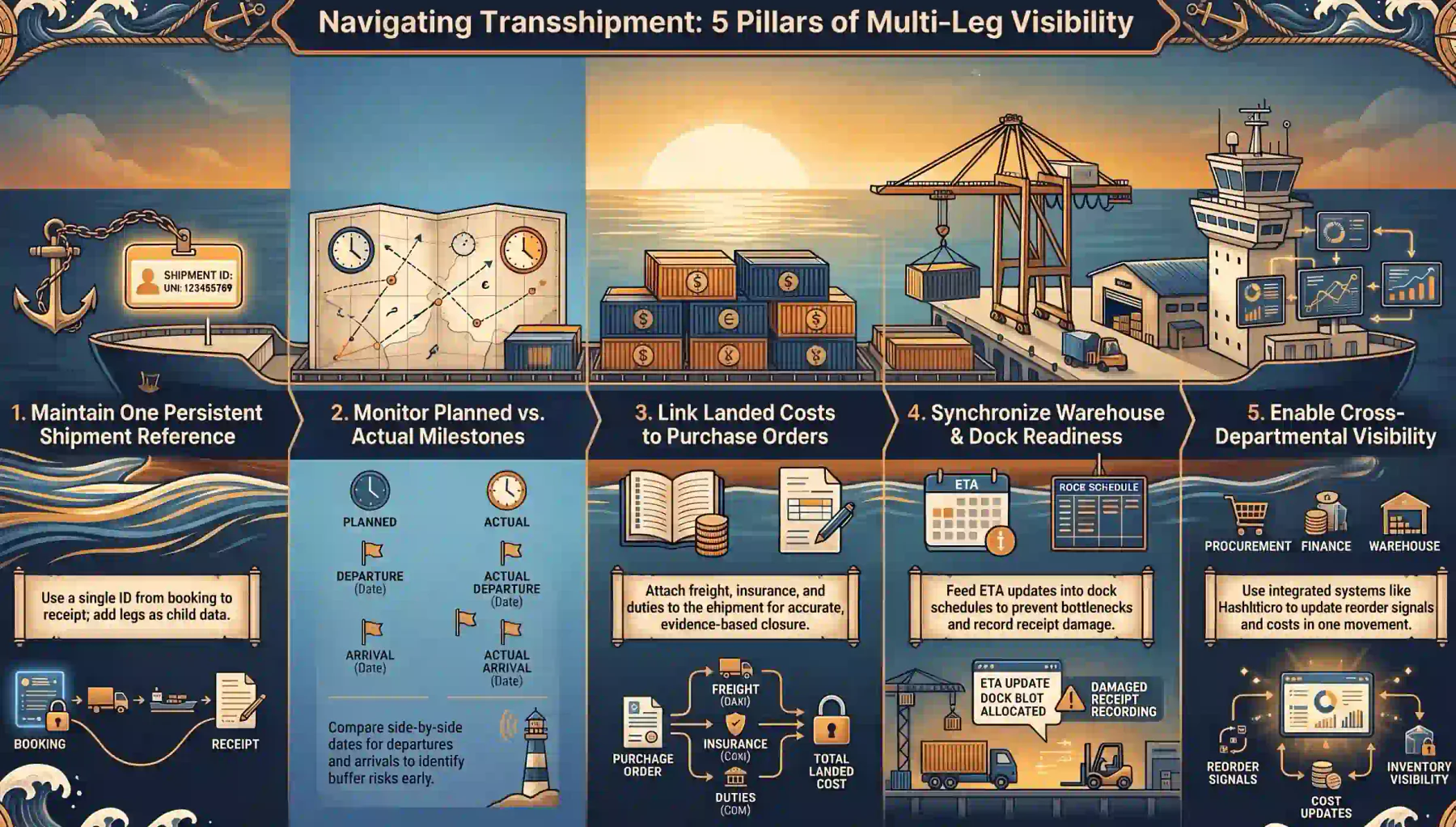
Tracking works when one record carries the shipment from booking to goods receipt. Carrier portals show a leg; your system of record has to show the journey and everything committed against it.
1. Keeping One Shipment Reference Across Multiple Transport Legs
Create the shipment record at booking and never replace it. Each leg adds carrier, vessel, and voyage detail as child data, so the reference that procurement raised is the one the warehouse receives.
2. Status, Milestone and Revised-ETA Updates in the System of Record
Define the milestones that must be captured: origin departure, hub arrival, hub departure, port arrival, release, and receipt. Anything else is optional detail rather than a control point.
Store planned and actual dates side by side for each milestone. The gap between them is the number that tells a planner whether the buffer is holding or the commitment is already at risk.
3. Linking Shipment Data to Purchase Orders, Costs and Landed Cost
The shipment record only earns its place when it links back to the buying document. That link lets a delayed hub departure surface automatically as a supplier commitment that is now at risk.
Attach freight, insurance, hub handling and duty to the same reference so landed cost builds as the goods move. Finance then closes the shipment on evidence rather than on an outdated estimate.
4. Goods Receipt, Warehouse Readiness and Exception Handling
A revised ETA is only useful if the warehouse sees it. Feed the arrival window into dock scheduling, labour rosters and storage allocation so a two-week slip does not become a receiving bottleneck.
Record shortages and damage at receipt against the shipment, not just the purchase order. That is the evidence a claim needs, and it feeds supplier and carrier performance reviews later.
5. How HashMicro Supports Multi-Leg Shipment Visibility
HashMicro connects purchasing, inventory, warehouse, and accounting around a single shipment reference. A hub delay updates the expected receipt, the reorder signal, and the cost accrual in one movement.
Exception queues, milestone fields, and landed-cost reconciliation give each team the same picture. The system does not stop a delay, but it stops a delay from reaching your customer as a surprise.
Multi-leg shipments only stay predictable when one record tracks every hand-off. Hashy AI reads bookings, hub milestones, documents, and costs together, then flags what needs attention.






Conclusion
Transshipment is a routing reality for most Australian importers, not an exception to manage occasionally. The control question is whether your record keeps pace with the cargo at every hand-off.
Start with one lane where hub delays already hurt, fix the milestone and ownership rules there, then extend. Confirm customs and biosecurity details with the ABF, DAFF and a licensed broker before you commit.
To learn further about transshipment, you should book a free consultation with our team and gain advanced business insight to improve your business.
Frequently Asked Questions
It means cargo is discharged at an intermediate port and loaded onto another service before reaching its destination. The commercial owner stays the same, but the carrier and the routing leg change.
No. Transit cargo describes goods passing through a territory without necessarily changing service, while cross-docking is a domestic warehouse practice with very short dwell between vehicles.
Duty treatment is generally unaffected, but preferential origin claims can be. Most agreements allow a transfer only if the goods stay under customs control and undergo no operation beyond reloading.
It depends entirely on the hub and lane, so treat published transit times with caution. Well-connected hubs may add only a few days, while thin lanes can add a fortnight or more of dwell.
Liability depends on the contract of carriage and where the damage occurred, which is exactly what makes hub incidents hard to resolve. Request condition evidence at the transfer to protect a claim.
Hold one shipment reference from booking to goods receipt and attach each leg to it as child data. Capture planned and actual dates per milestone so the variance is visible before it hits a commitment.
Switch to Code mode or refresh to load the visual preview.