







 Limited to 100 registrants

A request for tender invites qualified suppliers to submit formal, comparable offers against a buyer's defined requirement. It creates a procurement record spanning scope, issue, clarification, evaluation, and award.
Australian procurement teams use the rft process when a purchase is material and a formal supplier comparison is required. This article covers the rft meaning, process, template, and evaluation scoring.
Procurement rules and thresholds vary across Australian jurisdictions and enterprise types. Commonwealth entities should refer to the Commonwealth Procurement Rules; other buyers should check their applicable portal and policy.
Key Takeaways
A request for tender suits defined, material requirements where formal, comparable supplier responses are needed to support a documented selection.
The RFT process in Australia runs five stages from defining scope and issuing the document through to contract award and operational handover.
A strong request for tender template covers scope, eligibility, submission rules, evaluation criteria, and contractual terms before release.
Procurement software connects approvals, supplier records, scoring, budget checks, and audit trails inside one controlled workflow.

What Is a Request for Tender?
A request for tender asks qualified suppliers to submit formal, comparable offers against a defined requirement. Scope, evaluation criteria, and commercial conditions are established before any supplier responds.
An RFT suits purchases that are material or operationally important, where the required outcome can be defined clearly. It suits decisions where supplier capability, risk, and contract terms matter alongside price.
- The purchase is material, complex, or operationally significant.
- The required outcome and core deliverables can be defined clearly.
- Several suppliers could compete on the same requirements.
- Management needs a documented and defensible selection process.
- Supplier capability, risk, and contract terms matter alongside price.
- The decision may face audit, governance, or delegated-authority review.
Consider a business replacing its enterprise system. Procurement coordinates the process, but finance, operations, IT, and executives must each contribute requirements, making the RFT a cross-functional governance workflow.
When approvals, supplier records, and evaluation evidence must remain connected, a single controlled record from initial requisition through to purchase order supports governance and audit requirements.
"An RFT only works when finance, operations, IT, and executives agree on the requirement before a single supplier responds, because a moving target is impossible to evaluate fairly."
RFT vs RFQ vs RFP vs EOI
Choosing the wrong document produces responses that are difficult to compare. The practical distinction is how clearly the buyer can define the need and how much solution design it expects from suppliers.
| Document | Best Used When | What Suppliers Provide | Risk If Misused |
|---|---|---|---|
| Request for tender (RFT) | Requirements are defined, the decision is material, and formal comparison is required | A structured response covering compliance, delivery, capability, price, and contract matters | A vague scope forces suppliers to make different assumptions, undermining comparability |
| Request for quotation (RFQ) | The product or service is standardised and price drives the decision | A quote against specified quantities, specifications, and delivery conditions | Implementation, service, or operational risks may be overlooked in a complex purchase |
| Request for proposal (RFP) | The business outcome is known but suppliers may recommend different approaches | A proposed method, solution design, delivery plan, and commercial offer | Overly rigid requirements may prevent suppliers from presenting better alternatives |
| Expression of interest (EOI) | The buyer wants to test market interest or identify capable suppliers before a later process | Capability information, relevant experience, and an indication of interest | Treating an EOI as a final tender leaves price, scope, and contract matters unresolved |
The request for tender vs request for proposal distinction comes down to scope definition. Use an RFQ for standard goods, an RFP when supplier design matters, and an RFT when requirements support formal comparison.
Tender types determine who may respond. Open tenders are advertised to the wider market; selective tenders go to a shortlist; limited tenders are directed to identified suppliers where applicable policy permits.
Before releasing, confirm the relevant procurement portal and policy. Commonwealth buyers should check AusTender; state-based buyers should use their jurisdiction's applicable government procurement portal.
The 5 Stages of the RFT Process in Australia
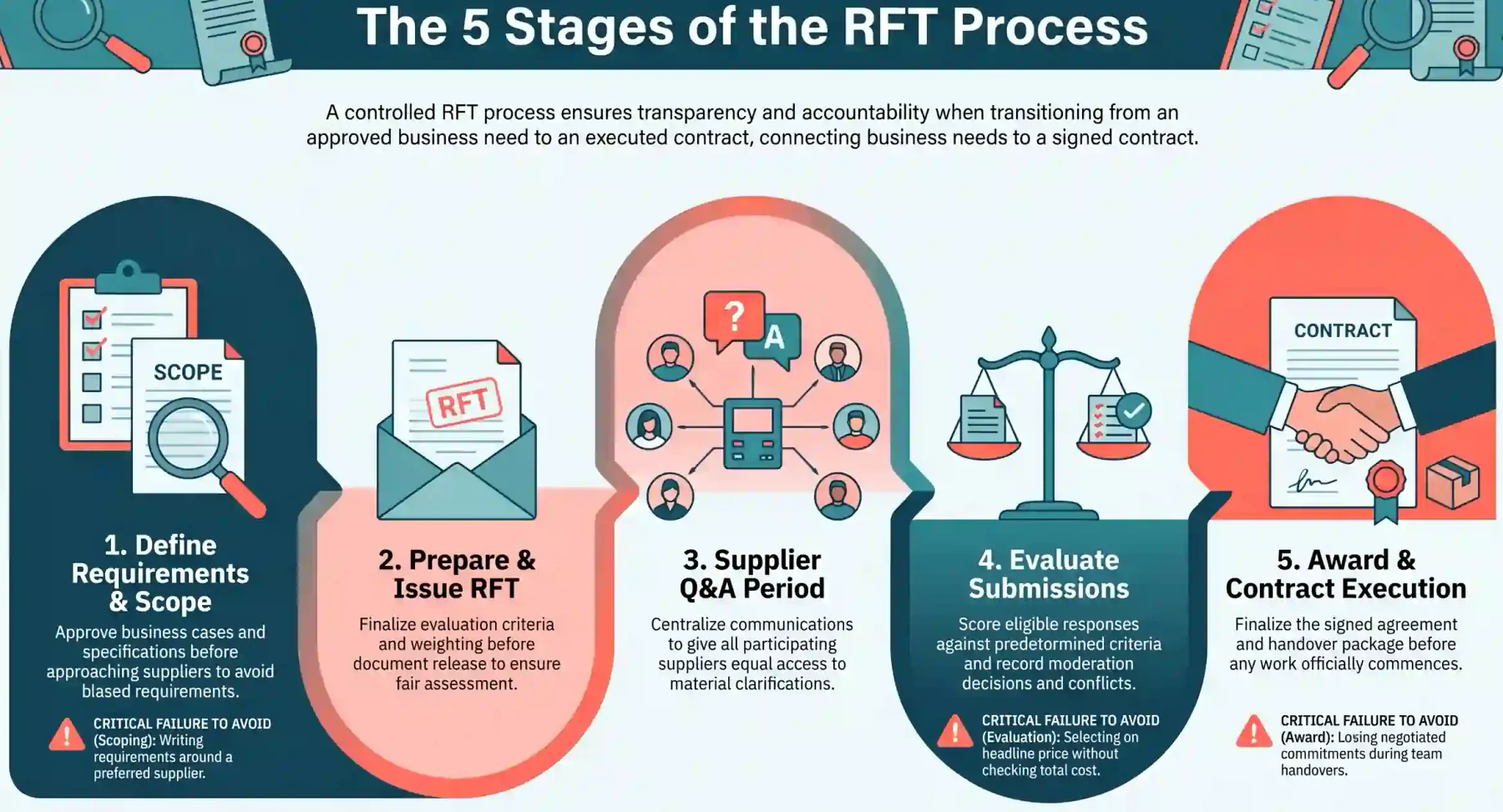
A controlled rft process connects an approved business need to an executed contract. Each stage should define who decides, what information is required, and what record must be retained.
1. Define Requirements & Scope
The business owner defines the required outcome with procurement and relevant specialists. Inputs cover the business case, budget, specifications, service levels, implementation dependencies, and risk assessment.
- Decision owner: Business sponsor or delegated authority holder.
- Practical control: Obtain approval before approaching any supplier.
- Common failure: Writing requirements around a preferred supplier, or releasing a scope built on unstated assumptions.
For an ERP system tender, scope must address entities, locations, users, integrations, data migration, training, and support. A scope limited to price alone produces responses that cannot be meaningfully compared.
2. Prepare & Issue the RFT Document
Procurement converts the approved requirement into instructions, schedules, and criteria. Finance, IT, and legal reviewers each contribute; the output is an approved, version-controlled RFT document with a release record.
- Decision owner: Procurement lead, with release approval under organisational policy.
- Practical control: Finalise evaluation criteria and weighting before publication.
- Common failure: Changing significant requirements after release without issuing the same amendment to all participating suppliers.
3. Supplier Q&A Period
Suppliers review the document and submit questions through the nominated channel. Procurement coordinates answers with subject-matter experts and maintains the clarification register and any formal addenda issued.
- Decision owner: Procurement or the nominated tender contact.
- Practical control: Give all participating suppliers equal access to material clarifications.
- Common failure: Allowing private conversations that give one bidder information unavailable to others.
4. Evaluate Submissions
The evaluation panel checks mandatory conditions, scores eligible responses against predetermined criteria, and records reasons for each assessment. Commercial, technical, and risk reviews may run in parallel before a moderated report is finalised.
- Decision owner: Evaluation chair or authorised panel.
- Practical control: Record conflicts, score changes, assumptions, and moderation decisions.
- Common failure: Selecting on headline price before checking total cost, delivery dependencies, or material exclusions.
A procurement approval workflow can connect submissions, scores, and approval history in a controlled record, without replacing the independent judgement each evaluator must apply.
5. Award & Contract Execution
The authorised decision-maker approves the recommendation and the company completes notifications and contract execution. The output is an approval record, a signed agreement, and an operational handover package.
- Decision owner: Delegated authority holder or governing body.
- Practical control: Do not begin work solely on an informal preferred-supplier message.
- Common failure: Losing negotiated commitments when the tender response is handed to the implementation or contract-management team.
What Must Be in a Request for Tender?
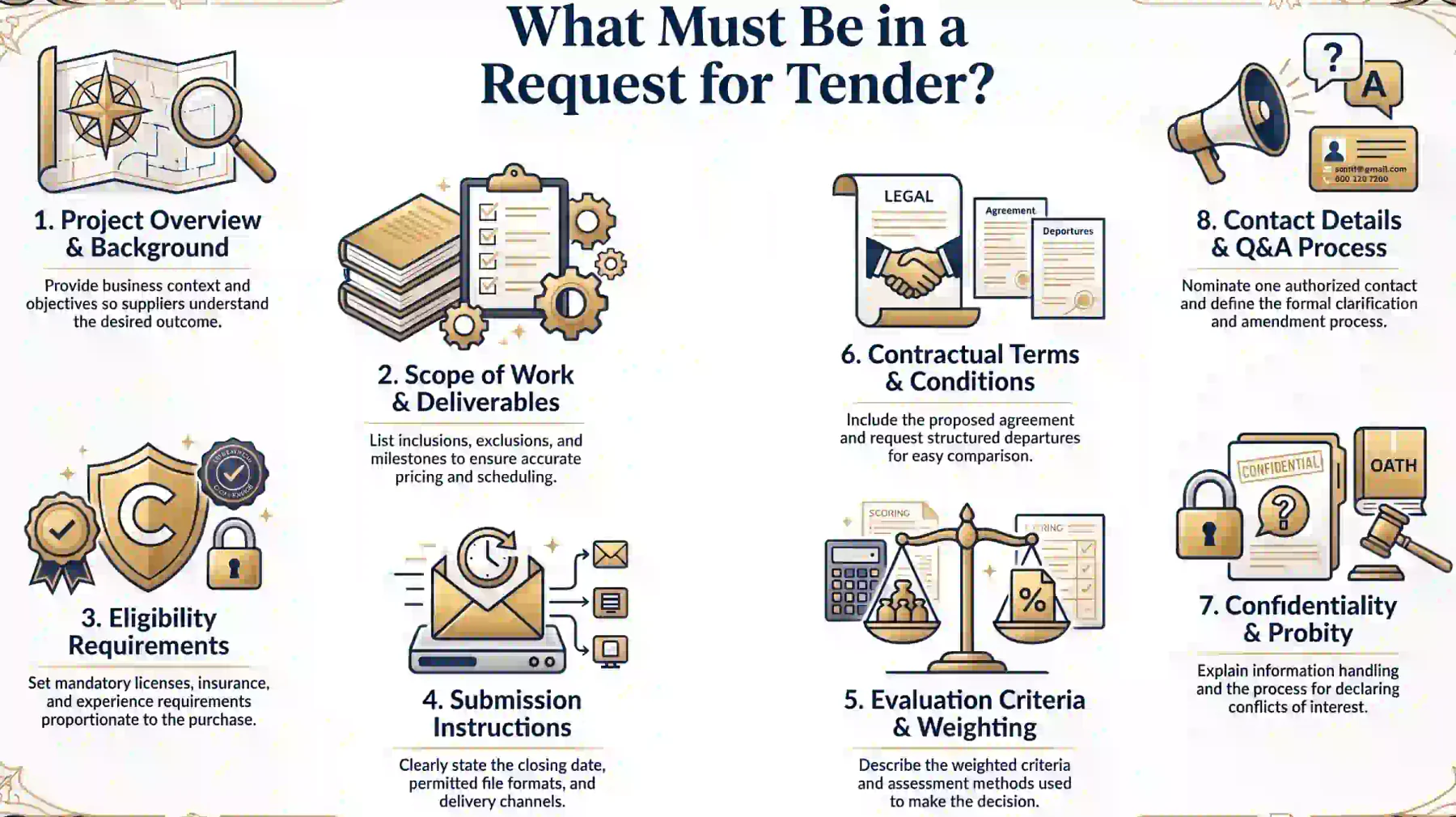
The template sections below cover what a request for tender document must include before suppliers are invited to respond. Adapt each section to the specific purchase; contractual terms should receive qualified review.
1. Project Overview & Background
Explain the business context, objective, and reason for approaching the market. Confirm that suppliers receive enough context to understand the desired outcome without sharing unnecessary confidential information.
Review question: Can a supplier understand the problem, affected operations, and intended result?
2. Scope of Work & Deliverables
List inclusions, exclusions, specifications, service levels, milestones, and acceptance requirements. For software, also cover configuration, integrations, migration, testing, training, and support.
Review question: Can suppliers price and schedule the scope without guessing?
3. Eligibility Requirements
Set mandatory licences, insurance, certifications, and experience requirements proportionate to the purchase. Separate true conditions of participation from preferences that belong in the weighted assessment.
Review question: Is every mandatory requirement necessary, measurable, and consistently assessable?
4. Submission Instructions
State the closing date, permitted format, file limits, delivery channel, and validity period. Also identify which schedules suppliers must complete and the rules applying to late or alternative submissions.
Review question: Could two suppliers independently follow these instructions and submit responses in the same structure?
5. Evaluation Criteria & Weighting
Describe mandatory compliance checks and weighted evaluation criteria. State whether demonstrations, reference checks, interviews, or best-and-final offers may form part of the assessment process.
Review question: Do the published criteria reflect the actual decision the business needs to make?
6. Contractual Terms & Conditions
Include the proposed agreement, pricing basis, payment terms, warranties, liability, and data provisions. Request contract departures in a structured schedule so they can be compared across all submissions.
Review question: Have material contract departures been requested in a structured schedule so they can be compared?
7. Confidentiality & Probity Statement
Explain how supplier information will be handled and the process for declaring conflicts of interest. Identify restrictions on public communication, staff contact, and use of buyer-provided information.
Review question: Are confidentiality, conflict, and communication expectations clear to both suppliers and evaluators?
8. Contact Details & Q&A Process
Nominate one authorised contact, the question deadline, the response method, and how amendments will be issued. Discourage suppliers from seeking material guidance through staff outside the formal channel.
Review question: Is there one complete clarification record available to the entire evaluation team?
Before issuing the RFT document, complete this numbered check:
- Confirm the scope, budget, and sourcing approval.
- Test whether the requirements allow comparable responses.
- Approve mandatory conditions, evaluation criteria, and weighting.
- Review submission, confidentiality, and contractual provisions.
- Assign the tender contact, evaluation panel, and decision authority.
- Lock the approved document version and release schedule.
- Establish the clarification, amendment, and records process.
Central procurement document control keeps the approved version, schedules, and supplier communications together. Confirm how document amendments and supplier communications are managed before releasing the RFT.
How to Build an RFT Evaluation Scoring Matrix
A defensible rft evaluation separates mandatory compliance from comparative merit. Mandatory conditions determine whether a response proceeds; weighted criteria determine how eligible offers are compared.
Agree on the decision logic before releasing the request for tender. Define what each criterion means, what evidence evaluators should examine, and how the rating scale applies consistently.
| Evaluation Area | Example Weight | Evidence to Assess |
|---|---|---|
| Commercial and whole-of-life cost | 20% | Pricing schedules, assumptions, payment model, and ongoing costs |
| Technical fit | 20% | Compliance, architecture, integrations, and technical limitations |
| Operational fit | 15% | Workflow support, usability, service levels, and operating impacts |
| Implementation approach | 15% | Plan, resources, migration, testing, training, and dependencies |
| Security and data controls | 10% | Access controls, hosting, privacy responses, and incident processes |
| Support and supplier capability | 10% | Support model, relevant experience, capacity, and references |
| Delivery and contract risk | 10% | Exceptions, dependencies, continuity measures, and risk treatment |
For each response, evaluators should:
- Check mandatory compliance before applying weighted scores.
- Score independently and record evidence-based comments.
- Declare actual, potential, or perceived conflicts.
- Moderate significant scoring differences as a panel.
- Document why a score changed during moderation.
- Complete commercial, risk, and reference checks before approval.
The lowest price does not represent the best outcome when implementation effort or delivery risk differs. Connecting evaluation records with budget control helps decision-makers assess total cost and financial exposure together.
Contract Award & Post-Tender Obligations in Australia
Selecting a preferred supplier does not by itself create a binding obligation. The legal effect depends on tender conditions, communications, conduct, jurisdiction, approval status, and contract wording.
After evaluation, the business should complete the following activities as applicable:
- Obtain approval from the relevant delegated authority.
- Notify participating suppliers in accordance with tender conditions and applicable policy.
- Offer or conduct debriefings where required or appropriate.
- Resolve permitted clarifications and contract departures.
- Execute the agreement through authorised representatives.
- Retain submissions, declarations, scores, moderation notes, and approvals.
- Protect confidential supplier and evaluation information.
- Create the supplier master record, purchase order, and budget commitment.
- Transfer milestones, risks, and negotiated commitments to the mobilisation team.
Award and debriefing requirements vary across Commonwealth, state, territory, and local procurement contexts. Private companies are guided by their own policies, delegated authorities, and risk profile.
The operational handover deserves the same discipline as the evaluation phase. Finance approval records should align with the signed agreement to prevent ordering against outdated prices or unapproved terms.
How Procurement Software Simplifies the RFT Process
Email and spreadsheets may work for a small, low-risk purchase. They become harder to govern when a tender involves multiple reviewers, document versions, supplier questions, evaluation rounds, and approval levels.
| RFT Problem | Software Support | Governance Benefit | Human Control Still Required |
|---|---|---|---|
| Supplier details are duplicated or incomplete | Controlled supplier master data | More consistent records across sourcing and purchasing | Supplier due diligence and approval |
| Release approval is difficult to trace | Configurable approval routing | Visible decision and delegation history | Appropriate authority settings |
| Teams use different RFT versions | Document version control | One approved release and amendment record | Accurate document preparation |
| Clarifications are lost in inboxes | Central Q&A and addenda log | Consistent communication evidence | Fair and authorised answers |
| Evaluator scores sit in separate files | Structured evaluation records | Traceable scoring and moderation history | Independent, evidence-based judgement |
| The preferred offer exceeds budget | Finance and budget checks | Earlier visibility of funding constraints | Budget-owner approval |
| Award data must be re-entered manually | Purchase order and ERP integration | Cleaner handover to purchasing and operations | Contract and order verification |
| Audit evidence is assembled manually | Time-stamped workflow and audit trail | Faster retrieval of approvals and records | Records policy and access governance |
HashMicro procurement software connects requisitions, supplier records, approvals, and purchase orders. Procurement data connects with accounting and operational records through a shared platform, reducing manual reconciliation after award.
Inventory integration is relevant when the tender covers stocked goods, replenishment, or multi-location availability. Software does not replace procurement policy, delegated authority, or legal review.
Review your existing rft process first, identify where approvals or records are being lost, and then decide whether a standalone procurement tool or a connected ERP module is appropriate.
When supplier records, approval history, evaluation scores, and budget checks share one system, Hashy AI can surface the tender steps that still need an owner or a decision.






Conclusion
An effective request for tender starts with a clearly defined requirement. The buyer must document scope, issue consistent instructions, and score eligible submissions against criteria approved before release.
Procurement software strengthens document control and audit trails but cannot fix an unclear scope. Review your process first, then decide whether a standalone tool or an integrated ERP module is the right fit.
To learn more, you can schedule a free consultation with our experts today. Start anytime and scale your business even further.
Frequently Asked Questions
An RFT suits defined requirements needing formal, comparable supplier submissions. An RFP suits outcomes where suppliers propose different approaches. Terminology and requirements can vary between businesses.
The legal effect of an RFT depends on its conditions, communications, the parties' conduct, jurisdiction and contract wording. Get legal review for complex or high-value tenders. This is not legal advice.
Timelines vary by RFT. Duration depends on scope complexity, internal approvals, the supplier Q&A period, evaluation, negotiation and any public or private-sector rules that apply.
Private companies are guided by their own procurement policies, delegated authorities and purchase value, not one universal rule. An RFT suits complex or high-risk purchases needing formal supplier comparison.
An EOI tests market interest, gathers capability information or shortlists suppliers. An RFT asks for formal offers against defined requirements, submission rules and evaluation criteria, usually after an EOI.