

A progress claim in construction is a formal request for payment covering completed work, approved variations or other amounts a contract allows. It links site progress to contract administration and accounting.
Contractors and subcontractors usually prepare claims, while principals, superintendents, quantity surveyors and finance teams may assess, certify or pay them. Roles depend on the contract and delivery model.
This article explains how a construction progress claim works, from site measurement to payment. It covers the process, Australian rules, calculation methods and a practical progress claim template outline.
Key Takeaways
Progress claims request payment for completed work, approved variations or other contractual amounts, and the amount finally paid can differ after assessment.
Claims and payments are not the same: a claim asks for money, while the progress payment is what remains after assessment, certification and agreed deductions.
Australian rules differ by state and territory, so claim dates, wording, service and response times must be checked against the contract and current law.
Variations, retention and previous payments should be reconciled against controlled registers so each claim shows only the movement for the period.

What Is a Progress Claim in Construction?
A construction progress claim asks a respondent to pay for measured work, achieved milestones, approved variations, or other claimable amounts. The figure claimed is a request, not the certified sum.
This makes the claim both a payment document and a controlled project record. It should tie the contract value to site evidence, variation approvals, previous payments, retention and the accounting ledger.
Construction is a major part of the economy, so disciplined claims matter for cash flow across the sector. Industry activity is tracked in Australian Bureau of Statistics building and construction data.
"A progress claim carries no weight until it is backed by measurements, approval, and a clean paper trail. Contractors who keep that evidence spend less time arguing over numbers and more time getting paid."
1. Who Submits and Receives a Progress Claim?
Several parties take part in the progress claim process, and their duties depend on the contract. The table below outlines who typically prepares, receives, assesses, or pays a claim, with key qualifications.
| Participant | Typical Responsibility | Important Qualification |
|---|---|---|
| Contractor or Subcontractor | Prepares and submits the claim | Entitlement and procedure depend on the contract |
| Principal or Head Contractor | Receives the claim and may be liable for payment | The respondent may use a different title |
| Superintendent or Contract Administrator | Reviews compliance and may assess or certify value | Authority is defined by the contract |
| Quantity Surveyor | Measures work and checks valuations | Not appointed on every project |
| Project Manager | Confirms progress, milestones and records | May coordinate rather than approve payment |
| Finance Team | Checks tax, accounting and payment details | Should not replace contractual assessment |
2. Monthly Claims vs Stage-Based Claims
A monthly progress claim follows recurring dates set by the contract or relevant rules. A stage-based claim becomes payable when a defined milestone is met, such as finishing structural work or handing over a phase.
Neither model should be assumed, so teams must confirm the claim date, valuation basis and submission method first. These checks belong in the wider plan for each construction work.
How Do Progress Claims and Progress Payments Work?
A progress claim requests payment; the progress payment is the amount actually paid after review, adjustment and approval. The two move together but rarely carry the same value at every stage.
1. Progress Claim Lifecycle at a Glance
The progress claim construction workflow runs through six repeatable stages. Following them in order keeps ownership clear and the claim auditable from the site record to settlement.
- Capture progress: site teams record quantities, milestones, deliveries and photographs.
- Value the work: apply contract rates, the schedule of values or the milestone value.
- Reconcile adjustments: check variations, previous payments and retention against registers.
- Submit the claim: serve the document on the correct respondent by the permitted method.
- Assess the request: the respondent or superintendent reviews entitlement, evidence and totals.
- Record and track: finance posts the transaction, matches payment and updates the status.
2. How Progress Claims Support Project Cash Flow
Reliable status data lets finance separate submitted, assessed, approved, invoiced and paid amounts. That separation supports sharper forecasts of incoming cash, committed costs and project margin.
The value comes from consistent records, not optimistic estimates. A claim marked submitted is not cash received, and any assessed reduction should reach the operational forecast quickly.
What Is the Difference Between a Progress Claim, an Invoice, a Payment Schedule and a Payment Certificate?
These documents look similar but do different jobs. A claim requests an amount, an invoice bills it, a payment schedule responds, a certificate certifies it, and a progress payment settles the obligation.
| Document or Transaction | Main Purpose | Typical Issuer | Typical Recipient | Payment Effect |
|---|---|---|---|---|
| Progress Claim | Requests payment for claimable work or amounts | Contractor or subcontractor | Contractual respondent | Initiates assessment |
| Invoice or Tax Invoice | Bills an amount and carries tax detail | Supplier or claimant | Customer or respondent | Supports accounts payable |
| Payment Schedule | Responds to a claim and states the amount proposed | Respondent | Claimant | Communicates an assessed position |
| Payment Certificate | Certifies an amount under the contract | Superintendent or certifier | Contract parties | Sets the certified amount |
| Progress Payment | Transfers the payable amount | Respondent or payer | Claimant | Settles all or part of the sum due |
The claim-versus-invoice difference matters most for finance teams. Some contracts require assessment before a tax invoice is raised, so check current tax invoice requirements before billing.
Payment terms, invoicing duties and dispute steps also sit in general business law in Australia. Government guidance on payments and invoicing is a useful cross-check alongside the contract.
What Should a Construction Progress Claim Include?
A controlled progress claim should identify the parties, contract, valuation period, cumulative work, variations, deductions, tax treatment and the amount claimed. Each figure should trace to a source and owner.
1. Essential Progress Claim Fields
The fields below turn a progress claim into an auditable, defensible record. Each one names why it matters, a likely source of evidence, and the person usually accountable for its accuracy.
| Field | Why It Matters | Suggested Source or Evidence | Typical Owner |
|---|---|---|---|
| Claimant and Respondent Details | Identifies who claims and who pays | Contract and approved supplier records | Contract administrator |
| Project and Contract Reference | Ties the claim to the right obligation | Executed contract and project master data | Commercial manager |
| Claim Date and Period | Sets when and for what period the claim runs | Contract calendar and current jurisdiction review | Contract administrator |
| Schedule of Values | Shows how the contract sum is divided | Approved contract breakdown | Quantity surveyor |
| Completed Work | Supports the current valuation | Measurements, milestone records, site reports | Project or site team |
| Approved Variations | Adds or removes authorised scope | Variation register and signed approval | Commercial manager |
| Previous Payments | Prevents duplicate recovery | Prior certificates, remittances and ledger | Finance team |
| Retention | Records the contractual deduction | Contract clause and retention register | Commercial and finance teams |
| GST Treatment | Supports correct tax processing | Tax records and reviewed invoice procedure | Finance team |
| Current Amount Claimed | States the requested figure after reconciliation | Claim calculation and approval record | Claim preparer |
| Payment Details | Supports settlement after approval | Validated supplier master data | Finance team |
2. Supporting Evidence Checklist
Strong evidence connects each claimed line to proof of progress. Label every document by project, date, location and work package so reviewers can verify value without chasing missing files.
- Site diaries, measurement sheets and milestone confirmations
- Dated photographs linked to the relevant work package
- Delivery dockets and receiving records
- Approved timesheets where labour is measured directly
- Approved variation records and revised scope documents
- Inspection, testing or completion records required by the contract
- Previous claims, payment schedules, certificates and remittances
- Ownership, storage and insurance evidence for stored or off-site materials
3. Free Progress Claim Template
A practical progress claim template can live as a controlled spreadsheet or a system-generated form. It should carry the fields above, built-in calculation checks, an approval history and a document register.
Before any team relies on a downloadable progress claim template, have it reviewed for contract, legal and tax accuracy. A generic form cannot prove entitlement or satisfy every Australian jurisdiction.
How Do You Prepare and Submit a Progress Claim?
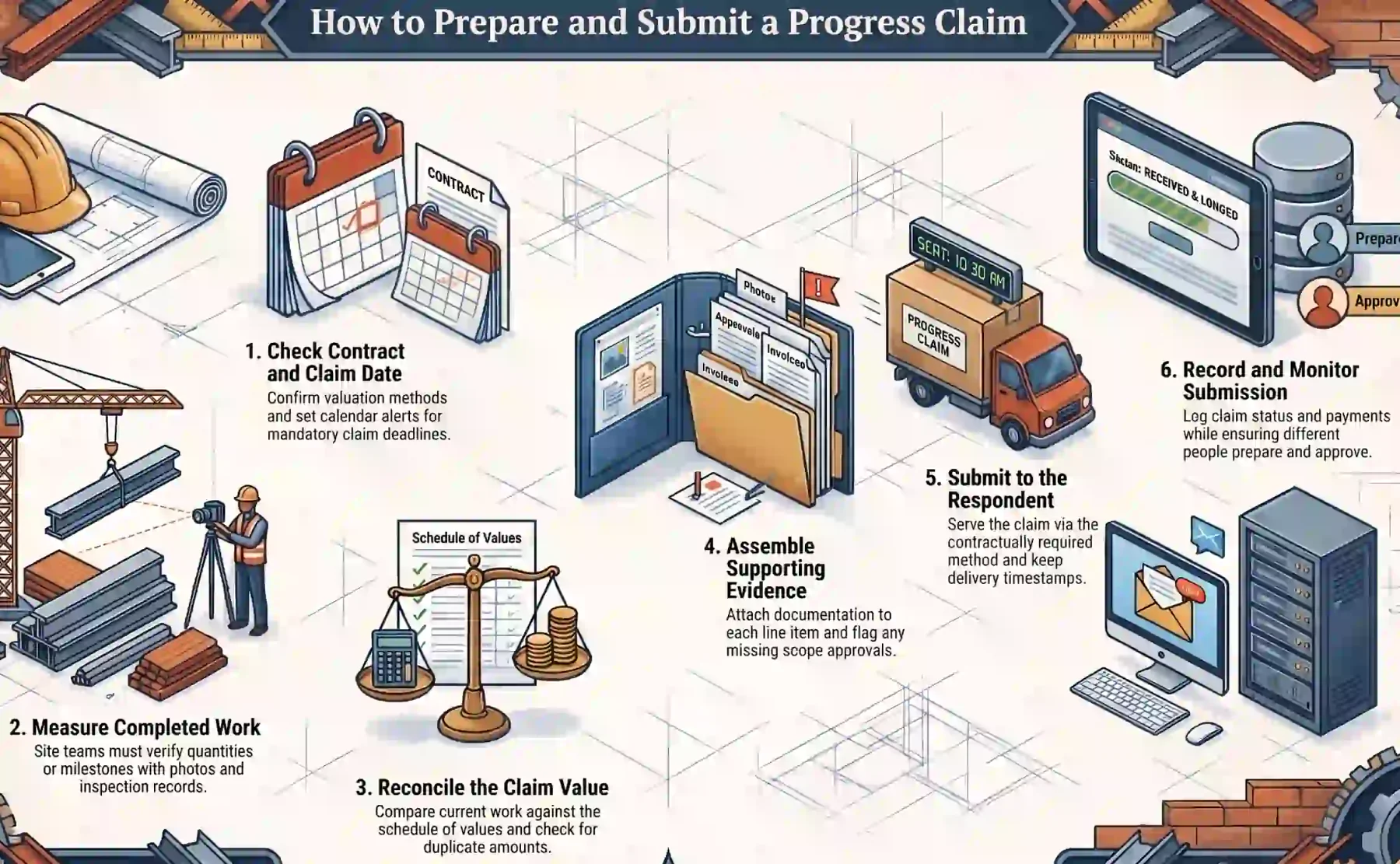
This workflow shows how to prepare a progress claim while keeping ownership clear and the record auditable. Each step names the responsible role so preparation, review and approval never collapse into one person.
1. Check the Contract and Claim Date
The contract administrator confirms the claim date, valuation method, eligible amounts, recipient, and service procedure. The contract register stays the source of truth, and a calendar alert flags upcoming dates.
2. Measure Completed Work
The site team measures completed quantities or confirms that milestones are met, backed by measurement sheets, photos and inspection records. Reviewers should challenge unsupported percentages, not accept them.
3. Reconcile the Claim Value
The preparer compares current work with the schedule of values, approved variations, prior claims, payments and retention. Cumulative controls in the construction financial records catch duplicated or omitted amounts early.
4. Assemble Supporting Evidence
The claim owner attaches evidence to each line and checks document versions. Missing approvals or unsigned variation instructions should be flagged, never quietly treated as approved scope.
5. Submit to the Correct Respondent
An authorised person serves the claim on the right party, using the method the contract and rules require. Verify recipient details first, then keep the sent document, timestamp and proof of delivery.
6. Record and Monitor the Submission
Finance or contract administration logs the submission date, claimed amount, response status, assessed amount and payment receipt. Separating duties keeps one person from preparing, checking and approving alone.
What Australian Rules Apply to Progress Claims?
Australian progress claim rules come from two sources: the contract itself and the security-of-payment regime in the relevant state or territory. They can overlap, but they are not interchangeable.
1. Contractual Claim vs Statutory Payment Claim
A contractual claim follows the procedure the parties agreed, including valuation rules, dates and certification. A statutory payment claim may carry extra rights if eligibility, content, timing and service are met.
A document's status cannot be read from its title alone. The contract, project location, parties, claim content and method of service all decide whether statutory protection applies.
2. Security-of-Payment Rules by State and Territory
Australia has no single national security-of-payment procedure, so the operative rules depend on where the work is performed. Verify the current legislation and official guidance before relying on statutory rights.
| Matter to Verify | Why Verification Is Necessary |
|---|---|
| Eligibility | The legislation may define covered contracts, claimants and exclusions |
| Claim or Reference Date | The right to submit may depend on the contract and current legislation |
| Prescribed Content | Particular identification or statements may be required |
| Service Method | Valid service may depend on where and how the claim is delivered |
| Response Period | Timeframes may differ between jurisdictions and circumstances |
| Payment Consequences | The effect of a scheduled amount or missing response is jurisdiction-specific |
| Adjudication Rights | Application procedures, timing and remedies need current legal review |
Each jurisdiction sets its own detail. For example, New South Wales security-of-payment legislation differs from the Queensland or Victorian regimes, so confirm the rules for your project's location.
This is why whether a progress claim is legally binding has no single answer. Contractual effect, statutory status and enforceability depend on the facts, so seek qualified advice when payment is disputed.
3. GST and Tax-Invoice Treatment
GST and tax-invoice treatment should be reviewed apart from the contractual valuation. Finance must decide when a valid tax invoice is required, if the claimant is registered for GST, and how amounts are recorded.
Check current Australian Taxation Office guidance and professional tax advice for the specific transaction. Current ATO GST guidance helps confirm invoice timing, wording and the right accounting entry.
How Are Variations, Retention and Previous Payments Calculated?
A progress claim starts with cumulative earned value, then reconciles approved variations, prior payments, retention and adjustments. The current claim is the movement for the period, not the whole cumulative value.
1. Original Contract Work and Percentage Complete
Each work package is valued by the method the contract sets. Where percentage complete is allowed, cumulative earned value equals the schedule-of-values amount multiplied by the assessed percentage complete.
The percentage must rest on measurement or milestone evidence. It should never be chosen simply to reach a target cash figure, since an inflated claim usually returns as an assessed reduction later.
2. Approved Variations
Variations should be drawn from a controlled register showing scope, approval status, value, date and prior claims. Unapproved changes may need separate treatment, so including them unmarked can hide cost exposure.
3. Previous Payments and Cumulative Value
The preparer reconciles cumulative work claimed with previously certified or scheduled amounts and actual payments. Any gap between certified and paid values should stay visible in the primary company ledger.
4. Retention and Defects Liability
Retention is calculated under the contract, often as a percentage subject to a cap. The amount held or released can change at milestones such as practical completion or the end of the defects-liability period.
For example, if an otherwise payable amount is AUD 100,000 and the contract requires 5% retention within its cap, AUD 5,000 is withheld, and AUD 95,000 remains before any GST. This figure is illustrative only.
5. Worked Progress Claim Example
Assume a commercial project has the values below for the current assessment. The source records would include the schedule of values, progress measurements, variation approvals, certificates and retention register.
| Calculation Item | Amount |
|---|---|
| Cumulative Original Contract Work Completed | AUD 720,000 |
| Approved Variations Completed | AUD 80,000 |
| Gross Cumulative Value | AUD 800,000 |
| Less Cumulative Retention | AUD 40,000 |
| Less Previous Certified Amounts | AUD 610,000 |
| Current Amount Before Applicable GST | AUD 150,000 |
If previous payments differ from previously certified amounts, track that gap separately rather than hiding it inside the current valuation. Clear separation keeps both the claim and the forecast trustworthy.
What Happens After a Progress Claim Is Submitted?
After submission, a claim may be approved in full, reduced, or disputed. It can also draw a request for clarification or, in some cases, no recorded response within the period the team is monitoring.
1. Claim Assessment and Payment Schedule
The assessor checks the claim against the contract, site progress and evidence. Depending on the contract and law, the respondent may issue a payment schedule, while a superintendent may issue a payment certificate.
| Status | Required Record | Process Owner | Next Control |
|---|---|---|---|
| Full Approval | Schedule, certificate or approval record | Contract administrator | Confirm invoicing and payment status |
| Partial Approval | Assessed amount and reasons for reduction | Commercial manager | Reconcile the difference and forecast impact |
| Clarification Requested | Information request and response | Claim owner | Track outstanding evidence and resubmission |
| No Recorded Response | Claim, service proof and response log | Contract administrator | Check jurisdiction-specific consequences promptly |
| Formal Dispute | Correspondence and disputed-item register | Authorised commercial or legal representative | Follow the contractual or statutory process |
2. Scheduled Amount and Reasons for Reduction
A claimed amount may be cut for measured quantity differences, unmet milestones, unsupported variations, defective work, wrong rates or deductions. Each reason should be recorded beside the assessed value.
Recording only the reduced total is not enough. Keeping the reasons lets project and finance teams see the effect on margin, cash flow and future claims, and prepare a focused response or resubmission.
3. Payment, Adjudication or Contractual Dispute
Approved amounts move into invoicing, accounts payable and settlement. Disputed amounts should stay visible without being treated as received cash, so the forecast reflects only money that is genuinely due.
If no payment schedule is issued, the consequences differ by regime. Preserve proof of service, confirm the response period and seek qualified advice before relying on statutory remedies or starting adjudication.
Progress Claim Checklist: How to Control Claims and Approvals
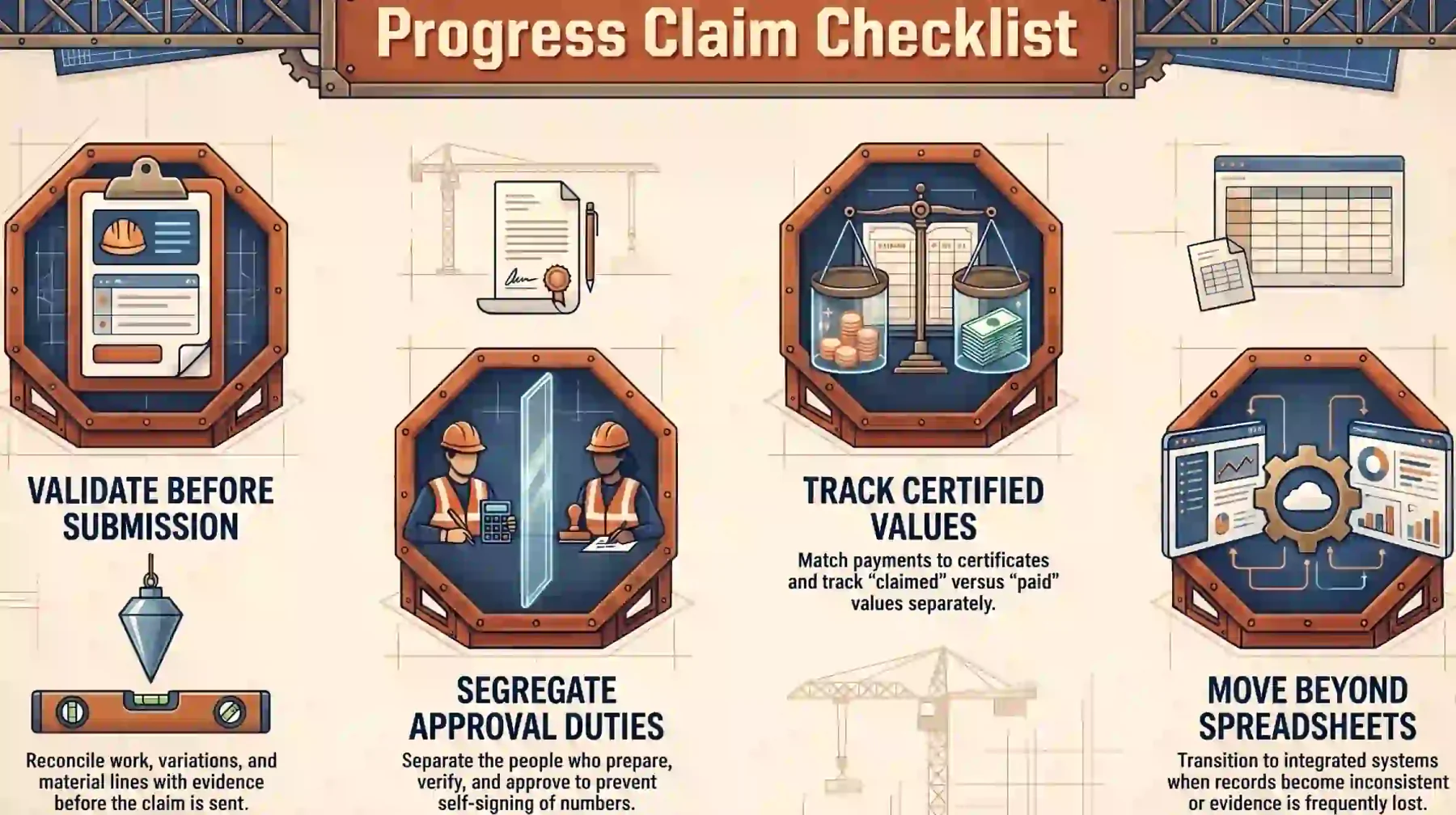
Strong control comes from clear ownership, not extra reviews after the fact. Group the checks into pre-submission, review and approval, and payment stages so responsibility is obvious at every step.
1. Pre-Submission Controls
Before the claim goes out, confirm the current contract record, claim date, recipient and schedule of values. Link each material line to evidence and reconcile work, variations, prior payments and retention.
2. Review and Approval Controls
Separate the people who prepare, verify and finally approve a material claim so no one signs off their own numbers. Independent review of large claims catches wrong rates, duplicate totals and unsupported variations.
3. Payment and Close-Out Controls
After approval, match the payment to the certificate or schedule and update the claim status. Track claimed, scheduled, certified, invoiced and paid values separately so a submitted claim is never mistaken for cash.
4. When Spreadsheets Are No Longer Enough
Spreadsheets fail when the same claim value cannot be traced across site, commercial and finance records. Wrong dates, reused totals, inconsistent retention and lost proof of service are the usual warning signs.
ERP software connects contract values, variation registers, approvals, accounting entries and payment status in one governed flow. HashMicro delivers this in a single construction management system.
A useful business case starts with a baseline: preparation time, reconciliation effort, unresolved exceptions and visibility gaps today. That baseline shows where a connected system would pay back fastest.
Most of that reconciliation effort comes from claim data sitting in three places at once: the site record, the commercial register, and the finance ledger. When those share a system, Hashy AI reads them together and flags claims that are stuck in assessment or still missing the evidence a reviewer will ask for.






Conclusion
A progress claim construction process is only as reliable as the records around it. Site evidence, contract values, approved variations, retention and payment status must stay connected across the whole lifecycle.
Start by mapping the current process and finding where data is rekeyed or approved without evidence. Then set ownership, source records and escalation rules, and talk to HashMicro about a connected claim workflow.
If you want to learn more, you can book a free consultation with our experts today. Start anytime and implement your own progress claim.

Frequently Asked Questions
A progress claim requests payment for completed work and starts an assessment, while an invoice bills the amount and supports accounts payable. Some contracts require assessment before a tax invoice is issued.
Frequency depends on the contract, applicable claim dates and the security-of-payment legislation in the relevant state or territory. Monthly claims are common, but always verify the current jurisdictional rules.
A controlled claim identifies the claimant, respondent, project, contract, claim date and period, then shows completed work, variations, previous payments, retention, GST treatment and the amount claimed.
It can, when the contract allows it and the claimant proves entitlement using approved variation records and evidence of ownership, delivery, secure storage and insurance for stored materials.
Consequences vary by state or territory regime. Preserve the submitted claim and proof of service, check the applicable response period, and seek qualified advice before relying on statutory rights.
Retention is calculated under the contract, commonly as a percentage subject to a cap. For example, 5% on a payable AUD 100,000 withholds AUD 5,000, often released at practical completion.