








 Limited to 100 registrants

A manufacturing AI agent monitors production data, detects problems, investigates causes, recommends corrective actions, and coordinates follow-up before issues escalate.
It reads ERP, MES, machine, quality, and inventory data, compares actual performance with the plan, and acts within defined approval boundaries when deviations occur.
Key Takeaways
A manufacturing AI agent monitors production data, investigates deviations, and supports controlled corrective action.
Governed autonomy allows the agent to respond while humans retain control over material decisions.
A continuous operational loop connects detection, investigation, approval, follow-up, and audit records.
Production bottleneck investigations become faster when planners review machines, labour, materials, capacity, and orders together.

What Is a Manufacturing AI Agent?
A manufacturing AI agent monitors production, inventory, quality, and machine data, detects deviations, investigates contributing factors, and prepares corrective actions within defined approval limits.
Standard manufacturing software records production activity for planners to interpret. An AI agent examines those records, traces the cause of an issue, and sends a supported recommendation to the right person.
The agent does not replace ERP, MES, or maintenance systems. It operates across them as an intelligence layer, while approved transactions and production records remain in their source systems.
Manufacturing AI Agent vs Other AI Technologies
Manufacturing AI covers tools with different capabilities and limits. Knowing where an AI agent sits among them helps teams match the technology to the right operational problem.
Manufacturing AI agents belong to a broader category of intelligent systems, and understanding the difference between AI agents and agentic AI helps clarify what level of autonomy and coordination a manufacturing deployment actually involves.| Technology | What it does | What it cannot do |
|---|---|---|
| AI chatbot | Answers questions about production status or procedures | Does not monitor systems, detect issues, or coordinate actions independently |
| AI copilot or assistant | Helps planners analyse data, draft schedules, and summarise reports | Requires user direction and does not manage an entire workflow |
| Rules-based automation | Executes fixed actions when predefined conditions are met | Cannot investigate unfamiliar conditions or adapt its response |
| Predictive analytics | Forecasts equipment failures, demand, or other likely outcomes | Does not investigate causes or coordinate the operational response |
| Robotic process automation (RPA) | Completes structured and repetitive tasks across software systems | Cannot apply judgement when data or conditions fall outside its rules |
| Manufacturing AI agent | Monitors data, investigates deviations, recommends actions, and coordinates follow-up | Requires reliable data, clear permissions, and defined approval controls |
The key distinction is governed autonomy. Fixed automation follows programmed logic, while an AI agent investigates and responds to changing conditions within limits set by the organisation.
How a Manufacturing AI Agent Works
A manufacturing AI agent follows a continuous operational loop. It monitors connected records, investigates deviations, coordinates approved responses, and records the result.
1. Monitor production and operational data
The agent reads production orders and output from ERP, machine status from MES or sensors, inspection results, inventory balances, and supplier delivery records.
Monitoring frequency reflects the workflow. Equipment warnings may require immediate signals, while material-readiness checks may run at scheduled intervals.
2. Detect a deviation or constraint
The agent compares actual conditions with schedules, specifications, and operating thresholds. It may identify low output, insufficient materials, excessive downtime, or rising defect rates.
Instead of forwarding raw data, it opens an investigation when the deviation meets the factory’s defined exception criteria.
3. Investigate affected resources and orders
If a work centre falls behind schedule, the agent checks machine availability, labour hours, material supply, quality holds, and the status of preceding operations.
This provides the planner with a supported diagnosis rather than another alert that still requires several records to be checked manually.
4. Recommend a corrective action
The agent may recommend resequencing orders, moving work to another line, expediting materials, scheduling maintenance, or escalating a quality hold.
Each proposal should include its evidence, assumptions, operational impact, and unresolved risks so the planner can assess the trade-offs.
5. Request approval when required
Changes affecting schedules, purchases, inventory, or quality status are routed to an authorised person. The agent prepares the action without approving its own proposal.
Low-risk notifications may run automatically, while purchase orders and changes to production planning normally require sign-off.
6. Coordinate follow-up across systems
Once approved, the agent can update a permitted ERP workflow, create a maintenance work order, notify a supplier, or adjust a material requirement.
This coordination reduces manual handoffs while keeping ERP, maintenance, quality, and inventory systems as the official transaction records.
7. Record the outcome
The agent records the original deviation, evidence reviewed, recommendation, approver, completed action, and recovery result in an auditable history.
Teams can use these outcomes to refine thresholds, approval policies, and response rules without removing human oversight from material decisions.
Core Manufacturing AI Agent Use Cases
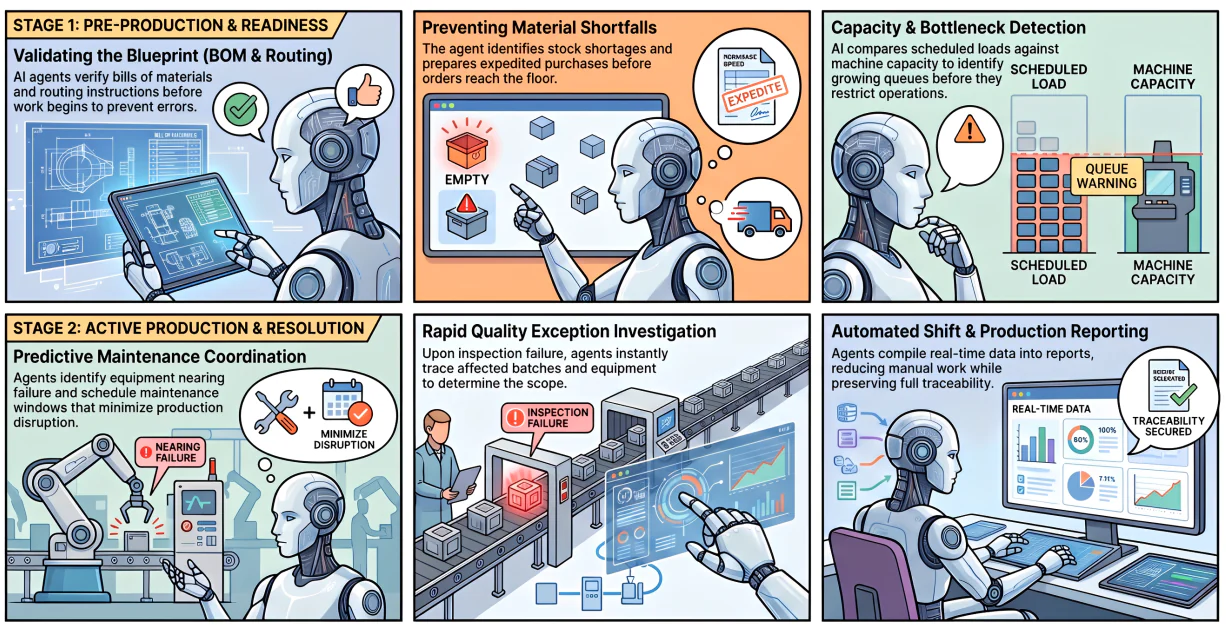
The most useful applications involve frequent, time-sensitive decisions where slow detection or manual investigation can disrupt several production activities.
1. Production planning and scheduling
AI agents compare output with schedules and recommend sequencing changes based on capacity, materials, and order priority.
Planners can address emerging constraints during production instead of waiting for the next planning meeting.
2. Material requirements monitoring
Connected to an MRP system , the agent checks production Connected to an MRP system, the agent checks requirements against stock, reservations, open purchases, and supplier lead times.
When materials run short, it identifies affected jobs and prepares a purchase or inter-site transfer for review.
3. BOM and routing checks
Before production begins, the agent checks BOMs, units, routing operations, work centres, and revision details.
It flags missing components or outdated instructions before they disrupt work on the factory floor.
4. Capacity and bottleneck detection
The agent compares scheduled workloads and work-in-progress with available capacity at each work centre.
It identifies orders at risk and presents alternative machines, shifts, or sequencing options to the planner.
5. Quality exception investigation
After an inspection failure, the agent traces the affected batch, materials, equipment, operations, and related orders.
Quality teams receive the evidence needed to quarantine, reinspect, rework, or investigate the affected output.
6. Predictive maintenance coordination
Machine readings, operating hours, and maintenance history can reveal when equipment may need attention.
The agent checks production commitments and recommends a maintenance window that limits disruption.
7. Inventory and work-in-progress monitoring
The agent compares raw materials, WIP, and finished goods with the production plan to identify unusual stock movements.
Rising WIP at one operation may reveal a downstream constraint before individual orders show a delay.
8. Production report generation
Shift and daily reports compile output, downtime, quality results, material use, and open exceptions.
Automated reporting preserves traceability and gives planners more time to review and resolve production issues.
How an AI Agent Handles a Production Bottleneck
This walkthrough shows how an agent responds when output begins falling behind plan at a constrained work centre during an active production shift.
1. Detect output below plan
Fresh production data shows that completed units have fallen below the scheduled rate. The agent opens an exception once the gap reaches the factory’s defined tolerance.
2. Identify the constrained work centre
The agent locates the operation producing below plan and calculates its current shortfall. It also checks whether delayed reporting is creating a false bottleneck signal.
3. Check machines, labour, materials, and preceding operations
Machine availability, maintenance alerts, scheduled labour, material supply, quality holds, and incoming WIP are reviewed together to identify contributing factors.
This prevents the investigation from assuming that low output has one obvious cause when several constraints may be affecting the same work centre.
4. Estimate downstream order impact
The current shortfall is mapped to dependent operations, internal production orders, and customer commitments. The agent shows what may be delayed if output does not recover.
5. Recommend resequencing or resource changes
Possible responses may include moving work to another line, changing labour allocation, expediting materials, or processing ready orders before blocked jobs.
Each option should show which commitments it protects and whether it creates a new delay, cost, or capacity constraint elsewhere.
6. Escalate for planner approval
The production planner receives the proposed response with the supporting capacity, material, order, and timing data. They can approve, modify, or reject it.
7. Monitor the recovery action
After approval, the agent compares actual output with the revised recovery target. If the response is insufficient, it reopens the exception or escalates the remaining risk.
Production bottlenecks are easier to resolve when orders, materials, machines, and capacity are reviewed together. See below how Hashy AI turns that connected context into a supported response for planners.






Manufacturing AI Agents and Predictive Maintenance
Predictive maintenance links machine warnings with production schedules, spare-parts availability, and maintenance capacity, helping teams plan repairs before equipment failure disrupts output.
The agent compares vibration, temperature, pressure, cycle counts, and operating hours with normal ranges. When conditions change, it investigates the risk and proposes a suitable service window.
Siemens explains how condition monitoring analyses machine data to detect early equipment degradation. After approval, the agent can prepare a CMMS work order and related schedule changes.
Benefits and Manufacturing KPIs
Manufacturers should measure AI agents against their own operating baselines. The Australian Government’s Manufacturing Industry Australia resources provide broader sector context.
- Schedule adherence: Divide production orders completed on time by all scheduled orders, then multiply by 100. Track whether earlier exception handling improves the result.
- Unplanned downtime: Record unplanned stop minutes by asset, work centre, shift, and cause. Compare the rate before and after maintenance coordination begins.
- Material variance: Compare actual material consumption with standard BOM usage in both quantity and value to identify waste, substitutions, or inaccurate reporting.
- Quality defect rate: Divide rejected or reworked units by total output. Also measure how much production continues after the first defect signal appears.
- Planning cycle time: Measure the time spent compiling reports, tracing exceptions, and preparing corrective actions before and after deployment.
- Exception-response time: Track the interval from detecting a deviation to approving a response. This directly shows whether investigation and escalation are becoming faster.
Performance targets should reflect each factory’s baseline, equipment, product mix, and data quality rather than using a universal improvement percentage.
A Staged Manufacturing AI Agent Implementation
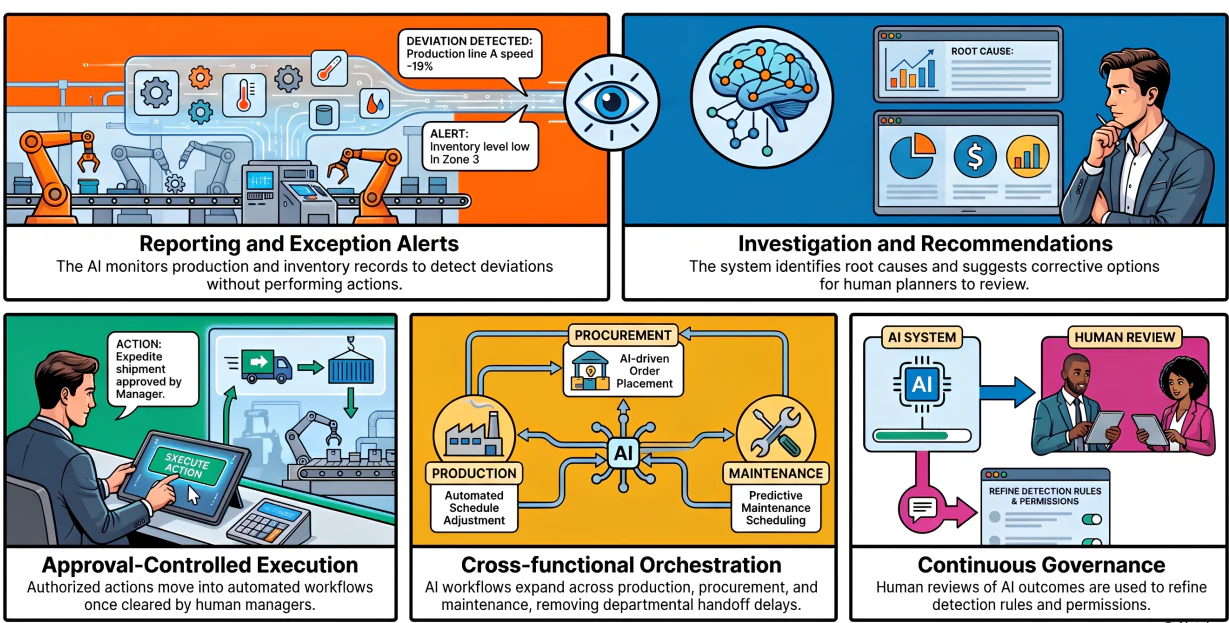
A manufacturing AI agent should gain broader responsibilities only as data quality, user confidence, and governance mature. This progression keeps authority aligned with operational risk.
1. Reporting and exception alerts
The initial rollout uses read-only access to production, quality, and inventory records. It detects deviations and generates alerts without recommending or performing actions.
Teams can compare each alert with the underlying records to confirm that the data and detection rules are reliable.
2. Investigation and recommendations
The system begins tracing affected orders, materials, machines, and operations. It presents likely causes and corrective options, while planners retain the final decision.
This allows users to assess the reasoning and evidence behind each recommendation before broader workflow access is introduced.
3. Approval-controlled workflow execution
Approved actions can now move into connected workflows, such as updating schedules, preparing work orders, or sending authorised supplier notifications.
Controls define which routine actions run automatically, which need one approver, and which require escalation to another responsible manager.
4. Cross-functional orchestration
The workflow expands across production, procurement, maintenance, inventory, and quality instead of relying on separate departmental handoffs.
Connected manufacturing resource planning records and tested approval rules are required before cross-functional actions are enabled.
5. Continuous optimisation with governance
Recorded outcomes show which recommendations supported recovery, where users applied overrides, and which thresholds produced unnecessary or incomplete alerts.
Regular governance reviews use that evidence to refine permissions, detection rules, and approval policies while keeping behaviour within intended limits.
"Manufacturing teams should expand an AI agent’s authority only after its data, recommendations, and approval controls have proved reliable in daily operations."
How HashMicro's Manufacturing AI Agent Supports Production Teams
HashMicro's Manufacturing AI Agent monitors schedules, material requirements, BOMs, routings, quality exceptions, and maintenance needs using connected manufacturing records from one environment.
When a production issue appears, it can review current stock, supplier lead times, work-centre status, and affected orders before preparing a supported recommendation for planner approval.
This setup suits Australian manufacturers that need AI support tied to operations. Explore the HashMicro Manufacturing AI Agent to review its connected production workflows and approval controls.
Conclusion
Manufacturing AI agents monitor production, detect deviations, investigate contributing factors, and prepare corrective actions within defined approval boundaries.
Australian manufacturers can identify a suitable starting workflow and review their data requirements through a free consultation with us.

Frequently Asked Questions About Manufacturing AI Agents
Yes. Older machines can provide data through MES connections, sensors, IoT gateways, or structured operator records. The appropriate method depends on the equipment, available interfaces, and required monitoring frequency.
Access should follow role-based permissions, least-privilege rules, approval controls, and audit logging. Sensitive records should remain protected through the same security policies applied to connected manufacturing systems.
Yes. Smaller manufacturers can begin with a narrow workflow such as exception alerts, production reporting, or material monitoring, then expand its responsibilities after confirming data quality and user confidence.
Testing should cover data mappings, exception rules, permissions, approval routing, fallback procedures, and audit records. Teams should also confirm that users can trace each recommendation to its supporting evidence.
The manufacturer remains accountable for operational decisions. Named process owners and authorised approvers should review material actions, while the agent records its evidence, recommendation, and approval history.