

 Limited to 100 registrants
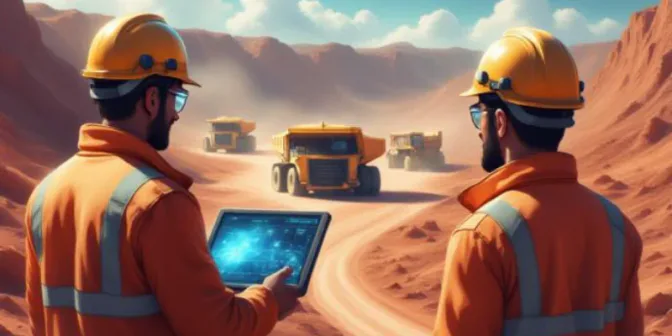
Mining automation uses technologies such as remote-operated equipment, automated drilling, process control, and robotics to improve efficiency, safety, and productivity across mining operations.
Australia is a global leader in mining automation, with many mines already using automated equipment. Successful implementation depends on reliable systems, strong safety practices, and skilled workers.
This guide explains how mining automation works, its key applications and benefits, and what mining companies should consider before adopting automation.
Key Takeaways
Mining automation combines equipment, sensors, control systems, and communication networks to improve mining operations.
Autonomous mining is one type of mining automation, not the entire concept.
ERP software connects automation with maintenance, inventory, procurement, workforce, and financial management, rather than controlling autonomous equipment.
Reliable automation depends on safety, connectivity, system integration, and workforce readiness.

What Is Mining Automation?

Mining automation is the use of technology to automate mining tasks with minimal human intervention. It includes automated equipment, sensors, control systems, and communication networks across mining operations.
These systems can automate equipment, production processes, and data sharing between mining sites, processing plants, and other operational facilities. This improves efficiency, consistency, and operational visibility.
Although many tasks are automated, people remain responsible for monitoring operations, managing exceptions, maintaining equipment, and ensuring safe and reliable performance.
Mining Automation vs Autonomous Mining
Mining automation is the broader concept, while autonomous mining is a type of automation where equipment performs tasks with minimal human intervention.
| Mining Automation | Autonomous Mining |
|---|---|
| Automates specific tasks or processes | Operates equipment with minimal human input |
| Requires varying levels of human supervision | People mainly monitor and manage exceptions |
| Includes remote operation, process control, and operator assistance | Includes autonomous haul trucks, drills, and loaders |
A mining operation can use both approaches. For example, a mine may operate autonomous haul trucks while using automated process control and manually operated support equipment.
"Mining automation creates the greatest value when technology, people, and processes work together."
What Can Be Automated in a Mine?
Mining automation can be applied across many daily operations to improve efficiency, safety, and productivity, including:
- Equipment operation and dispatch
- Drilling and repetitive tasks
- Crushing and mineral processing
- Ventilation, pumping, and dewatering
- Environmental monitoring
- Stockpile measurement and inspections
- Remote operations and site coordination
The right level of automation depends on the mine's operational needs, infrastructure, and safety requirements.
How Does Mining Automation Work?
Mining automation connects equipment, sensors, control systems, and software to automate mining tasks. Real-time data is collected, processed, and used to coordinate operations while allowing teams to monitor performance and respond when needed.
1. Sensors and machine telemetry
Sensors collect real-time data such as equipment condition, location, temperature, and environmental conditions. This information helps monitor operations and supports accurate decision-making.
2. Local and onboard control systems
Onboard controllers process sensor data and automatically operate equipment within predefined safety limits. They also help maintain safe operations if communication is interrupted.
3. Site-wide automation and fleet coordination
Central automation platforms coordinate equipment, production, and material movement across the mine. This improves efficiency by reducing delays and keeping operations connected.
4. Remote operations centres and human oversight
Remote operations centres allow teams to monitor and manage mining equipment from a central location. While many tasks are automated, people remain responsible for supervision, maintenance, and handling unexpected situations.
What Are the Levels of Mining Automation?
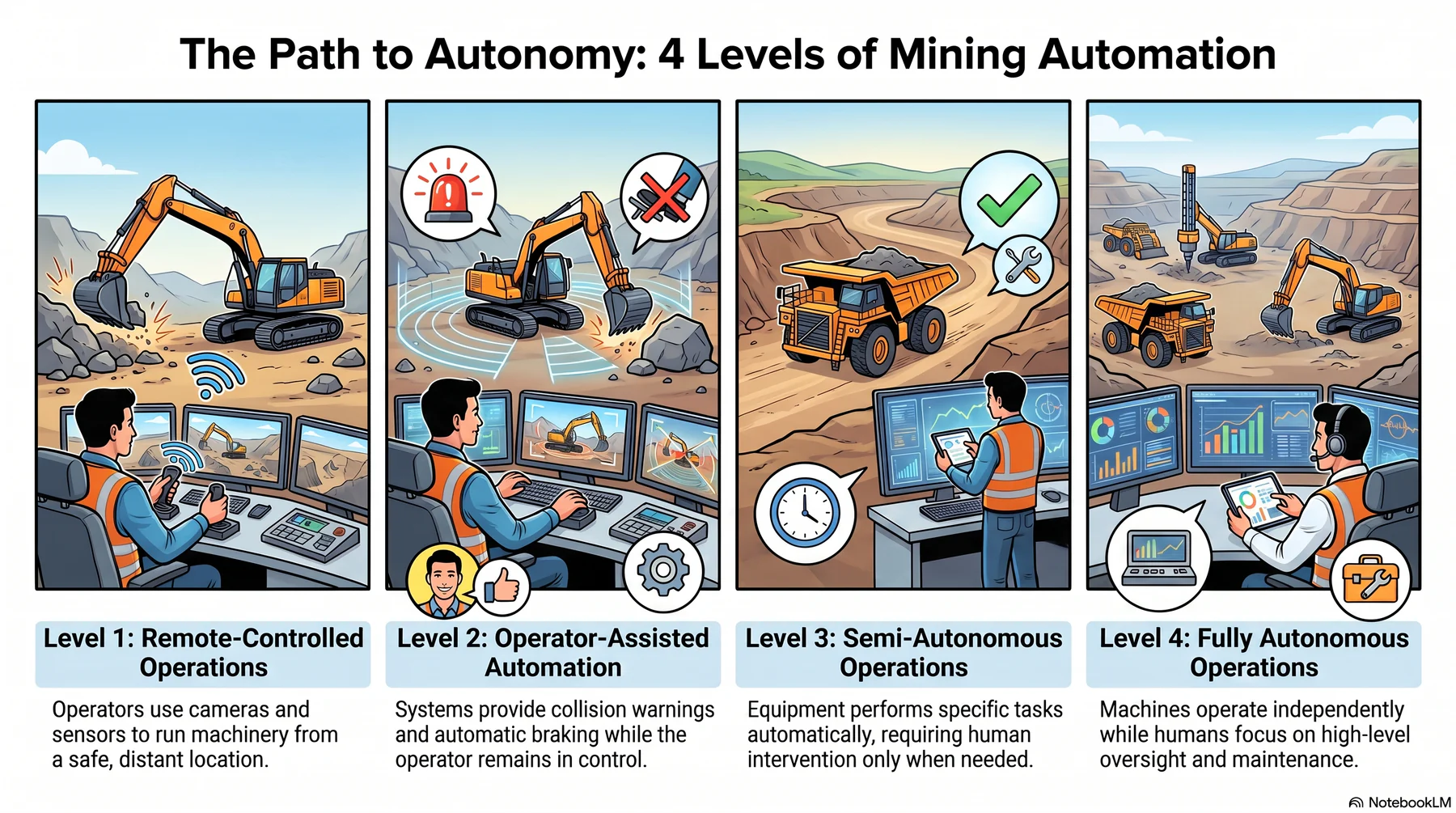
Mining automation is introduced gradually, allowing companies to improve efficiency and safety at a pace that matches their operational needs. Most mines combine different levels of automation across equipment and processes.
1. Remote-controlled operations
Operators control equipment from a safe location while using cameras and sensors to monitor the work area. This approach is commonly used in hazardous environments such as underground mines.
2. Operator-assisted automation
The operator remains in control while the system assists with functions such as collision warnings, automatic braking, speed control, and drill guidance. It improves safety without removing human oversight.
3. Semi-autonomous operations
Equipment can complete specific tasks automatically while operators monitor performance and step in when needed. This helps improve productivity and reduce repetitive manual work.
4. Fully autonomous operations
Autonomous equipment performs tasks with minimal human intervention, while teams oversee operations, maintenance, and safety. Although equipment operates independently, people remain responsible for managing the overall mining operation.
What Are the Main Applications of Automation in Mining?
Mining automation can be applied across the entire mining value chain, from extraction and processing to environmental monitoring. It helps improve productivity, safety, and operational efficiency by automating repetitive and high-risk tasks.
1. Autonomous haulage and mobile equipment
Automation enables haul trucks and other mobile equipment to operate more efficiently by managing routes, speeds, loading, and material transport with minimal human intervention.
2. Automated drilling and blasting
Automated drilling systems improve drilling accuracy and consistency while reducing manual work. They also help optimise blast planning and overall mining performance.
3. Remote operations and fleet coordination
Remote operations centres allow teams to monitor equipment, production, and fleet activities from a central location. This improves coordination across multiple mining sites.
4. Materials handling and mineral processing
Automation controls conveyors, crushers, ore sorting, and processing equipment to improve material flow, increase efficiency, and reduce operational delays.
5. Ventilation, dewatering, and environmental monitoring
Automated systems monitor airflow, water levels, gas, dust, and other environmental conditions to improve safety and maintain stable mining operations.
6. Robotics, drones, and automated inspection
Robots and drones inspect hazardous or hard-to-reach areas, helping mining companies improve safety while collecting accurate inspection and survey data.
What Are the Benefits of Mining Automation?
Mining automation helps companies improve safety, productivity, and operational efficiency. Key benefits include:
Improved worker safety: Reduces worker exposure to hazardous tasks by using remote and automated equipment.
More consistent production: Delivers accurate and reliable performance with fewer manual errors.
Better equipment performance: Monitors equipment in real time to reduce downtime and improve maintenance.
Greater resource efficiency: Optimises the use of fuel, energy, water, and materials to lower operating costs.
Increased operational visibility: Provides real-time data and insights for faster, more informed decision-making.
What Are the Risks and Challenges of Mining Automation?
Mining automation offers many benefits, but successful implementation requires disciplined mining project management, reliable technology, and a skilled workforce. Common challenges include:
Mixed-fleet safety: Managing autonomous and manually operated equipment safely within the same mining site.
System integration: Connecting automation systems with existing equipment, mining management software, and business platforms.
Reliable connectivity: Maintaining stable communication networks to support automated equipment and remote operations.
Cybersecurity: Protecting connected systems from cyber threats and preventing operational disruptions.
Workforce readiness: Training employees with the skills needed to operate, monitor, and maintain automated systems.
Implementation costs: Investing in infrastructure, system integration, maintenance, and change management to support long-term success.
How Does Mining Automation Connect with ERP?
Mining automation controls equipment and operational processes, while ERP manages the business activities that support them. Together, they connect operational data with maintenance, inventory, procurement, workforce, and financial management.
For example, when automated equipment reports a fault, the ERP system can create a maintenance work order, check spare parts availability, initiate purchasing if needed, assign technicians, and record repair costs. This creates a connected workflow from operations to business management.
How HashMicro Supports Connected Mining Operations
HashMicro Mining Management Software integrates maintenance, inventory, procurement, workforce management, accounting, and reporting into a single platform. This gives mining companies greater visibility over operational costs, equipment maintenance, and business performance.
Furthermore, businesses can gain smarter insights, automate routine workflows, and make faster data-driven decisions with Hashy AI, HashMicro's built-in AI assistant. Mining companies can also consult HashMicro's experts to identify the modules that best support their operational and business requirements.






What Is the Future of Mining Automation?
The future of mining automation will focus on greater connectivity between equipment, systems, and business operations. Advances in technology will help mining companies improve productivity, safety, and operational efficiency.
1. Greater interoperability
Future automation systems will better connect equipment from different manufacturers, making it easier to share data, coordinate fleets, and improve operational visibility.
2. Smarter and more sustainable operations
Automation will support electrification, energy management, water monitoring, and environmental controls, helping mining companies improve sustainability while reducing operating costs.
3. AI-powered mining
Artificial intelligence will enhance mining automation by analysing data, detecting anomalies, predicting equipment issues, and recommending operational improvements. Combined with automation, AI can help mining companies make faster and more informed decisions.
Conclusion
Mining automation helps companies improve safety, productivity, and operational visibility by automating equipment and connecting critical mining processes. Successful implementation depends on reliable technology, skilled teams, and a well-planned rollout.
Connecting automation with business systems further improves operational efficiency by linking maintenance, inventory, procurement, workforce management, and financial reporting.
Consult with HashMicro's experts to discover how an integrated Mining Management System can support your automation strategy and improve end-to-end mining operations.
FAQ
Mining automation uses equipment, sensors, and control systems to automate mining tasks and reduce manual intervention.
Mining automation includes all levels of automation, while autonomous mining refers to equipment that operates with minimal human input.
Equipment such as haul trucks, drills, loaders, conveyors, crushers, and pumps can be automated.
Mining automation improves safety, increases productivity, reduces downtime, and provides better operational visibility.
ERP connects automation data with maintenance, inventory, procurement, workforce, and financial management.