




Australian SMEs commonly wait 30 to 90 days for invoices to be paid while payroll, suppliers, and tax still fall due. As of May 2026, cash flow confidence among Australian SMEs has dropped to just 60%.
Invoice financing converts unpaid invoices into immediate working capital. It is not new debt but early access to money the business has already earned and is owed.
This article covers how invoice financing works, the three main types available in Australia, what it costs, who qualifies, and when it makes more sense than a business loan.
Key Takeaways
Invoice financing is a form of funding where unpaid invoices are advanced as working capital.
The right type depends on invoice volume, confidentiality needs, and whether you fund one invoice or the full ledger.
Invoice financing costs vary by provider, facility type, invoice value, and debtor quality.
Invoice financing suits businesses where cash flow pressure comes from slow-paying customers.

What Is Invoice Financing?
Invoice financing is a form of business funding where a lender advances cash against unpaid invoices. The business receives working capital immediately, and the advance is repaid automatically when the customer pays.
Unlike a business loan, invoice financing does not add a new liability with fixed repayments. Repayment moves with cashflow rather than against it, and no property collateral is required. The invoices themselves are the security.
Also called debtor finance, it is widely used by AU SMEs in construction, transport, manufacturing, and professional services where 30 to 90 day payment terms are standard. Strong accounts receivable management makes facilities easier to access.
The Three Types of Invoice Financing Available in Australia
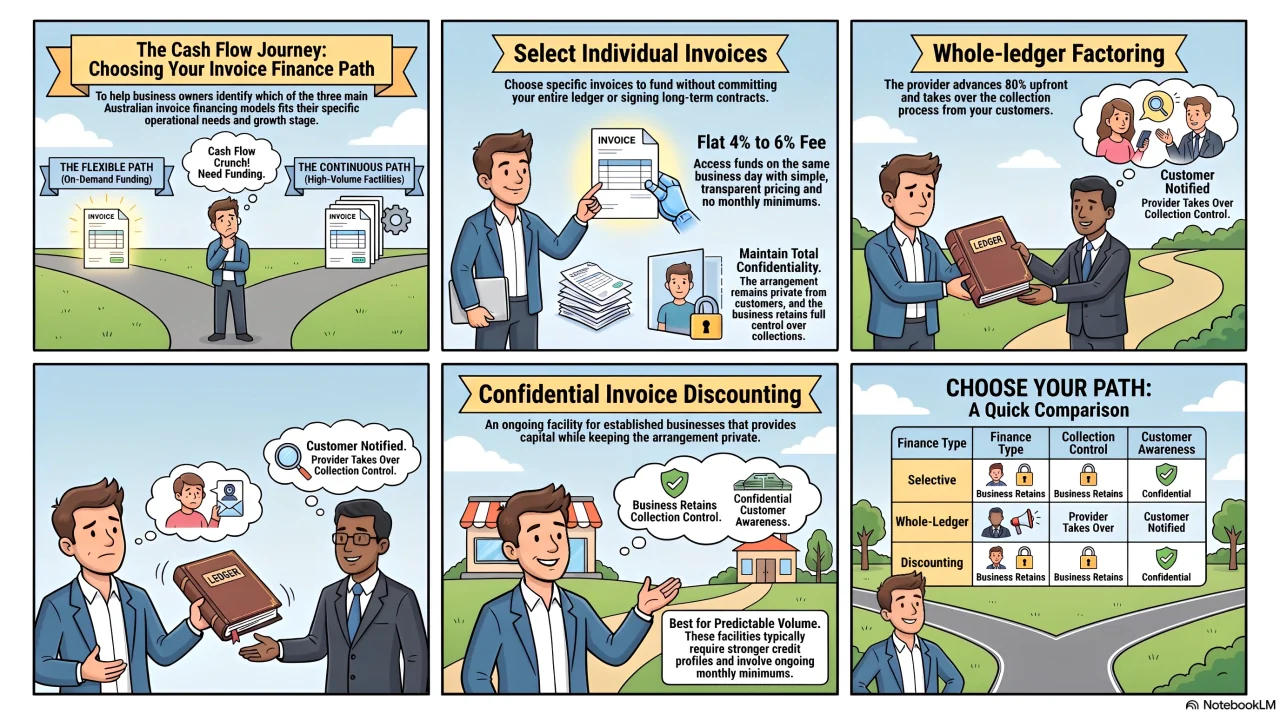
The right type depends on whether you want to fund individual invoices or your whole ledger, whether you need the arrangement kept confidential from customers, and how much volume you process monthly.
1. Selective (per-invoice) invoice finance
Selective invoice finance lets you choose which individual invoices to fund, with no whole-ledger commitment and no ongoing facility. It suits businesses that need occasional funding or want full control over which invoices they advance.
Providers like FundTap charge a flat 4 to 6% per invoice, keep the arrangement confidential from customers, and can have funds in a business account the same business day. There are no monthly minimums or lock-in periods.
2. Whole-ledger factoring
Whole-ledger factoring assigns your entire receivables ledger to the provider. The factor advances typically 80% of invoice value upfront and takes over collection from your customers, who are notified of the arrangement.
Providers like ScotPac and Earlypay serve higher-volume businesses that want their full book funded on an ongoing basis. The trade-off is reduced control over the customer relationship and collections process.
3. Invoice discounting
Invoice discounting is a confidential, ongoing facility where the business retains control of collections. Customers keep paying the business directly, and the arrangement remains private.
This type typically suits established businesses with predictable, high invoicing volume. It generally requires a longer trading history and stronger credit profile than selective finance, and most facilities come with monthly minimums.
| Selective invoice finance | Whole-ledger factoring | Invoice discounting |
|---|---|---|
| Commitment | Per invoice, no lock-in | Whole ledger, ongoing Ongoing facility |
| Confidentiality | Yes | No (customers notified) Yes |
| Collections | Business retains | Factor manages Business retains |
| Best for | Occasional funding needs | High-volume, ongoing Established, high-volume |
| Typical advance rate | 80–90% | 70–85% 80–90% |
| AU providers | FundTap, Fifo Capital | ScotPac, Earlypay Major banks, ScotPac |
How Invoice Financing Works in Practice
The process varies slightly by provider and type, but the core steps are consistent across AU invoice financing facilities.
- Issue the invoice as normal. Raise the invoice to your customer with standard payment terms of 30, 60, or 90 days.
- Submit the invoice to the financier. Via the provider's portal or directly throughintegrated accounting software integrated accounting software such as Xero or MYOB.
- Receive the advance. Typically 70 to 90% of the invoice value within 24 to 48 hours of approval.
- Customer pays on their normal terms. Payment goes to the financier (factoring) or to a trust account (discounting).
- Receive the balance minus fees. The remaining percentage is returned to the business once the invoice is settled.
Once a facility is established and connected to accounting software, submitting each invoice takes minutes. Most AU providers can have funds in a business bank account within 24 hours of submission.
What Does Invoice Financing Cost in Australia?
Invoice financing costs vary by provider, facility type, invoice value, and customer credit quality. Understanding the fee structure upfront prevents surprises when the first invoice is settled.
1. Discount or factoring fee
The main cost is the discount or factoring fee, typically 1 to 3% of invoice value per month for whole-ledger factoring. Selective finance usually charges a flat fee per invoice, such as FundTap's 4 to 6% for the full funding period.
Some providers reduce the fee if the customer pays early. Always confirm whether the rate quoted is monthly or for the full invoice term, as the difference significantly affects total cost.
2. Service or administration fee
Some providers charge an ongoing service fee on top of the discount rate, covering account management, debtor monitoring, and collections for factoring facilities. Not all providers charge this separately.
Ask for a total cost illustration before signing, including both the discount fee and any service or administration charges, so you can compare providers on a like-for-like basis.
3. Establishment and ongoing fees
Whole-ledger and discounting facilities often include a setup fee and monthly minimums. Selective invoice finance typically has neither, making it more accessible for businesses with irregular funding needs.
Factor these into the total cost calculation, particularly if monthly minimums apply and your invoice volume is inconsistent.
Invoice financing generally costs more per dollar than a bank overdraft but less than a business credit card. For businesses where the cost of waiting 60 to 90 days outweighs the fee, it is often the more practical option.
Who Qualifies for Invoice Financing in Australia?
Eligibility is generally more accessible than traditional business loans, but specific requirements apply to both the business and the invoices being financed.
1. Business requirements
Most AU providers require at least six months of trading history, though some accept newer businesses with strong B2B contracts. The business must be registered and operating in Australia with invoices issued in AUD.
B2B invoices only. Invoices issued to consumers are generally excluded because consumer law provides different protections that reduce the security value for lenders.
2. Invoice requirements
Invoices must be for completed goods or services already delivered, not for work in progress or future delivery. They must be undisputed, due within 90 to 120 days, and issued to creditworthy business debtors.
Construction progress claims are often excluded due to pay-when-paid clauses and potential disputes over work stages. Specialist lenders exist for this sector if invoice finance is needed for construction work.
3. Financial position
Outstanding ATO debt can affect approval in 2026. The Australian Small Business and Family Enterprise Ombudsman also offers small business finance and payment guidance.
The credit quality of your debtors matters more than your own financial position. Lenders assess whether your customers are likely to pay on time, not just whether your business has a clean credit history.
Invoice Financing vs Business Loan: When to Use Each
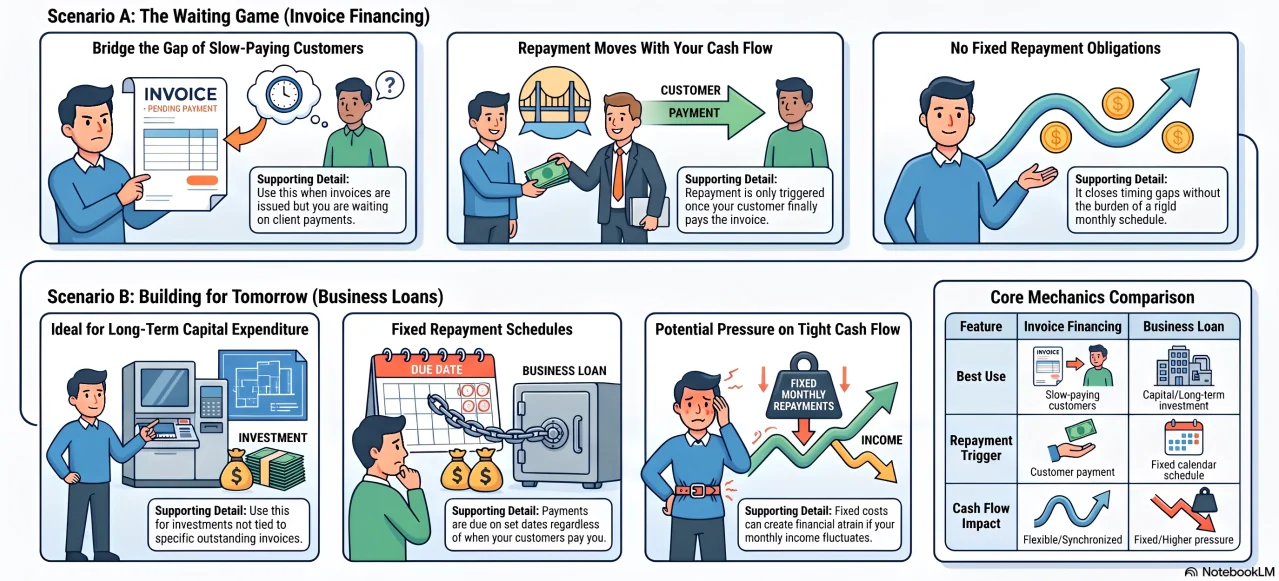
Both solve cash flow gaps differently. Anchor textexplains invoice finance as funding linked to unpaid invoices, while loans use fixed repayments.
Invoice financing suits businesses where the cash flow gap comes from slow-paying customers. If invoices are already issued and waiting on payment, it closes that timing gap without fixed repayment obligations.
A business loan suits capital expenditure or longer-term investment not tied to outstanding invoices. Repayments are fixed regardless of when customers pay, which can create pressure if cash flow is already tight.
The key distinction is repayment timing. Invoice financing repayment is triggered by customer payment, so it moves with your cash flow. A loan repayment schedule does not.
How Accounting Software Connects with Invoice Financing
Most AU invoice financing providers integrate directly with accounting software, making the process of submitting invoices and tracking advances largely automated once a facility is set up.
Common integrations include Xero and MYOB. Once connected, invoices can be submitted to the financier directly from the accounting platform without manual export or data re-entry between systems.
Good integration means advances reconcile automatically, balances are visible in real time, and fees reflect in accounting entries without manual journals. A connected accounting and finance management system makes invoice financing easier to manage.
Conclusion
Invoice financing converts unpaid invoices into working capital without adding debt or requiring property collateral. For AU businesses with strong B2B debtors and longer payment terms, it addresses a timing problem rather than a structural one.
Compare types based on volume, confidentiality needs, and how frequently you need funding. Book a free consultation to see how HashMicro can support your cash flow and receivables management.
Frequently Asked Questions About Invoice Financing
Invoice financing is not usually treated like a traditional business loan because repayment is tied to customer invoice payment. The invoice itself acts as security, and the business receives early access to money it has already earned.
Costs vary by provider, invoice value, debtor quality, and facility type. Selective invoice finance may charge a flat fee per invoice, while whole-ledger factoring often uses a monthly percentage plus service fees.
It depends on the facility type. Selective invoice finance and invoice discounting can remain confidential, while whole-ledger factoring usually involves the provider managing collections and notifying customers.
Some providers accept newer businesses, but most require trading history, valid business invoices, and creditworthy debtors. Businesses with strong B2B contracts may have a better chance of approval.
Invoices are usually not eligible if they are issued to consumers, disputed, overdue, linked to unfinished work, or owed by customers with weak credit. Construction progress claims may also be excluded by some providers.