




POS pricing can look simple until hardware, payment processing, additional locations, integrations, and support enter the calculation. A low monthly subscription may still produce a high total cost when transaction fees increase with sales volume.
POS System Cost should therefore include every expense required to install, operate, maintain, and eventually replace the platform. Australian businesses should compare total cost of ownership, contract terms, and operational value instead of relying on the advertised software price alone.
Pricing in this guide reflects publicly available information checked in July 2026. Providers can change their rates, so businesses should confirm all figures before signing a contract.
Key Takeaways
POS total cost includes software, hardware, payment processing, implementation, integrations, support, and future expansion, not just the monthly subscription.
Transaction volume and payment method often affect overall spending more than the software fee, so businesses should model processing costs before choosing a plan.
From 1 October 2026, major card networks will introduce no-surcharge rules, meaning businesses must absorb card acceptance costs within general pricing and margins.
A 12-month and 36-month TCO calculation with documented assumptions gives a more accurate cost comparison than the advertised software price alone.
What Is the Total Cost of a POS System?
"A POS system should be assessed by its total cost, not its advertised subscription fee. Hardware, payment processing, integrations, support, and future expansion can materially change what a business pays over time."
The total cost of a POS system covers every one-off, recurring, and transaction-based expense connected with the platform. It includes more than the fee shown on a provider’s pricing page.
A complete POS system may include checkout software, payment terminals, tablets, scanners, printers, cash drawers, inventory tools, reporting, and integrations. Businesses must also consider implementation time and ongoing administration.
Public pricing shows how widely costs can vary. Square currently offers free basic POS software, hardware starting from $65, and a 1.6% fee for eligible in-person transactions. Square Australia pricing
Shopify currently lists its Basic plan from $56 per month, with POS Pro costing an additional $129 per month for each selected location. Its advertised in-person card rate on the Basic plan starts at 1.95%. Shopify Australia POS pricing
These figures illustrate different pricing structures rather than the cost of a complete deployment. A business may still need additional devices, onboarding, data migration, applications, or back-office software.
The table below identifies the main components that belong in a POS total cost calculation.
Factors That Impact Point-of-Sale Costs
The same platform can produce different costs for two businesses. The following factors determine the final amount more accurately than company size alone.
- Number of locations: Each outlet may require another subscription, device set, payment terminal, and internet connection.
- Register count: Busy shops may need several checkout points within one location.
- Transaction value and volume: Processing charges increase as card sales grow, even when the software price remains fixed.
- Payment mix: In-person, online, manually entered, international, and buy now, pay later payments can carry different rates.
- Feature requirements: Advanced inventory, loyalty, rostering, analytics, and omnichannel capabilities may require higher plans.
- Hardware configuration: A mobile reader costs less than a counter setup with scanners, displays, printers, and cash drawers.
- Integration scope: Connections with an inventory management system, accounting platform, or online store may add subscription or development charges.
- Implementation complexity: Multi-location data migration, custom workflows, and staff training usually require more work.
- Contract structure: Annual commitments may reduce monthly fees but can increase exit or change costs.
- Support expectations: Extended-hours assistance and guaranteed response times may carry an additional charge.
Businesses should document these requirements before requesting quotations. A consistent scope makes competing proposals easier to compare.
POS Software Pricing Models
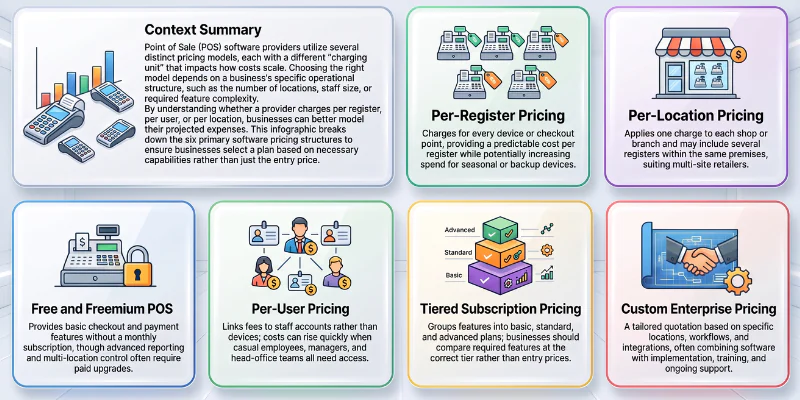
1. Free and Freemium POS Software
Free POS software usually provides basic checkout, product, and payment features without a monthly subscription. The provider may earn revenue through transaction fees, hardware sales, or optional services.This model can suit sole traders, pop-up shops, and businesses with straightforward operations. However, advanced reporting, staff permissions, loyalty tools, and multi-location control may require paid upgrades.
A free plan is not cost-free when payment processing remains compulsory. Therefore, businesses should model the fee against projected annual card turnover.
2. Per-Register Pricing
Per-register pricing charges for every device or checkout point that actively processes sales. A store with four registers may pay four software fees even though all devices operate in one outlet.This model gives businesses a predictable cost for each checkout. However, seasonal registers and backup devices may increase spending if the provider treats them as active licences.
3. Per-Location Pricing
Per-location pricing applies one charge to each shop, restaurant, warehouse counter, or branch. The plan may include several registers within the same premises.This structure can suit multi-site retailers because costs follow the outlet network. Businesses should confirm whether temporary stores, kiosks, and online channels count as separate locations.
4. Per-User Pricing
Per-user pricing links fees to staff accounts rather than checkout devices. It commonly appears when the platform includes permissions, customer management, back-office access, or workforce functions.The cost can rise quickly when casual employees, managers, and head-office teams all need access. Role sharing may reduce fees but weaken security and audit trails.
5. Tiered Subscription Pricing
Tiered pricing groups features into basic, standard, and advanced plans. Higher tiers may include deeper reporting, purchase orders, loyalty programs, staff controls, and integrations.A lower plan can appear cheaper but may exclude one essential capability. As a result, businesses should compare required features at the correct tier rather than comparing entry prices.
6. Custom Enterprise Pricing
Custom pricing applies when a provider designs the scope around locations, workflows, users, integrations, and service requirements. The quotation may combine software, implementation, training, and ongoing support.Growing retailers often use this approach when standard packages cannot cover their operational structure. A detailed proposal can provide greater cost clarity when it identifies inclusions, exclusions, and future expansion rates.
POS Processing Fees in Australia
Payment processing often becomes the largest recurring POS expense. Businesses should compare percentage rates, fixed charges, card types, and settlement services alongside software pricing.Flat-rate processing
Flat-rate processing charges the same percentage for eligible transactions within a payment category. For example, one rate may cover all in-person taps and inserts.This structure makes forecasting easier because the fee does not change by card network. However, a flat rate may cost more than negotiated pricing for businesses with high turnover or a favourable transaction mix.
Interchange-plus pricing
Interchange-plus pricing separates the card issuer’s interchange fee from network and provider charges. The final cost can vary according to card type, network, transaction method, and merchant arrangement.This model gives businesses more detail about what they pay. However, statements can require closer review because the effective rate may change each month.
Card-present, online and manually entered transactions
Card-present transactions usually carry less fraud exposure because the customer uses a physical card or digital wallet at the terminal. Online and manually entered payments commonly attract higher fees.For example, Square currently lists 1.6% for eligible in-person transactions and 2.2% for online or manually entered payments. Businesses with several sales channels should therefore calculate a weighted average rate rather than using the lowest advertised figure.
How transaction volume changes total POS cost
A percentage fee grows directly with card turnover. A business processing $50,000 per month at 1.6% would pay about $800 monthly, or $9,600 annually, before other payment charges.A difference of 0.2 percentage points equals $1,000 a year on $500,000 of card turnover. Therefore, higher-volume businesses may gain more from negotiating processing than from reducing a modest software subscription.
Transaction count also matters when the provider adds a fixed charge. A cafe processing many small purchases may face a different effective rate from a furniture retailer with fewer high-value sales.
Least-cost routing
Least-cost routing sends eligible dual-network debit transactions through the network expected to cost the merchant less. It can therefore reduce acceptance costs without changing the customer’s bank account.The Reserve Bank of Australia reported that 84% of merchants had least-cost routing enabled for in-person transactions by December 2025. However, the RBA also warns that enablement alone does not guarantee the lowest overall payment cost. RBA least-cost routing update
Businesses should ask whether routing is active, which transactions qualify, and whether the provider passes the saving on. Comparing effective merchant rates remains essential.
Card surcharges and the October 2026 change
Before 1 October 2026, Australian businesses may apply card surcharges that do not exceed the cost of accepting that payment type. The ACCC can investigate excessive card surcharges under the current framework. ACCC card surcharge guidanceFrom 1 October 2026, eftpos, Mastercard, Visa, and American Express will introduce no-surcharge rules. Businesses will generally no longer add a separate surcharge because a customer uses one of those card networks. RBA payment surcharge FAQs
Payment providers will continue charging merchants for card acceptance after the change. Therefore, businesses should model those costs within general pricing, margins, and budgets instead of assuming customers will cover them separately.
The change relates to card-payment surcharges. It does not automatically prohibit weekend, public holiday, booking, or service fees, although other pricing laws may apply.
Hidden POS Costs to Check Before Buying

A complete quotation should disclose expenses that may not appear in the headline subscription price. Confirming these items in writing before signing prevents unexpected spending once the platform is live.
Setup costs often include configuration, data migration, staff training, and onsite implementation support. Hardware also adds to the initial outlay, covering payment terminals, barcode scanners, receipt printers, customer displays, stands, and cash drawers. Businesses should confirm whether the provider charges separately for delivery, installation, warranty, and hardware replacement.
Ongoing software charges can extend beyond the base subscription. Providers may bill separately for additional registers, users, and location licences, as well as mandatory application subscriptions. API access, custom development, and integrations with accounting, inventory, e-commerce, or loyalty tools can also carry their own fees.
Payment processing brings further costs that are easy to overlook. Chargeback, refund, and payment dispute fees apply to transactions outside standard acceptance. Instant or expedited settlement services, internet backup, and mobile connectivity may also generate separate charges. Security and payment-compliance services sometimes appear as additional line items on invoices.
Contract terms can create exit costs that businesses do not anticipate at signing. Early cancellation fees and data export charges apply when a company decides to switch providers. Before committing, it is worth requesting the full fee schedule and reviewing the notice period required before renewal.
Manual reconciliation creates an indirect cost when a POS does not connect with accounting software. Employees may need to re-enter sales, tax, refund, and settlement data separately, which adds time and increases the chance of errors.
Downtime deserves similar attention because unavailable checkout equipment directly interrupts revenue. Before committing, businesses should ask about offline selling capability, recovery procedures, support hours, and hardware replacement time.
Things to Consider Before Buying a POS System
The right system should fit current operations and expected growth. Businesses should assess the following areas before choosing a provider.- Sales environment: Confirm whether the platform suits retail, hospitality, services, pop-up stores, or omnichannel selling.
- Checkout workflow: Test product search, discounts, exchanges, split payments, refunds, and receipt handling.
- Scalability: Request written pricing for future outlets, registers, users, and sales channels.
- Inventory needs: Check your inventory needs to confirm whether sales update stock across every branch and warehouse in real time.
- Payment flexibility: Compare supported providers, effective rates, least-cost routing, and settlement timing.
- Integration: Confirm how the POS connects with finance, purchasing, CRM, workforce, and e-commerce tools.
- Reporting: Review whether managers can analyse margins, sales, tax, stock, and cashier activity by location.
- Reliability: Assess offline capability, backups, device compatibility, and recovery arrangements.
- Security: Check permissions, audit trails, account protection, and payment-data responsibilities.
- Support: Confirm service hours, response targets, onboarding assistance, and training options.
- Data access: Understand how the business can export records during or after the contract.
- Contract terms: Review minimum periods, automatic renewals, price changes, and cancellation obligations.
Multi-store businesses should assess the wider retail management platform, not only the checkout screen. Connected inventory, procurement, finance, and customer data can reduce work that a cheaper standalone product leaves to employees.
How to Calculate POS Total Cost of Ownership
A useful TCO calculation covers the expected ownership period and states every assumption. The following calculations show how software, hardware, implementation, and payment fees combine.1. Calculate the Twelve-Month POS Cost
Use the following formula:12-month TCO = upfront hardware + implementation + migration + 12 months of software and support + annual processing fees + other recurring charges
Consider an illustrative single-store business with these assumptions:
- Hardware: $1,200
- Implementation: $500
- Data migration: $300
- Software: $79 per month
- Support: $20 per month
- Monthly card turnover: $40,000
- Processing rate: 1.6%
- Annual processing equals $40,000 multiplied by 12 and then by 1.6%, producing $7,680. The illustrative 12-month TCO would therefore be $10,868.
This example excludes GST, chargebacks, hardware replacement, internet, and internal labour. It does not represent a quotation from a specific provider.
2. Calculate the thirty-six-month POS cost
A longer comparison reveals whether a low setup price hides expensive recurring charges. Use the following formula:36-month TCO = upfront costs + 36 months of recurring fees + processing over three years + planned replacement and exit costs
Using the same assumptions, software would cost $2,844, support would cost $720, and processing would reach $23,040. After adding hardware, implementation, and migration, the illustrative 36-month total becomes $28,604.
The calculation assumes stable turnover and fees. Businesses expecting new outlets or higher sales should model those changes separately.
3. Find the free vs Paid POS break-even point
A free plan may charge a higher processing rate than a paid alternative. The break-even calculation identifies the sales volume at which a subscription produces lower payment costs.Assume a free plan charges 1.6%, while a paid option costs $100 per month plus 1.4%. The monthly fee difference is 0.2 percentage points, or 0.002 as a decimal.
Divide $100 by 0.002 to obtain a break-even point of $50,000 in monthly card turnover. Above that amount, the paid option would have a lower combined subscription and processing cost under these assumptions.
Features, fixed transaction charges, card mix, and contract conditions can change the result. Therefore, businesses should use rates from their actual quotations.
4. Record assumptions for every example
Every comparison should identify the calculation period, software tier, register count, locations, users, hardware, and implementation scope. It should also state transaction volume, average sale value, payment mix, and processing rates.Businesses should record whether prices include GST and whether hardware is purchased, rented, or leased. Growth estimates, fee increases, replacement costs, and staff time should also appear where relevant.
A documented assumption sheet prevents an attractive estimate from becoming a misleading budget. It also lets decision-makers update the calculation when a provider changes its proposal.
How Much Does HashMicro POS Cost?
HashMicro provides customised POS pricing rather than one public rate for every business. The quotation depends on the required locations, users, registers, modules, integrations, configuration, implementation, and support scope.This approach suits growing businesses that need POS to connect with inventory, procurement, accounting, CRM, promotions, and multi-outlet reporting. The proposal can reflect the full operating model instead of pricing checkout software separately from essential back-office workflows.
HashMicro also integrates accounting with CRM and sales data CRM and sales data, helping teams identify customers with unpaid or overdue invoices, while Hashy OS can help authorised users query sales information, review outlet performance, identify unusual transactions, and prepare follow-up actions from connected data.
Conclusion
POS System Cost includes much more than a monthly licence. Hardware, implementation, transaction fees, integrations, support, additional outlets, and contract conditions can materially change the final amount.Australian businesses should compare at least 12-month and 36-month ownership costs using the same operational assumptions. The October 2026 surcharge change also makes payment processing a more important part of pricing and margin planning.
HashMicro connects checkout, inventory, procurement, customer management, accounting, and multi-store reporting within one platform. Review your requirements and cost assumptions through a free POS software consultation with HashMicro.
Frequently Asked Questions
Buying usually costs less over a long ownership period and gives the business full control of the equipment. Leasing reduces the initial payment and may include maintenance or replacement services, but the total contract value often exceeds an outright purchase. Businesses should compare the full lease term, warranty conditions, upgrade options, and cancellation terms before deciding.
Payment providers may negotiate rates for businesses with higher card turnover, a stable processing history, or a favourable transaction mix. To get the best result, present recent merchant statements and request a written effective rate that includes percentage fees, fixed charges, terminal costs, settlement services, and chargeback fees.
A new store may require another software licence, payment terminal, tablet, scanner, receipt printer, cash drawer, internet connection, and setup service. Providers may also charge for additional users, integrations, training, or reporting access. Businesses should request both location and register expansion pricing before signing the initial contract.
A business should review POS pricing at least once a year and before any renewal, expansion, or significant change in transaction volume. The October 2026 card surcharge change also makes this a practical time to reassess payment costs and general pricing. Review effective processing rates, unused features, support quality, and alternative providers, keeping in mind that contract notice periods may require the assessment to begin several months before renewal.