










 Limited to 100 registrants

Financial consolidation software combines multiple entities into one group view. It eliminates internal transactions, translates currencies, and applies configured ownership treatments.
It maps each entity’s chart of accounts to a group structure, imports financial data, runs consolidation rules, and produces statements with a drill-down audit trail.
Key Takeaways
Financial consolidation software combines multiple entities' financial results into a single group view for reporting.
Every consolidation follows the same core sequence, from mapping accounts to eliminating intercompany transactions.
AASB 10 requires entities that control one or more subsidiaries to prepare consolidated financial statements.
Choosing the right solution depends on group complexity, ownership structure, and reporting needs.

What Is Financial Consolidation Software?
Financial consolidation software combines multiple entities’ financial statements into one group view. It handles intercompany eliminations, currency translation, and ownership adjustments.
Group CFOs, controllers, and finance teams use it for multi-entity accounting, foreign subsidiaries, and minority investments. Excel may suit a small group, but version, formula, and audit risks grow as entities are added.
How Financial Consolidation Works : With an Australian Example
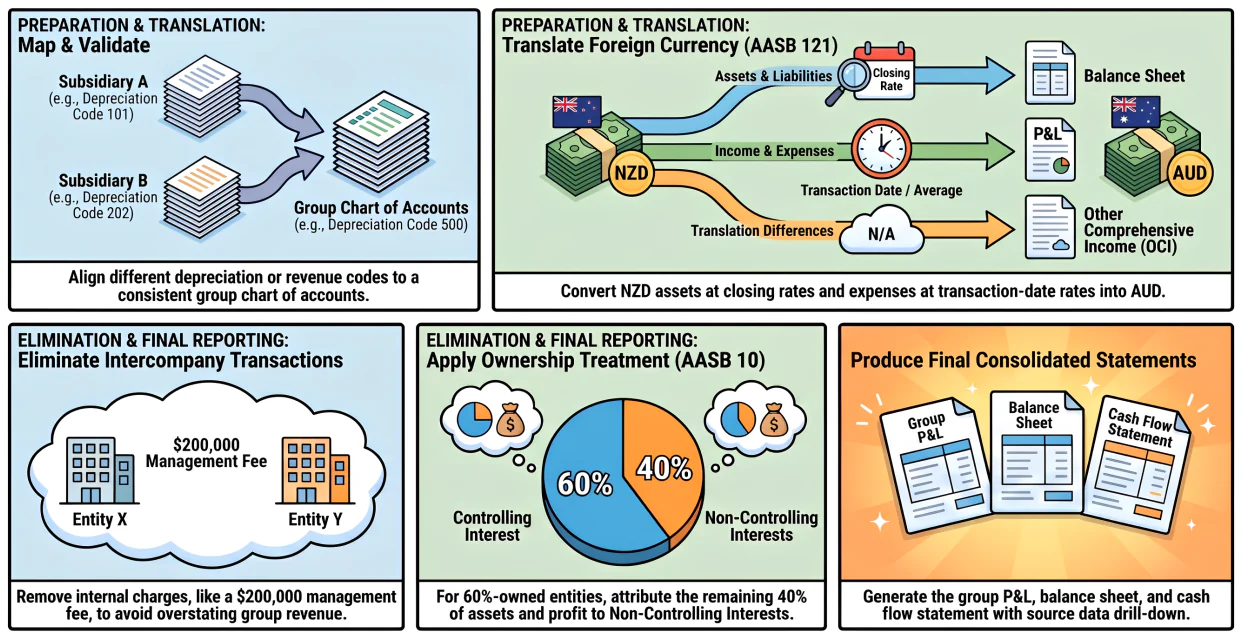
The process follows the same sequence in spreadsheets or software. This example covers a NSW parent, a Victorian subsidiary, and a 60%-owned New Zealand subsidiary.
1. Map and validate each entity’s accounts
Each entity’s chart of accounts maps to the group structure. Differences in depreciation codes or revenue classifications are resolved before consolidation.
Without consistent mapping, the group P&L and balance sheet may show misleading totals. Most systems retain existing mappings and flag new subsidiary accounts for review.
2. Translate the foreign subsidiary into AUD
The New Zealand subsidiary’s NZD accounts are translated under AASB 121. Assets and liabilities use the closing rate, while income and expenses use transaction-date rates or a suitable average. Differences go to OCI.
3. Eliminate the intercompany transaction
The parent charged its Victorian subsidiary a $200,000 management fee. Both the income and expense are removed so group revenue and costs are not overstated.
Intercompany loans and dividends also need elimination. As internal activity grows, automated matching helps finance teams find differences before close.
4. Apply the relevant ownership treatment
The New Zealand entity is 60% owned, so 40% of its net assets and results are attributed to non-controlling interests. AASB 10 presents NCI separately within equity and attributes profit or loss and OCI to it.
5. Produce the consolidated financial statements
After mapping, translation, eliminations, and ownership entries, the system produces the consolidated P&L, balance sheet, and cash flow statement with drill-down to source data.
Key Features of Financial Consolidation and Reporting Software
Feature depth varies by solution. Australian multi-entity groups should focus on the controls below and test how each one works with their structure and data.
1. Multi-entity hierarchy and ownership management
The system should model parents, subsidiaries, partly owned entities, and joint ventures. Accounting treatment must follow control and ownership assessments, not percentage alone.
Acquisitions, disposals, and restructures should be reflected without rebuilding the entire consolidation setup.
2. Chart of accounts mapping
Each entity’s accounts map to the group structure. These mappings should remain available between periods and flag new or changed accounts for review.
3. Intercompany matching and eliminations
The system identifies transactions between entities, matches corresponding entries, and removes them from consolidated results.
Unmatched balances should be flagged before close so finance can resolve differences in timing, currency, account, or amount.
4. Multi-currency translation
The platform should apply AASB 121 rates and record translation differences in OCI. Exchange rates need central control rather than separate manual entry by each entity.
- Consolidated statements and drill-down reporting: Group P&L, balance sheet, and cash flow reports should link each figure to its entity, account, adjustment, and source data.
- Journals, approvals, and audit trails: Adjustments, eliminations, and reclassifications need approval workflows and a timestamped history.
- Integration and data validation: Connections to source systems reduce repeated imports, while validation checks catch missing mappings and incomplete submissions.
- Security and scalability: Entity-level access and role-based permissions should remain manageable as companies, users, and reporting volumes grow.
"Consolidation isn't just adding up five sets of accounts. It's proving that every intercompany dollar has been eliminated and every ownership share correctly applied."
Types of Financial Consolidation Solutions
No single option suits every group. These solutions differ in capability, cost, and administration.
| Solution type | Best suited for | Key consideration |
|---|---|---|
|
ERP-native consolidation
HashMicro, Oracle NetSuite, Microsoft Dynamics 365 |
Groups running most entities on the same ERP with standardised accounting | Mixed source systems or complex statutory treatments may require added configuration |
|
Specialist consolidation software
Lucanet, CCH Tagetik, OneStream |
Complex ownership structures, multiple accounting frameworks, and high intercompany volumes | Implementation and administration are usually more involved |
|
EPM and FP&A platforms
Anaplan, Planful |
Groups combining planning, forecasting, and management reporting across entities | Confirm whether the platform supports a full statutory close |
|
Reporting add-ons
Fathom, Spotlight Reporting |
Simple management reporting from systems such as Xero or MYOB | They do not replace statutory consolidation under AASB 10 |
| Spreadsheet-based consolidation | Smaller groups with few entities, one currency, and limited internal activity | Formulas, file versions, and adjustments become harder to control as the group grows |
Australian Financial Consolidation Requirements
Australian consolidation is governed by AASB 10, ASIC reporting obligations, and separate ATO tax rules. Errors can create accounting, lodgement, and tax risks.
Subject to limited exemptions, AASB 10 requires a parent to consolidate controlled entities. Control depends on power, variable returns, and the ability to affect them, so it may exist without majority ownership.
Under ASIC financial reporting requirements, large proprietary companies and other covered entities must prepare and lodge reports. Directors remain responsible for compliant financial reporting that gives a true and fair view.
Eligible wholly owned Australian groups may elect to be taxed as one entity. The irrevocable election can pool eligible losses and disregard some internal transactions, subject to ongoing ATO rules.
Benefits of Financial Consolidation Software
The value of consolidation software becomes clearer when compared with the time, control gaps, and audit work created by a manual process.
- A faster and more controlled close: Automated validation, translation, and eliminations reduce repeated work and let finance focus on unresolved exceptions.
- More consistent financial data: Direct source-system data and shared mappings reduce re-entry errors and apply group rules consistently.
- Better audit readiness: Auditors can trace adjustments, eliminations, approvals, and reclassifications without relying on spreadsheet notes or email records.
- Clearer group-level visibility: Management and the board receive consistent group figures with access to the entities behind each result.
- Easier acquisition integration: A new entity can be added through mapping and hierarchy updates instead of expanding a fragile workbook model.
- More time for financial analysis: Less data gathering and reconciliation gives finance teams more time for variance analysis, forecasting, and management reporting.
Consolidated figures are more useful when finance can reach supporting details quickly. The banner below shows how Hashy OS helps teams find group finance records without checking separate files and reports.






How to Choose Financial Consolidation Software
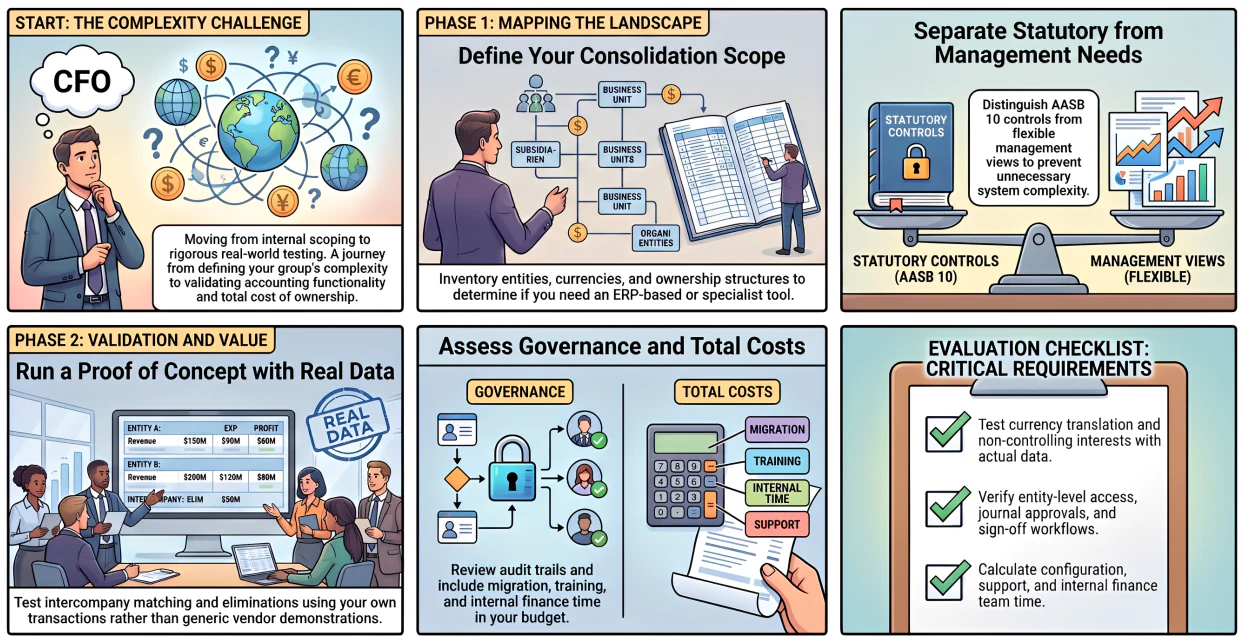
Choosing financial consolidation software depends on the group’s structure, reporting needs, and accounting consistency. Focus on the requirements that affect each close.
- Define the consolidation scope: List the entities, ownership structures, currencies, source systems, and reporting cycles. This helps determine whether an ERP-based or specialist tool is more suitable.
- Separate statutory and management requirements: AASB 10 reporting needs defined controls, while management reporting may need flexible views. Treating them separately avoids unnecessary complexity.
- Evaluate accounting functionality: Test intercompany matching, eliminations, currency translation, and non-controlling interests using the group’s own transactions.
- Assess governance and controls: Review journal approvals, entity access, and audit trails. Confirm who prepares, adjusts, reviews, and approves each result.
- Test integrations with actual data: Run a proof of concept with the existing chart of accounts and sample entity data to identify mapping or integration issues early.
- Review total costs: Consider migration, configuration, training, support, and internal finance time. Complex groups may justify the higher setup cost of specialist software.
Before You Implement: What to Prepare
Preparation prevents unresolved accounting issues from carrying into the new system. Organise the close process, master data, and controls before configuration starts.
1. Document the current close process
Map the process from entity submission to final approval, including owners, timing, adjustments, and recurring errors. This provides a clear baseline for improvement.
2. Clean entity and account master data
Inconsistent account codes, duplicate records, and outdated entity relationships can create mapping errors. Correct them before moving data into the new system.
Standardise entity names, verify ownership percentages, review account mappings, and reconcile outstanding intercompany balances.
3. Configure legal hierarchy and accounting rules
Set the legal structure, ownership relationships, functional currencies, and accounting policies as controlled rules. A multi-entity ERP should reflect how the group operates and reports.
4. Run parallel consolidation
Complete one reporting cycle in both the existing process and the new software. Compare balances, eliminations, translations, and ownership adjustments.
Reviewing differences gives finance time to correct the setup and verify the results before they reach auditors, directors, or other stakeholders.
5. Establish controls and ownership
Assign owners for entity hierarchies, account mappings, intercompany rules, and adjustment journals. Document how configuration changes are approved and tested.
6. Review the setup after organisational changes
Acquisitions, disposals, restructures, and new subsidiaries can change the consolidation scope. Review the setup whenever the group structure changes.
How HashMicro Supports Multi-Entity Financial Consolidation
HashMicro supports group reporting within an ERP environment, keeping entity structures and consolidation settings alongside the accounting data used across the business.
Finance teams can configure entity hierarchies, ownership percentages, consolidation methods, and a group reporting currency. The setup also supports multi-currency reporting.
This approach suits groups that want consolidation within their operational ERP. Businesses can book a free consultation to assess their entity and reporting requirements.
Conclusion
Financial consolidation software can automate eliminations, currency translation, and ownership adjustments. Australian groups must also consider AASB 10, ASIC reporting duties, and any applicable ATO tax consolidation rules.
The right setup depends on entity complexity, data quality, controls, and reporting needs. Discuss these requirements through a free consultation with us before choosing an implementation approach.

Frequently Asked Questions About Financial Consolidation Software
Financial consolidation software combines the financial statements of multiple legal entities into a single group view, handling intercompany eliminations, currency translation, and ownership adjustments as part of the process.
Is consolidated financial reporting mandatory for Australian groups? answer2: Yes. AASB 10 requires any entity that controls one or more subsidiaries to prepare consolidated financial statements. Disclosing entities and large proprietary companies must also lodge these statements with ASIC.
What gets eliminated during financial consolidation? answer3: Intercompany transactions such as management fees, loans, and dividends paid between entities within the group are eliminated so group revenue and expenses are not overstated by transactions the group had with itself.
Foreign subsidiary financials are translated using AASB 121-compliant rates, typically the average rate for profit and loss items and the closing rate for balance sheet items, with translation differences recognised in other comprehensive income.
Common triggers include a failed audit finding, an acquisition that adds entity complexity, or a finance team spending more than two weeks on the monthly close using manual spreadsheet consolidation.