









 Limited to 100 registrants

A goods received note is the internal record confirming what your business physically received, inspected, and accepted, which can differ from what was ordered or invoiced.
Warehouse or receiving staff usually create it, then procurement, quality, inventory, and accounts payable teams rely on the data. An incomplete record often means stock errors, delayed invoice approval, and unresolved supplier disputes.
Key Takeaways
A goods received note confirms what your business physically received, inspected, and accepted, not simply what was ordered or invoiced.
Three-way matching compares the purchase order, accepted receipt, and supplier invoice before payment moves forward.
Short deliveries, damaged goods, and quantity mismatches need separate statuses, owners, and next actions to stay resolvable.
ERP-based receiving connects procurement, inventory, quality, and finance while keeping permissions and an audit trail intact.

What Is a Goods Received Note?
A goods received note, also called a GRN, is created when goods arrive. It confirms what was physically delivered, inspected, accepted, rejected, or left outstanding.
Suppose a warehouse receives ten pumps but accepts only nine because one has a damaged housing. The GRN records nine accepted and one rejected.
Document names vary between businesses, but the operational boundaries usually look like this:
| Document | Created by | Timing | Role in matching |
|---|---|---|---|
| Purchase order | Buyer or procurement | Before despatch | Confirms what was approved |
| Delivery docket | Supplier or carrier | With the delivery | Shows what was transported, not accepted |
| Goods received note | Receiving staff | After inspection | Confirms what was accepted |
| Supplier invoice | Supplier | Per billing cycle | Shows what the supplier billed |
This clears up common confusion between GRN vs purchase order and GRN vs delivery docket. It supports accurate inventory management, but isn't proof an invoice should pay automatically.
Why Does a GRN Matter for Financial and Stock Control?
A GRN matters because the receiving decision affects both stock and financial approval. A late or incomplete record forces every team to rely on its own version of events.
1. Where the impact shows up across teams
An incomplete GRN doesn't just slow down one team, it breaks the same record for everyone downstream who relies on it.
- Inventory needs accepted quantity, location, and status, or stock looks available when it's missing or damaged.
- Procurement needs the rejected and outstanding quantity, or orders get closed too early and supplier follow-up gets lost.
- Accounts payable needs the accepted quantity and PO reference, or invoices get held or matched to unsupported quantities.
- Finance needs reliable receipt and liability data, or cut-off requires manual investigation.
- Supplier management needs documented shortages and damage, or claims rely on email trails and memory.
2. Impact on accounts payable accuracy
When accounts payable matches an invoice to an accepted quantity, not a delivered one, disputed goods can't slip into an approved payment.
3. Impact on inventory and stock-on-hand data
Stock-on-hand figures stay reliable only when accepted, rejected, and quarantined quantities post separately, so a damaged batch doesn't look like available inventory.
This operational value should stay separate from tax or legal conclusions. Retention and approval rules should align with documented policy and professional advice.
The GRN's Place in the Procure-to-Pay Process
The GRN sits after receipt and inspection but before invoice approval, converting a delivery event into data that inventory, procurement, and finance can all use.
1. From purchase order approval to supplier delivery
An authorised purchase order is issued, the supplier despatches the goods, and receiving staff check the delivery against the site and order.
2. From receipt confirmation to invoice release
Inspection identifies accepted, damaged, or missing goods, then staff create the GRN with evidence. Accounts payable compares the order, GRN, and invoice before payment proceeds.
Consider a mining-services supplier ordering 100 filter units. The first delivery brings 60, but inspection rejects five, leaving 55 accepted and 45 still outstanding.
- Receiving counts goods, records condition, and captures evidence.
- Quality control inspects and assigns accepted, rejected, or quarantine status.
- Procurement follows up shortages, excess goods, and supplier commitments.
- Accounts payable matches authorised and accepted quantities to the invoice.
Map these hand-off points before changing software. A process map often reveals whether delay starts at receiving, inspection, or invoice review.
10 Fields Every Receipt Record Should Include
A complete GRN should identify the transaction, location, purchase order, items, quantity outcomes, condition, and responsible people.
| Field | Example | Control purpose |
|---|---|---|
| 1. Unique GRN number | GRN-BNE-004821 | Prevents ambiguity, supports traceability |
| 2. Receipt date and time | 11 Aug 2026, 09:42 AEST | Marks when the delivery was assessed |
| 3. Purchase order reference | PO-260731-118 | Connects receipt to authorised purchasing |
| 4. Supplier identity | Southern Industrial Supplies Pty Ltd | Prevents posting against wrong supplier |
| 5. Delivery docket reference | DKT-88214 | Links record to transport evidence |
| 6. Receiving site | Brisbane Distribution Centre | Identifies where stock entered the business |
| 7. Item code and unit | FLT-220, hydraulic filter, each | Prevents confusion between similar items |
| 8. Ordered/delivered/accepted/rejected/outstanding | 100 / 60 / 55 / 5 / 45 | Preserves the gap between order and acceptance |
| 9. Condition and discrepancy reason | Five rejected, damaged seals | Explains why goods weren't accepted |
| 10. Receiver, approval status, attachments | J. Lee; review complete; three photos | Records responsibility and evidence |
Make the purchase order reference mandatory wherever matching depends on it, and stop users replacing delivered and rejected quantities with one "received" figure.
Check whether a form, spreadsheet, or mobile screen can distinguish all five quantity states in field eight. A template with only ordered and delivered amounts can't show partial acceptance.
How Does a GRN Support Three-Way Matching?
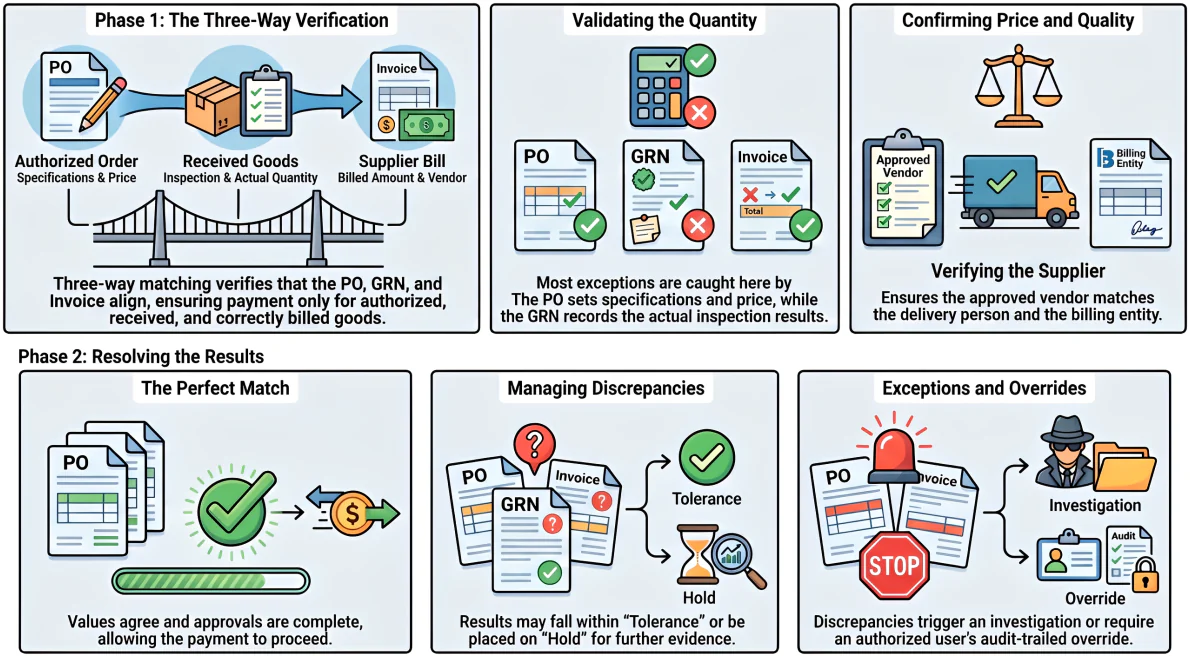
Three-way matching is the control point where these three documents finally get checked against each other before money moves.
1. What accounts payable compares across the three documents
Three-way matching checks whether supplier, item, quantity, price, and references agree within approved tolerances. The accepted quantity should drive the receipt side.
- Supplier: the PO names the approved vendor, the GRN links the supplier to the actual delivery, and the invoice names the billing entity.
- Quantity: the PO authorises an amount, the GRN confirms what was accepted, and the invoice states what's billed, this is the check that catches most exceptions.
- Price: the PO carries the agreed unit price and the invoice states the claimed price, while the GRN usually has no authority to set or change price.
- Quality: the PO sets the specification and the GRN records the inspection result, but the invoice is rarely evidence of quality on its own.
2. What happens when the records don't align
Back to the filter example: 100 units were ordered, 55 accepted from the first delivery. If the supplier invoices for 60, the system flags a five-unit exception.
- Match: relevant values agree and approvals are complete.
- Tolerance: a permitted variation falls within a documented rule.
- Hold: payment waits for specified evidence or approval.
- Investigation: the exception returns to receiving or the supplier.
- Authorised override: an approved user accepts it with a reason and audit entry.
Automating this can complement e-invoicing, though electronic delivery doesn't itself prove goods were accepted.
"A goods received note is the moment a delivery becomes an accounting fact. Get that record wrong, and every downstream approval inherits the same error."
How Is a Goods Received Note Created and Approved?
Creating a GRN means identifying the delivery, checking it against the order, inspecting the goods, recording the outcome, and routing exceptions for approval.
Six-stage creation workflow
- Identify the delivery. Confirm supplier, site, and purchase order before unloading.
- Count and identify the goods. Check item codes, units, and quantity delivered.
- Inspect condition and quality. Mark items accepted, rejected, or quarantined.
- Create the GRN. Enter required fields and supporting evidence.
- Verify and approve exceptions. Route higher-risk receipts to the right role.
- Post and notify. Update accepted inventory and enable invoice matching.
Separate physical confirmation from financial exception approval where the risk justifies it. Not every receipt needs multiple approvers.
What Common GRN Problems Should You Prevent?
Delivery exceptions should be distinct quantity and status outcomes, each with an owner, rather than a generic note that just says "short delivery."
1. Short deliveries and partial shipments
Record each partial delivery as a separate receipt linked to the same purchase order, and keep the undelivered balance open until an authorised user closes it.
2. Damaged, rejected and quarantined goods
Separate accepted, rejected, and quarantined stock, and require a reason code plus evidence for damage or rejection so it doesn't become available inventory by default.
Suppose a construction project orders 40 safety barriers. The site receives 30, accepts 27, and quarantines three because their specification can't be confirmed.
3. Excess goods and quantity or pricing mismatches
Record excess goods without automatically raising the authorised order quantity. Procurement should decide whether the business accepts, returns, or separately authorises them.
Manual, paper-based processing tends to blur these distinctions, which is part of why GST recordkeeping and system choice matter next.
What Does GRN Compliance Look Like Under Australian GST Rules?
A GRN isn't a tax document, but it sits close to the evidence a business needs when claiming GST credits. Requirements depend on the transaction, so treat this as general guidance.
1. ATO recordkeeping expectations for receipt records
The ATO's GST records guidance expects retained documents supporting what was purchased and how much GST applied. A GRN can corroborate that invoiced goods actually arrived.
2. Using GRNs to substantiate GST input tax credit claims
Under current ATO guidance on claiming GST credits, a valid tax invoice usually supports the claim. A GRN tied to that invoice strengthens the file if it's ever reviewed. Confirm current requirements with the ATO or an adviser.
Paper, Spreadsheet or ERP: Which GRN Process Fits?
A paper or spreadsheet process can stay workable when volumes are low. The risk grows when several teams re-enter the same data or lose sight of a receipt's status.
| Approach | Works well when | Common limitation |
|---|---|---|
| Paper form | Low volume, simple local receiving | Lost documents, weak searchability |
| Spreadsheet | Small team, modest exception volume | Duplicate versions, unclear audit history |
| Standalone tool | Receiving outgrows accounting-system capability | Integration gaps, delayed posting |
| Integrated ERP | Multiple sites, departments, or statuses | Needs proper configuration and governance |
An ERP deployment plan for receiving should address migration, integrations, testing, and training, not just licensing.
How Can ERP Software Automate Goods Receipt Management?
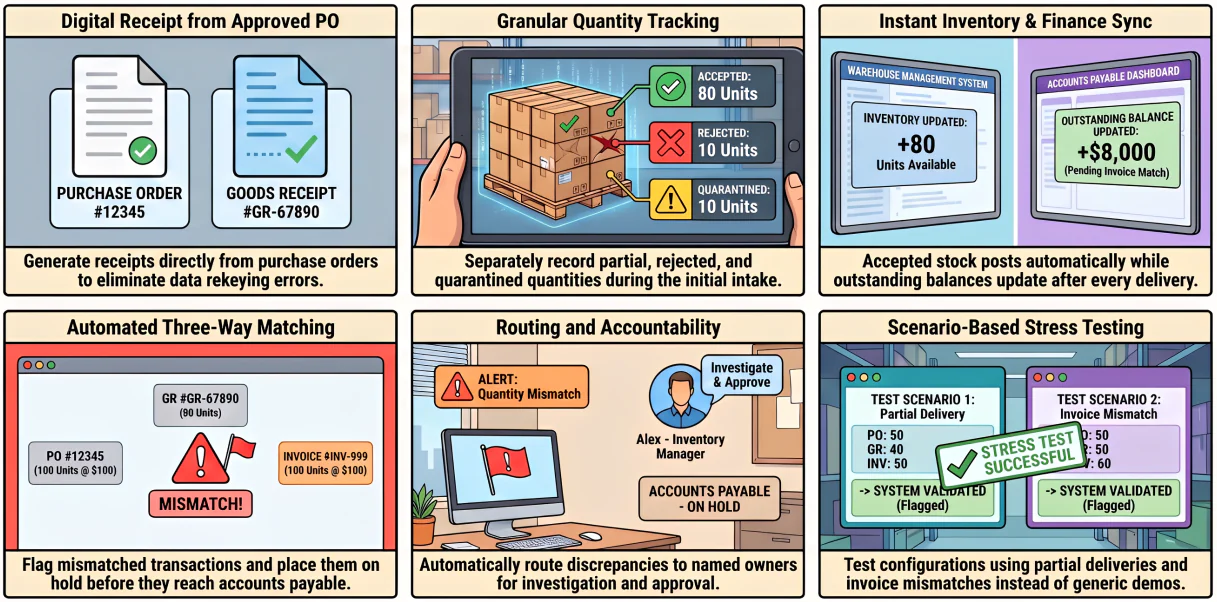
The right workflow should reflect how your business actually receives goods, including what happens when a transaction doesn't follow the happy path.
1. Replacing paper and spreadsheet-based receiving
Users should create a receipt from an approved purchase order without rekeying data, and record partial, rejected, and quarantined quantities separately.
2. Connecting GRN data to inventory and finance in real time
Accepted inventory should post automatically while rejected stock stays unavailable, and the outstanding order balance should update after every delivery.
3. Flagging discrepancies before they reach accounts payable
Invoice matching should place mismatched transactions on hold and route them to a named owner, with audit history showing every change and approval.
Test these capabilities with an anonymised scenario, including a partial delivery and an invoice mismatch, against actual product configuration rather than a generic demo.
Best Practices for Managing Goods Received Notes
Improvement doesn't always start with new software. It starts with clarifying the data and decisions the process needs to preserve.
1. Separate receiving, approval and payment duties
Keep physical confirmation, exception approval, and payment release with different roles so no single person controls a delivery end to end.
2. Set clear tolerance rules for quantity and price variance
Define how much variance can auto-approve versus what needs a named reviewer, so routine receipts move quickly and real exceptions get attention.
3. Digitise GRN creation instead of relying on paper
Use consistent item codes and site identifiers, and prevent a purchase order from closing just because one delivery arrived.
4. Reconcile GRNs against POs and invoices regularly
Review aged open receipts and unmatched invoices on a set schedule, not only when accounts payable escalates a problem.
The objective isn't to maximise approvers. It's to produce a reliable record once and retain enough evidence to explain the outcome later.
Building a Business Case for an Integrated GRN Process
A useful business case starts with current process evidence: where staff re-enter data, how long unmatched invoices stay open, and which exceptions repeat.
Compare the future workflow against the current one across control and operating impact, including migration and change-management effort in an ERP implementation.
State benefits cautiously unless the business has baseline data. Actual value depends on volume, discipline, and user adoption.
Make the Receipt Record Reflect What Actually Happened
A goods received note is useful because it records reality at the point of receipt, distinguishing what was ordered, delivered, accepted, and outstanding.
The strongest process isn't the one with the most approvals. It's the one that captures reliable data and keeps unsupported quantities out of stock or payment.
Conclusion
Trace one anonymised delivery from purchase order approval through inspection, posting, matching, and payment. That exercise shows where the real priority sits.
If procurement, inventory, and accounts payable are still reconciling receipts by hand, book a free consultation with HashMicro's team to map a more controlled receiving process.

Frequently Asked Questions
It depends on policy and risk level. When receipt confirmation is required, accounts payable should hold the invoice or route it for authorised review, with the reason and evidence recorded.
Record each delivery as a separate receipt linked to the same order, showing delivered, accepted, rejected, and outstanding quantities separately. This keeps the remaining balance open.
Receiving staff usually confirm the item and quantity, while quality, procurement, or finance review higher-risk exceptions. Roles should follow company size, value thresholds, and item risk.
The GRN creates a quantity exception. The business can verify the receipt, await the remaining delivery, or request a corrected invoice rather than paying the disputed amount automatically.
Yes. Businesses commonly issue GRNs through spreadsheets or an ERP workflow, as long as the record captures the required fields and approval history. Check retention rules against current ATO guidance.