



On large engineering and construction projects, the difference between a build that runs to plan and one that stalls often comes down to procurement. EPC procurement sits at the centre of that outcome, since it controls how equipment, materials, and services move from design into a working site. Get it right and cost, schedule, and quality stay aligned; get it wrong and long-lead delays ripple through the whole programme.
For Australian businesses running capital projects, EPC procurement is not just purchasing. It ties engineering design to sourcing, contracts, expediting, and site delivery under a single accountable model. This guide walks through the process across eight stages, sets out who owns what, and shows how digital controls keep the whole chain visible from purchase requisition to handover.
Key Takeaways
EPC procurement converts approved engineering requirements into controlled supplier commitments, inspected deliveries, and construction-ready materials.
Procurement accountability depends on the contract and governance model, so every approval, handoff, and record needs a clearly assigned owner.
EPC and EPCM create different contracting relationships, owner-control needs, and coordination demands, so neither model suits every project.
Digital controls deliver the most value when they connect requisitions, bids, commitments, vendor documents, inspections, deliveries, and receipts in one traceable process.

What is EPC Procurement in a Project Delivery Model?
"Running procurement inside one accountable EPC contract changed how our projects hold together. Every purchase now ties back to the design and the schedule, so we answer for cost and delivery in one place instead of chasing separate suppliers."
EPC procurement is the part of an Engineering, Procurement, and Construction contract that sources, buys, and delivers every item the project needs to be built. It covers major equipment, bulk materials, and specialist services, and it links each purchase back to the engineering design and the construction schedule.
Under an EPC model, a single contractor takes responsibility for design, buying, and building, so procurement happens on the contractor's own account. The owner receives a completed, working asset rather than managing dozens of separate suppliers.
This single point of accountability is what sets EPC procurement apart from ordinary purchasing. For example, when a pump specification changes, the same contractor must absorb the design, sourcing, and installation impact rather than passing it between parties.
The discipline matters because equipment and materials often make up the largest share of project cost. Therefore, tight control over sourcing, commitments, and delivery protects both the budget and the completion date.
How Does the EPC Procurement Process Work Across Eight Stages?
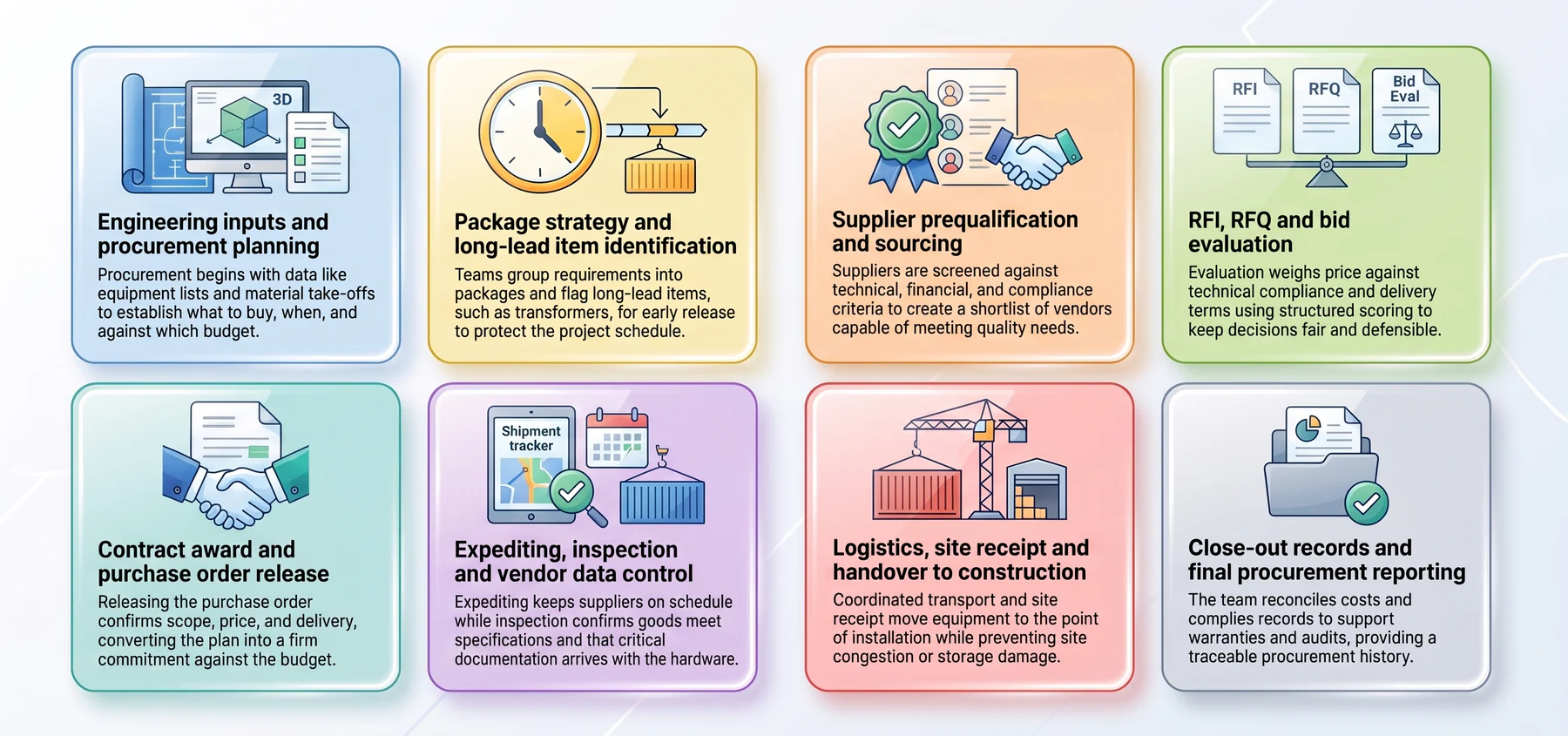
The EPC procurement process moves through eight connected activities that turn engineering requirements into delivered, installed equipment. Each activity feeds the next, so a gap early in the chain usually surfaces as a delay on site later.
1. Engineering inputs and procurement planning
Procurement begins with engineering data such as equipment lists, datasheets, and material take-offs. The procurement team builds an early plan from these inputs, setting out what to buy, when, and against which budget.
Accurate engineering inputs matter because they define the specifications suppliers will quote against. Therefore, procurement and engineering should align on data quality before any sourcing begins.
2. Package strategy and long-lead item identification
The team then groups requirements into procurement packages and flags long-lead items that need early action. Long-lead equipment, such as transformers or large vessels, can take many months to manufacture.
Identifying these items early protects the schedule, since a late order on a long-lead item can delay the entire build. As a result, many EPC teams release long-lead orders well before the full design is complete.
3. Supplier prequalification and sourcing
Next, the team prequalifies suppliers against technical, financial, and compliance criteria. This creates a shortlist of vendors capable of meeting the project's quality and delivery needs.
Prequalification reduces risk before bids even arrive, since it screens out suppliers who cannot perform. Therefore, only credible vendors reach the formal enquiry stage.
4. RFI, RFQ and bid evaluation
The team issues requests for information and requests for quotation, then evaluates the returned bids. Evaluation weighs price alongside technical compliance, delivery, and commercial terms.
A structured comparison keeps the decision defensible and fair across bidders. For example, a like-for-like scoring sheet prevents a low headline price from hiding weak delivery terms.
5. Contract award and purchase order release
After evaluation, the team awards the contract and releases the purchase order to the chosen supplier. The purchase order confirms scope, price, delivery dates, and terms.
This point converts a plan into a firm commitment against the budget. Therefore, accurate commitment recording here keeps the project's cost position current.
6. Expediting, inspection and vendor data control
Once orders are placed, the team expedites progress, arranges inspections, and controls incoming vendor data. Expediting keeps suppliers on schedule, while inspection confirms the goods meet specification.
Vendor data control matters because drawings and certificates must arrive with the equipment. As a result, missing documents can hold up installation even when the hardware is ready.
7. Logistics, site receipt and handover to construction
The team then manages transport, customs, site receipt, and handover to the construction crew. This stage moves equipment from the supplier to the point of installation.
Careful logistics protect both the schedule and the condition of the goods. Therefore, coordinated delivery windows prevent site congestion and storage damage.
8. Close-out records and final procurement reporting
Finally, the team closes out orders, reconciles costs, and compiles the final procurement records. These records support handover, warranty, and any future audit.
Complete close-out records give the owner a clear account of what was bought and spent. Consequently, the project finishes with a defensible, traceable procurement history.
Who Is Responsible for Procurement in an EPC Project?
Procurement in an EPC project involves several roles that hand work between engineering, commercial, and construction teams. Clear responsibility keeps decisions, approvals, and records from falling through the gaps.
The roles below shape how procurement runs day to day.
- Project owner: Sets the budget, approves major spend, and receives the completed asset, while relying on the contractor to deliver.
- EPC contractor: Carries overall procurement responsibility, buys on its own account, and manages suppliers end to end.
- Procurement manager: Runs the sourcing process, controls packages, and reports commitments against budget.
- Engineering, commercial, finance, and construction teams: Hand over specifications, terms, payments, and site readiness at defined points in the chain.
A clear responsibility matrix records who decides, who approves, and who keeps each record. Therefore, a documented matrix reduces disputes when a decision or approval is later questioned.
Which EPC Contract Structures Affect Procurement Decisions?

The contract structure shapes how much procurement risk the contractor carries and how the owner approves spend. Different structures suit different levels of design certainty and owner involvement.
The structures below each change the procurement approach.
- Lump-sum turnkey EPC: A single fixed price puts cost risk on the contractor, so procurement focuses on tight control and margin protection.
- Cost-reimbursable or target-cost EPC: The owner reimburses actual cost plus a fee, which gives transparency but needs strong commitment tracking.
- Split-package and specialist vendor procurement: Certain packages go directly to specialist vendors, which adds interface management across suppliers.
- How structure changes strategy: The chosen model decides how risk, approvals, and supplier selection are handled across the project.
Reading the structure early helps the team set the right approval thresholds and supplier strategy. As a result, procurement controls match the real risk the business carries rather than a generic template.
What Benefits Can EPC Procurement Create for Project Owners?
A well-run EPC procurement function delivers value that reaches well beyond the purchase price. The benefits below explain why owners favour the model on complex builds.
Clearer cost and schedule accountability
A single contractor owns the link between what is bought and when it arrives. Therefore, the owner has one accountable party for both cost and schedule performance.
Earlier control over long-lead equipment
Early identification of long-lead items lets the team order them ahead of the full design. As a result, critical equipment arrives in time to protect the construction programme.
Better alignment between engineering design and construction readiness
Procurement sits between design and site, so it keeps the two in step. This alignment means equipment matches the design and reaches the site when the crew needs it.
Stronger supplier commitment and project visibility
A structured process secures firmer supplier commitments and clearer delivery data. Consequently, the project team can see progress and act before a slip becomes a delay.
What Risks Can Disrupt EPC Procurement Before Construction?
Several risks can stall EPC procurement before a single component reaches the site. Recognising them early lets the team put controls in place rather than react to a crisis.
The risks below deserve close attention during planning.
Late engineering changes and incomplete specifications
Design changes after ordering can force rework, cancellations, or costly variations. Therefore, stable specifications before award protect both cost and schedule.
Long-lead equipment delays and import constraints
Long manufacturing times and import steps can push out delivery dates. For example, a delayed transformer or a customs hold can idle a whole work front.
Weak supplier qualification and bid comparison
Poor prequalification or inconsistent bid scoring can hand work to a supplier who cannot perform. As a result, the project risks late or non-compliant equipment.
Missing vendor data, inspection records and expediting visibility
When drawings, certificates, or inspection records go missing, installation stalls even with hardware on site. Therefore, disciplined document control keeps delivery and paperwork together.
Budget leakage from disconnected procurement records
When commitments, invoices, and budgets sit in separate tools, cost creep hides until late. Consequently, connected records are essential to catch variances early.
How Do EPC and EPCM Differ for Procurement Control?
EPC and EPCM sound similar, yet they place procurement risk in very different hands. Understanding the split helps an owner choose the model that suits its appetite for control and risk.
The table below sets the two side by side across the factors that matter most for procurement.
| Factor | EPC | EPCM |
|---|---|---|
| Who buys | The contractor procures on its own account | The manager procures on the owner's behalf |
| Procurement risk | Sits mainly with the contractor | Stays mainly with the owner |
| Owner visibility | Lower, since the contractor controls detail | Higher, since the owner sees each order |
| Cost certainty | Higher under a lump-sum price | Variable, based on actual cost plus fee |
| Best suited to | Owners wanting a fixed price and single point of responsibility | Owners wanting close control and flexibility |
Reading the split this way helps an owner match the model to its own capacity to manage suppliers. As a result, the procurement approach reflects the real risk the business is willing to hold.
How Can Digital Procurement Controls Improve EPC Delivery?

Manual spreadsheets struggle to keep requisitions, orders, vendor data, and budgets aligned across many packages. Construction and project procurement software connects these threads, so the whole team works from one current view.
The controls below show where connected software makes the biggest difference.
PR to RFQ to PO tracking across procurement packages
A connected system follows each item from purchase requisition through RFQ to purchase order. This traceability removes the re-keying and version gaps that slow manual procurement.
Vendor data register and document-control visibility
A central register tracks drawings, certificates, and inspection records against each order. Therefore, the team can see whether documents are ready well before equipment reaches the site.
Commitment vs budget dashboards for project teams
Live dashboards compare committed spend against budget across every package. As a result, the team spots cost creep early rather than at final reconciliation.
Expediting, inspection and delivery status tracking
Status tracking shows where each order sits, from manufacture through inspection to delivery. This visibility lets the team act on a slipping supplier before it affects the schedule.
How HashMicro supports EPC Procurement Workflows Through Construction and Project ERP
HashMicro's construction and project software links purchase requisitions, RFQs, purchase orders, vendor data, and budgets in one connected system. Because the data lives together, commitment positions and delivery status stay current without manual reconciliation.
On top of that connected data, Hashy, HashMicro's AI Coworker, reads the live procurement and project records through the Company Nexus. It then surfaces budget variances, flags overdue vendor data, and answers procurement questions in plain language, so the team acts on live numbers rather than chasing reports.
That same connected data lets Hashy work as a true procurement coworker, so your team asks a question and acts on the answer rather than pulling reports from separate tools.






Conclusion
EPC procurement decides whether a capital project reaches the site on time and on budget, since it connects engineering design to sourcing, contracts, and delivery under one accountable model. For Australian businesses, the strongest results come from early control of long-lead items, disciplined vendor data, and connected records that keep commitments visible.
The right approach depends on your contract structure, your risk appetite, and how tightly procurement links to your project controls. To see how connected construction and project procurement could work across your builds, book a free consultation with HashMicro.
Frequently Asked Questions
EPC procurement is the coordinated process that converts approved engineering requirements into sourced, contracted, inspected, delivered and closed-out supplier commitments. Unlike routine purchasing, it must maintain alignment between technical requirements, commercial authority, supplier performance, logistics and construction readiness.
In an EPC model, the EPC contractor typically contracts with suppliers and manages integrated delivery, subject to the owner's retained rights. In an EPCM model, the owner commonly enters supplier and works contracts directly while the EPCM manager advises and administers the process. The executed contracts determine the final authority and risk allocation.
The EPC contractor and its procurement manager typically coordinate procurement, but engineering, commercial, finance, quality, logistics, construction and owner representatives may retain defined reviews or approvals. Authority should follow the EPC contract, delegation limits and project governance documents.
Long-lead items are materials or equipment whose design, manufacture, inspection or transport duration can constrain the project schedule. Depending on the project, examples may include transformers, switchgear, pressure vessels, turbines, crushers and custom control systems.
Common records include specifications, material requisitions, RFIs, RFQs, bidder lists, technical and commercial evaluations, approval histories, purchase orders, vendor documents, inspection records, shipping documents, goods receipts, invoices and close-out files.
Connected workflows can improve approval traceability, supplier-data control, budget-versus-commitment visibility, expediting status and receipt records. Software supports information control but does not replace engineering judgement, legal interpretation, commercial authority or physical inspection.