




AI in Logistics helps Australian businesses improve delivery planning, warehouse accuracy, inventory control, and supply chain visibility. For SMBs and mid-market companies facing higher freight costs, labour pressure, customer delivery expectations, and wider service areas, AI can turn logistics data into faster decisions.
Logistics teams already manage orders, suppliers, carriers, warehouses, and customer promises across many systems. Therefore, AI becomes more useful when it connects with ERP, WMS, inventory, and transport data rather than operating as a separate tool.
Key Takeaways
AI helps logistics teams forecast demand, optimise routes, manage stock, and improve warehouse and freight planning.
Connected AI can improve operational visibility, speed up decisions, lower logistics costs, and strengthen supply chain resilience.
ERP, WMS, and TMS platforms give AI reliable operational data, while Hashy OS supports natural-language access to connected logistics records.
Businesses should begin with one high-impact workflow, centralise their data, connect existing systems, and measure practical logistics results.
What Is AI in Logistics?

AI in Logistics refers to the use of artificial intelligence to analyse logistics data, recommend actions, automate repetitive work, and improve supply chain decisions. It can support warehouse management, freight planning, inventory forecasting, order fulfilment, route planning, and customer communication.
For example, AI can review sales history, delivery patterns, warehouse capacity, and supplier performance to forecast demand more accurately. As a result, logistics teams can reduce stockouts, avoid overstocking, and plan transport with better confidence.
AI works best when it receives reliable operational data from connected systems. Therefore, businesses should treat AI as part of a broader logistics technology stack, not as a standalone shortcut.
How AI Is Used in Logistics and Supply Chain Operations
AI supports logistics work by analysing patterns that teams may not see quickly through spreadsheets or manual reporting. The following areas show where Australian businesses commonly apply AI across supply chain operations.
Demand Forecasting
AI demand forecasting helps businesses predict future stock needs by reviewing sales history, seasonality, promotions, customer behaviour, and market patterns. This gives logistics and purchasing teams a clearer view of what products may move faster or slower.
For example, a retailer can use AI to forecast higher demand before peak shopping periods. Then, the business can adjust procurement, warehouse labour, and delivery planning earlier.
Route Optimisation
AI route optimisation helps transport teams plan more efficient delivery routes based on distance, traffic patterns, delivery windows, vehicle capacity, and service priorities. This can reduce fuel use, improve on-time delivery, and lower driver idle time.
For Australian businesses covering metro and regional areas, route planning matters because delivery distance and freight costs can change quickly. As a result, AI can help teams respond faster when routes, orders, or driver availability change.
Warehouse Operations
AI can improve warehouse operations by supporting slotting, picking priorities, labour planning, replenishment, and space usage. It helps teams understand where goods should be stored and which orders should move first.
In addition, AI can identify slow-moving stock, frequent picking bottlenecks, and layout issues. This gives warehouse managers practical insight before delays affect customer delivery.
Inventory Management
AI inventory management helps businesses balance stock availability with working capital control. It can flag reorder needs, detect unusual stock movements, and forecast future inventory requirements.
This matters for companies that manage multiple warehouses, online orders, wholesale customers, or seasonal products. Therefore, AI can help reduce manual checking while improving stock accuracy.
Freight and Transport Management
AI supports freight and transport management by analysing carrier performance, delivery costs, shipment delays, and route efficiency. It can also recommend better carrier choices based on cost, reliability, or customer service requirements.
For example, a distributor can compare freight partners by delivery time, cost per order, and issue rate. Then, logistics managers can negotiate better terms or adjust carrier allocation.
Key Benefits of AI in Logistics
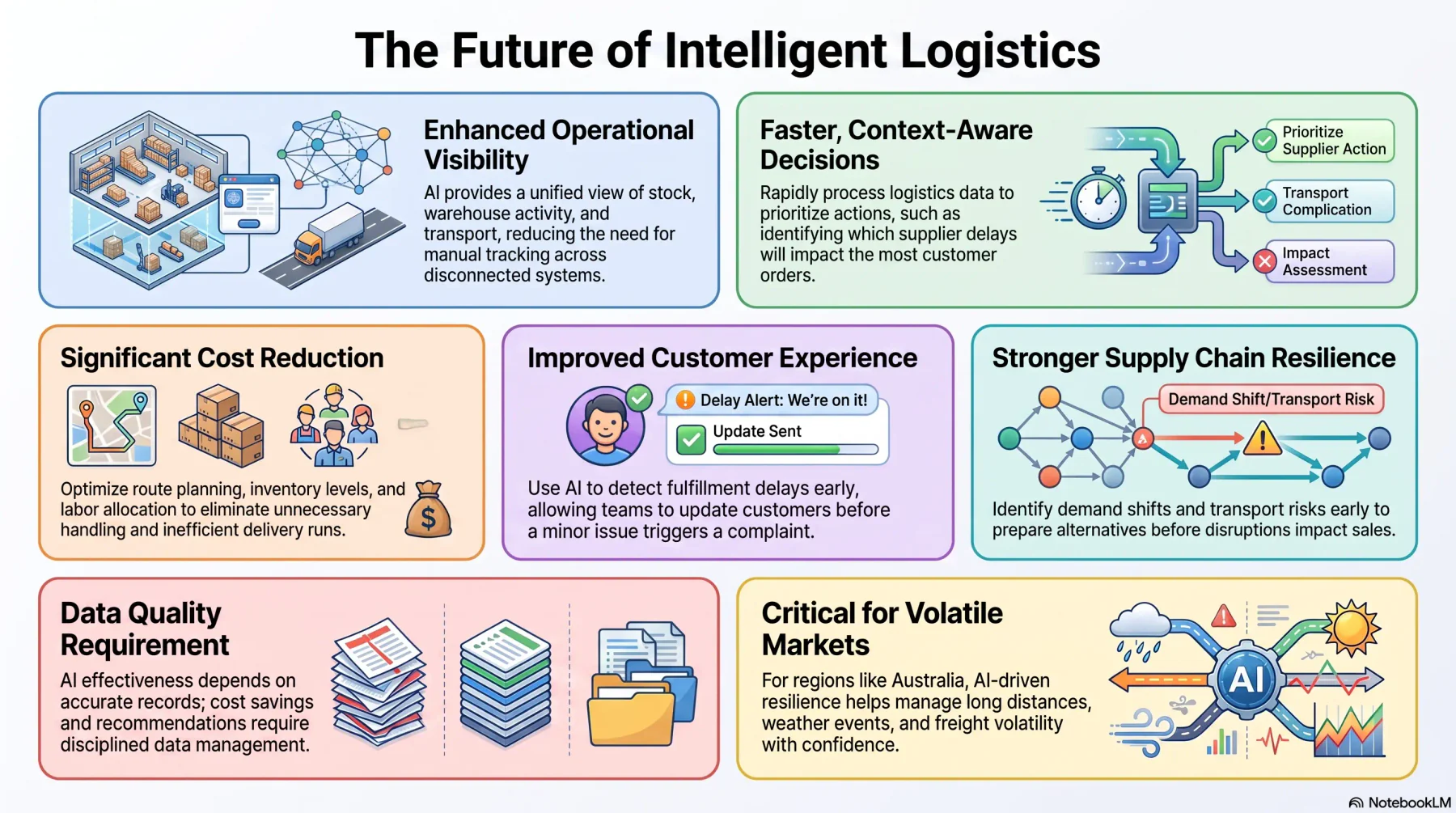
AI creates value when it improves daily logistics decisions, not only when it produces reports. The benefits below show why businesses are adding AI to their logistics and supply chain systems.
Better Operational Visibility
AI gives logistics teams a clearer view of orders, stock, warehouse activity, supplier delays, and transport performance. This reduces the need to chase updates across spreadsheets, emails, and disconnected systems.
For example, managers can see which orders risk delay and which warehouse locations may run low on stock. As a result, teams can act earlier instead of reacting after customers complain.
Faster Decision-Making
AI can process large volumes of logistics data much faster than manual review. It helps teams identify problems, compare options, and prioritise actions.
For example, AI can highlight which late supplier shipment will affect the most customer orders. Then, managers can reroute stock or adjust fulfilment plans with better context.
Lower Logistics Costs
AI can reduce logistics costs by improving route planning, inventory levels, warehouse labour allocation, and freight selection. These improvements help businesses avoid unnecessary handling, excess stock, and inefficient delivery runs.
However, cost savings depend on data quality and process discipline. Businesses need accurate order, inventory, warehouse, and transport records for AI recommendations to work well.
Improved Customer Experience
AI helps businesses keep customers informed with better order visibility, delivery estimates, and issue detection. This matters because customers increasingly expect accurate updates and fast fulfilment.
For example, an e-commerce business can use AI to detect fulfilment delays and update customer service teams sooner. As a result, teams can communicate before a small issue becomes a complaint.
Stronger Supply Chain Resilience
AI can strengthen supply chain visibility by identifying demand shifts, supplier risks, transport delays, and inventory gaps earlier. This helps businesses prepare alternatives before disruption affects sales.
For Australian companies dealing with distance, weather events, supplier lead times, and freight volatility, resilience has become a practical logistics requirement. Therefore, AI can help teams plan with more confidence.
AI Logistics Use Cases for Australian Businesses
Different industries use AI in Logistics for different reasons. The examples below show how SMB and mid-market companies can apply AI across common Australian business models.
Retail and E-commerce Fulfilment
Retail and e-commerce businesses can use AI to forecast product demand, prioritise orders, allocate stock, and improve delivery promises. This helps teams manage spikes during sales periods, holidays, and promotional campaigns.
In addition, AI can support returns analysis and customer service workflows. For example, it can identify products with high return rates and help teams review stock, fulfilment, or product data issues.
Wholesale and Distribution
Wholesale and distribution companies can use AI to improve replenishment, warehouse picking, stock allocation, and customer order planning. This is useful when businesses serve many customers with different order cycles and delivery expectations.
For example, AI can recommend stock transfers between branches when one location has excess stock and another faces shortage risk. As a result, teams can improve service levels without overbuying.
Manufacturing and Supply Chain
Manufacturers can use AI to connect production planning with inventory, procurement, and dispatch schedules. This helps businesses avoid material shortages, late deliveries, and excess finished goods.
AI can also review supplier reliability and production demand patterns. Then, purchasing and logistics teams can plan materials and freight earlier.
Freight and Transport Companies
Freight and transport companies can use AI to optimise routes, allocate vehicles, forecast delivery times, and monitor carrier performance. This supports faster dispatch decisions and better fleet utilisation.
In addition, AI can help identify recurring causes of delivery delays. For example, a transport business may find that certain routes, customers, or time windows create repeated service issues.
Cold Chain and Regulated Goods
Cold chain businesses can use AI to monitor temperature-sensitive goods, delivery timing, storage conditions, and compliance risks. This is important for food, pharmaceuticals, healthcare supplies, and other regulated products.
AI can flag unusual patterns before goods become unsafe or non-compliant. However, businesses still need clear accountability, audit trails, and human review for regulated logistics decisions.
Generative AI in Logistics
Generative AI can help logistics teams query data, summarise reports, draft customer updates, and search operational records using natural language. This reduces time spent manually pulling information from several systems.
For example, Hashy OS, HashMicro’s native AI layer, can help users interact with ERP-connected logistics, inventory, procurement, and financial data through conversation. This gives teams a practical way to ask about stock levels, order status, cost variances, or operational bottlenecks without moving through multiple screens.
Challenges of Using AI in Logistics
AI can improve logistics performance, but it needs the right foundation. The challenges below explain where businesses should be careful before investing too much too quickly.
Poor Data Quality
AI relies on accurate and consistent data. If product codes, stock counts, delivery records, supplier details, or customer addresses are incorrect, AI recommendations may become unreliable.
Therefore, businesses should clean operational data before expecting advanced automation. Better data discipline usually creates value even before AI starts.
Disconnected Systems
Many logistics teams still manage data across separate tools for sales, inventory, warehouse, transport, accounting, and customer service. This makes it harder for AI to produce complete recommendations.
For example, AI cannot accurately predict delivery risk if it cannot see order status, warehouse stock, carrier capacity, and customer commitments together. As a result, connected systems matter as much as the AI model itself.
Change Management
AI changes how teams plan, check, and approve logistics work. Staff may resist the system if they do not understand how it helps their daily tasks.
Businesses should involve warehouse, purchasing, transport, finance, and customer service teams early. Then, users can test AI recommendations against real workflows and build trust gradually.
Cost and Implementation Scope
AI projects can become expensive when businesses try to solve too many problems at once. A broad implementation can also create delays if data, workflows, and ownership are unclear.
A practical approach starts with one high-impact logistics problem. For example, a business may begin with inventory forecasting, route planning, or warehouse picking before expanding further.
Compliance and Accountability
AI can support logistics compliance, but businesses still need clear records, approvals, and accountability. This matters for regulated goods, financial reporting, customer data, and chain-of-responsibility obligations.
For example, AI may recommend a transport action, but managers still need to confirm whether it meets company policy and legal requirements. Therefore, businesses should keep audit trails and human oversight in critical workflows.
How ERP, WMS, and TMS Systems Support AI in Logistics
ERP, WMS, and TMS systems give AI the operational data it needs to support logistics decisions. ERP connects sales, procurement, inventory, finance, and customer records, while WMS manages warehouse activity and TMS supports transport planning.
For many growing businesses, AI becomes more valuable when it works inside these systems. This means managers can ask questions, review recommendations, and act on data without switching between disconnected tools.
HashMicro’s Warehouse Management System helps businesses manage warehouse operations, stock movement, picking, packing, and fulfilment from an integrated platform. In addition, HashMicro’s ERP ecosystem can connect warehouse data with inventory, procurement, accounting, sales, and Hashy OS for AI-supported decision-making.
How to Start Using AI in Logistics
Businesses do not need to automate every logistics process at once. The actions below provide a practical way to introduce AI while keeping risk and cost under control.
1. Identify the Highest-Impact Logistics Problem
Start by choosing the logistics problem that creates the most cost, delay, or customer impact. This could include stockouts, delivery delays, poor warehouse visibility, slow picking, or high freight costs.
Then, define the result you want to improve. For example, a business may aim to reduce late dispatches, improve forecast accuracy, or lower urgent freight spend.
2. Clean and Centralise Operational Data
AI needs accurate data from orders, inventory, warehouses, suppliers, carriers, and customers. Therefore, businesses should fix duplicate records, inconsistent product codes, missing addresses, and incorrect stock counts.
Centralising data in ERP, WMS, or inventory software also reduces manual reconciliation. As a result, teams can trust reports and AI recommendations more easily.
3. Choose One Workflow to Improve First
Select one workflow where AI can create visible value quickly. For example, a business may start with inventory forecasting, route planning, replenishment alerts, or warehouse task prioritisation.
This focused approach helps teams test AI in a controlled way. In addition, it makes training, measurement, and process improvement easier.
4. Connect AI to Existing Business Systems
AI should connect with the systems that already hold logistics data. These may include ERP, WMS, TMS, inventory management, accounting, CRM, and e-commerce platforms.
For HashMicro users, Hashy OS can support this approach by working as an AI layer within the ERP ecosystem. Teams can interact with connected business data through natural language while keeping workflows tied to the system of record.
5. Measure Operational Results
Measure AI performance against practical logistics outcomes. Useful metrics include on-time delivery, picking accuracy, stockout rate, order cycle time, freight cost per order, and inventory turnover.
However, businesses should also review user adoption. AI only creates value when teams trust it, use it, and improve processes around it.
AI in Logistics vs Traditional Logistics Software
Traditional logistics software helps teams record, track, and manage logistics activity. AI-enabled logistics software goes further by analysing data, identifying patterns, and recommending actions.
Both approaches can support business operations. However, AI adds more value when teams need faster decisions, predictive insight, and more automation across complex workflows.
Conclusion
AI in Logistics can help Australian businesses improve forecasting, warehouse performance, inventory control, route planning, and customer service. However, businesses need clean data, connected systems, and a clear implementation focus to get practical value from AI.
For growing companies, HashMicro offers ERP-connected warehouse, inventory, procurement, and finance tools that can work with Hashy OS as an integrated AI layer. To explore the right logistics technology setup for your business, book a free consultation with HashMicro.
FAQ About AI in Logistic
AI in logistics uses technologies such as machine learning, predictive analytics, and automation to improve transport, warehousing, inventory, and supply chain decisions.
Businesses use AI for demand forecasting, route optimisation, warehouse automation, inventory planning, shipment tracking, predictive maintenance, and delivery scheduling.
AI can improve operational visibility, reduce manual work, support faster deliveries, control costs, and help businesses respond to supply chain disruptions.
Common examples include systems that predict product demand, recommend delivery routes, identify warehouse bottlenecks, monitor vehicle condition, and flag delayed shipments.
Businesses may face data quality issues, integration costs, cybersecurity risks, skill gaps, and resistance to new processes. Clear planning and reliable system integration can reduce these challenges.
AI primarily automates repetitive tasks and supports decision-making. Employees still provide operational knowledge, manage exceptions, maintain customer relationships, and oversee important decisions.
A business can begin by identifying a specific operational problem, reviewing its data quality, and choosing a suitable pilot project. It can then measure the results before expanding AI across other logistics activities.