









 Limited to 100 registrants

A stock discrepancy occurs when the physical inventory count does not match the quantity recorded in the inventory system. It may result from missing stock, unrecorded transactions, counting errors, or incorrect inventory records.
Warehouse teams should investigate every discrepancy before making adjustments. This includes verifying stock counts, reviewing recent transactions, and identifying the root cause to maintain inventory accuracy.
This guide explains the common causes of stock discrepancies, how to investigate them, and best practices for preventing future inventory mismatches.
Key Takeaways
Stock discrepancies occur when physical inventory does not match the quantity recorded in the inventory system.
Most stock discrepancies are caused by transaction errors, inaccurate counts, or incorrect inventory records.
An integrated inventory system helps businesses prevent stock discrepancies through real-time tracking and controlled inventory processes.

What Is a Stock Discrepancy?

The basic formula is:
Stock discrepancy = Physical count − Recorded quantity.
For example, if the system shows 500 units but only 491 units are counted, the discrepancy is −9 units.
A negative discrepancy means the physical stock is lower than the recorded amount, while a positive discrepancy means there is more stock than expected. However, the difference does not always indicate lost stock and should be investigated before any inventory adjustment is made.
Stock Discrepancy vs Reconciliation vs Adjustment
Although these terms are related, they describe different stages of inventory control.
| Term | Simple Meaning |
|---|---|
| Stock discrepancy | A difference between physical and recorded inventory that needs investigation. |
| Inventory reconciliation | The process of finding and resolving inventory differences. |
| Stock adjustment | An approved correction to inventory quantity or value. |
| Variance report | A report showing the difference between expected and actual inventory. |
If six apparently missing units are found at another warehouse, the correct action may be to fix the location or transfer record. It would be incorrect to reduce the organisation’s total inventory by six units.
"Accurate inventory starts with consistent processes and reliable data."
What Causes Stock Discrepancies?
Stock discrepancies can happen at any stage of stock management and warehouse operations. Identifying the cause helps businesses resolve inventory issues accurately and prevent them from happening again.
1. Transaction timing
Inventory records may not update at the same time as physical stock movements. Delayed receipts, transfers, or shipments can create temporary differences between actual and recorded stock.
2. Receiving and putaway errors
Incorrect receiving quantities, wrong storage locations, unit-of-measure mistakes, or missing lot and serial numbers can lead to inventory discrepancies from the moment goods enter the warehouse.
3. Picking, dispatch, and returns
Picking the wrong items, incomplete shipment confirmations, or incorrectly processed returns can cause physical inventory to differ from system records.
4. Counting and data errors
Duplicate counts, missed locations, incorrect barcodes, or inaccurate product data can result in recurring discrepancies, even after stock adjustments.
5. Damage, expiry, and shrinkage
Damaged, expired, lost, or stolen inventory should be recorded correctly. Businesses should investigate other possible causes before classifying a discrepancy as shrinkage.
How to Investigate and Reconcile a Stock Discrepancy
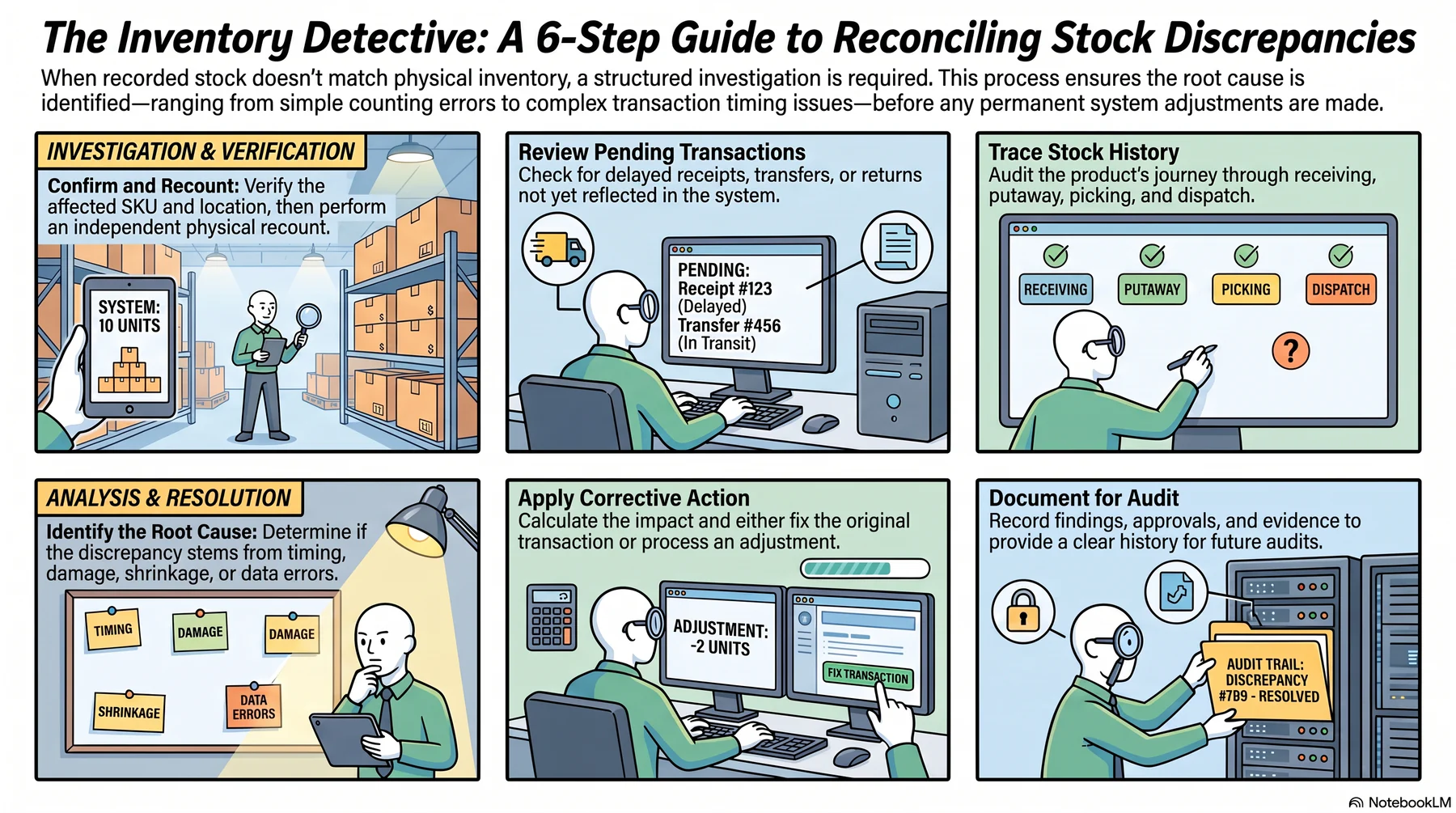
A structured investigation helps businesses identify the cause of a stock discrepancy before making any inventory adjustments.
1. Verify the discrepancy
Confirm the affected product, location, recorded quantity, physical count, and the time the stock was counted.
2. Recount the inventory
Perform an independent recount and check nearby storage areas to rule out counting errors or misplaced stock.
3. Review recent transactions
Check for pending or delayed receipts, transfers, dispatches, or returns that may not yet be reflected in the inventory system.
4. Trace stock movements
Review the product's movement history, including receiving, putaway, transfers, picking, dispatch, production, and returns.
5. Check locations and product data
Verify the correct warehouse, bin location, barcode, SKU, lot or serial number, and unit of measure.
6. Identify the root cause
Determine whether the discrepancy was caused by counting errors, transaction timing, receiving, transfers, picking, damage, shrinkage, or incorrect master data.
7. Assess the impact
Calculate the confirmed quantity difference and evaluate its impact on inventory value and business operations.
8. Apply the correct resolution
Correct the original transaction where possible, or process an approved stock adjustment if the discrepancy is confirmed.
9. Document the investigation
Record the findings, root cause, corrective action, approvals, and supporting evidence for future reference and audits.
Worked Example: From Missing Stock to an Approved Adjustment
A warehouse system records 500 units of an item, but a cycle count finds only 491 units, creating an initial discrepancy of −9 units. After an independent recount, the quantity remains the same.
The investigation shows that 6 units were transferred to another warehouse but recorded incorrectly, while 3 units were damaged and moved to quarantine without being recorded. Instead of adjusting all 9 units, the warehouse corrects the transfer record and processes a stock adjustment only for the 3 damaged units.
This example shows that businesses should identify and resolve the root cause first, then adjust only the confirmed inventory difference.
How to Prevent Stock Discrepancies
Preventing stock discrepancies starts with accurate inventory processes and consistent warehouse controls. Businesses can reduce inventory errors by following these best practices:
- Verify receiving, transfers, and dispatch transactions before updating inventory.
- Use barcode scanning and maintain accurate product and location data.
- Perform regular stocktakes and cycle counts to identify discrepancies early.
- Review recurring discrepancies to improve warehouse processes and controls.
An integrated warehouse management system also helps improve inventory accuracy by tracking stock movements in real time and reducing manual errors.
What Should an Inventory System Support?
As warehouse operations grow, managing inventory across spreadsheets becomes more difficult. An integrated inventory system helps businesses track stock accurately and investigate discrepancies more efficiently.
A good inventory system should support:
Real-time stock movement and inventory tracking.
Multi-warehouse, lot, and serial traceability.
Stocktakes, inventory adjustments, and approval workflows.
Audit trails and reporting for faster investigations.
Furthermore, businesses can gain greater visibility into inventory performance with Hashy AI, HashMicro's built-in AI assistant. It helps analyse inventory data, identify discrepancy trends, and support faster, data-driven decisions across warehouse operations.






HashMicro's Inventory Management System combines these capabilities in one platform, helping businesses maintain accurate inventory records and resolve stock discrepancies more efficiently.
Conclusion
Stock discrepancies can affect inventory accuracy, fulfilment, and business performance if they are not investigated properly. Identifying the root cause before making inventory adjustments helps businesses maintain reliable stock records and prevent the same issues from recurring.
An integrated inventory management system makes this process more efficient by providing real-time inventory visibility, accurate stock movement records, and controlled adjustment workflows.
Consult with HashMicro's experts to discover how an integrated Inventory Management System can help your business improve inventory accuracy and streamline warehouse operations.
FAQ
A stock discrepancy is a difference between the physical inventory count and the quantity recorded in the inventory system.
Recount the stock, review recent inventory transactions, identify the cause, and make an approved stock adjustment if needed.
No. Stock reconciliation investigates the cause of the discrepancy, while a stock adjustment corrects the inventory record.
No. Always verify transactions, locations, and inventory records before updating the system.
High-value or fast-moving inventory should be reconciled more often, usually through regular cycle counts.