




A well-researched message can start a valuable business conversation. However, an irrelevant pitch can damage trust and expose the sender to compliance risks.
A cold email contacts a potential customer or partner who has not previously spoken with the sender. Australian businesses must still obtain valid consent before sending commercial emails, even when the message targets a work address.
Effective outreach therefore requires more than persuasive writing. Teams need a relevant reason to contact the recipient, accurate prospect data, a clear offer, and controls that meet Australian spam requirements.
Key Takeaways
A cold email starts a new business conversation, but Australian senders still need express or valid inferred consent.
Effective outreach begins by identifying a suitable recipient, relevant business trigger, specific problem, and single objective.
A strong cold email connects a verified observation with a concise value proposition, credible proof, and simple call to action.

What Is a Cold Email?
A cold email is an unsolicited message sent to someone who has no established relationship with the sender. Businesses commonly use this form of outreach to introduce a relevant service, request a meeting, explore a partnership, or identify the right contact.
Unlike newsletter marketing, a cold email usually targets one recipient and refers to their role or current business situation. Personalisation does not automatically make the message lawful, though.
Under Australia’s Spam Act 2003, commercial electronic messages generally require the recipient’s express or inferred consent. The message must also identify the sender, provide accurate contact information, and contain a functional unsubscribe option.
Express consent may come from a submitted form, an event registration, a telephone conversation, or another clear agreement. The ACMA recommends retaining evidence of who provided consent, when they provided it, and how it was obtained.
Inferred consent requires careful assessment. A publicly available business address does not automatically provide permission to send marketing messages.
The Spam Act allows consent to be inferred from a conspicuously published address only in limited circumstances. The publication must not state that unsolicited commercial messages are unwanted, and the message must directly relate to the recipient’s work duties or business role.
The following table distinguishes cold outreach from other common email types.
| Email Type | Recipient Relationship | Main Consideration |
|---|---|---|
| Cold email | No previous conversation or established relationship | Requires valid consent, strong relevance, sender identification, and an unsubscribe facility |
| Warm outreach | Previous enquiry, referral, meeting, or permitted interaction | Should reflect the context and scope of the recipient’s consent |
| Marketing newsletter | Usually an established subscriber or customer | Needs documented consent, accurate sender details, and straightforward opt-out controls |
The term “cold email” describes the relationship rather than a legal exemption. A business should confirm consent before focusing on subject lines, templates, or conversion techniques.
What to Do Before Contacting a Prospect
Effective prospecting begins before anyone drafts the email. The following preparation helps teams improve relevance while reducing inappropriate outreach:
- Define your ideal recipient: Specify the industry, company size, location, role, and operational responsibility that make someone suitable for the offer.
- Research a relevant business trigger: Look for a verified event such as expansion, recruitment, a new location, regulatory change, product launch, or published project.
- Identify one problem you can address: Select a problem that reasonably relates to the recipient’s responsibilities instead of listing every service your company provides.
- Choose one objective for the conversation: Decide whether the email should request a brief call, confirm interest, introduce a resource, explore a partnership, or find the correct contact.
Research should rely on reliable and proportionate information. A job title, company announcement, or published business responsibility may support a relevant message, while personal details unrelated to the offer should remain outside the email.
Before sending, the business should also record why it believes consent exists. The record should include the source, collection date, relevant relationship, published context, and any restrictions attached to the address.
Businesses should treat purchased databases cautiously. According to the ACMA’s spam guidance, the sender remains responsible for confirming consent even when another supplier provides the list.
Australian law also prohibits the use or supply of address-harvesting software and harvested-address lists. Therefore, scraping large numbers of addresses without understanding their source and permitted use creates serious compliance risks.
A sender cannot use a commercial email simply to ask for consent because that request is itself a marketing message. If valid consent cannot be established, the business should use a suitable non-electronic channel or wait for the prospect to initiate contact.
How to Write the Body of a Cold Email
"Effective cold email outreach is not about sending more messages. It means contacting the right prospect with a relevant reason, clear value, and a respectful follow-up process."
A good email should make its relevance clear without forcing the recipient to read several dense paragraphs. The following structure keeps the message focused and respectful.
1. Open with a Relevant Observation
Begin with a specific and verifiable detail connected to the recipient’s company or responsibilities. A recent expansion, advertised role, published initiative, or operational change can provide suitable context.
Avoid artificial familiarity or excessive praise. One accurate observation usually sounds more credible than several generic compliments copied from the company website.
2. Connect the Observation to a Business Problem
Explain why the observation may create a practical challenge within the recipient’s area of responsibility. Use cautious wording unless the company has publicly confirmed the problem.
For example, a new warehouse may increase inventory coordination requirements. The email should not claim that the prospect has stock accuracy problems without evidence.
3. Present a Concise Value Proposition
Describe the result your product or service supports rather than listing every feature. The recipient should quickly understand the connection between their situation and the proposed value.
A clear value proposition might focus on reducing repeated entry, coordinating multiple locations, improving reporting, or controlling a defined workflow. Keep the claim proportionate and avoid guaranteed outcomes.
4. Add Credible and Verifiable Proof
Support the offer with a relevant customer example, recognised qualification, published case study, or clearly sourced result. Proof should relate closely to the recipient’s industry, business size, or operational issue.
Never invent customer names, performance figures, partnerships, or awards. If suitable evidence is unavailable, explain the capability plainly instead of adding an unsupported statistic.
5. End with One Low-Friction Call to Action
Ask for one simple response, such as confirming interest, identifying the correct contact, or considering a short discussion. Multiple requests make the recipient decide which action matters.
A question such as “Would a 15-minute discussion next Tuesday be useful?” provides more direction than “Please review our website, download the guide, book a demonstration, and share this with your team.”
Every commercial message must also identify the sender and include current contact information. The unsubscribe method should remain functional for at least 30 days, and the business must action requests within five working days under ACMA unsubscribe requirements.
Six Cold Email Examples
The following examples show how cold emails can address different business situations. Each message assumes valid consent and must include accurate sender details, contact information, and a clear unsubscribe facility.
1. Problem-led cold email
Subject: Reducing manual stock checks across three locations
Hi Sarah,
Managing stock across several locations can become difficult when each branch updates separate spreadsheets. Our inventory system gives operations teams one view of stock movements, replenishment needs, and product availability.
Would a short discussion about your current inventory process be useful?
Regards,
Daniel Wong
Clearpath Business Systems
2. Trigger-based cold email
Subject: Supporting your new Brisbane warehouse
Hi Michael,
I noticed that Northside Distribution recently opened a warehouse in Brisbane. Adding another location can increase the work involved in stock transfers, order allocation, and inventory reporting.
We help distributors coordinate these processes through one connected system. Would you be open to a 15-minute conversation next Tuesday?
Regards,
Amelia Grant
Vertex Operations Solutions
3. Mutual-connection introduction
Subject: Introduction through James Patel
Hi Rebecca,
James Patel suggested that I contact you about your purchasing approval process. Our team helps growing manufacturers centralise supplier requests, approval records, and purchase orders.
Would a brief overview be relevant to your current procurement priorities?
Regards,
Oliver Chen
Summit Process Advisory
4. Value-first cold email
Subject: Inventory planning checklist for multi-site retailers
Hi Emma,
I prepared a short checklist covering stock transfers, reorder points, supplier lead times, and branch-level demand. It may be useful as your retail network expands into additional locations.
I can send the checklist directly by email without adding you to a mailing list. Would you like a copy?
Regards,
Sophie Martin
Retail Operations Advisory
5. Partnership proposal
Subject: Potential partnership for manufacturing clients
Hi David,
Your team supports manufacturers with equipment installation, while our consultants manage production planning and inventory workflows. The services may complement each other when clients need both operational systems and technical implementation.
Would you be open to a short conversation about a possible referral partnership?
Regards,
Liam Foster
Coreline Consulting
6. Referral-to-the-right-person email
Subject: Who manages sales operations at Westbridge Supplies?
Hi Jessica,
I am trying to identify the person responsible for sales operations at Westbridge Supplies. Our team helps wholesalers coordinate customer records, quotations, follow-ups, and sales reporting.
If this sits outside your role, could you direct me to the appropriate person?
Regards,
Natalie Evans
Brightfield Sales Solutions
How to Follow Up Without Overwhelming the Recipient
A follow-up should provide a useful reason to revisit the conversation. Repeating the original message several times rarely improves relevance.
1. Decide when a follow-up Is appropriate
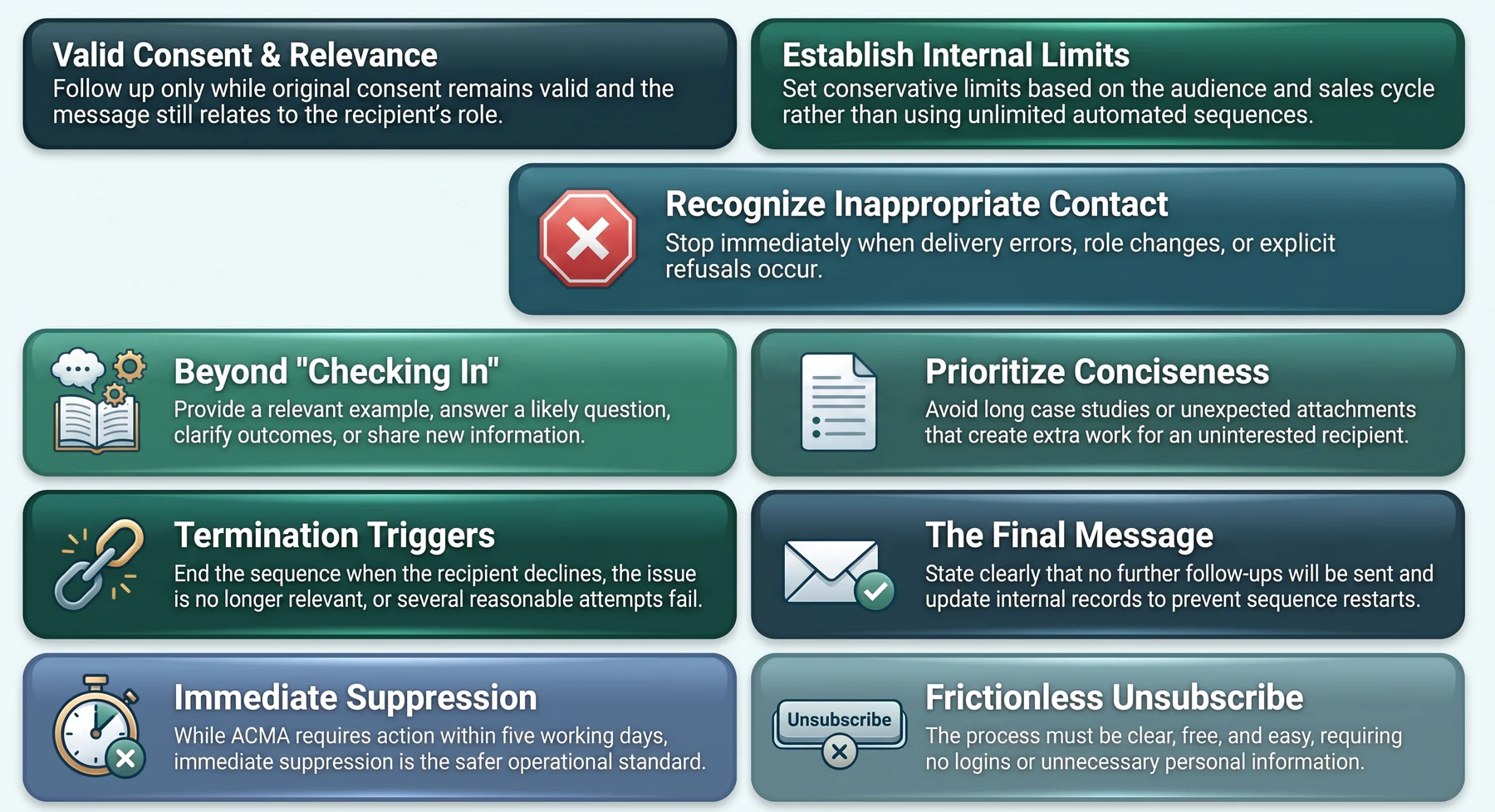
Follow up only while the original consent remains valid and the message still relates to the recipient’s role. A lack of response does not justify an unlimited automated sequence.
Set a conservative internal limit based on the audience and sales cycle. The business should also stop when delivery errors, role changes, explicit refusals, or other signals make further contact inappropriate.
2. Add new value to each message
A useful follow-up can add a relevant example, answer a likely question, clarify the proposed outcome, or provide new information. It should not merely ask whether the recipient saw the previous email.
Keep the additional value concise. A long case study or unexpected attachment can create more work for a recipient who has not expressed interest.
3. Recognise when to end the sequence
End the sequence when the recipient declines, the proposed issue is no longer relevant, or several reasonable attempts receive no response. Continuing indefinitely can harm the sender’s reputation and email deliverability.
A final message can state that no further follow-ups will be sent. The business should then update its records so another representative does not restart the same sequence.
4. Honour opt-out requests immediately
An unsubscribe request should stop commercial emails from the business, not only one campaign. The ACMA requires businesses to action the request within five working days, but immediate suppression provides a safer operational standard.
The unsubscribe process must remain clear, free, and easy to use. It cannot require the recipient to log in, create an account, or provide unnecessary personal information.
Common Cold Email Mistakes to Avoid

Poor outreach usually fails because it ignores relevance, evidence, or recipient preferences. The following mistakes can also create legal and reputational risks.
1. Sending the same generic message to everyone
A generic template often ignores differences in role, sector, business size, and operational priorities. Personalising only the recipient’s name does not make an irrelevant message useful.
Create separate messaging for distinct recipient groups. Each variation should reflect a real responsibility, business trigger, or use case.
2. Focusing on the sender instead of the recipient
Long company introductions delay the reason for contact. The recipient first needs to understand why the message relates to their work.
Mention the sender’s background only when it supports credibility. The email should devote most of its limited space to the recipient’s situation and potential outcome.
3. Making multiple requests in one email
An email that asks for a call, document review, referral, website visit, and product demonstration creates unnecessary friction. The recipient may ignore the message because no action appears straightforward.
Choose one request that matches the relationship. A first contact usually needs less commitment than an established sales conversation.
4. Using misleading claims or subject lines
False reply prefixes, invented deadlines, misleading personal references, and exaggerated results can damage trust. They may also create broader consumer law and brand risks.
The subject line should accurately reflect the content. Any urgency, customer evidence, pricing, or performance claim must be genuine and verifiable.
5. Relying on purchased or harvested contact lists
A database provider cannot transfer responsibility for consent to the buyer. The sender should inspect how every address was collected and whether the permission covers the intended message.
The Spam Act prohibits address-harvesting software and harvested-address lists. Businesses should also maintain evidence supporting the permitted use of contact information.
6. Adding unnecessary links and attachments
Several links can distract from the requested action and make the email appear suspicious. Unexpected attachments may trigger security controls or concern recipients.
Include only a link that directly supports the message. Offer to provide a document after the recipient responds when the material is not essential to the initial contact.
How CRM Supports Responsible Cold Email Outreach
CRM software cannot create consent where none exists. However, it can help a business apply its prospecting policies consistently and retain the evidence needed to manage outreach responsibly.
1. Centralise prospect sources and interaction history
A CRM record can show where the contact came from, when the details were collected, and which employee reviewed the source. The record can also retain relevant interactions, consent evidence, and campaign history.
Centralised information prevents representatives from treating every address as a new lead. It also helps teams recognise existing customers, previous refusals, duplicate records, and earlier conversations.
2. Pause automated sequences when prospects reply
Automation should stop when a prospect responds, even if the reply does not immediately create an opportunity. Continuing to send scheduled messages after a personal response makes the outreach appear careless.
CRM rules can pause tasks and sequences while assigning the conversation to a representative. The employee can then respond according to the prospect’s actual question or preference.
3. Maintain unsubscribe and suppression records
A central suppression record helps every sales and marketing channel respect an opt-out. Deleting the contact without retaining a suitable suppression marker may allow another import to recreate the same problem.
Access controls should limit who can change consent or suppression data. Businesses should also review integrations to confirm that opt-outs transfer correctly between CRM, email, and marketing platforms.
4. Track conversations, meetings, and opportunities
CRM software can connect initial outreach with replies, meetings, notes, qualification decisions, and opportunities. Managers gain a clearer view of which sources and messages create relevant conversations.
Reporting should focus on quality as well as volume. Complaint rates, opt-outs, invalid addresses, unanswered sequences, and source accuracy can reveal problems that activity totals conceal.
Hashy, HashMicro’s AI Coworker, helps sales teams turn scattered prospect information into useful context before they follow up. By drawing on connected ERP data and the Company Nexus, Hashy can surface account history and recommended actions, while each business remains responsible for its consent, suppression, and outreach policies.






Conclusion
A cold email can start a useful business conversation when the sender has a legitimate basis for contact and provides clear relevance. The strongest messages use a verified observation, one practical value proposition, credible proof, and a simple request.
Australian businesses must place compliance before conversion. Commercial emails generally require express or valid inferred consent, accurate sender identification, current contact details, and a functional unsubscribe facility.
Reliable prospect data and clear internal policies also matter. Teams should document contact sources, control follow-ups, honour refusals, and avoid harvested lists or misleading claims.
To explore how connected CRM workflows can support prospect records, follow-ups, and sales pipeline visibility, arrange a free consultation with HashMicro.
Frequently Asked Questions
A cold email is an initial business message sent to someone who has not previously communicated with the sender. It usually aims to introduce a relevant product, service, partnership, or business opportunity.
Commercial emails must comply with the Spam Act 2003. Senders generally need express or valid inferred consent before contacting someone, and each message must identify the sender and provide a working unsubscribe option.
A publicly displayed email address does not automatically provide permission to send marketing messages. Businesses should confirm that inferred consent applies, the message relates directly to the recipient’s role, and no statement rejects unsolicited commercial emails.
A strong cold email includes a relevant subject line, personalised opening, clear value proposition, supporting evidence, and simple call to action. Australian commercial emails must also contain accurate sender details, current contact information, and an accessible unsubscribe facility.
Follow-ups should add useful context instead of repeating the original message. Businesses should space them appropriately, stop when the recipient declines, and process unsubscribe requests within five working days.
CRM software helps businesses record prospect sources, consent details, email interactions, follow-up activities, and opt-out requests. It also gives sales teams a consistent view of each relationship and reduces duplicated or inappropriate contact.