






 Limited to 100 registrants
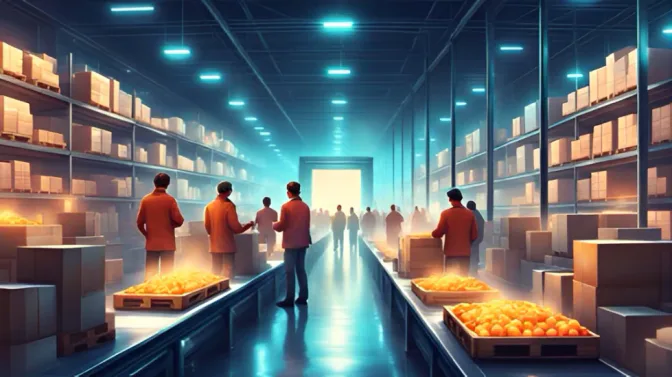
Food can pass through suppliers, warehouses, central kitchens, outlets, and customers before it is consumed. If contamination or incorrect labelling is found, the business must trace where it came from and where it went.
Food traceability tracks food, ingredients, and packaging through production, processing, storage, and distribution. It helps a business identify where an item came from, what happened to it, and where it went.
Key Takeaways
Food traceability is the ability to track food, ingredients, and packaging through every stage from receiving to distribution.
Australian food businesses must meet FSANZ requirements, including the one-step-forward, one-step-back principle for suppliers and customers.
Reliable traceability depends on supplier, internal handling, and distribution records that stay retrievable during an investigation.
Connected F&;B software links receiving, inventory, production, and sales so traceability becomes part of daily operations.
What Is Food Traceability?
Food traceability tracks food, ingredients, and packaging across the supply chain. It shows where an item came from, what happened to it, and where it went.
Backward traceability identifies the supplier and source. Internal traceability records how an item was handled within the business.
Forward traceability shows who received the product next. Together, these records form one connected chain, as explained in the FSANZ food traceability guidance.
Why Is Food Traceability Important for F&B Businesses?
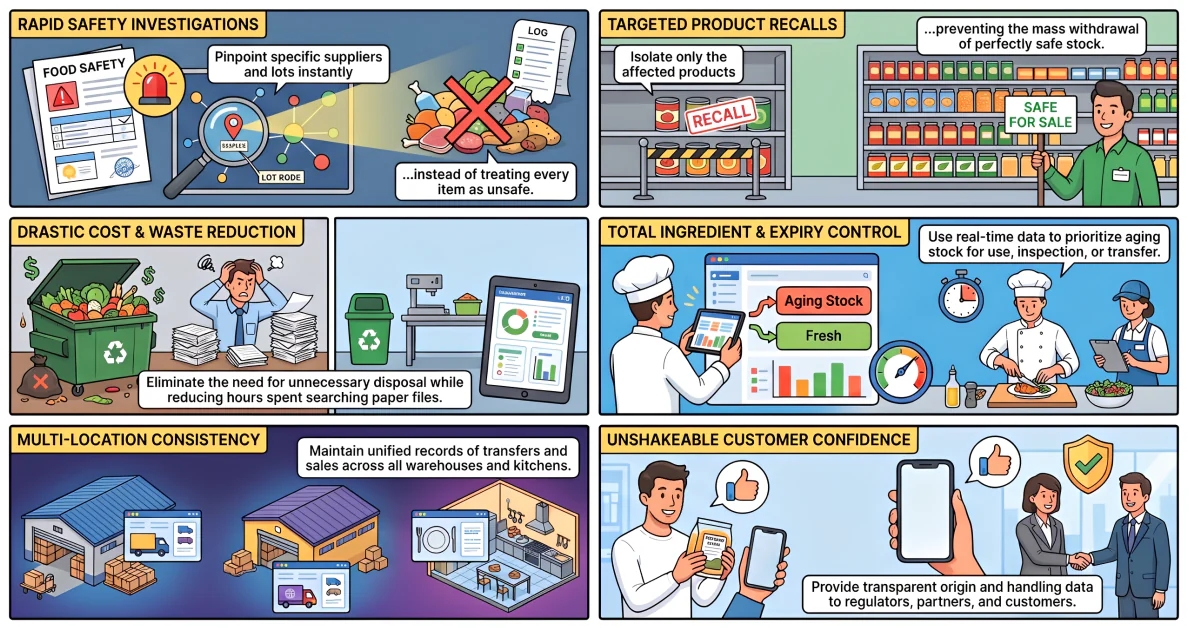
Food traceability is often associated with compliance, but its value is much broader. Reliable records also support faster investigations, tighter stock control, and clearer decisions across daily operations.
1. Faster food safety investigations
When an issue is reported, traceability records help staff identify the relevant supplier, lot, ingredient, product, or location. They can focus the investigation instead of treating every item as unsafe.
2. More targeted food recalls
Accurate lot and distribution records help a business isolate affected products. Without that detail, it may need to withdraw more stock because staff cannot confirm which items are involved.
3. Better ingredient and expiry control
Tracking ingredients by batch, expiry date, and storage location helps staff identify ageing stock. They can then prioritise it for use, inspection, transfer, or disposal.
4. Consistency across locations
Multi-outlet businesses need consistent records across warehouses, kitchens, and branches. Traceability shows what each location received, transferred, prepared, sold, or discarded.
5. Reduced waste and investigation costs
Identifying the exact stock affected can prevent unnecessary disposal of safe products. Searchable records also reduce the time spent checking paper files and separate spreadsheets.
6. Stronger customer confidence
A business that can explain a product’s origin, handling, and destination is better prepared to respond clearly to customers, regulators, and trading partners.
Food Traceability Requirements in Australia
Australia’s Food Standards Code covers traceability through labelling, recall, and commodity-specific rules in Standards 1.2.2, 3.2.2, and Chapter 4.
Businesses must know what food they hold, its source, and its destination. Manufacturers, importers, and wholesalers need a written recall system, while primary producers follow relevant commodity rules.
The one-step-forward, one-step-back principle
Under the FSANZ produce traceability requirements, primary processors must identify immediate suppliers and customers, products, quantities, and relevant dates.
This principle does not track internal handling. A central kitchen must also link each ingredient lot to the meal batches and outlets supplied.
What Records Should an F&B Business Maintain?
Record needs vary, but most systems cover receipts, internal handling, and distribution. Accurate vendor management keeps source details reliable.
| Record type | What it should capture |
|---|---|
| Supplier and receiving records | Supplier, product, receipt date, quantity, lot or batch ID, expiry date, inspection result |
| Internal handling records | Storage location, stock movement, preparation date, recipe, transfers, quality checks, waste |
| Distribution and sales records | Customer or outlet, dispatch date, quantity, lot supplied, destination, transaction, returns |
At minimum, FSANZ recommends keeping supplier and customer details, transaction and delivery dates, lot identifiers, quantities, and production records.
How Does Food Traceability Work Across F&B Operations?
Traceability should form part of daily work, not be assembled only after a safety issue occurs.
1. Supplier and ingredient receiving
Receiving staff capture the supplier, product, lot number, quantity, expiry date, condition, and arrival date before accepting the goods.
2. Central kitchen and food preparation
A central kitchen software connects incoming ingredients with recipes, preparation dates, and finished batches.
For example, a soup batch may use vegetables from lot V214 and stock from lot S108. Recording both lots against batch SOUP-32 shows which ingredients were used and which outlets received the soup.
3. Storage and expiry management
Storage records show each lot’s location, available quantity, expiry date, and movement between dry, chilled, and frozen areas.
4. Transfers between warehouses, kitchens, and outlets
Each transfer should identify the product, lot, quantity, origin, destination, dispatch time, and receiving confirmation.
5. Restaurant, café, catering, and outlet operations
Restaurants, cafés, and outlets usually connect preparation batches with the service date, location, menu item, and POS transaction.
Caterers need extra detail, including the event, venue, customer, production date, delivery time, and dishes supplied.
6. Distribution, sale, and customer delivery
Dispatch and sales data should show which customer or outlet received each lot, along with the quantity, delivery date, and order reference.
How Traceability Differs Across F&B Business Models
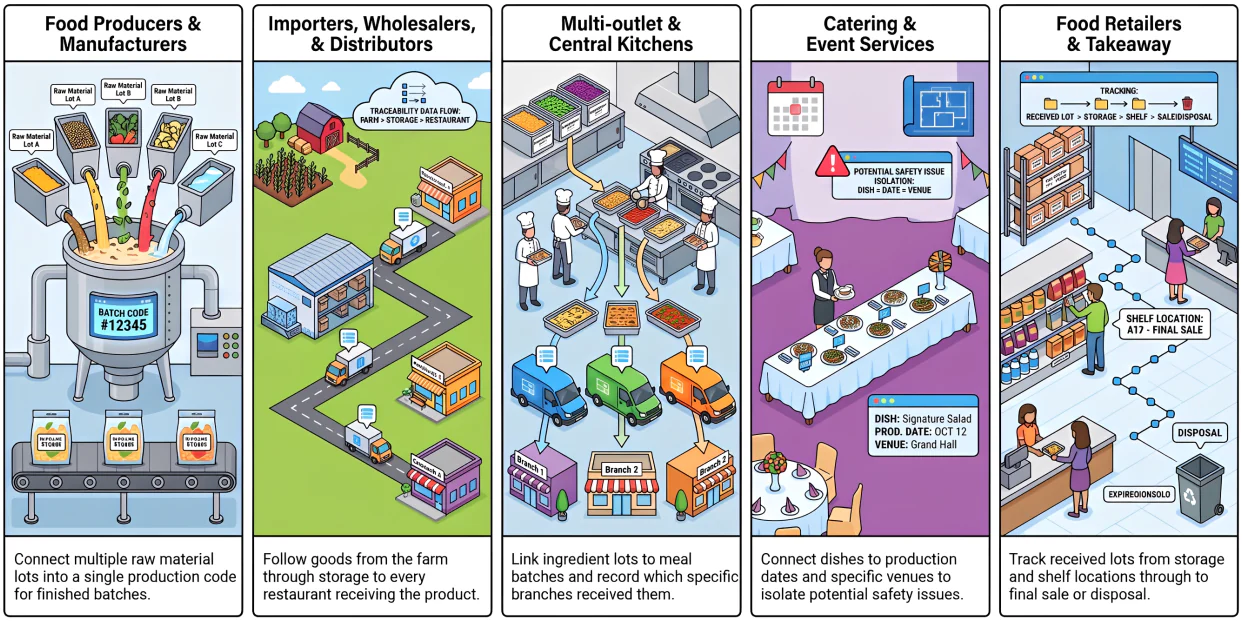
Different business models need different levels of detail based on how food is prepared, moved, and sold.
1. Multi-outlet restaurants and central kitchens
Multi-outlet groups must connect supplier lots with preparation batches, internal transfers, and receiving outlets.
For example, a central kitchen links an ingredient lot to a meal batch and records which branches received each portion.
2. Catering and event food services
Caterers connect dishes with their production date, venue, event, and customer. This helps isolate food served at one event without affecting unrelated orders.
3. Food importers, wholesalers, and distributors
Distributors follow goods from the farm or supplier through storage and delivery. A produce lot, for example, can be linked to every restaurant that received it.
4. Food producers and manufacturers
Producers connect raw materials with finished batches. One packaged sauce batch may contain ingredients from several supplier lots, all recorded under one production code.
5. Food retailers and takeaway businesses
Retailers and takeaway businesses track received lots, shelf or storage locations, expiry dates, sales, and discarded stock.
Key Components and Selection Criteria for an F&B Traceability System
Whether developed internally or purchased, the system must cover the full journey from supply to sale.
1. Lot, batch, and expiry identification
Reliable batch tracking and lot control gives each item a clear identity and keeps expiry details visible.
2. Ingredient-to-recipe or product linkage
Ingredients should connect directly with the recipes, dishes, or finished products that use them.
3. Stock location and movement history
Users need to see where stock is held and review every receipt, transfer, issue, return, or disposal.
4. Supplier, outlet, and customer linkage
Supplier and customer details should remain attached to each lot so its source and destination are easy to confirm.
5. Quality inspection and exception records
The system should retain inspection results, rejected deliveries, temperature issues, substitutions, and corrective actions.
6. Internal transfer tracking
Transfers need clear origin, destination, quantity, lot, dispatch, and receipt details.
7. Audit trail, reporting, and recall retrieval
A complete audit trail should show who changed a record and allow affected lots to be retrieved quickly.
8. Integration with procurement, inventory, production, and POS
The platform should connect these workflows, support barcode scanning, remain simple for staff, and scale across more products and locations.
"A lot number is meaningless until it's connected to a receiving record, a storage location, and a sales record. That connection is what makes traceability work, not the number itself."
Food Traceability vs Food Recall
Food traceability follows ingredients and products through supply, handling, preparation, and sale.
A food recall removes unsafe or unsuitable products from distribution. The FSANZ's food recall process outlines how affected food is identified, removed, and reported.
Traceability provides the information needed for a recall, while the recall is the action taken in response to a confirmed risk.
Manual vs Digital Food Traceability
Businesses can maintain traceability in several ways, although each approach differs in speed, accuracy, and operational coverage.
- Paper-based records: Suitable for small operations, but documents can be incomplete, damaged, or slow to review during an investigation.
- Spreadsheet-based tracking: Easier to search than paper, although duplicate files and manual entry can create gaps.
- Standalone traceability applications: Provide focused lot and recall functions but may require staff to re-enter purchasing or sales data.
- Integrated F&B or ERP software: An inventory management system connected with procurement, production, transfers, and POS keeps records in one workflow.
Common Traceability Gaps in F&B Operations
- Supplier or lot identifiers are not recorded when goods arrive.
- Original labels are lost when ingredients are opened, split, or repacked.
- Recipe substitutions and preparation batches are not documented.
- Internal transfers do not carry the original lot details.
- Outlet sales or deliveries cannot be linked to the relevant batch.
- Information is scattered across paper forms, spreadsheets, emails, and separate systems.
A practical test is to select one finished item and trace it back to its ingredients and suppliers, then forward to every outlet or customer. If the existing records cannot answer both sides clearly, a gap remains.
How HashMicro Supports End-to-End F&B Traceability
HashMicro connects supplier, receiving, inventory, preparation, transfer, and delivery records. Its inventory tools track warehouses, batches, serial numbers, stock locations, and item movements.
Central kitchen tools monitor ingredient shipments, expiry dates, and kitchen reports across outlets. Its food manufacturing ERP features cover scheduling, waste, recipes, and multi-level bills of materials.
F&B and POS tools link sales, stock, kitchens, and multi-outlet activity. Connected records help teams investigate issues faster and more precisely, but do not replace a compliant recall plan.
When traceability records span suppliers, kitchens, outlets, and sales, finding the right detail quickly matters. The banner below shows how Hashy OS helps teams retrieve connected operational information.






Conclusion
Food traceability connects suppliers, ingredients, handling, recipes, stock, transfers, outlets, and customers. Paper and spreadsheets may work at a small scale, but complexity grows quickly across more products and locations.
HashMicro can help centralise these records and support faster investigations across F&B operations. Arrange a free consultation to discuss the right setup for your business.

Frequently Asked Questions About Food Traceability in Australia
Each food business is responsible for meeting the requirements that apply to its activities. Regulators and enforcement arrangements differ between states and territories, so businesses should confirm their obligations with the relevant food authority.
It means a business can identify its immediate supplier and the immediate business or customer it supplied a product to. Internal records are still needed to trace what happe
Typical records include supplier and customer details, transaction dates, delivery information, quantities, lot or batch identifiers, expiry dates, production or preparation records, stock movements, transfers, and relevant quality records.
Traceability identifies where food came from, what happened to it, and where it went. A recall is the process used to withdraw unsafe food and notify affected businesses, customers, regulators, or the public.
Yes, but spreadsheets become harder to control as transaction volumes and locations increase. Manual entry, inconsistent identifiers, separate versions, and limited integration can slow investigations and create gaps.