

Most conversations about AI at work begin with the wrong question. Whether AI will replace people is far less useful than asking how humans and AI produce outcomes together that neither could reach alone.
Human-AI collaboration is the working model that answers this, pairing people and machines so each contributes what the other cannot, across finance, HR, supply chains, and beyond.
This article covers what human-AI collaboration means in practice, why it is becoming a competitive necessity for Australian businesses, and how to build it into your operations starting this quarter.
Key Takeaways
Human-AI collaboration is a working model where human intelligence and AI systems each contribute what the other genuinely cannot.
Key benefits of human-AI collaboration include higher productivity, better decisions, improved customer experience, and cost efficiency.
What to automate vs what to keep human covers a practical framework for deciding which workflows suit AI and which need human oversight.
HashMicro enables human-AI collaboration across accounting, HR, inventory, CRM, and operations, with human sign-off designed into each module.

What Is Human-AI Collaboration?
Human-AI collaboration is a working model where human intelligence and AI systems operate in partnership. Each contributes what the other genuinely cannot.
Humans bring ethical reasoning, contextual judgment, and the capacity to handle genuine ambiguity. AI contributes speed, pattern recognition across large datasets, and 24/7 operational consistency.
Together, they produce decisions and outputs that neither could reach as well on their own. The goal is not AI doing more. It is both parties doing what they do best.
Pure automation using, for example, the best HR software in Australia, removes human involvement entirely. It suits fully rule-based processes but cuts out the judgment that makes output trustworthy in complex situations. AI replacement is the narrative that AI will simply take jobs wholesale.
Most evidence does not support this as a blanket outcome. It supports task-level substitution in bounded contexts, not role elimination. Human-AI collaboration sits between these extremes and covers a spectrum of working arrangements.
"“Human-AI collaboration is not about choosing between people and technology. It works when AI handles volume and speed, and humans hold the judgement calls that carry real risk."
Why Human-AI Collaboration Matters for Businesses in 2026
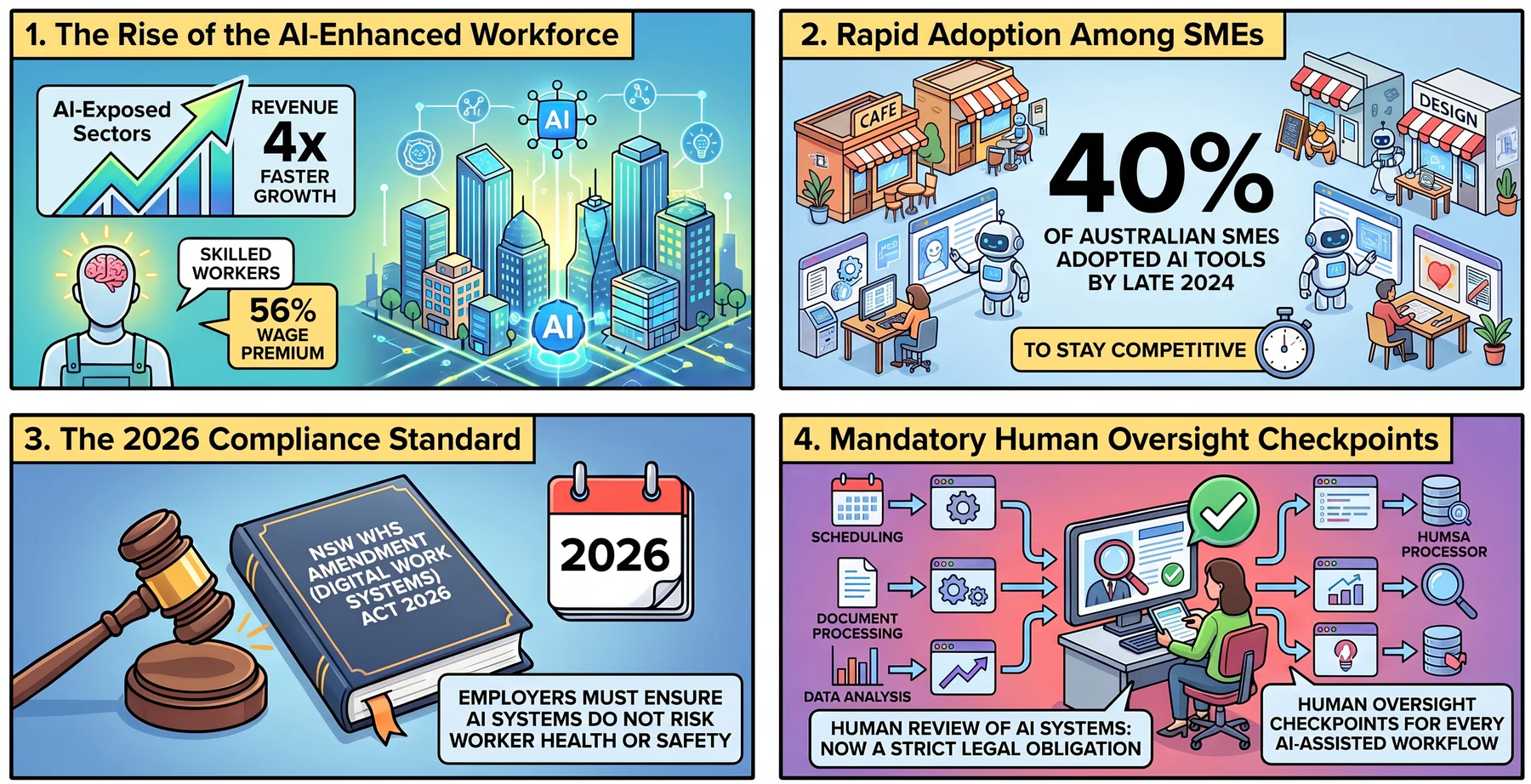
In 2025, PwC Australia found that AI-skilled workers command a 56% average wage premium. Industries most exposed to AI grew revenue per employee nearly four times faster than less-exposed sectors.
Three forces are making this urgent for Australian businesses. The first is competitive pressure. As of Q4 2024, 40% of Australian SMEs had adopted AI tools, up five percentage points in a single quarter (Department of Industry, Science and Resources, Q4 2024 AI Adoption Tracker).
The second is workforce regulation. In February 2026, NSW passed Australia's first state law explicitly governing AI in the workplace. It requires employers to ensure AI systems do not put worker health and safety at risk.
The third is operational efficiency. According to the Australian Bureau of Statistics, businesses investing in digital technologies consistently outperform peers on productivity across manufacturing, retail, and professional services.
Under the NSW Work Health and Safety Amendment (Digital Work Systems) Act 2026, AI-assisted workplace tools must include human oversight.
This covers scheduling, performance monitoring, and document processing systems. Build human review checkpoints into every AI-assisted workflow. Under this legislation, human oversight is not just best practice. It is a legal requirement.
Human vs AI: Who Does What Best?
Getting human-AI collaboration right starts with an honest accounting of what each party actually does well. Misassigning tasks is the most common failure.
The two typical mistakes are assigning AI to judgment-heavy tasks and keeping humans on tasks AI would handle faster and more accurately. Both reduce the value of collaboration.
The strongest collaboration pairs AI's data depth with human context. When AI flags a procurement anomaly, a finance manager can assess whether it reflects a genuine risk or a known seasonal exception. That judgment is not in the data.
6 Key Benefits of Human-AI Collaboration
Businesses that have moved past early AI experimentation and built structured human-AI collaboration models are seeing measurable results. The evidence spans six dimensions.
1. Increased productivity
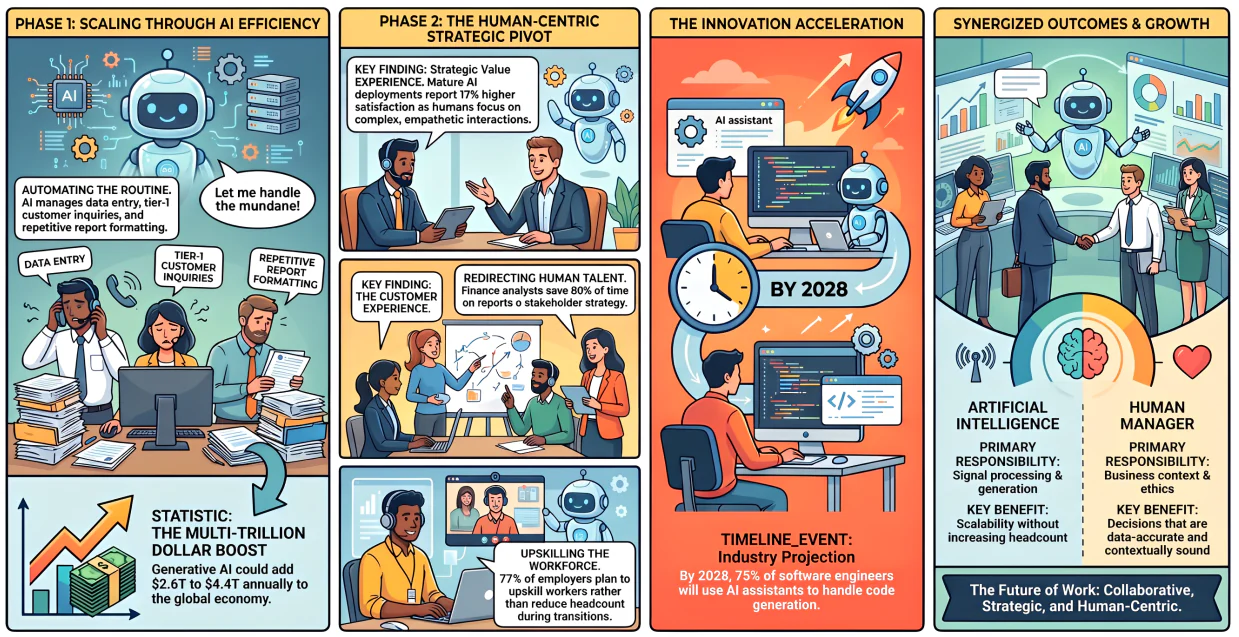
In 2023, McKinsey Global Institute estimated generative AI alone could add between $2.6 trillion and $4.4 trillion annually to the global economy across 63 analysed use cases.
The gains concentrate in workflows where humans redirect time saved by AI toward higher-order work. A finance analyst spending 80% less time on variance reports invests that time in strategic input and stakeholder conversations instead.
2. Enhanced decision-making
AI processes signals across thousands of records in seconds, covering inventory movement, customer behaviour, and supplier performance.
Human managers apply business context and ethical judgment that no model currently replicates. The combination produces decisions that are both data-accurate and contextually sound.
3. Better customer experience
IBM's Institute for Business Value found that businesses at maturity in AI-powered customer service reported 17% higher customer satisfaction scores than early-stage deployments. The mechanism is not AI replacing agents.
AI handles tier-1 volume, so human agents spend more time on complex, relationship-critical conversations where empathy and judgment drive the outcome.
4. Faster innovation cycles
In 2024, Gartner forecast that 75% of enterprise software engineers will use AI code assistants by 2028, up from less than 10% in early 2023.
The same pattern applies across product development, marketing, and operations planning. AI handles generation and iteration while humans focus on judgment calls about direction, quality, and fit.
5. Employee satisfaction
Repetitive, low-complexity tasks are a consistent driver of disengagement. When AI handles data entry, report formatting, and routine scheduling, employees spend more time on work that uses their skills.
The 2025 WEF Future of Jobs Report found that 77% of employers plan to upskill workers as part of their AI transition, not reduce headcount. Businesses that communicate this clearly see lower attrition during rollouts.
6. Cost efficiency
AI scales in ways people do not. A support team of ten can handle three times the inquiry volume with well-deployed AI assistance, without tripling headcount.
For Australian businesses operating in tight labour markets, this is a concrete operational benefit. It is the difference between scaling output and being constrained by hiring capacity.
What to Automate vs What to Keep Human
Most automation decisions go wrong not because businesses lack the technology, but because they lack a clear framework. The instinct is to automate everything that looks automatable.
That instinct misses the tasks where human judgment is genuinely load-bearing. Use the matrix below when evaluating any workflow for AI deployment.
1. Is this task rule-based and repeatable?
If the output follows a predictable pattern from consistent inputs, AI handles it well. If the right answer changes based on context, relationships, or judgment, keep human oversight in the loop.
2. What is the cost of a wrong output?
Low-stakes errors such as a formatting mistake in a report are easy to correct. High-stakes errors need a human checkpoint before the output becomes final.
Compliance decisions, performance assessments, and financial sign-offs carry real consequences. Keep human accountability in the final step for each of these.
3. Does it require reading between the lines?
AI reads what is in the data. Humans read what is not. A supplier's stalling pattern that signals financial trouble, or a candidate who underperforms on paper but excels in an interview, requires that subtext reading. HRM systems for managing employee data, for example, can organise and surface relevant information, but human judgement is still needed to understand the context behind it.
4. Would the person receiving this output expect a human behind it?
Customer escalations, performance feedback, and compliance decisions involve people who expect and deserve human accountability. Automate the supporting work. Keep the human in the decision.
Human-AI Collaboration Across Industries: Australian Relevant Examples
In practice, human-AI collaboration looks different across industries. Here are five Australian contexts where the division between human and AI work is already well-defined.
1. Finance and accounting
AI runs variance analysis across thousands of transactions, flags anomalies, and routes them to the finance manager with supporting data already prepared.
The manager does not start from scratch. Reporting that once took a week now takes hours. The time freed goes to strategic interpretation, stakeholder conversations, and audit preparation.
2. HR and recruitment
AI applications in human resources screens incoming CVs against defined criteria, ranks candidates by role fit, and presents shortlists to the HR manager with supporting rationale.
The manager then conducts interviews. Culture fit, motivation, and long-term potential are not things any algorithm reliably measures. Under Australia's Fair Work Act obligations, all AI-assisted employment decisions still require human accountability.
3. Supply chain and inventory
AI forecasts demand based on sales history, seasonal patterns, and external signals, then triggers purchase recommendations at reorder thresholds.
The operations manager reviews each recommendation in context, approves, adjusts, or rejects based on knowledge the AI does not have. The result is inventory that is tighter and more accurate than either approach alone.
4. Customer service
AI handles tier-1 inquiries 24/7, covering password resets, order status checks, and standard policy questions with instant resolution. Complex cases and high-value interactions escalate to human agents with full conversation context already loaded.
Human agents apply relationship intelligence and empathy that actually resolves difficult situations. IBM's research shows 17% higher customer satisfaction scores at maturity. The result is not fewer agents. It is agents handling better conversations.
5. Operations and remote sites
AI monitors production and equipment data in real time, detects anomaly patterns that precede failures, and alerts operations teams with diagnostic context already attached.
This is particularly relevant for Australian mining, agriculture, and construction, where remote sites mean AI monitoring provides coverage that physical checks alone could not maintain.
The engineer or site manager investigates, applying knowledge of recent maintenance and site-specific conditions the model cannot access. Decisions require human sign-off.
How HashMicro Enables Human-AI Collaboration in Your Operations
HashMicro provides an enterprise management platform built around this working model. Every module is designed so AI surfaces recommendations and humans make the final call.
1. Accounting and finance AI
HashMicro's Accounting module runs automatic anomaly detection across transactions. AI flags variance outliers and routes them to the finance manager for review, not automated resolution.
Compliance sign-off stays with the human. Reporting time drops. Strategic interpretation time goes up.
2. HR and payroll AI
AI agents for streamlined HR operations leave approval workflows, shift scheduling optimisation, and payroll anomaly detection reduce administrative load across the HR function.
HR managers retain authority over all people decisions. AI handles the data processing that used to consume their working day.
3. Inventory and supply chain AI
Demand forecasting generates AI-powered reorder recommendations. Operations managers approve each order before it goes to procurement.
No AI action without human sign-off. That is not a constraint on the system. It is the design principle that keeps humans accountable and the AI accurate.
4. CRM and sales AI
AI scores leads, surfaces churn risk signals, and drafts follow-up sequences. Account managers review, personalise, and send. AI handles the analysis.
Humans manage the relationship. That division produces faster pipelines without sacrificing the quality of customer engagement.
5. Hashy OS across your operations
Hashy OS functions as an intelligent layer across all HashMicro modules, connecting data from finance, HR, supply chain, and sales into a unified picture that departments cannot see on their own.
Cross-departmental signals that would otherwise go unnoticed surface as alerts your leadership team can act on. A finance anomaly combined with an HR overtime surge and a supply chain delay becomes a business risk signal.
You configure exactly where AI acts autonomously and where it pauses for human review. The model adapts to your risk tolerance, not the other way around.
Conclusion
Human-AI collaboration is not a future state. It is already active across finance, HR, and operations in Australia.
Businesses building it deliberately are outpacing those that treat AI as a separate initiative. The question is not which AI tools to adopt, but where the line sits between what AI should do and what your people should do.
Start with one workflow, build in the human checkpoints, and expand from there. To go further, book a free consultation with our team and see how human-AI collaboration fits your operations.

Frequently Asked Questions
The 30% rule suggests keeping AI-generated content to no more than 30% of any final output. It ensures meaningful human input rather than passive acceptance of AI results.
The key principles are complementarity, transparency, human oversight, and continuous improvement. Each party focuses on what it does best, and humans retain final say on high-stakes decisions.
Examples include AI flagging financial anomalies for accountants and screening job candidates for HR managers. AI also forecasts inventory demand for operations teams to approve.
Start with a workflow audit to identify rule-based tasks suited to AI and judgement-heavy tasks that need a human. Pilot AI in lower-risk workflows first, then build in human checkpoints.